




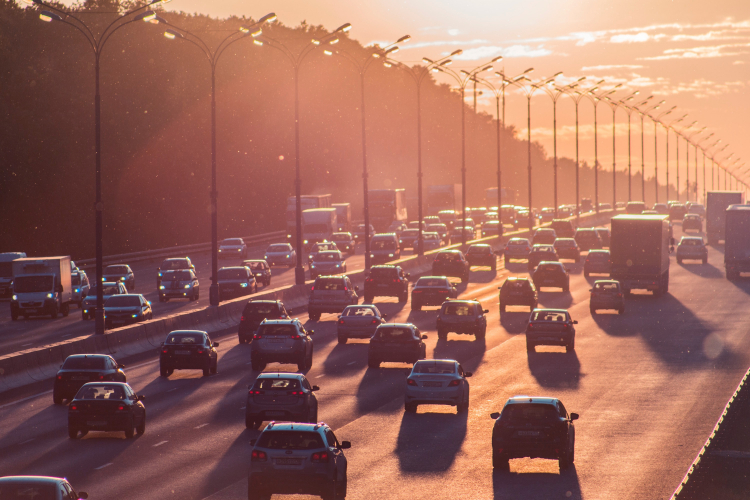
An underappreciated marvel of modern life unfolds daily on our roads and highways. Millions of drivers safely navigate complex traffic environments with little supervision. No governing body tells us when to brake, when to merge, or how fast to go. Instead, we rely on a handful of simple rules: stop at red lights, pay attention to speed limits, stay in your lane, yield when necessary, and avoid collisions.
As governments both left and right appear increasingly seduced by the appeal of managed economies—through tariffs, industrial policy, and price controls—road lessons are worth remembering. Millions of us spontaneously coordinate on roadways each day to travel safely to our destination. The same principles that keep traffic flowing can also keep economies growing.
At first glance, driving appears heavily regulated. But given the countless contingencies we face daily—weather changes, unpredictable pedestrians, varying vehicle performance, diverse skill levels—rulebooks are surprisingly thin. No centralized authority controls every movement of every car. Nor could it. Instead, we are guided by a few general principles and, crucially, by our own self-interest. Each of us has a compelling reason to avoid accidents: to protect our own lives, our passengers’ lives, and our finances. This alignment of incentives creates a shared interest in a common goal—to arrive safely at our destinations.
The success of decentralized systems like driving depends on local knowledge. Every driver continuously processes information—speed, distance, road conditions, nearby cars, etc.—and adjusts accordingly. The result is a dynamic, adaptive system that functions remarkably well. This spontaneous order from apparent chaos is striking not only in its own right, but also because it mirrors Adam Smith’s profound insight that self-interested behavior, when channeled through markets, can generate outcomes that benefit society.
The parallels to a market economy are striking. Like driving, markets depend on continuous feedback. Both systems are largely self-correcting and require little intervention. In traffic, the signals are immediate and tangible: a brake light, a honking horn, a slippery surface. The feedback mechanism in markets rests on price signals. When, for example, prices rise due to increased demand, producers produce more. When prices fall due to falling demand, producers produce less. Consumers benefit when competing companies supply better goods at lower prices, and companies profit by anticipating consumer desires.
Over the past two centuries, countries and regions that allowed markets to operate relatively freely have seen extraordinary gains in productivity, innovation, and living standards. When people are free to pursue their own interests, the results speak for themselves. Immediately after WWII Americans spent nearly a quarter of their income on groceries. Thanks largely to market-friendly policies, today we spend closer to 7 percent. Over the same period clothing costs fell, due in part to reduced restrictions on imports, from over 10 percent of household spending to under 3 percent. Meanwhile, the World Bank estimates that in the three decades after 1990, roughly 1.5 billion people escaped extreme poverty This includes a historic period of growth in global markets that saw the fall of the Berlin Wall and the opening of China.
Like road travel, markets require a common set of rules and basic infrastructure. Traffic laws together with investments in safe roads and signage help govern behavior on roadways. Similarly, well-functioning markets need governments to protect property rights, deter fraud, and enforce contracts.
But when governments interfere too heavily in the economy, this carries its own risks. Overly detailed or prescriptive interventions have predictable consequences. For example, price caps, such as rent controls, cause shortages, and price floors, such as minimum wages, lead to surpluses.
Our daily commute offers an elegant lesson in decentralized decision-making. Just as traffic can flow without central controls, markets function best when not heavily regulated by governments.
