




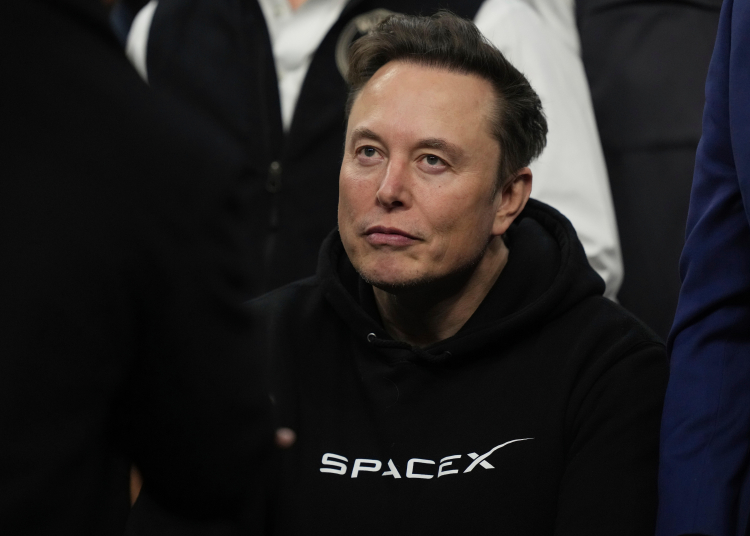
“In our political age of envy, the press and Democrats are preoccupied by Elon Musk’s otherworldly wealth. But he has enriched the country by building a remarkable company.” That was from an excellent editorial (“Who Wants to Be a Trillionaire?”) at the Wall Street Journal, for decades (and to this day) the Holy Grail of freedom and market-friendly opinion from prestigious names on and off the page.
The editorial was yet again a great read, but it followed a great deal more criticism of Musk on the page from the past, along with the stock market that his achievements helped lift.
For the longest time Musk was portrayed as a crony capitalist on the Journal editorial page. Since Tesla cars enjoyed, among other things, a $7,500 federal tax credit, somehow this was evidence of Musk playing Washington more than the market itself.
Except that it never made sense. See the spectacular Jimmy Soni op-ed run at the Journal in concert with the SpaceX IPO. It was a look back to the Elon Musk of the early 2000s who had the courage to start SpaceX around the same time that he was buying into Tesla to become its largest shareholder. As Soni’s piece made clear, Musk was an unknown then, and a peculiar one at that. The very idea that he could have bent Washington to his ways then, and in Tesla’s favor never survived simple scrutiny.
Furthermore, it wouldn’t have mattered. As was the case with the $7,500 credit, it only applied to the first 200,000 cars sold. Keep this in mind relative to Tesla’s eventual market cap, whether $1 billion+ at the time of IPO, or $1.27 trillion now. Markets look ahead, which means investors had quite quickly priced a future for Tesla that had nothing to do with a federal tax credit that Musk on his own could never have instituted, and that realistically had nothing to do with car sales as is. See the valuation of other carmakers, plus Soni’s op-ed once again.
The second narrative promoted in unsigned and signed editorials (Ruchir Sharma regularly made this point) at the Journal’s editorial page was that the stock market rally of 2009 and beyond wasn’t an effect of “remarkable companies” in the U.S., but the impossibility that was and is “easy money.” There’s never a time when money is easy, and Musk’s history shows us why.
While Sharma and others were taking the Fed’s move to zero literally, the biographies of Musk written by Ashlee Vance (2015), Soni (The Founders, a history of PayPal came out in 2022) and Walter Isaacson were clear that Musk faced bankruptcy for his capital starved companies on a regular basis. Conservatives had long made the case that government price controls result in scarcity as is, but suddenly in the 2000s the Fed was some kind other, capable of overwhelming markets on the path to easy, “costless credit.” Evidently Musk never got the memo.
Sharma and the Journal editorial page as previously mentioned took it further. The accepted wisdom was that the Fed’s “easy money” had lifted the stock market too. This was Barack Obama's "you didn't build that," conservative edition.
Stock markets, like all markets, are a collision of buyers and sellers. Assuming a mob of gleeful buyers with “easy money” in hand, they could only express that glee in stocks insofar as dour pessimists were selling them their shares to exit a seemingly “fake” stock market. It’s worth adding that Japan’s central bank had been at zero for much longer alongside the opposite of a stock market rally, and that Europe’s indices were a pale imitation of those in the U.S. even though the ECB was in many ways mimicking the Fed.
Most important of all, the “easy money” narrative was always belied by the reality that markets, like economies, don’t gain strength from government intervention that enables fake prices, but by the past being replaced by the present. Put another way, when the 21st century began, Nvidia was routinely on the verge of bankruptcy, Google was largely unknown, Amazon was “Amazon.org,” Apple was stumbling out of near bankruptcy, a late to the internet and near-broken-up by the DOJ Microsoft was a look into the past, while Meta, Tesla, and SpaceX didn’t yet exist.
Conversely the greatest, most blue-chip of blue-chip American companies in 2000 were GE (the world’s most valuable company), Tyco (the next GE, according to Barron’s), and Enron (the world’s smartest company). AOL and Yahoo were seen as the gold-standard of the U.S.’s internet future as the 21st century dawned.
What the past tells us is that even if Fed machinations could prop up stock markets, the results would be economically disastrous. Imagine where the U.S. economy would be today if what reigned supreme in 2000, 2009, 2017, or even 2022 reflected the present. What we see from a profound change in the faces featured in blue-chip team pictures is that equity markets once again gain strength from those at the top being replaced, and being replaced nearly always and everywhere by former unknowns.
In making its own, highfly articulate case that Elon Musk’s rise is a happy story of Musk “building a remarkable company,” the Journal editorial is implicitly rejecting what its editorial page long contended about the stock market from 2009 and beyond, along with contributors to its page. Stock markets have always been lifted by the “vital few” (Reuven Brenner) visionaries working tirelessly to replace the present, which means that the true story of 21st century stock market vitality wouldn’t mention the Fed at all, but would heavily feature Jeff Bezos, Jensen Huang, Sergey Brin, Larry Page, Steve Jobs, Mark Zuckerberg, Satya Nadella, and most certainly Elon Musk.
If the Wall Street Journal’s editorial page can change its narrative about Musk, it can easily do the same about the stock market. More importantly, it must do so to be consistent. That's because without Musk and other visionaries like him, there's quite simply no stock market rally to speak of.
