<?phpxml version="1.0" encoding="utf-8"?>
		<feed xmlns="http://www.w3.org/2005/Atom">
				<title>RealClearMarkets - Articles</title>
				<link rel="alternate" type="text/html" href="http://www.realclearmarkets.com/articles/" />
				link rel="self" type="application/atom+xml" href="http://www.realclearmarkets.com/articles/atom.xml" />
				<id>tag:www.realclearmarkets.com,2009:/articles//4</id>					
				<updated>Wed, 27 May 2020 15:01:41 -0500</updated>
				<entry>
					<title>Housing Finance Post Covid-19 Is In Better Shape Than You Think</title>
					<link rel="alternate" type="text/html" href="http://www.realclearmarkets.com/articles/2020/05/28/housing_finance_post_covid-19_is_in_better_shape_than_you_think_104097.html" />
					<id>tag:www.realclearmarkets.com,2009:/articles//104097</id>
					<published>2020-05-28T00:00:00Z</published>
					<updated>2020-05-28T00:00:00Z</updated>


					<summary>In the world of mortgage investors, the glorified days of the Salomon Brothers trading desk, with stories of John Gutfreund,&amp;nbsp;Lew Ranieri&amp;nbsp;and games of liar&amp;rsquo;s poker, are a distant memory. Instead, scars from the global financial crisis endure in hearts and minds. The painful memories include the collapse of Bear Stearns and Lehman Brothers and the implosion of America&amp;rsquo;s mortgage finance and housing sectors.
For better or worse investors in mortgage securities, like investors in other markets, look to the past to forecast the future. In the wake of the...</summary>
										
					<author><name>Ken Shinoda</name></author><category term="Ken Shinoda" scheme="http://www.sixapart.com/ns/types#category" /><content type="html" xml:lang="en" xml:base="http://www.realclearmarkets.com/articles/"><![CDATA[<p>In the world of mortgage investors, the glorified days of the Salomon Brothers trading desk, with stories of John Gutfreund,&nbsp;Lew Ranieri&nbsp;and games of liar&rsquo;s poker, are a distant memory. Instead, scars from the global financial crisis endure in hearts and minds. The painful memories include the collapse of Bear Stearns and Lehman Brothers and the implosion of America&rsquo;s mortgage finance and housing sectors.</p>
<p>For better or worse investors in mortgage securities, like investors in other markets, look to the past to forecast the future. In the wake of the pandemic-led market convulsions, some now worry of the history of 2008 repeating itself in mortgage credit and housing. I believe such fears are ill-founded. To be sure, higher default rates and weaker housing prices are likely in the near term. However, I view the odds of a dire 2008-like scenario as remote.</p>
<p>As a manager of portfolios of residential mortgage credit, I often get questions about this asset class and the housing market from investors, homeowners and prospective home buyers. Today many people are trying to sort out what the surge in unemployment means for mortgage credit and housing values. Their questions typically take one of two forms: Does the near-term horizon threaten a 2008-sized contagion of mortgage defaults and housing depreciation? Or is this time different? In fact, this time is very different from prior down cycles, especially 2008.</p>
<p>Homeownership represents a major investment for most homeowners. Looking back through different recessionary periods, home prices have often proven resilient, especially when aggregated on a national level. In contrast, the credit meltdown of 2008 led to a 35% national decline in home prices. Some regions in the Southwest and Southeast dropped more than 50%. Thus 2008 was an anomaly among past down cycles rather than a precedent for the future. Furthermore, given shelter-in-place efforts to slow the spread of COVID-19, never in recent history has the home been so important to our daily lives.</p>
<p>Home prices are largely driven by a combination of supply/demand dynamics and affordability. In the months and years leading up to the global financial crisis, all these metrics were aligning &ndash; firing on all cylinders like a Formula One race car, just before careening out of control on the speedway. The supply of homes skyrocketed as homebuilders hit records on new housing starts. This activity was spurred by a flood of new entrants into the housing market.</p>
<p>Much of this demand came in response to affordability juiced up by the loosening and even virtual abandonment of underwriting standards and Wall Street financial wizardry. The national homeownership rates tracked by the U.S. Census Bureau diverged from the long-term national average of 65%, rising upwards of 69% by mid-2004. To paraphrase the character Gale Boetticher, Walter White&rsquo;s unfortunate superlab assistant in the television series &ldquo;Breaking Bad,&rdquo; that last four percent may not sound like a lot. But it was.&nbsp;</p>
<p>As recession took hold in 2008, banks teetered, Americans lost their jobs, and mortgage payment defaults began to climb. Mortgage borrowers typically default for understandable reasons: they lose their job or succumb to one of the &ldquo;Three Ds&rdquo;: death, divorce or disease. None are happy events, but these nevertheless are the &ldquo;normal&rdquo; causes of default. The global financial crisis brought us a brand-new breed of delinquent borrowers: the &ldquo;strategic defaulters.&rdquo; Due to the abundance of alternative-document and subprime mortgages, these borrowers put down little to no equity to buy their homes. The famous NINA (No Income, No Asset) loan, which later came to be notoriously known as the NINJA (No Income, No Job, No Assets), is just one example of the underwriting craziness of the time.</p>
<p>As home prices fell borrowers with little or no equity abandoned their homes, dumping more inventory on a foreclosure supply already growing from &ldquo;normal&rdquo; defaults. Why pay my mortgage when I can rent the house next door for half price?&nbsp; Perhaps a decade prior such a decision might have stigmatized the strategic defaulters among their social groups and neighbors, but this practice became accepted by societal norms during the global financial crisis. In fact, how not to pay your mortgage and still live in your house was a common topic at cocktail parties, much like the tech stock tips of the late 1990s.</p>
<p>The abundance of new homes for sale combined with the flood of foreclosures swelled the available housing stock, leading to a vicious collapse in home prices as demand and affordability contracted with the economic recession and dramatic tightening of lending standards.&nbsp;</p>
<p>In the days leading up to the COVID-19 pandemic and population lockdown, the housing and mortgage markets were quite different. In the beginning of this year the supply of existing homes for sale was near 35-year lows, with shortages particularly acute at the entry-level portion of the market. Housing starts struggled during the post-crisis decade of the 2010s as home builders contended with increased labor, material and land costs. Instead, home builders tended to focus on high-priced homes with higher margins and on multifamily building to meet the &ldquo;urbanization&rdquo; demand as millennials flocked to large cities for employment.</p>
<p>In the summer of 2016, with economic growth, demand for single-family homes was increasing, lifting the homeownership rate toward its long-run average of 65% from its lows of 62.9%. De-urbanization had already begun in response to the rising cost of living and rents in cities. For example, according to a study by the national rental listing service RENTCaf&eacute;, average rent here in Los Angeles has increased by 65% to $2,527 over the past 10 years.</p>
<p>As the millennial generation ages, forms households and has children, the migration to the suburbs will continue. I can attest to this phenomenon myself as a child of the early 1980s and now the father of three children under five years of age. In addition, demand has increased from institutional investors, especially with the growth of the institutional single-family-rental buyers such as real estate investment trusts (REITs) like American Home 4 Rent and Invitation Homes.</p>
<div class="body-photo-inline">
<div class="body-photo"><img class="body-photo-inline" src="http://assets.realclear.com/images/51/511265_5_.png" border="0" width="715" height="434" /></div>
</div>
<p><strong>Source</strong>: <em>Morgan Stanley, Current Population Survey/Housing Vacancy Survey (U.S. Census Bureau)</em></p>
<p>The housing market was humming along as 2020 began. The credit quality of new loans as measured by average credit scores of borrowers and the down payment required by lenders were significantly higher than during the years leading into 2008. In fact, borrower home equity was near all-time highs as home prices had steadily risen by 64% from their 2012 lows, and borrowers had been paying down the principal on their mortgages at an increasing rate relative to the prior decade due to low interest rates.</p>
<div class="body-photo-inline">
<div class="body-photo"><img class="body-photo-inline" src="http://assets.realclear.com/images/51/511266_5_.jpg" border="0" width="715" height="416" /></div>
<div class="body-photo-byline"></div>
</div>
<p><strong>Source</strong>:&nbsp;<em>Federal Reserve Bank of St. Louis (Economic Research Division)</em></p>
<p>Then came COVID-19 and the shock of economic shutdowns. Unemployment surged, accompanied by an equally dramatic drop in growth. What does this mean for home prices?&nbsp; We must re-visit the supply/demand dynamic and affordability.</p>
<p>Take existing low levels of inventory for sale, remove homes from the market as sellers seek to shelter-in-place, and you have a continued lack of supply. The wave of foreclosures that drowned the market in supply during the global financial crisis is now postponed by forbearance programs. The Coronavirus Aid, Relief, and Economic Security (CARES) Act allows borrowers to miss up to 12 monthly mortgage payments without damaging their credit scores, providing time to work with their servicers to make up payments in the future. Additionally, with high levels of home equity (&ldquo;skin in the game&rdquo;), there should be few strategic defaulters. In fact, the home is now perhaps more important than ever.</p>
<p>The immediate spike in unemployment has hurt homeowners less than renters. Homeowners on average are more likely to have white-collar jobs, higher median incomes and higher savings. Furthermore, an acceleration in de-urbanization has driven a near-term spike in demand in certain areas. Families are looking for more space as working from home becomes a more permanent, even attractive reality for some rather than a temporary, suboptimal solution. I know many financial firms that are quite surprised at the efficiency of their telecommuting workforce.</p>
<p>Even before the pandemic and shutdowns, years-long price appreciation in the housing market was starting to diminish affordability. Nevertheless, affordability remained above the long-term average given low mortgage rates. The current crisis will withdraw access to credit as lenders tighten their underwriting boxes in anticipation of job losses and related defaults. However, this should be offset by historically low mortgage rates, perhaps balancing the affordability equation.</p>
<p>While prices of homes will decline due to the economic contraction, the favorable supply/demand dynamics and continued affordability &ndash; particularly relative to renting &ndash; should prevent the collapse of home prices seen during the global financial crisis. Certain regions will be hit harder than others. High-priced homes in high-tax states are especially vulnerable. Some of those markets had already begun to weaken due to changes in state and local tax (SALT) deductions from 2018. Vacation and second home destinations seem more at risk than primary homes. Suburban areas nearest jobs-rich urban centers should weather the storm the best, as was the case during the last recession.</p>
<p>I wish the best health and happiness to everyone and their families during these trying times as a nation and people. May the summer bring us warm weather, a revival of the economy, and positive news for the future.</p>
<p><em>Ken Shinoda is a portfolio manager on the mortgage-backed securities team at DoubleLine Capital, LP, a Los Angeles-based asset manager.</em></p><br/><br/>]]></content>
				</entry>
				<entry>
					<title>Don&#039;t Punish Tech Companies For Being Great</title>
					<link rel="alternate" type="text/html" href="http://www.realclearmarkets.com/articles/2020/04/29/dont_punish_tech_companies_for_being_great_104096.html" />
					<id>tag:www.realclearmarkets.com,2009:/articles//104096</id>
					<published>2020-04-29T00:00:00Z</published>
					<updated>2020-04-29T00:00:00Z</updated>


					<summary>During the COVID-19 pandemic, digital tools have become indispensable to millions of home-bound Americans. Information technology businesses have quickly created or refined systems for distance learning, teleworking, telemedicine, news dissemination, and e-commerce. Yet, despite these successes, there are new demands to regulate companies such as Amazon, Zoom, and Facebook. Companies that step up in a time of crisis should not be punished with aggressive government oversight.
Government-imposed lockdowns have stalled the economy and our lives by blocking us from physical movement. But we...</summary>
										
					<author><name>Mark Jamison &amp; Peter Wang</name></author><category term="Mark Jamison &amp; Peter Wang" scheme="http://www.sixapart.com/ns/types#category" /><content type="html" xml:lang="en" xml:base="http://www.realclearmarkets.com/articles/"><![CDATA[<p>During the COVID-19 pandemic, digital tools have become indispensable to millions of home-bound Americans. Information technology businesses have quickly created or refined systems for distance learning, teleworking, telemedicine, news dissemination, and e-commerce. Yet, despite these successes, there are new demands to regulate companies such as Amazon, Zoom, and Facebook. Companies that step up in a time of crisis should not be punished with aggressive government oversight.</p>
<p>Government-imposed lockdowns have stalled the economy and our lives by blocking us from physical movement. But we humans are adaptable. We&rsquo;re substituting digital movements for physical ones wherever possible, and our new demands mean that our digital suppliers must rapidly expand and adapt.</p>
<p>And they have. Amazon hired thousands more workers and is prioritizing household staples and medical deliveries. Cable TV companies are handling 25% more internet traffic. Verizon reports a ten-fold increase in the use of collaboration tools by its customers, applications that enable customers to see and speak with colleagues, friends, and family. Zoom expanded to accommodate a 378% increase in video-conferencing. When uninvited guests began &ldquo;Zoombombing,&rdquo; Zoom adapted with new security measures.</p>
<p>How valuable are these responses to market demands? We undertook research in March to measure them. We extended the work of MIT economists Erik Brynjolfsson, Avinash Collis, and Felix Eggers who pointed out three years ago that the value of some of our most important digital services are missing from official estimates of the size of the economy, such as gross domestic product. In 2017 the missing value of Facebook alone was about $102 billion.</p>
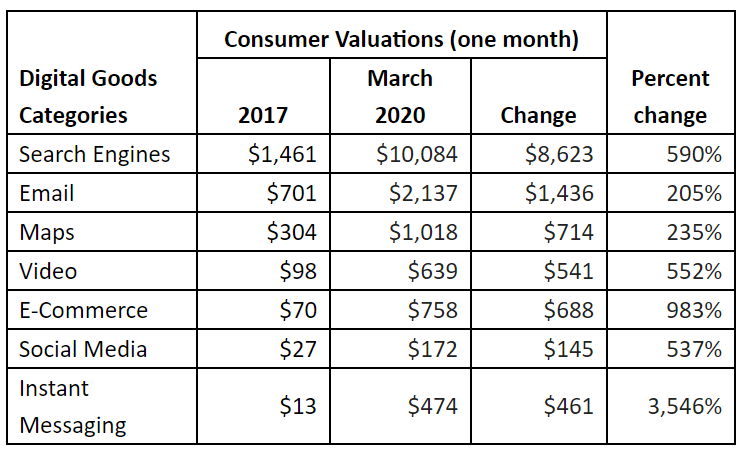
<p>We measured how the pandemic has increased this value. The table below illustrates some of our findings, comparing them with the 2017 study. Increases in value ranging from 200% to over 3,500% might seem shocking, but they make sense. Why is one month of search $8623 more valuable today than in 2017? A recent&nbsp;report&nbsp;on public attitudes about the coronavirus found that Americans don&rsquo;t trust the media and politicians for accurate coronavirus information, and instead search the internet for information from health professionals.</p>
<p style="text-align: left;"><strong>Table 1. Comparisons of consumers&rsquo; valuations of digital goods, 2017 versus March 2020</strong></p>
<div class="body-photo-inline">
<div class="body-photo"><img class="body-photo-inline" src="http://assets.realclear.com/images/50/508599_5_.png" border="0" width="715" height="434" style="display: block; margin-left: auto; margin-right: auto; float: left;" />
<div style="text-align: left;" class="hover-social" data-feed-name="null" data-feed-caption="AEI" data-feed-photo="http://assets.realclear.com/images/50/508599_5_.png">
<div class="socialBar" data-style="full" data-dialog="feed">
<div class="left toolset"></div>
</div>
</div>
</div>
<div class="body-photo-title"><span style="color: #919191; font-size: 0.8em; font-weight: bold;">Authors&rsquo; calculations and Erik Brynjolfssona, Avinash Collisa, and Felix Eggersc, &ldquo;Using massive online choice experiments to measure changes in well-being,&rdquo; <em>Proceedings of the National Academy of Sciences of the United States of America</em>, April 9, 2019, vol. 116, no. 15, <a href="http://www.pnas.org/cgi/doi/10.1073/pnas.1815663116">www.pnas.org/cgi/doi/10.1073/pnas.1815663116</a>. &ldquo;Video&rdquo; means streaming video, such as YouTube and Netflix.</span></div>
</div>
<p>Working from home and distance learning make other tools more valuable, too. The value of Email jumped to $2,137. Instant messaging increased from $13 to $474. E-commerce went up by nearly 1,000%. Maps jumped $714 in part because of the importance of home delivery.</p>
<p>Some of this jump in value is because government regulators are letting market forces work. The Federal Communications Commission&rsquo;s deregulatory policies encouraged internet service providers to build networks that are handling the new traffic. This isn&rsquo;t the case in pro-regulation Europe where internet networks have been overwhelmed and inadequate. Search engines, e-commerce, and other digital services also enjoy greater economic freedom in the US than in Europe.</p>
<p>Yet, despite the demonstrated value of letting digital markets respond to customers, some antitrust advocates have trained their sights on these companies. Yale economist Fiona Scott Morton tweeted that Zoom&rsquo;s growth during the pandemic is good reason for greater scrutiny should another company seek to merge with Zoom. Some lawyers are&nbsp;pushing&nbsp;for an investigation into how Amazon has prioritized the shipping of household and medical items.</p>
<p>Also asking for increased government control, New York Times journalists have&nbsp;expressednervousness that information technology companies are becoming too powerful during the pandemic, while refusing to acknowledge the utility of such companies during the crisis.</p>
<p>These are exactly the wrong responses. Businesses should not be punished or brought under greater scrutiny simply because they are valuable during the pandemic. Companies should not be made fearful of doing so well for customers that the company&rsquo;s size will be interpreted as market power.</p>
<p>Lawmakers and policy makers should be explicit that companies serving customers and the country well in this time of need will not be hunted and punished for their good work. The people who matter are not the critics, but the people who step up and make life better.</p>
<p>&nbsp;</p><br/><p><em>Mark Jamison is a visiting scholar at the American Enterprise Institute, and the director of the Digital Markets Initiative at the University of Florida where Peter Wang is a post doc.</em></p><br/>]]></content>
				</entry>
				<entry>
					<title>&#039;Celebrity&#039; or &#039;Notable&#039; Covid-19 Deaths Call Into Question Rates Of</title>
					<link rel="alternate" type="text/html" href="http://www.realclearmarkets.com/articles/2020/04/07/celebrity_or_notable_covid-19_deaths_call_into_question_rates_of_104095.html" />
					<id>tag:www.realclearmarkets.com,2009:/articles//104095</id>
					<published>2020-04-07T00:00:00Z</published>
					<updated>2020-04-07T00:00:00Z</updated>


					<summary>A friend commented he personally knew three people who died of coronavirus, none of whom knew or associated with each other, and none of whom had been in places with high rates of infection. The 9,610 reported US coronavirus deaths works out to about one death per 34,000 people, so it seems astronomically unlikely for one person to know three unrelated victims.
I had been thinking along the same lines with respect to celebrity infections and deaths reported in the news. There seem to be too many, relative to the population numbers. The chart below shows the number of &amp;ldquo;notable...</summary>
										
					<author><name>Aaron Brown</name></author><category term="Aaron Brown" scheme="http://www.sixapart.com/ns/types#category" /><content type="html" xml:lang="en" xml:base="http://www.realclearmarkets.com/articles/"><![CDATA[<p>A friend commented he personally knew three people who died of coronavirus, none of whom knew or associated with each other, and none of whom had been in places with high rates of infection. The 9,610 reported US coronavirus deaths works out to about one death per 34,000 people, so it seems astronomically unlikely for one person to know three unrelated victims.</p>
<p>I had been thinking along the same lines with respect to celebrity infections and deaths reported in the news. There seem to be too many, relative to the population numbers. The chart below shows the number of &ldquo;notable people&rdquo; Wikipedia lists as dying each day in March. The blue line is deaths that don&rsquo;t mention CoVID-19, the orange line is the total with CoVID-19.</p>
<div class="body-photo-inline">
<div class="body-photo"><img class="body-photo-inline" src="http://assets.realclear.com/images/50/506653_5_.png" border="0" width="715" height="430" /></div>
</div>
<p>CoVID-19 deaths obviously increased rapidly after the 15th, but there was also an increase in the blue line that almost has to be the result of the virus. The cause of death may not have been reported, or perhaps the case did not meet official criteria for CoVID-19 (for example, the person may have been weakened by the virus, but succumbed to another condition).</p>
<p>An average of 19 notable people died in the first ten days in March 2020, which is close to the average of 21 notable people who died each day in March 2019. But an average of 35 notable people died in the last ten days of March. It seems reasonable to assign those 16 extra deaths to the virus, meaning that for every 100 notable deaths from other causes, 84 notable people died as a result of the virus.</p>
<p>77,000 people were expected to die in the last ten days of March before the virus. If we gross that up by the 84% increase we see among notable people, we project 66,000 deaths due to the virus. But official CoVID-19 reports show only 3,752 deaths in the US over that period.</p>
<p>The notable people list is global, some celebrities are from places with more CoVID-19 mortality than the US. But the list is US-heavy and even Italy reported a 34% increase in total mortality due to CoVID-19 during the last ten days in March, not even half the 84% we observe among notable people. And many non-US people on the list came from places with lower CoVID-19 rates.</p>
<p>We might expect notable people to die from CoVID-19 less often than non-notable people, as they may have better access to healthcare, especially when resources are strained. They probably live less crowded lives than average, although they may travel more and meet more people from faraway places.</p>
<p>It&rsquo;s possible that dying from CoVID-19 makes a marginally notable person more likely to be included in Wikipedia&rsquo;s list&mdash;but we see the trend even among celebrities whose deaths are not listed as CoVID-19. I cross-checked using lists of pre-defined people, such as major-league baseball former players, and found similar increases (although for baseball only 5 deaths versus an expected 4, so no statistical significance).</p>
<p>None of these factors seems adequate to explain the 18:1 ratio between the increase in death rate of notable people versus the announced CoVID-19 deaths among the general population. Some possible explanations that come to mind (I leave out the &ldquo;massive conspiracy theory to cover up the seriousness of the crisis&rdquo; as too implausible to credit).</p>
<p>&middot;&nbsp;&nbsp;&nbsp;&nbsp;&nbsp;&nbsp;&nbsp;&nbsp;&nbsp;The virus is &ldquo;harvesting&rdquo; deaths, either the infection or the associated strain on healthcare resources. There is a temporary blip in deaths as people who were going to die in April expire in the last week of March instead. If so, we should see a decline in non-CoVID notable deaths below average values soon. This commonly happens in heat waves and natural disasters.</p>
<p>&middot;&nbsp;&nbsp;&nbsp;&nbsp;&nbsp;&nbsp;&nbsp;&nbsp;&nbsp;One or a few events infected many notable people. Notable people tend to congregate with each other, and perhaps many of the excess deaths can be traced to specific events.</p>
<p>&middot;&nbsp;&nbsp;&nbsp;&nbsp;&nbsp;&nbsp;&nbsp;&nbsp;&nbsp;The official CoVID death counts are significantly understated due to over-strict reporting criteria or missed deaths. The virus may be a contributor to many deaths that are not officially categorized as CoVID-19 cause of death.</p>
<p>I think this is a serious question that deserves a serious answer from public health authorities. Public perceptions may be more influenced by deaths among celebrities and acquaintances than official figures.</p><br/><p><em>Aaron Brown is the author of many books, including The Poker Face of Wall Street.&nbsp; He's a long-time risk manager in the hedge fund space.&nbsp;&nbsp;</em></p><br/>]]></content>
				</entry>
				<entry>
					<title>What Do Infectious Disease Experts Know, When Did They Know It?</title>
					<link rel="alternate" type="text/html" href="http://www.realclearmarkets.com/articles/2020/04/02/what_do_infectious_disease_experts_know_when_did_they_know_it_104094.html" />
					<id>tag:www.realclearmarkets.com,2009:/articles//104094</id>
					<published>2020-04-02T00:00:00Z</published>
					<updated>2020-04-02T00:00:00Z</updated>


					<summary>One of the challenging things about understanding the SARS-CoV-2 pandemic is the variety of seemingly conflicting projections from infectious disease experts, and the even greater variety of definitely conflicting reformulations of those projections from political leaders.
My sometime-collaborator Philip Tetlock has made a career studying the defects of expert judgements and, more important, finding ways to extract the actual expertise into useful forecasts. He&amp;rsquo;s currently exploring this with infectious disease experts and told me:
We had a very similar experience with...</summary>
										
					<author><name>Aaron Brown</name></author><category term="Aaron Brown" scheme="http://www.sixapart.com/ns/types#category" /><content type="html" xml:lang="en" xml:base="http://www.realclearmarkets.com/articles/"><![CDATA[<p>One of the challenging things about understanding the SARS-CoV-2 pandemic is the variety of seemingly conflicting projections from infectious disease experts, and the even greater variety of definitely conflicting reformulations of those projections from political leaders.</p>
<p>My sometime-collaborator Philip Tetlock has made a career studying the defects of expert judgements and, more important, finding ways to extract the actual expertise into useful forecasts. He&rsquo;s currently exploring this with infectious disease experts and told me:</p>
<p>We had a very similar experience with epidemiologists: subjective probability forecasting was an alien exercise to them and they produced noisy, occasionally erratic, judgments. One solution is sharpening the disciplinary division of labor: (a) ask epidemiologists to offer explanations/models in language they are comfortable with (e.g., SIR or SEIR models); (b) ask superforecasters to translate explanations into implied probability estimates.</p>
<p>I unhesitatingly acknowledge that Phil and his team at the Good Judgement Project are the world experts in these matters. My career has been in gambling and financial risk management which gives faster and more streetwise solutions.</p>
<p>The job of a bookie is the inverse of Phil&rsquo;s goal&mdash;the bookie wants to extract maximum profit from disagreements among bettors rather than to identify the area of agreement. Betting odds, the related prediction markets, have their own problems as forecasts, among other things because they can be influenced by decidedly non-expert bettors. But asking where Las Vegas would set betting odds on various pandemic outcomes if all the customers were infectious disease experts&nbsp;and&nbsp;experienced, successful gamblers is my quick approach to estimating what the experts know. It&rsquo;s less elegant than Phil&rsquo;s research, but it gives faster results.</p>
<p>Financial risk management is also relevant here. As chief risk officer, I had to decide which trades and strategies to approve, in what size, with what limits and restrictions. I had information from world experts in both the underlying economics and successful trading. But the information was not all consistent. The subject matter experts often lacked trading skills, and disagreed among themselves. The traders had good knowledge about markets, but their understanding of the fundamentals could be deep but narrow. My job was to tease out from both groups exactly what they really knew, and combine it to make sensible risk decisions that could be sold to traders, senior management and the board.</p>
<p>For raw material, I took answers to a survey organized by Professor Nicholas Reich at Amherst. The first thing I noticed is the infectious disease experts in the survey are not like typical experts who opine on matters of public interest. Public experts are not rewarded for forecast accuracy. If you want your op-ed published, or to sell books, or to get interviewed on news shows; you need dramatic, confident opinions. On the other hand, to preserve your professional reputation, it doesn&rsquo;t pay to stray too far from the median. Then you have incentives from professional activities, and pressure to remain consistent to previous views. All of these things get in the way of predictions people can bet on.</p>
<p>Infectious disease experts appear to be different. I suspect the reason is sociological. The mathematical and medical expertise needed to have useful opinions about pandemics are highly rewarded in other fields&mdash;not so much in the study of infectious disease. Therefore, the people in the field turned down more lucrative activities, likely out of either intellectual interest or public spirit. This makes them more independent-minded than people likely to climb the ladder of success in finance, economics or politics.</p>
<p>Independent-minded is good in that it brings a wider variety of views to the table, but it means we must do post-processing to decompose uncertainty into disagreement among experts versus randomness that none of the experts can predict.</p>
<p>I began by converting the confidence intervals in the chart to complete subjective probability distributions. This goes beyond what the expert respondents submitted, so it should not be taken as representing their views, but my views based on seeing their views. I focused on the number of CoVID-19 deaths in the US in 2020.</p>
<p>If you don&rsquo;t care about the math, you can skip this and the next paragraph. I assumed the logarithm of deaths has a double exponential distribution with median on the best estimate (B), 10th-percentile on the low estimate (L) and 90th-percentile on the high estimate (H).</p>
<p>This means that the probability the number of deaths is less than c is:</p>
<p>c &lt; B, 0.5 x 0.2[ln(B) &ndash; ln(c)]/[ln(B) &ndash; ln(L)]<br />c &gt; B, 1 &ndash; 0.5 x 0.2[ln(c) &ndash; ln(B)]/[ln(H) &ndash; ln(B)]</p>
<p>Next, I assumed that the experts were all Kelly bettors. This is highly unlikely to be true, but we know Kelly gives consistent betting decisions, that are optimal under assumptions that are pretty reasonable for many repeated bounded bets.</p>
<p>Then I asked how a bookmaker would set odds to extract the maximum profit from my Kelly-betting, double-exponential, versions of Professor Reich&rsquo;s experts. The table below shows the results in the cost for a payout of $1,000. I used power-of-two ranges starting from under 40,000 (fewer deaths than from a typical influenza season) to over 2,560,000 (worse than the 1918 pandemic).</p>
<div class="body-photo-inline">
<div class="body-photo"><img class="body-photo-inline" src="http://assets.realclear.com/images/50/506155_5_.png" border="0" width="715" height="123" /></div>
</div>
<p>For example, consider the first column. The bet is that there will be fewer than 40,000 CoVID-19 deaths in the US in 2020. The bookie will pay you $16 now if you agree to pay $1,000 if deaths are below $40,000. Or you can pay the bookie $305 now and the bookie will pay you $1,000 if deaths are below 40,000. This is by far the widest disagreement among my version of Reich&rsquo;s experts.</p>
<p>Using these prices, the three most optimistic experts combine to pay the bookie $1,740 (I start them all out with $1,000 each) to buy contracts that pay $5,707 if the number of deaths in under 40,000; while seven more pessimistic experts are willing to accept only $91 to pay the $5,707 if that event occurs (eight of the experts wouldn&rsquo;t bet because they estimated the probability of under 40,000 deaths to be greater than 1.6% but less than 30.5%). The bookie makes $1,740 - $91 = $1,649, which is 9.18% of the $18,000 bankroll I allowed our bettor experts. If there are under 40,000 deaths, the pessimists pay $5,707 which the bookie sends to the optimists. If there are over 40,000 deaths, no one pays anything. Either way, the bookie doesn&rsquo;t care.</p>
<p>The $16 and $305 payouts were selected as the numbers that generate the maximum profit for the bookie. If the numbers were closer together, say $100 and $200, the bookie would collect more bets, but with a thinner spread between between them. If the spread were wider, say $5 and $500, the bookie would collect fewer bets. If the two numbers were not carefully balanced, the bookie could end up having to make net payouts if the event occurred.</p>
<p>To put the profit numbers in perspective, retail sports betting is generally done at around a 5% spread, while Professor Ken French at Dartmouth has estimated the costs of active management in financial markets at 0.67%. These numbers are not directly comparable to the profit numbers above, but they can be used for ballpark assessment.</p>
<p>When we see bookies making profits around 5% or more, as in the under 40,000 bet and the 80,000 to 160,000 bet, we&rsquo;re probably looking at more disagreement than is reasonable. While there are expert sports bettors&mdash;insiders and quantitative analysts&mdash;the vast majority of retail betting is done by basically uninformed opinionated bettors. If a bookie could extract 5% or more of the expert&rsquo;s wealth if they were willing to bet in the manner I construct, I&rsquo;m quite confident that some practice at betting would reduce their disagreement. Perhaps some experts would prove to be more accurate than others, or perhaps the consensus would be better than any individual experts. But the disagreement could not stand up to objective reality (unfortunately, or in another sense fortunately, we cannot rerun the pandemic many times to find out).</p>
<p>But on the other bets, particularly the 1,256,000 to 2,512,000 bet with 0.44% profit to the bookie, the profit extraction is in the ballpark of financial markets values. Financial markets are dominated by sophisticated traders betting very large amounts of money, taking advice from the best experts. The remaining disagreements plausibly represent genuine differences of informed opinion, rather than miscalibrations by people inexperienced at betting.</p>
<p>I don&rsquo;t buy the result for under 40,000 deaths. I think if we offered the optimists $16 today to pay $1,000 if deaths are under 40,000, they would refuse and readjust their survey answers&mdash;or perhaps they would object to my parametrization of their responses. Stating probability estimates as bets often focuses the mind and gets more reasonable answers.</p>
<p>The $305 number is also hard to credit. Note that the bid prices are unimodal (going steadily up to a peak, then steadily down), but the ask price for 40,000 to 80,000 is much lower than either under 40,000 or 80,000 to 160,000. It&rsquo;s possible there is some reason that under 40,000 is particularly likely, but once deaths cross the 40,000 threshold they&rsquo;re likely to jump beyond 80,000, but it&rsquo;s unlikely. There is also a bump at the far right, over 2,560,000 is greater than 1,280,000 to 2,560,000, but that could be a reasonable belief.</p>
<p>However, in the other categories with spreads around 3:1 for ask to bid prices, I think the numbers are reasonable summaries of expert opinion. There is very substantial disagreement about probabilities&mdash;such as 0.8% to 3.8% of CoVID-19 being worse than the 1918 flu&mdash;but this does seem to roughly correspond with public statements from experts. Note that this disagreement does not represent the unpredictability of the pandemic&mdash;that&rsquo;s shown by the wide range of outcomes with significant probability. For many highly unpredictable things experts largely agree on the probabilities. This is about differences among experts in what the probabilities are.</p>
<p>It&rsquo;s tempting to treat the bid and ask prices above as minimum and maximum probabilities. For example, we&rsquo;d like to say there&rsquo;s between a 0.8% and 3.8% of a higher overall mortality event than the 1918 flu. But 3.8% is not the maximum probability, my constructions of 5 of the 18 experts think the probability is higher than that, enough higher that they&rsquo;d bet an average of 4% of their wealth to back their judgment. Another ten think the probability is lower than 0.8%, and will bet 0.4% of their wealth on that.</p>
<p>But for a non-expert, disagreement among experts is just as real a source of uncertainty as the inherent unpredictability of the pandemic. Therefore, a non-expert supporting policies based on probabilities under 0.8% or above 3.8%, is implicitly making a claim of more expertise than the experts. Looking at it another way, if all society were made up of infectious disease experts like the ones in the survey, you could always find a superior policy to those, one that everyone would prefer (&ldquo;Pareto&rdquo; superior in economist terms).</p>
<p>It&rsquo;s sobering to see how much disagreement there is. The median expert has a 10:1 ratio between the high estimate of deaths and the low&mdash;such as 1.5 million to 150,000. But there is a 16:1 ratio between the best estimate of the most pessimistic and most optimistic expert. So while there&rsquo;s a lot we don&rsquo;t know, there&rsquo;s a lot more that experts think they know, but at least some don&rsquo;t.</p>
<p>That makes it imprudent to set policy based on any one expert or institution that employs experts. Using the average of expert opinions is only slightly better. Unless we think we can identify which experts are the most trustworthy, it makes more sense to look for policies that are sensible under the wide range of expert beliefs. Not ones that satisfy every expert, but ones that are at least consistent with both bid and ask prices above.</p>
<p>It&rsquo;s hard to deal with highly uncertain situations with some extreme potential outcomes. Not just pandemics but long-term environmental issues, wars, natural disaster planning and others. Expert judgements can help, but it&rsquo;s important to analyze them. There are three sources of uncertainty: the uncertainty individual experts predict, the disagreement among the experts and the uncertainty if all the experts are wrong. The first two we can quantify, and that&rsquo;s what I tried to do here. The last could only be addressed by someone more expert than the experts.</p>
<p>Specific quantitative estimates of the two sources of uncertainty we can measure may seem like small use in making hard policy choices. But I think they&rsquo;re much better than relying on individual experts or averages of experts&mdash;and far, far better than ignoring experts.</p><br/><p><em>Aaron Brown is the author of many books, including The Poker Face of Wall Street.&nbsp; He's a long-time risk manager in the hedge fund space.&nbsp;&nbsp;</em></p><br/>]]></content>
				</entry>
				<entry>
					<title>Beware the Fed Overpaying, and Subsidizing Bad Bets</title>
					<link rel="alternate" type="text/html" href="http://www.realclearmarkets.com/articles/2020/03/19/beware_the_fed_overpaying_and_subsidizing_bad_bets_104093.html" />
					<id>tag:www.realclearmarkets.com,2009:/articles//104093</id>
					<published>2020-03-19T00:00:00Z</published>
					<updated>2020-03-19T00:00:00Z</updated>


					<summary>With all the dramatic public health and financial news of the last couple of weeks, thinking about ETF discounts may feel like rearranging the deck chairs on the Titanic. But these discounts provide us with an unprecedented window into financial markets in crisis, and are a natural experiment to test opposing strongly held theories of optimal regulation in a crash.
Exchange-traded funds hold baskets of securities, and I&amp;rsquo;m going to be looking at bond ETFs, which&amp;mdash;of course&amp;mdash;hold bonds. Shares of the funds trade on the stock market. Normally the price at which the...</summary>
										
					<author><name>Aaron Brown</name></author><category term="Aaron Brown" scheme="http://www.sixapart.com/ns/types#category" /><content type="html" xml:lang="en" xml:base="http://www.realclearmarkets.com/articles/"><![CDATA[<p>With all the dramatic public health and financial news of the last couple of weeks, thinking about ETF discounts may feel like rearranging the deck chairs on the Titanic. But these discounts provide us with an unprecedented window into financial markets in crisis, and are a natural experiment to test opposing strongly held theories of optimal regulation in a crash.</p>
<p>Exchange-traded funds hold baskets of securities, and I&rsquo;m going to be looking at bond ETFs, which&mdash;of course&mdash;hold bonds. Shares of the funds trade on the stock market. Normally the price at which the ETFs trade on the stock market are close to the Net Asset Value of the underlying bonds. For example, if the fund holds $1 billion in bonds, and has 10 million shares outstanding, the shares should trade for about $100 each.</p>
<p>If the ETF price differs significantly from the NAV, certain dealers designated as &ldquo;authorized participants&rdquo; can either buy more bonds and put them in the fund in exchange for more shares&mdash;which they would do if the ETF traded at a premium to NAV, meaning the ETF shares sell for more than the bonds cost&mdash;or redeem ETF shares for the underlying bonds&mdash;which they would do if the ETF trades at a discount.</p>
<p>Over the last 12 trading days, we&rsquo;ve seen ETFs trade at unprecedented levels of discount and&mdash;more rarely&mdash;premium. This is true for all kinds of ETFs, more for bond ETFs than stock ETFs.</p>
<p>Why does this matter to anyone not trading bonds and ETFs? It&rsquo;s hard to interpret market prices in a crisis. To what extent do they represent fundamental economic value, versus panicked over-reaction, versus investors desperate for cash. An omniscient regulator would know the fundamental economic value, and slow or close markets when panic took prices too far away from it. This is the theory behind trading halts, circuit breakers, market closures and other mechanisms.</p>
<p>Knowing the fundamental value, this ideal regulator could separate the entities with cash flow issues from the ones that were genuinely insolvent. The former would be supported with liquidity to survive, and the latter would be liquidated promptly to prevent contagion, reduce uncertainty and assure fair resolutions. This is the rationale for rate cuts, liquidity injections and bailouts.</p>
<p>Sadly, we do not have omniscient regulators and we still argue over how much prices in previous crises reflected fundamentals versus panic versus cash needs; and which entities were threatened by illiquidity versus insolvency. This does not stop some people from claiming great certainty about these issues, making strong policy recommendations.</p>
<p>In March 2020 we have two prices, which gives us the potential to measure the effects of panic and cash needs. One theory is that the ETF prices are correct, and that the NAVs are overstated because they are using out-of-date and unrepresentative prices. When news comes out, ETF dealers adjust prices immediately, because there is a lot of trading activity in the ETFs. However, the bond prices used to calculate the NAV won&rsquo;t start adjusting until&mdash;if&mdash;people actually trade individual bonds. That doesn&rsquo;t happen very often, and trade reporting is not instantaneous, it can be delayed minutes, days or forever. Moreover the bonds people trade may not be representative of all bonds, for example people may only offer bonds for sale that have been least affected by the crash.</p>
<p>If that is the &ldquo;ETF price right&rdquo; theory, there is also an &ldquo;ETF price wrong&rdquo; theory that says ETF prices represent forced selling because this is the only market in which sellers can get liquidity, while NAVs represent arms-length, unforced trades based on fundamental economic value.</p>
<p>People who insist on &ldquo;ETF price right&rdquo; argue against providing liquidity to bail out troubled bondholders, because the ETF price shows they are insolvent. People who adhere to &ldquo;ETF price wrong&rdquo; support intervention to institutions holding temporarily hard-to-sell bonds.</p>
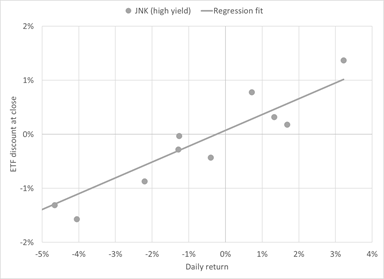
<p>&ldquo;ETF price right&rdquo; predicts end-of-day discounts should be proportional to the size of the market move during the day. In particular, it predicts premiums to NAV on days prices increased. This is precisely what we see for the biggest high-yield ETF, as shown below. High-yield, or junk bonds, are bonds from issuers with higher default probabilities than issuers of investment-grade bonds. If the ETF discount represented selling pressure, we would not expect any strong dependence on one day&rsquo;s performance in one asset class, it should depend on longer-term overall market conditions. The discount or premium should look like random noise, unrelated to the direction of the market on the day.</p>
<div class="body-photo-inline">
<div class="body-photo"><img class="body-photo-inline" src="http://assets.realclear.com/images/50/504720_5_.png" border="0" width="715" height="520" /></div>
</div>
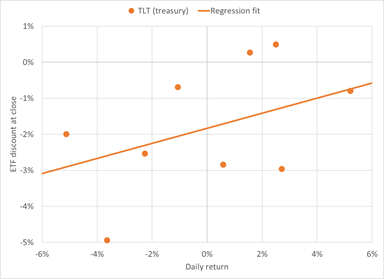
<p>In treasuries, there is less support for &ldquo;ETF price right.&rdquo; It&rsquo;s true discounts are larger on days the market went down, but there are large discounts on average even on days prices went up. The treasury bond prices do seem to lag the ETF, the slope of the regression line is positive, but that does not seem to explain most of the discount.</p>
<div class="body-photo-inline">
<div class="body-photo"><img class="body-photo-inline" src="http://assets.realclear.com/images/50/504721_5_.png" border="0" width="715" height="520" /></div>
</div>
<p>Investment-grade bonds look like high-yield bonds on days the market goes down. The ETF price looks right. But on days the market goes up, the investment grade ETF trades near market value. This supports the &ldquo;ETF price right&rdquo; theory, and suggests the NAVs are reliable as well, but only on days the market goes up.</p>
<div class="body-photo-inline">
<div class="body-photo"><img class="body-photo-inline" src="http://assets.realclear.com/images/50/504723_5_.png" border="0" width="715" height="520" /></div>
</div>
<p>This suggests the ETF prices are right for corporate bonds. They represent arms-length transactions between unforced participants, while NAVs are unreliable except for investment-grade bonds on days the market is up.</p>
<p>Treasury ETF prices do not seem to be reliable indicators of value. Selling pressure is one explanation for the discounts, but it&rsquo;s undercut because other securities for liquid treasury trading&mdash;the on-the-run bonds&mdash;went up in price relative to off the run at the same time the ETFs were going down. So for the moment we leave this unresolved, except to say that people who insist treasury ETF prices are right, or that they&rsquo;re wrong, have some explaining to do.</p>
<p>The other issue is panic versus rational price changes. &ldquo;Panic&rdquo; is shorthand not just for human over-reaction but for institutional constraints, errors, stressed systems or market frictions that cause irrational trades.</p>
<p>If ETF discounts are caused by panic selling then you would expect to make money buying at discounts and selling at premiums. The chart below shows the result of buying the high-yield ETF at end-of-day, for different values of discount. The &ldquo;ETF wrong&rdquo; line is what we would expect if the discounts were pure panic. If you buy at a 2% discount, you make an average of 2% the next day.</p>
<div class="body-photo-inline">
<div class="body-photo"><img class="body-photo-inline" src="http://assets.realclear.com/images/50/504724_5_.png" border="0" width="715" height="520" /></div>
</div>
<p>If the ETF prices were right, and the individual bond prices wrong, we would expect next day return to be uncorrelated to the discount at the previous end-of-day. But we see the slope of the line is even steeper than the ETF-wrong line. This suggests that both ETF and individual bond prices are over-reactions, with ETFs more extreme than individual bonds. If the ETF is trading at a 1% premium, not only do you expect to lose that 1% premium the next day, but you expect the underlying bonds to fall 2% as well for a 3% loss.</p>
<p>In treasuries, the ETF price wrong theory is clearly contradicted. The slope of the regression line is slightly positive, which is the opposite of what we expect if ETF prices represent panic. But it&rsquo;s close enough to flat to support the claim that the ETF prices are right.</p>
<div class="body-photo-inline">
<div class="body-photo"><img class="body-photo-inline" src="http://assets.realclear.com/images/50/504726_5_.png" border="0" width="715" height="520" /></div>
</div>
<p>Investment-grade bonds are very hard to explain with either theory. The biggest discount day, -5%, resulted in over +4% return the following day, suggesting the ETF price was wrong. But for all other days, the bigger the discount, the worse the return the next day. This suggests ETF prices are halfway between individual bond prices and the right prices.</p>
<div class="body-photo-inline">
<div class="body-photo"><img class="body-photo-inline" src="http://assets.realclear.com/images/50/504727_5_.png" border="0" width="715" height="520" /></div>
</div>
<p>Of course, this is only twelve days of data, and perhaps this is an unusual market without broad lessons. But extreme events can generate more useful information that everyday trading and this is the first crisis of this magnitude with established, highly liquid bond ETF trading. No doubt academics will pour over the data using more granular information to tease out nuanced conclusions in a few years.</p>
<p>But for those of us who have to make decisions now, and who trust empirical evidence over opinionated people or untested theories, there are some tentative lessons. Corporate bond ETF prices seem to be correct, with individual bond prices underlying the NAVs often out-of-date. But in the treasury market that does not seem to be the case. In none of the three asset classes does selling pressure explain the ETF price.</p>
<p>For high-yield bonds we have evidence of panicked over-reaction, with the ETF worse than the underlying bonds. But for corporate bonds we have evidence of under-reaction, with the underlying bonds worse than the ETF. Treasury trading has no evidence of either under or over-reaction.</p>
<p>These data give no support to people who want to ignore ETF prices to provide liquidity support or bailouts to institutions that are insolvent if marked to ETF-market. If the central bank buys bonds at bond-market prices, without considering the ETF discount, these data suggest it is overpaying and subsidizing bad bets rather than supplying liquidity temporarily absent from the market.</p>
<p>The data do give support to people who want to slow trading in corporate bond and corporate bond ETF markets with trading halts or curbs, circuit breakers or other devices to let market participants consider decisions carefully, to relieve stress on systems and to give time to adjust institutional constraints and market frictions.</p>
<p>Twelve days of data won&rsquo;t overturn strongly held convictions, but it&rsquo;s still worth looking at data when we get it.</p><br/><p><em>Aaron Brown is the author of many books, including The Poker Face of Wall Street.&nbsp; He's a long-time risk manager in the hedge fund space.&nbsp;&nbsp;</em></p><br/>]]></content>
				</entry>
				<entry>
					<title>Some Questions for the Many Critics of the Gold Standard</title>
					<link rel="alternate" type="text/html" href="http://www.realclearmarkets.com/articles/2020/02/25/some_questions_for_the_many_critics_of_the_gold_standard_104088.html" />
					<id>tag:www.realclearmarkets.com,2009:/articles//104088</id>
					<published>2020-02-25T00:00:00Z</published>
					<updated>2020-02-25T00:00:00Z</updated>


					<summary>&amp;ldquo;Money does not pay for anything, never has, never will. It is an economic axiom as old as the hills that goods and services can be paid for only with good and services.&amp;rdquo;&amp;nbsp;&amp;ndash; Albert Jay Nock
Though the dollar&amp;rsquo;s exchange value vis-a-vis gold, global currencies, indexes, seashells, and any other alleged benchmark has never been part of the Fed&amp;rsquo;s portfolio, the fact that current Federal Reserve Board nominee Judy Shelton has long expressed support for a gold-defined dollar has propelled the &amp;ldquo;gold standard&amp;rdquo; back into the...</summary>
										
					<author><name>John Tamny</name></author><category term="John Tamny" scheme="http://www.sixapart.com/ns/types#category" /><content type="html" xml:lang="en" xml:base="http://www.realclearmarkets.com/articles/"><![CDATA[<p><em>&ldquo;Money does not pay for anything, never has, never will. It is an economic axiom as old as the hills that goods and services can be paid for only with good and services.&rdquo;</em>&nbsp;&ndash; Albert Jay Nock</p>
<p>Though the dollar&rsquo;s exchange value vis-a-vis gold, global currencies, indexes, seashells, and any other alleged benchmark has never been part of the Fed&rsquo;s portfolio, the fact that current Federal Reserve Board nominee Judy Shelton has long expressed support for a gold-defined dollar has propelled the &ldquo;gold standard&rdquo; back into the economics discussion. Some who support a commodity anchor for the dollar side with Shelton, while all-too-many who disagree with Shelton have dismissed the notion of a gold-defined dollar as the stuff of witless cranks.</p>
<p>Up front, count yours truly as an energetic supporter of Shelton and a return to a commodity definition for the dollar. About gold or the gold standard, it should be said right away that an ongoing problem with a gold standard is that all-too-many &ldquo;witless cranks&rdquo; support one without knowing what it is they&rsquo;re supporting. These are usually the same individuals who tie every economic ill of the last 100 years to the Federal Reserve, who believe the Fed &ldquo;monetizes&rdquo; budget deficits, and who claim that the central bank was a conspiratorial creation of the Rockefellers.</p>
<p>I&rsquo;m not one of them. And at risk of presuming to speak for others with whom I regularly discuss monetary policy with, I speak for those who view money in the way that Adam Smith did. Smith made the basic point in <em>The Wealth of Nations</em> that &ldquo;the sole use of money is to circulate consumable goods.&rdquo; Implicit in Smith&rsquo;s reasoning was something that I and the others I presume so speak for understand as an historical truth: &ldquo;money&rdquo; wasn&rsquo;t first a creation of government, plus it well predates central banks. Money was a logical consequence of producers seeking an objective&nbsp;<em>agreement about value</em> that would make it possible for producers to exchange with one another: I have bread and I want your wine, but you have no interest in my bread given your mouthwatering desire for the butcher&rsquo;s meat.</p>
<p>Money means producers with totally disparate wants can easily trade with one another. So while money itself doesn&rsquo;t stimulate growth, its existence as a trusted medium stimulates enormous growth for it enabling the specialization that gives life to productivity.&nbsp;</p>
<p>Why gold? This is a question that&rsquo;s been answered by producers over millennia. Producers stressed stability of value when it came to money. Translated: they didn&rsquo;t want to get ripped off. The fear was providing real goods and services for money, only for the money to exchange for exceedingly less. As a consequence, gold imbued money with credibility. Per John Stuart Mill, it appealed to producers because it was one of the commodities &ldquo;least influenced by any of the causes that produce fluctuations in value.&rdquo; Money defined in terms of gold would be heavily circulated precisely because the definer of it was &ldquo;least influenced by any of the causes that produce fluctuations in value.&rdquo;</p>
<p>Why gold today? I&rsquo;ll confidently speak for others who broadly share my opinions on money when I say that no serious gold-standard advocate is rigid in his or her need for a return to gold-defined money. Where we&rsquo;re rigid is in our belief that money of ever-changing value deprives money to varying degrees of its singular purpose as a medium of exchange that enables individual specialization that powers productivity. I&rsquo;ll add that floating money also slows progress that is always and everywhere a consequence of investment. Why put dollars to work if the value of dollar is wildly uncertain such that any returns could be eviscerated by money the value of which is changing all the time?</p>
<p>Stated simply, supporters of a gold standard, commodity standard, or currency stability more broadly seek just that given our view that it elevates money to its highest purpose as a facilitator of the exchange and investment that pushes people and physical resources to their highest use. There&rsquo;s also a compassionate angle to this: Americans earn dollars, and a lack of currency stability has meant that Americans have suffered periodic devaluations that have amounted to a not-so-stealth shrinking of the value of their work. Translated, we work for dollars because dollars are exchangeable for goods and services. When the dollar is devalued, the fruits of our labor are logically shrunk.</p>
<p>Crucial about the gold-standard advocates for whom I presume to speak is that none of us equates a commodity definition for the dollar with "tight money." To believe that a gold-defined dollar equates with "tight money" is to wholly misunderstand what money is. It's once again a faciliator of exchange. We all trade products for products, with "money" as the agreed upon medium refereeing the exchange. Translated: a gold-defined dollar would, in the eyes of gold-standard advocates, associate with soaring dollars in circulation to reflect an even greater desire on the part of producers to use the dollar when exchanging goods, services and labor. Stable, credible currencies are logically the most "supplied" or circulated currencies, while floating, volatile, uncertain currencies can rarely be found in the marketplace. Looked at in the extreme, amid Germany's post-WWI hyperinflation it was known that the thoroughly debased mark was exceedingly hard to find, and accepted nowhere, while the U.S. dollar was plentiful and commanded all manner of goods and services in Berlin. Good money is everywhere, bad is scarce. Gresham's Law is a myth.&nbsp;</p>
<p>Lastly, Cornell professor Eswar Prasad (no fan of the gold standard as far as I know) wrote in his excellent 2017 book <em>Gaining Currency: The Rise of the Renminbi</em>, that Confucians back in 7th century China were fans of private money over that issued by government given their belief that "the market would compel private issuers of money to maintain its value.&rdquo; This is mentioned briefly given the view of some gold standard or stable currency advocates that eventually market actors will issue broadly circulated currencies that will replace the dollar, euro, yen, Swiss franc, and other heavily issued government-issued currencies. Time will tell, but it seems Amazon, J.P. Morgan, Target and Starbucks dollars might hold their value better than the dollar has under the U.S. Treasury&rsquo;s watch. What will this money be like? Who knows? The main thing is that a private sector that can put supercomputers in our pockets can likely issue a trusted medium of exchange that workers would prefer over Federal Reserve Notes. Still, at this point it&rsquo;s all a speculation.</p>
<p>Which leads to the questions for gold-standard critics:</p>
<p>1.&nbsp;&nbsp;&nbsp;&nbsp;&nbsp;&nbsp;&nbsp; <strong>Why money?</strong> In particular, do gold-standard critics believe money is a medium of exchange? If no, what is money?</p>
<p>2.&nbsp;&nbsp;&nbsp;&nbsp;&nbsp;&nbsp; <strong>If yes, do critics agree that underlying monetary exchanges is the exchange of goods and services for goods and services?</strong></p>
<p>3.&nbsp;&nbsp;&nbsp;&nbsp;&nbsp;&nbsp; <strong>If money largely exists to facilitate exchange, why do gold-standard critics think that gold emerged globally in the marketplace of currencies as &ldquo;money par excellence,&rdquo; in the words of Karl Marx?</strong></p>
<p>4.&nbsp;&nbsp;&nbsp;&nbsp;&nbsp; <strong>When critics of gold take fiat money in exchange for a good or service rendered, do they take the money on the expectation that it will reliably hold its value so that they can exchange it for roughly commensurate goods and services they want?</strong></p>
<p>5.&nbsp;&nbsp;&nbsp;&nbsp;&nbsp;&nbsp; <strong>Would gold critics willingly be paid a salary denominated in Bitcoin?</strong> For background, this question comes up among stable currency types quite a lot. We generally say no given our broadly held view that Bitcoin really isn&rsquo;t a currency as much as it&rsquo;s a speculation. To be paid in Bitcoin would force an obvious question of "Which Bitcoin?" The one that was exchangeable for $250 three years ago, the one that fetched $22,000 at one point two years ago, the one that purchased $6,000 a few months ago, or the one that commands $10,000 at present? The volatility of the so-called currency presents a problem for those who view money as a medium of exchange. Bitcoin would be too risky as a trade-facilitating measure in that depending on the day, week, month, or year, its meaning in terms of value is a wildly moving target.</p>
<p>6.&nbsp;&nbsp;&nbsp;&nbsp;&nbsp;&nbsp; <strong>Did adherence to the gold standard cause the Great Depression?</strong> This question similarly comes up a lot, and we can&rsquo;t find the connection. For one, gold had been used as a definer of money for thousands of years. If it were an economic depressant, wouldn&rsquo;t it have long before been replaced? And if it was the source of a 1930s slowdown, why did global monetary authorities (including the Soviet Union, albeit implicitly) peg their currencies to a dollar defined as 1/35th of an ounce in 1944? Did an economic downturn ensue? President Nixon de-linked the dollar from gold in 1971, and for good in 1973, but the &lsquo;70s were a pretty brutal, stagflationary decade as we recall.</p>
<p>Some say the gold-defined dollar led to &ldquo;tight money&rdquo; that restrained the Fed in the 1930s, but such a view ignores that the Fed had a very limited mandate back then. It was supposed to act only if lending rates among banks soared, but per monetary expert Nathan Lewis, &ldquo;overnight lending rates between solvent banks remained low, indicating that there was no systemwide shortage.&rdquo;</p>
<p>Was it a money supply thing? Some critics yet again say the Fed &ldquo;tightened&rdquo; money, but Lewis has exposed such theorizing as false. Furthermore, such thinking presumes that money is an instigator of economic activity as opposed to a consequence. What do the critics think? If it&rsquo;s an instigator of economic growth such that Fed &ldquo;tightness&rdquo; restrained growth in the 1930s, could Cairo, IL, Charleston, WV and Buffalo, NY be modernly revived economically if the Fed aggressively bought up interest-bearing bonds from banks in each city? More broadly, could Bridgeport become Greenwich, East Palo Alto become Palo Alto, and Baltimore become Bethesda if the Fed &ldquo;guns money supply&rdquo; in the perpetually recessed locales, or is money yet again a consequence of economic activity? Why is there so much money in Pasadena, but relatively little in Duarte, CA? Coincidence, the Fed, or is productivity higher in Pasadena?</p>
<p>Lastly, why would a stable currency in terms of value cause economic ill health? Isn&rsquo;t money just a veil as is? Doesn&rsquo;t it just measure? No doubt the Bureau of Weights and Measures could shrink the inch in order to double my height to 12 feet, but my actual height wouldn't change one iota, and NBA teams would still have no interest in my services. Isn&rsquo;t the disdain for money as a consistent measure among gold-standard critics underlay by a mystic belief that monetary manipulation can alter reality?</p>
<p>7.&nbsp; &nbsp; &nbsp; &nbsp;<strong>Critics of dollar-price stability lament that a rigid dollar in terms of price would limit the ability of monetary authorities to act during downturns; the implicit point that a price rule would limit the ability of monetary authorities to devalue. Ok, but Americans earn dollars? How would devaluation help them? So do corporations earn dollars. Investors seek returns in dollars, and investment drives economic growth. How would devaluing the returns of investors boost the economy? Or is it the point of critics that investment isn't important to economic growth? If not, what is?&nbsp;</strong></p>
<p>8.&nbsp;&nbsp;&nbsp;&nbsp;&nbsp;&nbsp; <strong>One gold standard critic acknowledged the truth that gold &ldquo;proved&rdquo; a reliable medium of exchange that market-based producers happened on in the past, but he stressed &ldquo;proved&rdquo; in the past tense. So what&rsquo;s changed?</strong></p>
<p>9.&nbsp;&nbsp;&nbsp;&nbsp;&nbsp;&nbsp; <strong>Why, if stability in terms of value no longer matters, do so many countries peg their currencies to relatively stable currencies like the dollar, euro, yen, Swiss franc?</strong></p>
<p>10.&nbsp;&nbsp;&nbsp; <strong>If gold is a past tense concept, as in if it is no longer necessary as an anchor for currencies, why were currency trading markets rather non-existent before 1973?</strong> And then why is currency trading a $5 trillion/day industry today? In short, if gold is some barbarous relic, why all the trading among currencies meant to mitigate their modern instability; instability that is plainly a consequence of a lack of a commodity anchor?</p>
<p>So here we go. Lots of questions, but maybe ones that, if addressed, will lead to some kind of understanding. Question #10 is the one I&rsquo;m most curious about. To be clear about this, gold-standard advocates aren&rsquo;t so much wedded to gold in religious fashion as they&rsquo;re wedded to the currency stability that gold once provided, but that no longer exists as $5 trillion daily currency markets persistently remind us. If currency stability no longer matters, why is there so much currency trading?&nbsp;</p><br/><p><em>John Tamny is editor of&nbsp;RealClearMarkets and a senior economic adviser to Toreador Research and Trading (<a href="http://www.trtadvisors.com">www.trtadvisors.com</a>). His new book is titled <a href="https://www.amazon.com/Theyre-Both-Wrong-Frustrated-Independent-ebook/dp/B07WX1L3HP/ref=sr_1_2?crid=GXX53IXN28OX&amp;keywords=john+tamny&amp;qid=1574603008&amp;sprefix=John+Tamny%2Caps%2C135&amp;sr=8-2">They're Both Wrong: A Policy Guide for America's Frustrated Independent Thinkers</a>. Other books by Tamny include&nbsp;<a href="https://www.amazon.com/End-Work-Your-Passion-Become/dp/1621577775/ref=sr_1_1?ie=UTF8&amp;qid=1525739441&amp;sr=8-1&amp;keywords=the+end+of+work+john+tamny">The End of Work</a>, about the exciting growth of jobs more and more of us love,&nbsp;<a href="http://www.amazon.com/Who-Needs-Fed-Abolish-Americas/dp/1594038317/ref=sr_1_3?s=books&amp;ie=UTF8&amp;qid=1457980544&amp;sr=1-3&amp;keywords=john+tamny">Who Needs the Fed?</a>&nbsp;and&nbsp;<a href="http://www.amazon.com/Popular-Economics-Rolling-Stones-Downton/dp/1621573370/ref=sr_1_1?s=books&amp;ie=UTF8&amp;qid=1420933425&amp;sr=1-1&amp;keywords=john+tamny">Popular Economics</a>. He can be reached at jtamny@realclearmarkets.com.&nbsp;&nbsp;</em></p><br/>]]></content>
				</entry>
				<entry>
					<title>Ignore the Neo-Keynesians, &#039;Easy Money&#039; and &#039;Sloppy Loans&#039; Didn&#039;t Cause 2008</title>
					<link rel="alternate" type="text/html" href="http://www.realclearmarkets.com/articles/2020/02/24/ignore_the_neo-keynesians_easy_money_from_the_fed_didnt_cause_2008_104087.html" />
					<id>tag:www.realclearmarkets.com,2009:/articles//104087</id>
					<published>2020-02-24T00:00:00Z</published>
					<updated>2020-02-24T00:00:00Z</updated>


					<summary>Economic discourse would be a great deal more informative if it were broadly understood that no one borrows money. What they borrow is what money can be exchanged for. Always.
That&amp;rsquo;s why readers should always be skeptical when pundits and economists talk of &amp;ldquo;easy money&amp;rdquo; or &amp;ldquo;too much liquidity&amp;rdquo; care of some government entity like the Fed. Implicit there is that governments, by virtue of printing money or increasing so-called &amp;ldquo;money supply,&amp;rdquo; can increase the supply of goods available for borrowing, and by extension, borrowing...</summary>
										
					<author><name>John Tamny</name></author><category term="John Tamny" scheme="http://www.sixapart.com/ns/types#category" /><content type="html" xml:lang="en" xml:base="http://www.realclearmarkets.com/articles/"><![CDATA[<p>Economic discourse would be a great deal more informative if it were broadly understood that no one borrows money. What they borrow is what money can be exchanged for. <em>Always</em>.</p>
<p>That&rsquo;s why readers should always be skeptical when pundits and economists talk of &ldquo;easy money&rdquo; or &ldquo;too much liquidity&rdquo; care of some government entity like the Fed. Implicit there is that governments, by virtue of printing money or increasing so-called &ldquo;money supply,&rdquo; can increase the supply of goods available for borrowing, and by extension, borrowing itself. Such a view isn&rsquo;t serious. Only the private sector can increase borrowing or liquidity simply because all goods and services are produced in the private sector. &nbsp;</p>
<p>All of this rates mention yet again given some comments Michael Bloomberg made about faulty lending that allegedly led to 2008. Bloomberg was criticized for weighing in, at which point conservatives and libertarians trotted out their own familiar arguments about what happened almost twelve years ago.</p>
<p>One conservative economist blamed Fannie Mae and Freddie Mac for making it possible for lenders to make &ldquo;sloppy loans&rdquo; since they &ldquo;knew those mortgages could be bundled into securities and sold&rdquo; to the two quasi-governmental entities. This stance is a popular one among conservatives, but it ignores a rush into housing that was <em>global</em> in nature, and that took place in countries where there was no Fannie or Freddie. After that, it's worth pointing out that housing soared in England even though the mortgage interest deduction was jettisoned there back in the 1980s. Housing boomed in Canada even though it&rsquo;s long been very difficult for borrowers to access home loans there.</p>
<p>Furthermore, the argument ignores the simple truth that a substantial majority of those allegedly &ldquo;sloppy loans&rdquo; performed. As Blackstone co-founder Stephen Schwarzman pointed out in his excellent new book, <em>What It Takes</em>, mortgage loan performance was over 90%. That it was is and was a statement of the obvious. Banks, precisely because they&rsquo;re not equity lenders, must issue loans that will be paid back.</p>
<p>They were in trouble not because the loans were generally sloppy, but because even a small percentage of bad loans can render a bank insolvent. Furthermore, it rates stress that even without Fannie and Freddie, demand for bundled mortgages was already extraordinarily high; as in even if Fannie and Freddie hadn&rsquo;t been size buyers of these securities, demand for them well outstripped supply as is. They were seen as safe. Banks and investment banks had lots of exposure to them precisely because they were seen as safe. John Paulson&rsquo;s billions are today evidence of just how safe they were seen to be. It only took a brief change in the perception about loans that largely performed for Paulson to make his fortune. A focus on Fannie and Freddie kind of misses the point.</p>
<p>Why did some eventually go south? Who knows, but it&rsquo;s worth pointing out that investment is what powers economic growth, investment is a consequence of savings, and in any economic scenario businesses reliant on investment are always competing for resources with consumers. It seems one big driver of eventual loan non-performance is that with consumption of housing soaring, capital availability wrought by savings wasn&rsquo;t as a great; thus sapping the economic vitality and progress that made loan repayment more doable.</p>
<p>Which brings us to the other popular view among conservatives and libertarians: the Fed did it. They point to a low, 1% Fed funds rate in the early 2000s as the driver of the rush to housing. It all seems so simple except that housing in the U.S. boomed in the 1970s when the Fed was aggressively hiking rates. The Fed/rate argument also ignores that the housing boom in the 2000s was once again global in nature, and happened in countries where short rates targeted by central banks were quite a bit higher.</p>
<p>But considering conservative/libertarian blame of the Fed for 2008 more broadly, it can&rsquo;t be stressed enough that their &ldquo;easy money&rdquo; and &ldquo;too much liquidity&rdquo; critiques of the central bank reveal a Keynesian quality to their commentary. Call it neo-Keynesian? Think about it.</p>
<p>Members of the right properly mock Keynesians for laughably arguing that government spending boosts economic growth. No, it doesn&rsquo;t. Governments only have money to spend insofar as the private sector creates the wealth that enables their spending. Keynesians typically get it backwards. <em>The growth already occurred</em>; thus the ability of governments to obnoxiously waste precious resources.</p>
<p>Yet all too many conservatives and libertarians once again contend that &ldquo;easy money&rdquo; and &ldquo;too much liquidity&rdquo; helped fuel a frothy housing market. Their argument is at best Keynesianism turned inside out. Keynesians say governments can create a wealth multiplier by spending, while conservatives and libertarians claim central banks, seemingly for being central banks, can decree easy access to resources through &ldquo;easy money.&rdquo; Just decree low rates of interest and resources aplenty will magically appear? No, that&rsquo;s not how economies work. If they did, the former Soviet Union would still exist thanks to an always &ldquo;easy&rdquo; central bank.</p>
<p>As for &ldquo;too much liquidity,&rdquo; implicit there is that the Fed enabled a rock-bottom lending environment. Ok, but how? Let&rsquo;s never forget that no one borrows money. They once again borrow what money can be exchanged for. In blaming the Fed for 2008 conservatives and libertarians seem to be saying that the Fed engineered easy resource access by making lending artificially cheap. If true, apartment abundance in Manhattan is as simple as Mayor De Blasio forcing stringently cheap rent controls on the Borough. In reality, access to loans is only possible insofar as private actors are producing goods and services that individuals would borrow money to access. Governments don&rsquo;t produce anything, so to pretend that they can make money &ldquo;easy&rdquo; or lending &ldquo;liquid&rdquo; is to pretend that for being governments, they can magically summon the goods and services that would cause people to borrow money in the first place.</p>
<p>Applying all this to 2008, the explanations from the right about what happened remain insufficient. That the boom was global rejects the popular explanations about Fannie, Freddie and the Fed, as does logic. As for the left blaming "de-regulation" and "predatory lenders," oh please.&nbsp;</p>
<p>So perhaps readers might consider the dollar. It was declining in the &lsquo;70s, and it was declining in the 2000s. Housing and other tangible commodities like gold and oil tend to do best when the dollar is doing the worst. It&rsquo;s low rent to focus on the dollar, but it&rsquo;s the common denominator of the &lsquo;70s and &lsquo;00s that no one dare mention. And when the dollar is in decline, it tends to be a global event as currency authorities around the world aim to maintain some kind of consistency with the greenback.&nbsp;</p>
<p>Crucial is that the dollar is a political concept, as opposed to something managed by the Fed. It&rsquo;s worth keeping in mind as left and right continue to stake out their familiar positions about what happened not too long ago. Their arguments don&rsquo;t stand up to common sense.</p><br/><p><em>John Tamny is editor of&nbsp;RealClearMarkets and a senior economic adviser to Toreador Research and Trading (<a href="http://www.trtadvisors.com">www.trtadvisors.com</a>). His new book is titled <a href="https://www.amazon.com/Theyre-Both-Wrong-Frustrated-Independent-ebook/dp/B07WX1L3HP/ref=sr_1_2?crid=GXX53IXN28OX&amp;keywords=john+tamny&amp;qid=1574603008&amp;sprefix=John+Tamny%2Caps%2C135&amp;sr=8-2">They're Both Wrong: A Policy Guide for America's Frustrated Independent Thinkers</a>. Other books by Tamny include&nbsp;<a href="https://www.amazon.com/End-Work-Your-Passion-Become/dp/1621577775/ref=sr_1_1?ie=UTF8&amp;qid=1525739441&amp;sr=8-1&amp;keywords=the+end+of+work+john+tamny">The End of Work</a>, about the exciting growth of jobs more and more of us love,&nbsp;<a href="http://www.amazon.com/Who-Needs-Fed-Abolish-Americas/dp/1594038317/ref=sr_1_3?s=books&amp;ie=UTF8&amp;qid=1457980544&amp;sr=1-3&amp;keywords=john+tamny">Who Needs the Fed?</a>&nbsp;and&nbsp;<a href="http://www.amazon.com/Popular-Economics-Rolling-Stones-Downton/dp/1621573370/ref=sr_1_1?s=books&amp;ie=UTF8&amp;qid=1420933425&amp;sr=1-1&amp;keywords=john+tamny">Popular Economics</a>. He can be reached at jtamny@realclearmarkets.com.&nbsp;&nbsp;</em></p><br/>]]></content>
				</entry>
				<entry>
					<title>Will Congress Pick Up Where DOJ Left Off and Stop Ticketmaster Monopoly?</title>
					<link rel="alternate" type="text/html" href="http://www.realclearmarkets.com/articles/2020/02/24/will_congress_pick_up_where_doj_left_off_and_stop_ticketmaster_monopoly_104092.html" />
					<id>tag:www.realclearmarkets.com,2009:/articles//104092</id>
					<published>2020-02-24T00:00:00Z</published>
					<updated>2020-02-24T00:00:00Z</updated>


					<summary>When Live Nation and Ticketmaster merged in 2010, many feared that the new giant would use its dominant position in the concert touring business to pressure venues into contracting with Ticketmaster, which now controls 80 percent of ticket sales at the nation&amp;rsquo;s largest venues. Those fears came true -- Live Nation Entertainment has since systematically and strategically attempted to control the entire ticket supply chain and the prices consumers pay.
The Department of Justice (DOJ) sought to limit the company&amp;rsquo;s attempts to bully venues seeking Live Nation music talent to...</summary>
										
					<author><name>Mark Perry</name></author><category term="Mark Perry" scheme="http://www.sixapart.com/ns/types#category" /><content type="html" xml:lang="en" xml:base="http://www.realclearmarkets.com/articles/"><![CDATA[<p>When Live Nation and Ticketmaster merged in 2010, many feared that the new giant would use its dominant position in the concert touring business to pressure venues into contracting with Ticketmaster, which now controls <a href="https://www.nytimes.com/2018/04/01/arts/music/live-nation-ticketmaster.html">80 percent</a> of ticket sales at the nation&rsquo;s largest venues. Those fears came true -- Live Nation Entertainment has since systematically and strategically attempted to control the entire ticket supply chain and the prices consumers pay.</p>
<p>The Department of Justice (DOJ) sought to limit the company&rsquo;s attempts to bully venues seeking Live Nation music talent to use Ticketmaster for ticketing through conditions included in the merger approval consent decree. Christine Varney, the then-Assistant Attorney General for Antitrust, <a href="https://www.justice.gov/atr/speech/ticketmasterlive-nation-merger-review-and-consent-decree-perspective">stated in 2008</a> that the DOJ was concerned that &ldquo;the merger posed a threat to growing competition in primary ticketing&rdquo; and that &ldquo;it was this substantial lessening of competition that we concluded violated the antitrust laws.&rdquo; Sadly, in the decade since the world&rsquo;s largest ticketing company combined with the world&rsquo;s largest concert promoter, tickets have become increasingly more expensive, more difficult for fans to access, and more difficult for fans to resell.&nbsp; &nbsp;</p>
<p>In December 2019, the DOJ reported that Live Nation has &ldquo;repeatedly and over the course of several years engaged in conduct that&hellip;.violated the Final Judgment&rdquo; that was supposed to &ldquo;prohibit the company from retaliating against concert venues for using another ticketing company, threatening concert venues, or undertaking other specified actions against concert venues for ten years.&rdquo;</p>
<p>The DOJ responded by extending the settlement five years, imposing $1 million fines for each future violation, and appointing an independent monitor. But even these measures don&rsquo;t go far enough to protect music fans.</p>
<p>The live music and ticketing markets have evolved over the last decade. Measures taken to curb anti-competitive practices in 2010 no longer apply. Today, Live Nation Entertainment controls virtually all of the &ldquo;primary&rdquo; consumer ticket market, where tickets are initially put on sale, and is taking steps to crush competition in the &ldquo;secondary&rdquo; ticket resale market too. New technologies empower Ticketmaster to stifle its competition and control consumer behavior that go well beyond the activities that DOJ sought to constrain in 2010. These anti-competitive strategies begin before tickets go on sale and extend through the day of the event.</p>
<p>For example, Ticketmaster creates artificial market conditions by secretly holding tickets back from sale to the public. In some cases, half of the seats to an event are sold by &ldquo;slow ticketing,&rdquo; where tickets are gradually released to create a buying frenzy at higher prices. Ticketmaster executives call this program &ldquo;Verified Fan&rdquo; and claim it prevents fraud and attacks by illegal software bots, yet they admit it has resulted in more profit and less competition from other ticket sellers.</p>
<p>It is shameful to allow fans to access a seat map when tickets go on sale showing only a few tickets available for purchase when in reality there is a huge hidden inventory of tickets released to the market slowly. This deceptive, artificially generated scarcity should be outlawed or otherwise strictly regulated. However, the company has invested millions to develop this mousetrap, &ldquo;innovation&rdquo; that it won&rsquo;t so easily allow lawmakers or regulators to reign-in. Two summers ago, Live Nation lobbied New Jersey lawmakers to rescind a longtime consumer protection law that prohibited venues from holding back more than five percent of tickets.</p>
<p>Separately, Ticketmaster&rsquo;s new &ldquo;SafeTix&rdquo; app-based technology generates a new barcode every 15 seconds, making the electronic tickets usable only if the customer bought it from Ticketmaster and uses a Ticketmaster app. &ldquo;SafeTix&rdquo; is a blatant attempt to undermine the competition from secondary markets that have proved extremely valuable to consumers, where consumers often find better, supply-and-demand driven prices. Because of SafeTix, some fans who purchased valid tickets from other sellers have been stranded outside of their shows. And these are not fake or counterfeit tickets but are real tickets bought from Ticketmaster and then resold on the secondary market.</p>
<p>All of these anti-competitive actions are violating free-market principles and harming consumers. As a direct result of the merger, consumers have increasingly been at the mercy of a single company for access to tickets. If lawmakers only focus on the secondary resale market at their congressional hearing this week, they will miss the bigger picture of anti-competitive practices.</p>
<p>What we need now is a new and aggressive approach that will protect a fundamental principle: the ability of ticketholders to freely transfer, give away, or resell their tickets. The evidence clearly shows that the more Ticketmaster uses its powerful position to curtail competition and ticket transferability, fan access to tickets goes down and the prices go up.</p>
<p>Some states have passed laws to protect the rights of fans to transfer tickets, making Ticketmaster&rsquo;s anti-competitive practices illegal. Other states, like Indiana, have attempted to pass similar laws but met strong resistance from Ticketmaster&rsquo;s lobbyists. In place of a patchwork of state laws, a federal standard would be a much better approach</p>
<p>Until the current anti-competitive monopolistic behaviors of the merged companies are curtailed, new technologies will continue to emerge that will further increase frustration and ticket prices for fans. The BOSS Act currently being considered by Congress contains much of what is needed to safeguard consumers, protect market competition, and prevent a total market takeover by Live Nation-Ticketmaster.</p><br/><p><em>Mark J. Perry is a scholar at the American Enterprise Institute and a professor of economics at the Flint campus of the University of Michigan.&nbsp;</em></p><br/>]]></content>
				</entry>
				<entry>
					<title>Arizona Rightly Pushes Back on California&#039;s Privacy Aggression</title>
					<link rel="alternate" type="text/html" href="http://www.realclearmarkets.com/articles/2020/02/24/arizona_rightly_pushes_back_on_californias_privacy_aggression_104090.html" />
					<id>tag:www.realclearmarkets.com,2009:/articles//104090</id>
					<published>2020-02-24T00:00:00Z</published>
					<updated>2020-02-24T00:00:00Z</updated>


					<summary>Over the past few years, no state has been more aggressive in pushing constitutional limits on its authority than California, most recently with its attempt to make national law on internet privacy. This effort is just a small part of a growing trend of states attempting to tax and regulate outside their borders.
Thus, it&amp;rsquo;s a relief when at least one state pushes back on California&amp;rsquo;s aggression, arguing that the Golden State&amp;rsquo;s regulatory power should end where its borders do. That&amp;rsquo;s the case with Arizona&amp;nbsp;House Concurrent Resolution 2013, a bill...</summary>
										
					<author><name>Andrew Wilford</name></author><category term="Andrew Wilford" scheme="http://www.sixapart.com/ns/types#category" /><content type="html" xml:lang="en" xml:base="http://www.realclearmarkets.com/articles/"><![CDATA[<p>Over the past few years, no state has been more aggressive in pushing constitutional limits on its authority than California, most recently with its attempt to make national law on internet privacy. This effort is just a small part of a growing trend of states attempting to tax and regulate outside their borders.</p>
<p>Thus, it&rsquo;s a relief when at least one state pushes back on California&rsquo;s aggression, arguing that the Golden State&rsquo;s regulatory power should end where its borders do. That&rsquo;s the case with <a href="https://legiscan.com/AZ/text/HCR2013/id/2090396">Arizona&nbsp;House Concurrent Resolution 2013</a>, a bill in the state House of Representatives that would make it the Arizona government&rsquo;s position that internet privacy regulation is the purview of Congress, not individual states.</p>
<p>Arizona&rsquo;s legislature doesn&rsquo;t bring this up idly. California&rsquo;s landmark consumer privacy legislation, the California Consumer Privacy Act (CCPA), went into effect less than two months ago and threatens to impose crippling compliance burdens on businesses all across the country.</p>
<p>The CCPA set data privacy standards for businesses that transact in <a href="https://leginfo.legislature.ca.gov/faces/billTextClient.xhtml?bill_id=201720180AB375">50,000 or more</a> Californians&rsquo; data, even if the business lacks any physical presence within the state. Given that this represents just 0.18 percent of the state&rsquo;s adult population, this standard was always likely to ensnare a significant number of out-of-state businesses.</p>
<p>After all, most businesses <a href="https://www.ntu.org/foundation/detail/five-types-of-businesses-you-might-not-expect-could-be-targeted-by-nys-digital-tax">collect</a> consumer data as a matter of course, even if they are not selling this data. Restaurants&nbsp;collect&nbsp;email addresses for reservations, auto insurers collect your age and driving history to calculate your premium, and retailers that offer rewards programs keep track of your purchase history. It would be very easy for businesses that use consumer data for mundane purposes to find themselves caught up in the CCPA&rsquo;s net.</p>
<p>And California was well aware that it would be creating a substantial compliance burden for many businesses that it had little right to regulate. Firms with less than 20 employees were estimated by the state to incur $50,000 in initial compliance costs, with double that amount for businesses with between 20 and 100 employees. All in all, the state estimated <a href="http://www.dof.ca.gov/Forecasting/Economics/Major_Regulations/Major_Regulations_Table/documents/CCPA_Regulations-SRIA-DOF.pdf">$55 billion</a> in total up-front compliance costs alone &mdash; and that&rsquo;s only for California-based companies, with billions more in costs likely for those out of state.</p>
<p>Failing to comply can be very costly for businesses, whether based in San Francisco or New York City. Unintentional violations of the CCPA are fined at $2,500 per instance &mdash; a number that balloons very quickly when multiplied by the 50,000 consumer threshold.</p>
<p>Given this, it&rsquo;s understandable that Arizona is upset that California is effectively attempting to dictate national policy on this issue. California legislators and government bureaucrats were elected by Californians, not Arizonans, after all.</p>
<p>On top of this, other states following California&rsquo;s lead could create an impossible web of overlapping and conflicting state laws. The CCPA alone is burdensome enough, but were 49 states to follow suit with their own variants, the burden on interstate commerce would be near paralyzing.</p>
<p>Therefore, Arizona is right to assert that regulation of things like internet privacy should be the prerogative of the federal government. States rightly hold power to dictate their own affairs but if they attempt to regulate for the entire country, it&rsquo;s Congress&rsquo;s job to step in and protect the national economy from a downward spiral of state aggression.</p><br/><p><em>Andrew Wilford is a policy analyst with the National Taxpayers Union Foundation, a nonprofit dedicated to tax policy education and analysis at all levels of government.</em></p>
<p>&nbsp;</p><br/>]]></content>
				</entry>
				<entry>
					<title>It&#039;s Not the &#039;Currency Wars,&#039; This Is THE Currency War</title>
					<link rel="alternate" type="text/html" href="http://www.realclearmarkets.com/articles/2020/02/21/its_not_the_currency_wars_this_is_the_currency_war_104089.html" />
					<id>tag:www.realclearmarkets.com,2009:/articles//104089</id>
					<published>2020-02-21T00:00:00Z</published>
					<updated>2020-02-21T00:00:00Z</updated>


					<summary>What do you do if you find your country in the midst of a currency war? For Brazil&amp;rsquo;s Finance Minister in early 2011 the response seemed clear enough. After all, it had been Guido Mantega who had made the initial declaration. Back at the end of September 2010, once it became very clear Ben Bernanke&amp;rsquo;s Fed was about to launch a second round of &amp;ldquo;massive&amp;rdquo; &amp;ldquo;money printing&amp;rdquo;, Mantega had gone before the world&amp;rsquo;s microphones and stated his outrage.
&amp;ldquo;We&amp;rsquo;re in the midst of an international currency war, a general...</summary>
										
					<author><name>Jeffrey Snider</name></author><category term="Jeffrey Snider" scheme="http://www.sixapart.com/ns/types#category" /><content type="html" xml:lang="en" xml:base="http://www.realclearmarkets.com/articles/"><![CDATA[<p>What do you do if you find your country in the midst of a currency war? For Brazil&rsquo;s Finance Minister in early 2011 the response seemed clear enough. After all, it had been Guido Mantega who had made the initial declaration. Back at the end of September 2010, once it became very clear Ben Bernanke&rsquo;s Fed was about to launch a second round of &ldquo;massive&rdquo; &ldquo;money printing&rdquo;, Mantega had gone before the world&rsquo;s microphones and stated his outrage.</p>
<p style="padding-left: 30px;">&ldquo;We&rsquo;re in the midst of an international currency war, a general weakening of currency. This threatens us because it takes away our competitiveness.&rdquo;</p>
<p>From his perspective, one shared by many around the emerging market (EM) world, the purpose was textbook. The United States or Europe would attempt to get back up from the Great &ldquo;Recession&rdquo; on the backs of those other systems. At that early &ldquo;recovery&rdquo; stage, it was becoming obvious that something wasn&rsquo;t right.</p>
<p>To begin with, how could it have been quantitative easing, what everyone assumes is money printing, if it had to be done twice? To the Brazilians and a great many more, the Federal Reserve was going to start beggaring all its neighbors to make up for its growing economic shortfall.</p>
<p>The Economics textbook says that a lower currency exchange rate equals stimulus. It makes your exports relatively less expensive against others on world markets, particularly when your currency is falling against the US dollar. As a consequence, your neighbors&rsquo; goods are disadvantaged.</p>
<p>The same textbook also claims that the offended party isn&rsquo;t without recourse. A local central bank or Finance Ministry is presumed able to strike back. That&rsquo;s the war part of any currency war. The issue, at least in convention, isn&rsquo;t getting the thing to move; it is the same such as it is for any war, estimating prospective costs and chances for success in order to judge whether or not it is worth the fight.</p>
<p>From Brazil&rsquo;s perspective, if Ben Bernanke wanted to drop the dollar then Brazilian monetary officials, including those at the central bank (Banco central do Brasil), would indeed fight back.</p>
<p>These specific countermeasures are described as currency swaps when they are, in fact, rate swaps. Brazil&rsquo;s opening salvo had consisted of 20,000 reverse swap contracts whose ultimate goal was to stimulate local bank behavior. No dollars were bought by the central bank. None were sold.</p>
<p>Instead, for each contract Banco offered to pay the counterparty the overnight rate in reals, the local currency, against a fixed rate in dollars. The idea was to influence this future spread, called the cupom cambial, increasing the future rate therefore price of dollars against reals which would then influence the activities of banks operating in foreign currency markets.</p>
<p>In January 2011, utilizing reverse swaps, the goal was to make that spread increasingly unprofitable for banks obtaining dollars on global markets. The more costly the cupom cambial, the less they would sell dollars to buy reals thereby counteracting the wicked force of Ben Bernanke&rsquo;s printing press.</p>
<p>But if the Fed was tanking the dollar, why didn&rsquo;t the dollar tank? You can argue that such wasn&rsquo;t the goal of US QE, still there must be something wrong with the textbook view. Whether intentional or not, by all established accounts the dollar &ldquo;should&rdquo; have fallen and fallen further. That&rsquo;s why when Minister Mantego showed up on TV and all over the internet everyone just nodded their heads.</p>
<p>What&rsquo;s truly interesting about this is how different it was from Brazil&rsquo;s response to QE3 (and 4) only a year and a half later. In September of 2012, again confronted by what was actually the same false dawn, Bernanke&rsquo;s Fed responded to mounting pressures: falling interest rates, rising eurodollar futures prices, curve distortions, even some repo problems, etc.</p>
<p>Unlike 2010 and QE2, however, there were no howls of foreign protest the third time around. Once damned as the aggressor in sparking a global currency war, the official world seemed to have moved on from it &ndash; without explaining why it had.</p>
<p>Data from Google Trends shows that over the last fifteen years search volume for the term &ldquo;currency war&rdquo; was highest in September 2010, as you would expect courtesy of Brazil&rsquo;s Finance Minister. Second highest was February 2013.</p>
<p>In addition to two more QE&rsquo;s in the US, the Europeans had their LTRO&rsquo;s and were acting toward keeping Mario Draghi&rsquo;s promise, and the Japanese were moving ever closer to the launch of QQE and its supposedly end-of-world, turbo-charged everything &ldquo;money printing.&rdquo; A developed world full of central banks promising to be irresponsible in 2013 more so than at any time before.</p>
<p>In light of what everyone said was so much heavyweight action, what chance did any EM&rsquo;s stand? Their currencies were doomed to rise and wipe out the fragile recoveries in those places.</p>
<p>Yet, as for Guido Mantega, no burst of outrage was forthcoming. Early in 2013, Brazil&rsquo;s officials were busy winding down all their previous efforts. Despite a proliferation of what only a few years earlier were taken as currency war measures aimed squarely at Brazil, Mantega had changed his tune completely.</p>
<p>In an interview conducted during the month when the global public was pinging Google with searches about the currency war, Mantega declared that he had succeeded in protecting domestic manufacturers by pushing the real almost 20% lower since Banco had started up its reverse swaps. No need to worry about foreign central banks, he said, Brazil&rsquo;s easily got it covered.</p>
<p>Take that, Ben Bernanke.</p>
<p>Five months later, though, in August 2013 suddenly swaps. No longer of the reverse variety, Banco would start to auction $500 million a day desperate to influence local bank behavior in the opposite direction from what it was doing just months before. To motivate the cupom cambial positively, to make it more profitable for the country&rsquo;s banks to import dollars.</p>
<p>Brazil&rsquo;s currency had gone from too high to just right - and then screamed right on by just right into holy crap.&nbsp;</p>
<p>Take that, Guido Mantega.</p>
<p>But it wasn&rsquo;t Bernanke&rsquo;s revenge, though today some still conclude that it was. The summer of the so-called taper tantrum didn&rsquo;t actually end with that summer. In Brazil, by March 2015 Banco had racked up a stunning $114.9 billion (with a &ldquo;B&rdquo;) in outstanding rate swaps essentially subsidizing its banks&rsquo; dollar raising activities.&nbsp;</p>
<p>And still those weren&rsquo;t nearly enough. For all that had been done, the currency was at best a little lower and over more recent months, that fateful second half of 2014, falling in more determined fashion. Faced with the reality of the real&rsquo;s situation, officials pulled the plug and the currency cratered in 2015 making 2013&rsquo;s crisis seem like a minor speedbump.&nbsp;&nbsp;</p>
<p>The economic effects in Brazil were mind-bogglingly devastating. Somehow what was once a textbook currency war had been turned completely around. Rather than having protected Brazilian manufacturers as Mantega boasted in February 2013, they had been decimated as the currency dropped further and further.</p>
<p>It wasn&rsquo;t just Brazil, you might recall. All its neighbors were stunned and stung by the rising dollar. The upending of the Economics textbook was pretty near universal. You probably even remember the violence of another falling currency, China&rsquo;s, in August of 2015. And that was only the midpoint in the yuan&rsquo;s downward odyssey.</p>
<p>King Dollar wrecks everything; or, as I wrote last week with regard to Russia&rsquo;s experience with it all the way back in 1998, a rising dollar is the world&rsquo;s biggest bear to bear.</p>
<p>Unlike in 2010, 2013, or even 2015, global officials have finally started to come around. This rethinking began, I suppose, in its most primitive form when Guido Mantega intriguingly sat silent as QE3 was launched in the US and QQE in Japan. Central banks had been well on their way to establishing that the dollar (therefore their local currency) isn&rsquo;t theirs to command, and that most definitely includes the US central bank.</p>
<p>Academic and official scholarship has more and more validated this obvious correlation. The dollar goes up, the global economy goes down. Neighbors don&rsquo;t beggar each other because there&rsquo;s nothing to gain nor lose. Everyone gets whacked by their own falling currencies, if not equally than at least in the same manner.</p>
<p>But what makes the dollar rise? That&rsquo;s the real question. Establishing how its upward trend is harmful was the easy part. Figuring out the method to this madness will be the long march for the world&rsquo;s monetary authorities, and it&rsquo;s already twelve and a half years since August 9, 2007.</p>
<p>Brazil&rsquo;s role in this global dollar system, this eurodollar system, and its unique setup teaches us something important about the way in which all this actually works. For Banco, influencing the cupom cambial is effectively either a subsidy for acquiring dollars on global markets (swaps) or a penalty (reverse swaps).</p>
<p>The currency&rsquo;s exchange rate is nothing more than a barometer of these conditions. Are dollars easily obtained, or more difficult? If the latter, the central bank subsidy futilely attempts to address the symptoms of the more important dollar imbalance. The inevitable &ldquo;devaluation&rdquo; is far from the stimulus described in the textbook.</p>
<p>Global banks must always have dollar balances available. That&rsquo;s the reserve currency&rsquo;s role; its entire purpose the widespread availability so that the dollar can become the medium for exchanging goods as well as financial intentions linking often vastly different systems. To be a good reserve currency, it must be easily and readily available everywhere.</p>
<p>As it had been throughout most of the eurodollar market&rsquo;s history. Globalization wouldn&rsquo;t have happened without the sharp rise in eurodollar size and scope. There had to have been the global money behind the more and more interconnected global economy. The eurodollar was that connection.</p>
<p>Russia&rsquo;s 1998 episode along with the whole Asian Financial Crisis had been both an outlier and a warning. It had been widespread but still isolated in systemic terms. The warning came in realizing what could happen if the whole system ran aground instead of one (at the time) small region contained within it.</p>
<p>For that, August 9, 2007.</p>
<p>When the system broke, however, being so far in the shadows has meant no alternative to it; nothing to replace the eurodollar to cure the actual disease. Central bankers keep promising to fix each&rsquo;s local symptoms, coming up short every single time. That&rsquo;s another primary lesson from Brazil.</p>
<p>You may or may not be aware that Brazilian authorities last week intervened in local currency markets again. Nothing huge, just what looks like an opening round of testing the waters and the market&rsquo;s resolve.</p>
<p>No, not the reverse swap type, either. Though that is what mainstream commentary would have you believing. The real is falling to record lows. Brazil&rsquo;s current Finance Minister Paulo Guedes, now styled the Minister of the Economy (how quaint), surely wishes the Fed would try to spark some new textbook currency war.&nbsp;&nbsp;</p>
<p>Even if it was called not-QE this time.</p>
<p>According to the latest narrative, one that began last autumn, the world is getting better after an &ldquo;unexpected&rdquo; bout with what Fed Vice Chairman Richard Clarida termed global headwinds and disinflationary pressures. The former the consequences of the latter, those being the more obvious financial symptoms the rising dollar always brings with it.</p>
<p>Falling interest rates, rising eurodollar futures prices, curve distortions, maybe even some repo problems, etc.</p>
<p>What Clarida was trying to say was that in his view, one shared by the rest of the Fed&rsquo;s policymakers, the global financial problem seemed to have run its course; the dollar&rsquo;s uptrend broken. It was a belief widely shared among all the prominent &ldquo;currency experts&rdquo; who remain steadfastly bearish on the US currency &ndash; though, it is clear, for reasons that have nothing to do with what we are talking about here.</p>
<p>The real shame is that there are any number of ways to check on these assumptions, starting with interest rates, eurodollar futures prices, curve positions, and even the repo market. All the things that describe the liquidity situation and therefore availability within this global monetary system.</p>
<p>Not just as it pertains to Brazil.</p>
<p>It is true that curves last summer were all screaming toward the ground, indicating the approach of a seeming global abyss. It is also true that they stopped late in August.</p>
<p>The problem is how many especially those in official capacities took that to mean something it did not. The way the &ldquo;bond market&rdquo; had behaved was misinterpreted as if it had been an imminent, all-or-nothing alarm. It had sounded and then went silent, so for those who took this view the transition was a pretty clear sign of better days ahead. A scare and nothing more.</p>
<p>The curves themselves, however, haven&rsquo;t really changed all that much in the past five months. And that in itself isn&rsquo;t unusual. We&rsquo;ve seen this happen before including that period in the middle of 2015 &ndash; up until that July and the few weeks preceding CNY.</p>
<p>What had really happened was the bond market all the way back in the middle of 2018 began to price a non-trivial chance of global liquidity problems (which could be seen in the dollar&rsquo;s sudden turnaround) leading to a global downturn of some unknown proportion; these disinflationary pressures developing into strong enough headwinds which could blow the global economy into dangerous territory.</p>
<p>Falling interest rates, rising eurodollar futures prices, curve inversions, and repo problems together said the probability of such a fate was growing with these. The further they went, the greater the implied chance as well as its downside potential. It was that way in August and, contrary to the official assessment, is much the same today.</p>
<p>Take a look at the US Treasury curve or eurodollar futures; both are pricing for more Fed rate cuts to come. Not only is that, by the textbook, supposed to be dollar negative it is once more dead set against what Jay Powell (and Richard Clarida) thinks. If a recession &ldquo;scare&rdquo; had caused him three rate cuts he didn&rsquo;t foresee nor want, what&rsquo;s going on in the global economy that pulls some more out of the reluctant Chairman over the months ahead?</p>
<p>He might want to avoid looking at Europe and Japan. And that&rsquo;s all before the coronavirus.</p>
<p>The dollar is rising sharply and causing all sorts of immediately negative consequences&nbsp;-&nbsp;as we can easily see via Brazil again. The disinflationary pressures are being expressed all over the place. The economic headwinds already intensified.</p>
<p>The main dollar exchange index, DXY, this week very nearly touched 100 for the first time in almost three years.</p>
<p>When Guido Mantega had originally complained about Ben Bernanke&rsquo;s sinister dollar devaluation plan, the Fed&rsquo;s second round of money printing, the index was 79.5 and by the time Banco had conducted the first reverse swaps it was 77.5. When the world was googling about currency wars in February 2013, though, DXY was 80 despite two more QE&rsquo;s (and a Twist) in between.</p>
<p>It hasn&rsquo;t been a straight line by any means, but there&rsquo;s a reason DXY&rsquo;s lowest point came on March 17, 2008 &ndash; the day Bear Stearns&rsquo; fate was announced to the world. For the dollar, and for the globalized economy, no matter how many monetary policy adjustments and QE&rsquo;s, or whatever trillions in bank reserves they create, it just hasn&rsquo;t been the same since.</p>
<p>It&rsquo;s not currency wars; this is&nbsp;<em>the</em>&nbsp;currency war.</p><br/><p>Jeffrey Snider is the Chief Investment Strategist of <a href="http://www.alhambrapartners.com/">Alhambra Investment Partners</a>, a registered investment advisor.&nbsp;</p><br/>]]></content>
				</entry>
				<entry>
					<title>Book Review: Sam Wasson&#039;s Thoroughly Excellent &#039;The Big Goodbye&#039;</title>
					<link rel="alternate" type="text/html" href="http://www.realclearmarkets.com/articles/2020/02/20/book_review_sam_wassons_thoroughly_excellent_the_big_goodbye_104084.html" />
					<id>tag:www.realclearmarkets.com,2009:/articles//104084</id>
					<published>2020-02-20T00:00:00Z</published>
					<updated>2020-02-20T00:00:00Z</updated>


					<summary>It was sometime in December of 1984, and memory says it was a Friday night. The show was Nightline. Memory also says that on the aformementioned show&amp;nbsp;legendary film producer Robert Evans was being interviewed. The only thing was that by 1984, and unbeknownst to yours truly, he was no longer legendary.
It had realistically been nearly a decade since Evans had been a bigger-than-life studio executive and producer, with his name or studio (Paramount Pictures) associated with classic films like The Godfather, The Godfather II, Rosemary&amp;rsquo;s Baby, Love Story, etc. And while he...</summary>
										
					<author><name>John Tamny</name></author><category term="John Tamny" scheme="http://www.sixapart.com/ns/types#category" /><content type="html" xml:lang="en" xml:base="http://www.realclearmarkets.com/articles/"><![CDATA[<p>It was sometime in December of 1984, and memory says it was a Friday night. The show was <em>Nightline</em>. Memory also says that on the aformementioned show&nbsp;legendary film producer Robert Evans was being interviewed. The only thing was that by 1984, and unbeknownst to yours truly, he was no longer legendary.</p>
<p>It had realistically been nearly a decade since Evans had been a bigger-than-life studio executive and producer, with his name or studio (Paramount Pictures) associated with classic films like <em>The Godfather, The Godfather II, Rosemary&rsquo;s Baby, Love Story</em>, etc. And while he produced <em>Urban Cowboy</em> in 1979, the second half of the &lsquo;70s wasn&rsquo;t as kind to Evans. Once the head of Paramount, he&rsquo;d been demoted to producer. In 1980 there was a cocaine arrest, there was a big budget box office failure titled <em>Popeye</em>, and then there was <em>The Cotton Club</em>.</p>
<p>That&rsquo;s when I came to know of Evans. This most compelling of individuals was on <em>Nightline</em> aggressively defending a big budget film that those in the know had written off. Worse, the production had been overshadowed by the questionable money behind it, spiraling costs, and the possibility that Evans himself would have to declare bankruptcy over it. Goodness, an investor in this most star-crossed of films had been <em>murdered</em>. Though Evans still had enough juice to get on network television in order to desperately try and save <em>The Cotton Club</em>, his persuasive powers couldn't save the film.</p>
<p>Still, what a fascinating person. I never forgot Evans, only to eventually devour all manner of books about him or that featured him in later years, including but not limited to Peter Biskind&rsquo;s all-time great history of the movie industry in the 1970s, <em>Easy Riders, Raging Bulls</em>, Brian Kellow&rsquo;s <em>Can I Go Now?</em> (about &lsquo;70s superagent Sue Mengers), not to mention Evans&rsquo;s very own autobiography, <em>The Kid Stays In the Picture</em>. The latter ultimately became a cult favorite, particularly inside Hollywood, so much so that Graydon Carter later produced a documentary of the same name to visualize this most readable of memoirs. &nbsp;&nbsp;</p>
<p>All that&rsquo;s been previously written helps explain the excitement I felt upon learning of a new book by Sam Wasson about the making of the classic 1974 film, <em>Chinatown</em>. Evans produced <em>Chinatown</em> while still running Paramount, and it&rsquo;s on any film lover&rsquo;s list of the best movies ever made. Indeed, it watches well to this day. Wasson&rsquo;s book, <em><a href="https://www.amazon.com/Big-Goodbye-Chinatown-Years-Hollywood/dp/1250301823/ref=sr_1_1?crid=3AZGX0CDQR7PX&amp;keywords=the+big+goodbye&amp;qid=1582061274&amp;s=books&amp;sprefix=The+Big+Goodbye%2Caps%2C148&amp;sr=1-1">The Big Goodbye</a></em>, will read extraordinarily well for a very long time too as an essential snapshot of Hollywood in the 1970s. There&rsquo;s nothing boring in <em>The Big Goodbye</em>, but so much that&rsquo;s so interesting about a wildly glamourous time for the movie industry, and so much that&rsquo;s instructive about business and economics more broadly. As with all my book reviews, the analysis of <em>The Big Goodbye</em> will focus on the economic lessons that Wasson relayed.</p>
<p><em>The Big Goodbye</em> is primarily about the four men - Evans, Jack Nicholson, Robert Towne, and Roman Polanski - who made <em>Chinatown</em> happen. Wasson reports that Evans&rsquo;s connection with the film&rsquo;s director, Polanski, began in classic Evans style. One day Polanski took a call from a man with a voice &ldquo;as snug and sultry as bourbon and a fireplace.&rdquo; It was of course Evans, who &ldquo;gushed&rdquo; to Polanski that &ldquo;You&rsquo;re a genius.&rdquo; And thus a working relationship began that led to <em>Rosemary&rsquo;s Baby</em>, and eventually to the making of the movie that inspired this book.</p>
<p>It&rsquo;s best to lead with Polanski mainly because his name can&rsquo;t be separated from what later happened, something anyone reading this review knows about, and that led to Polanski becoming a fugitive from U.S. law. Wasson doesn&rsquo;t shy away from what happened with Polanski, nor does he seem to render a verdict on the matter. He reports in fairly detailed fashion what happened. Readers are free to focus on the rape charges as little or as much as they want.</p>
<p>Wasson also spends time detailing Polanski&rsquo;s early life in Poland, and the horrors he witnessed. In a sickening preview of what Polanksi himself would eventually endure as the husband of Sharon Tate, his pregnant mother was taken to Auschwitz when Polanski was only a child where she was murdered. Polanski also saw his father being taken away by the Nazis, only for Ryszard to pretend he didn&rsquo;t know his terrified son (&ldquo;Shove off&rdquo;) in the hope that Roman himself wouldn&rsquo;t be taken too. Ryszard thankfully survived, and son and father were reunited after the war.</p>
<p>The tragedy of the Holocaust rates mention for so many reasons, but for the purposes of this review the focus will be economic. All too many economists and pundits continue to promote the horrifying fiction that World War II extricated the U.S. from the Great Depression. No. War is the ultimate economic <em>depression</em> precisely because it exterminates the very people who drive progress. The brilliant Polanski thankfully avoided the concentration camps, Mike Nichols (born <a href="https://www.realclearmarkets.com/articles/2020/01/30/book_review_ash_carter__sam_kashners_oral_history_of_the_great_mike_nichols.html?fbclid=IwAR0svfX5kqnIr1fJFvVcAekogxmCnMACW6FrWwzqUdJl-BZPYlSllPXM0wI">Igor Peschkowsky</a>) escaped Berlin before his likely extermination in one, but what of all the brilliant men and women killed well before they had their chance to make their mark? Economists, including Paul Krugman, near monolithically believe that war is the path to economic revival. How embarrassing for them, but also how <em>horrifying</em>. Polanski lived to transform cinema for the better, but readers might consider the unseen the next time some economist obsessed with charts, equations and ludicrous measures of &ldquo;growth&rdquo; like GDP casually mentions that a global tragedy that exterminated over 800,000 American men alone somehow boosted economic output.</p>
<p>Considering people through the lens of 1970s moviemaking, Evans was what a football player would perhaps refer to as a &ldquo;player&rsquo;s coach.&rdquo; For him it was all about the people showing up on the movie set each day. As Wasson explained it about him, Evans &ldquo;was betting on talent,&rdquo; or as he put it ten pages later, the &ldquo;talent business was the people business.&rdquo; So he cultivated the talent, and plainly knew before cocaine arguably scrambled his brain how to coax remarkable performances out of the talent. Evans&rsquo;s extraordinary success born of focusing on people nearly fifty years ago needs to be remembered in consideration of how much politicians to this day stress plant and equipment over people. As this review is being written, much ink is being spilled by tax pundits about the expensing provision for tangible capital goods in the tax code. That&rsquo;s so <em>yesterday</em>, so 100+ years ago, so very much about a time when factories symbolized economic advance.</p>
<p>Much the same, others in the economic space spend a great deal of time writing about energy and extraction of same. About this, nothing against oil. It&rsquo;s essential to progress, but it&rsquo;s also a commodity ably extracted in some of the most backward countries on earth. That Americans get excited about production stateside speaks to very backward thinking. The only closed economy is the world economy. If primitive countries can bring oil to market, that&rsquo;s a pretty prominent sign that Americans would be better off importing what is plentiful globally rather than producing what is plentiful globally. All that, plus if the dollar weren&rsquo;t debased relative to the &lsquo;80s and &lsquo;90s (when the U.S. energy industry was largely non-existent), there would be no economic basis for oil exploration in the U.S. to begin with.</p>
<p>Interesting about physical wealth, or wealth of the earth, is that the latter is a major theme of <em>Chinatown</em> as written by Towne. Fascinated by a history of southern California written by historian Carey McWilliams titled <em>Southern California: An Island On the Land</em>, the screenwriter aimed to write a sprawling screenplay about Los Angeles&rsquo;s theoretically corrupt origins. As Wasson reports, Towne unearthed from McWilliams&rsquo;s book that while Los Angeles was &ldquo;home to nearly half the residents of California,&rdquo; it could claim &ldquo;only .06% of the state&rsquo;s natural water flow.&rdquo; Wasson describes the Los Angeles area as &ldquo;a semi-arid desert masquerading as a paradise.&rdquo; But for the &ldquo;Owens Valley Tragedy&rdquo; whereby the well-connected and rich in Los Angeles built &ldquo;a 238-mile aqueduct from the Owens River to Los Angeles" with taxpayer funds extracted in underhanded fashion, one of the world&rsquo;s most prominent cities allegedly wouldn&rsquo;t be. Towne, the Brentwood-raised son of a very successful real estate developer, would write a screenplay detailing the corruption that purportedly made Los Angeles possible.</p>
<p>Except that there&rsquo;s no economic basis for Towne&rsquo;s screenplay, or McWilliams&rsquo;s book. This is in no way meant to besmirch what is a brilliant movie. But <em>it is</em> meant to point out that the remarkably talented people of the movie industry don&rsquo;t always understand basic economics. Implicit in Towne&rsquo;s thesis is that absent corruption, Los Angeles would be a desert. In truth, a commodity is just that. There&rsquo;s no oil in Switzerland or Japan, and not much to speak of in China, but the citizens of all three countries consume the byproducts of oil as though it first bubbled up in Zurich, Tokyo and Shanghai. They do because they import it. Phoenix is a desert, but the city just grows and grows. There aren&rsquo;t any real farms to speak of in New York City, factories have left too, but New Yorkers are arguably the most prodigious consumers of food and manufactured goods of anyone in the world.</p>
<p>So Los Angeles had and has desert qualities? It&rsquo;s of no consequence. If we accept that the accession of water by the city fathers of Los Angeles was handled in corrupt fashion, we should say that&rsquo;s too bad while adding that the cheaper, more pro-growth route certainly would have been for city leadership (or private sector actors) to acquire water rights in the most above board way possible. Cities and countries that import all manner of goods, services and commodities aren&rsquo;t impoverished for doing so; rather the ability to import is what frees people to focus on what they do best. The corrupt accession of water rights has made for a classic film, but the economics underlying Towne&rsquo;s argument are wholly nonsensical.</p>
<p>For economic understanding, it remains more worthwhile to focus on Evans. Wasson asserts that &ldquo;the secret to his success with friends and film was: Give. Give to get.&rdquo; Amen. Evans understood Say&rsquo;s Law intuitively. We can only get things insofar as we supply first. Economists who think war stimulates growth also think demand stimulates growth. No. We all have infinite wants and demands; wants and demands that we can only fulfill insofar as we supply first. Evans produced in abundance, and for quite some time he was able to consume abundantly as a consequence.</p>
<p>Evans gave Towne $25,000 for the option to acquire a finished <em>Chinatown</em> script. As Wasson goes on to write, the $25,000 &ldquo;won Paramount the right to purchase Chinatown, should the script meet the studio&rsquo;s approval, for the terrific sum of $210,000, a figure that&rdquo; signaled &ldquo;Evan&rsquo;s skepticism.&rdquo; In short, Evans liked the idea of <em>Chinatown</em>, he loved that it was a project that Jack Nicholson (a longtime colleague and friend of Towne) was attached to, but the script was a work-in-progress with all that the latter conjures up.</p>
<p>Crucial here is that what&rsquo;s been written is in no way meant to denigrate Towne. While Polanski subsequently claimed to have wholly cleaned up and rewritten the 400+ page script that Towne initially delivered to him, Towne came up with a brilliant idea for a movie meant to bring viewers back in time to 1937 Los Angeles. Towne won an Oscar for his work.</p>
<p>At the same time, it&rsquo;s a reminder of how much great art of the moviemaking kind is the result of endless cooperation frequently interrupted by a great deal of squabbling. Translated, Towne and Polanski didn&rsquo;t get along, but without Towne there&rsquo;s no <em>Chinatown the classic film</em>, and without Polanski there&rsquo;s no <em>Chinatown the classic film.</em> The late Evans (he died last year) might argue that absent his hiring of music composer Jerry Goldsmith in the weeks leading up to release, the movie bombs as is. Indeed, Wasson makes plain throughout how much stress Evans put on music in movies, he surely claimed in <em>The Kid Stays In the Picture</em> that he saved <em>The Godfather</em> and <em>Love Story</em>&nbsp;with his taste in music (recounted in <em>The Big Goodbye</em>), and the hiring of Goldsmith transformed the feel of a film that some worried would fail right up to release. Trade and exchange, or the division of labor, improves us. <em>Always</em>. When politicians promise to put up barriers to the plenty produced by people in around the world, they rob Americans of the extra &ldquo;hands&rdquo; that help make abundant progress possible.</p>
<p>Notable about the days and weeks leading up to release is that after seeing what was presumed to be the final print of <em>Chinatown</em>, Nicholson was horrified. He got up after a screening held at Paramount to warn Evans et al that &ldquo;I&rsquo;ll disown this movie if this print is used.&rdquo; Wasson writes that what had Nicholson furious was that the film&rsquo;s &ldquo;print was brighter than anyone had remembered,&rdquo; thus robbing <em>Chinatown</em> of its noirish feel. Per Wasson &ldquo;Evans consented&rdquo; on the matter. There&rsquo;s so much that&rsquo;s so interesting in this excellent book, and one very interesting revelation (at least to this reader) is what a literate person Nicholson is, and also what a consummate moviemaker he is. He truly understands all aspects of it, and Wasson makes plain that he elevated the movie sets he was on.</p>
<p>Nicholson&rsquo;s protest rates more discussion given all the hand wringing at the moment about China. Politicians, pundits and economists on both sides increasingly express worry that China is growing too fast economically, and that its growth will enable the country to overtake the U.S. economically and militarily if not checked. This is backwards thinking. If China gets rich, imagine how rich the U.S. will become thanks to advances in a once desperately poor country lifting living standards stateside. Trade is not war. Trade is the process whereby buyers and sellers <em>improve one another</em>.</p>
<p>Those paranoid about China justify their paranoia with shaky talk about the Chinese &ldquo;stealing&rdquo; intellectual property. Nicholson&rsquo;s quote should give them pause. Stated simply, one of the greatest films ever made was awful right up until release. It was improved thanks to the remarkable doings of a few remarkable men. &ldquo;China&rdquo; couldn&rsquo;t have stolen <em>Chinatown</em>, and to presume that it could have is to seriously insult the geniuses who turned what was a disaster into a masterpiece.</p>
<p>Furthermore, this notion of genius stolen ignores how very much it&rsquo;s often not seen as genius until after the fact. Throughout <em>The Big Goodbye</em>, Wasson alerts readers to the exceedingly low expectations about <em>Chinatown</em>. He quotes one of Polanski&rsquo;s girlfriends, actress Nandu Hinds, as saying &ldquo;nobody I spoke with thought it would be any good.&rdquo; Once they screened it for the Hollywood crowd, Wasson reports that one executive walked out while uttering &ldquo;Evans has a bomb.&rdquo; Sue Mengers, even though her client (Faye Dunaway) starred in <em>Chinatown</em>, asked &ldquo;What kind of dreck is this shit?&rdquo; Rona Barrett the gossip columnist asked &ldquo;How could you make this picture?&rdquo; If we ignore how difficult &ndash; or impossible - it is to steal genius to begin with, not stressed enough is how incredibly challenging it is to know what to steal! The paranoia about China is way, way overdone.</p>
<p>Sure enough, Towne and Nicholson eventually teamed up (Nicholson, loyal to Evans to the end, included the figuratively shrunken producer in nightly viewings of the &ldquo;dailies") to create the sequel to <em>Chinatown</em>. Needless to say, <em>The Two Jakes</em> was a critical and box office bomb. What happens in Hollywood could teach the economically focused so much about economics. If only they were teachable&hellip;</p>
<p>Still, what a book! What an entertaining read that will thrill fans and moviemakers alike. Was there a weakness? There&rsquo;s always something. It&rsquo;s referenced in the title. The full title of Wasson&rsquo;s book is <em>The Big Goodbye: Chinatown and the Last Years of Hollywood</em>. Yet another book that aims to make a case that an era ended because of (insert your historical instance).&rdquo; The title in mind, Wasson lamented the Hollywood that came after Evans and the rest as one defined by a &ldquo;new breed&rdquo; that &ldquo;no longer feigned tasted and knowledge of movies, but touted knowledge, hardly feigned, of box office trends.&rdquo; Oh dear, where have we heard this line before? It&rsquo;s in every book about every industry seemingly: profits ruined it. The focus on the almighty dollar robbed (name the industry) of its soul. Oh please. Having grown up in Los Angeles (Pasadena specifically, where parts of <em>Chinatown</em> and <em>The Two Jakes</em> were filmed according to Wasson), I remember well having to drive great distances in the 1980s (usually to Beverly Hills) to find obscure people and dialogue driven films of the kind that Evans loved. Nowadays art houses are thankfully everywhere, and not just in and around Los Angeles and New York. If the &lsquo;70s had Polanski, William Friedkin, Hal Ashby, Marting Scorsese and Woody Allen, the 21st century has geniuses like Whit Stillman, Michael Winterbottom, Quentin Tarantino, Richard Linklater, and Steven Soderbergh. Profits free up capital for experimentation, as opposed to suffocating it. Movies are still amazing, not to mention what television has become. &nbsp;</p>
<p>Where I might agree with the author is with the sense that the personalities have left us? And the moguls? Along these lines, I&rsquo;ve long wanted to ask Michael Ovitz <a href="https://www.forbes.com/sites/johntamny/2018/10/24/michael-ovitz-has-published-the-best-business-book-of-the-year/#30285332ca3f">if there will ever be</a> another Michael Ovitz. Much the same, where are the Robert Evans and Woodlands (the house where he lived) of today? Hollywood and the industry used to be so BIG. But now, maybe not as much? Particularly since he&rsquo;s moved into venture capital, it&rsquo;s not unreasonable to assume that Ovitz wouldn&rsquo;t choose the movie industry if he were graduating from UCLA in May. That&rsquo;s too bad. The mystery&rsquo;s gone, or so it seems?</p>
<p>In closing, Evans once observed in more flush days that &ldquo;the Hollywood film&rdquo; is &ldquo;America&rsquo;s gift, its greatest cultural export to every country in the world.&rdquo; Amen. Hollywood generates a beautiful global perception of the U.S. Let&rsquo;s not mess with it. America is great for existing as America. The other stuff just shrinks us. Sam Wasson&rsquo;s <em>The Big Goodbye</em> is a beautiful story about the Hollywood that lifts the U.S. up so much around the world. Readers should run to get it.&nbsp; &nbsp;</p><br/><p><em>John Tamny is editor of&nbsp;RealClearMarkets and a senior economic adviser to Toreador Research and Trading (<a href="http://www.trtadvisors.com">www.trtadvisors.com</a>). His new book is titled <a href="https://www.amazon.com/Theyre-Both-Wrong-Frustrated-Independent-ebook/dp/B07WX1L3HP/ref=sr_1_2?crid=GXX53IXN28OX&amp;keywords=john+tamny&amp;qid=1574603008&amp;sprefix=John+Tamny%2Caps%2C135&amp;sr=8-2">They're Both Wrong: A Policy Guide for America's Frustrated Independent Thinkers</a>. Other books by Tamny include&nbsp;<a href="https://www.amazon.com/End-Work-Your-Passion-Become/dp/1621577775/ref=sr_1_1?ie=UTF8&amp;qid=1525739441&amp;sr=8-1&amp;keywords=the+end+of+work+john+tamny">The End of Work</a>, about the exciting growth of jobs more and more of us love,&nbsp;<a href="http://www.amazon.com/Who-Needs-Fed-Abolish-Americas/dp/1594038317/ref=sr_1_3?s=books&amp;ie=UTF8&amp;qid=1457980544&amp;sr=1-3&amp;keywords=john+tamny">Who Needs the Fed?</a>&nbsp;and&nbsp;<a href="http://www.amazon.com/Popular-Economics-Rolling-Stones-Downton/dp/1621573370/ref=sr_1_1?s=books&amp;ie=UTF8&amp;qid=1420933425&amp;sr=1-1&amp;keywords=john+tamny">Popular Economics</a>. He can be reached at jtamny@realclearmarkets.com.&nbsp;&nbsp;</em></p><br/>]]></content>
				</entry>
				<entry>
					<title>Sorry Virtue Signalers, A Carbon Tax Would Have No Impact on Climate</title>
					<link rel="alternate" type="text/html" href="http://www.realclearmarkets.com/articles/2020/02/20/sorry_virtue_signalers_a_climate_tax_would_have_no_impact_on_climate_104086.html" />
					<id>tag:www.realclearmarkets.com,2009:/articles//104086</id>
					<published>2020-02-20T00:00:00Z</published>
					<updated>2020-02-20T00:00:00Z</updated>


					<summary>Many of America&amp;rsquo;s corporate and academic elites have united to advocate for a carbon tax.
With all the money and brains behind the self-anointed &amp;ldquo;Climate Leadership Council&amp;rdquo; (CLC) you&amp;nbsp;would think it would be able to figure out&amp;nbsp;&amp;frac34;&amp;nbsp;the math is simple&amp;nbsp;&amp;frac34;&amp;nbsp;that a carbon tax will have no effect on climate. There are reasons they haven&amp;rsquo;t.
The CLC is undertaking a media and lobbying blitz to push for a $40-per-ton national carbon tax, escalating by 5% per year. The CLC calls this &amp;ldquo;the...</summary>
										
					<author><name>Steven Milloy</name></author><category term="Steven Milloy" scheme="http://www.sixapart.com/ns/types#category" /><content type="html" xml:lang="en" xml:base="http://www.realclearmarkets.com/articles/"><![CDATA[<p>Many of America&rsquo;s corporate and academic elites have united to advocate for a carbon tax.</p>
<p>With all the money and brains behind the self-anointed &ldquo;<a href="https://clcouncil.org/">Climate Leadership Council</a>&rdquo; (CLC) you&nbsp;would think it would be able to figure out&nbsp;&frac34;&nbsp;the math is simple&nbsp;&frac34;&nbsp;that a carbon tax will have no effect on climate. There are reasons they haven&rsquo;t.</p>
<p>The CLC is undertaking a media and lobbying blitz to push for a $40-per-ton national carbon tax, escalating by 5% per year. The CLC calls this &ldquo;the most cost-effective, environmentally ambitious and politically viable climate solution.&rdquo;</p>
<p>A $40 carbon tax would immediately raise the price of oil by $17, or to about 133% of today&rsquo;s prices. We&rsquo;re told not to fret the price increase because the government will remit the tax back to taxpayers as a &ldquo;carbon dividend.&rdquo; Most consumers will get back more money via the dividend than they paid in the tax, says the CLC.</p>
<p>Let&rsquo;s breakdown this hucksterism.</p>
<p>First, a carbon tax is no sort of &ldquo;climate solution.&rdquo; Manmade emissions of greenhouse gases in 2019 were 55.3 billion tons of carbon dioxide-equivalents and increasing with no end in sight, according to the United Nations. The U.S. share was 7.2 billion tons&nbsp;&frac34;&nbsp;13% and shrinking as the rest of the world increases emissions.</p>
<p>Imagine the U.S. magically went dark and emitted no more carbon dioxide (CO2) or other greenhouse gases evermore. The rest of the world, which shows no signs of emitting less, would still emit at least 48 BILLION tons annually, which is 13 billion tons greater than the Kyoto Protocol&rsquo;s goal of stabilizing emissions at 35 billion tons.</p>
<p>Even if the U.S. never emitted again, the difference in atmospheric CO2 concentration would be about two percent (2%) by the year 2100. No matter your view of climate science, that slight difference in CO2 would make no discernible difference to global temperature.</p>
<p>So simple math shows a CO2 tax would accomplish nothing. Even if a CO2 tax only cost you a nickel, you&rsquo;d still be ripped off.</p>
<p>Next, although taxes tend to reduce use of the thing being taxed, this isn&rsquo;t meaningfully true with oil. During the mid-2000s when oil rose to $140 per barrel, US oil consumption dipped a mere five percent (i.e., 20 million vs. 19 million barrels per day). Under the CLC&rsquo;s plan, it would take 35 years to get the current price of oil up to that $140 level&nbsp;&frac34;&nbsp;which barely reduced oil consumption in the first place. Absent sensible alternatives, Americans would likely cling to gasoline even as they were ripped off by the carbon tax.</p>
<p>Now for the really cynical part of the CLC&rsquo;s carbon tax&nbsp;&frac34;&nbsp;the &ldquo;dividend.&rdquo;</p>
<p>The CLC&rsquo;s plan calls for a family of four to receive a $2,000 annual dividend check from the government in the first year, an amount that would grow as the tax increases. But is anyone paying attention to the math?</p>
<p>In 2019, US energy-related emissions were 5.1 billion tons. At $40 per ton, those emissions would raise $204 billion in taxes. Divide that $204 billion by 330 million Americans and you get a carbon tax costing each American $618&nbsp;&frac34;&nbsp;or $2,472 per family of four. But the carbon dividend is only worth $2,000 for a family of four, leaving them to pointlessly pay $472 more in energy costs every year.</p>
<p>The CLC&rsquo;s device around this is to limit the dividend so that 70 percent of households would receive more in dividends than paid in carbon tax. So the CLC&rsquo;s tax just amounts to a vote-buying, Marxist income redistribution scheme via climate.</p>
<p>Who exactly is the CLC anyway? It&rsquo;s comprised of multinational corporate rentseekers and greenwashers, ivory tower economists, has-been politicians and left-wing environment groups.</p>
<p>The carbon tax is not about the climate so much as it is about CLC members&rsquo; various economic, political and personal agendas. Here are some of them.</p>
<p>Big Oil members (ExxonMobil, Shell, and BP) want to regain control over the price of oil lost due to the fracking revolution. Nuclear utility Exelon and First Solar hope to advance their interests by making fossil fuels more expensive. Goldman Sachs has investments in all sorts of green technologies. Two members are former Energy secretaries from the Obama &lsquo;war on coal&rsquo; years. Former UN climate chief Christina Figueres is a leftist looking to end capitalism, as are the green groups like the World Wildlife Fund and the World Resources Institute.</p>
<p>The last time such a diverse cabal of powerbrokers united on climate was to push cap-and-trade&nbsp;&frac34;&nbsp;a different kind of carbon tax&nbsp;&frac34;&nbsp;during the late 2000s. Cap-and-tax failed. Now the CLC has resurrected it. Meet the new fraud. Same as the old fraud.</p><br/><p><em>Steve Milloy publishes <a href="http://junkscience.com/">JunkScience.com</a>, served on the Trump EPA transition team and is the author of &ldquo;Scare Pollution: Why and How to Fix the EPA (Bench Press, 2016).&rdquo; </em></p><br/>]]></content>
				</entry>
				<entry>
					<title>In the Beltway, No Inefficient Policy Deed Goes Unrewarded</title>
					<link rel="alternate" type="text/html" href="http://www.realclearmarkets.com/articles/2020/02/19/in_the_beltway_no_inefficient_policy_deed_goes_unrewarded_104085.html" />
					<id>tag:www.realclearmarkets.com,2009:/articles//104085</id>
					<published>2020-02-19T00:00:00Z</published>
					<updated>2020-02-19T00:00:00Z</updated>


					<summary>In the Beltway, no inefficient policy deed goes unrewarded. That is an eternal truth illustrated well by the expansion of federal powers---at the expense of state and local authority---attendant upon efforts to ameliorate the adverse effects of prior policies to favor one set of energy technologies over others.
The latest example of this dynamic is a recent order from the Federal Energy Regulatory Commission (FERC) to the PJM Interconnection, a regional transmission organization that coordinates through auctions the purchase and movement of bulk power in 13 states and the District of...</summary>
										
					<author><name>Benjamin Zycher</name></author><category term="Benjamin Zycher" scheme="http://www.sixapart.com/ns/types#category" /><content type="html" xml:lang="en" xml:base="http://www.realclearmarkets.com/articles/"><![CDATA[<p>In the Beltway, no inefficient policy deed goes unrewarded. That is an eternal truth illustrated well by the expansion of federal powers---at the expense of state and local authority---attendant upon efforts to ameliorate the adverse effects of <a href="https://www.finance.senate.gov/imo/media/doc/14jun2016Zycher.pdf">prior policies</a> to favor one set of energy technologies over others.</p>
<p>The latest example of this dynamic is a recent <a href="https://www.ferc.gov/media/news-releases/2019/2019-4/12-19-19-E-1.asp#.XkyiI0tKjIV">order</a> from the Federal Energy Regulatory Commission (FERC) to the <a href="https://www.pjm.com/about-pjm.aspx">PJM Interconnection</a>, a regional transmission organization that coordinates through auctions the purchase and movement of bulk power in 13 states and the District of Columbia. The FERC expansion of the &ldquo;minimum offer price rule&rdquo; (MOPR) will set a base price for all power sources in PJM&rsquo;s capacity market, where generators bid to supply future market electricity demands, so as to offset the artificial competitive advantages created by state subsidies for wind, solar, and nuclear facilities.</p>
<p>States are subsidizing wind and solar power because of political pressures to increase the market share of &ldquo;clean&rdquo; electricity, notwithstanding the reality that there is <a href="https://www.heartland.org/_template-assets/documents/publications/EnviHarmsPB.pdf">nothing</a> &ldquo;<a href="https://www.aei.org/wp-content/uploads/2019/04/RPT-The-Green-New-Deal-5.5x8.5-FINAL.pdf">clean</a>&rdquo;&nbsp;about those power technologies. Some states have implemented subsidies for nuclear generation as well in part because federal and state favoritism toward wind power in particular allows wind facilities to underbid (sometimes to negative levels) nuclear operators, which essentially must continue to produce electricity regardless of market prices on a given day.&nbsp;&nbsp;</p>
<p>In short, traditional power generation sources like coal and gas plants often find themselves competing on a playing field decidedly not flat. This has led FERC to conclude that the state subsidies have distorted cost competition in the PJM Interconnection.</p>
<p>Because renewable power is unreliable, FERC appropriately has elected to address that adverse condition in a multistate power market. Note that the FERC order excludes from the minimum price calculation the effects of federal subsidies for renewables, which represents a substantial <a href="https://rtoinsider.com/when-all-else-fails-read-the-order-pjm-mopr-151901/">preference</a>. Those subsidies are very large on a <a href="https://www.eia.gov/analysis/requests/subsidy/">per-megawatt hour</a> basis, and are the major source of the&nbsp;reduced&nbsp;reliability&nbsp;and&nbsp;higher costs&nbsp;characterizing the U.S. electricity sector.</p>
<p>There also are the <a href="https://www.ncsl.org/research/energy/renewable-portfolio-standards.aspx">guaranteed market shares</a> (&ldquo;renewable portfolio standards (RPS)&rdquo;) for renewables mandated by a number of states. The federal subsidies---in particular, the <a href="https://windexchange.energy.gov/projects/tax-credits">wind production tax credit</a> and the <a href="https://www.energy.gov/eere/solar/downloads/residential-and-commercial-itc-factsheets">solar investment tax credit</a>---allow states implementing those guaranteed market shares to shift part of the higher costs resulting from their RPS policies onto taxpayers in other states. That is an important erosion of federalism, which the FERC order does not ameliorate because of the exclusion of federal subsidies from the MOPR calculations. That cost-shifting attendant upon the&nbsp;federal subsidies&nbsp;increases the incentives of states to mandate ever-higher market shares for renewables, and thus exacerbates the problems of unfair competition, higher costs, and reduced reliability.</p>
<p>So: FERC finds itself in a market environment in which federal and state policies (1) bestow large artificial advantages upon renewable power, thus (2) reducing the competitiveness of state and regional power markets, (3) increasing costs and reducing reliability, and (4) leading states to subsidize the disadvantaged parts of their power sectors.</p>
<p>The FERC focus on competitiveness and reliability issues in an interstate power market, however justified narrowly, is a good example of the &ldquo;stovepiping&rdquo; problem universal among federal administrative agencies. They have a particular mandate, they are required to pursue it, and they do so. Larger issues are too fraught politically to address, or simply are far outside their area of focus. Why not allow states to bear the consequences of their policy choices? Federal policies may make renewable power artificially cheap in the short run, but states are not required to buy it, and the longer run considerations of costs, competitiveness, and reliability are hardly irrelevant.</p>
<p>FERC could simply allow states to make their choices and live with them. The efforts of states to offset the distortions created by federal and state favoritism toward renewables with more distorting subsidies are not entirely unreasonable given the adverse cost and reliability effects of that favoritism. Accordingly, FERC&rsquo;s goal of leveling the playing field also is understandable. But achievement of that objective will prove impossible as long as the MOPR order excludes federal subsidies from the relevant calculations. In the larger context, FERC&rsquo;s order by definition will do nothing to preserve federalism: policy experimentation, and ability of citizens in a constitutional republic to choose among different policy environments.</p>
<p>FERC has a narrow <a href="https://www.ferc.gov/media/news-releases/2019/2019-4/12-19-19-E-1.asp#.XkyjF0tKjIW">mandate</a> to &ldquo;ensure the competitiveness&rdquo; of the power markets under its jurisdiction; accordingly, FERC is pursuing a strengthening of competitive conditions. It would be better to eliminate all favoritism, whether from federal or state policies, but that may be a bridge too far. At a minimum, the FERC order should be amended to include the large federal subsidies as inputs in the calculation of the minimum prices.</p><br/><p><em>Benjamin Zycher is a resident scholar at the American Enterprise Institute.&nbsp;</em></p><br/>]]></content>
				</entry>
				<entry>
					<title>Ignore the Alarmists, the Public Debt Is No Burden At All</title>
					<link rel="alternate" type="text/html" href="http://www.realclearmarkets.com/articles/2020/02/19/ignore_the_alarmists_the_public_debt_is_no_burden_at_all_104083.html" />
					<id>tag:www.realclearmarkets.com,2009:/articles//104083</id>
					<published>2020-02-19T00:00:00Z</published>
					<updated>2020-02-19T00:00:00Z</updated>


					<summary>Many have written articles clamouring at and assailing the dreaded Public Debt of various municipalities, states, provinces and nations. When have economists, thinkers, politicians, and citizens not deplored the public debt and perceived burden inherent in these ornate pieces of paper issued and accumulating in ever greater amounts over the years? But is the Public Debt, so condemned and derided, the scourge all believe it to be?
In truth, the expanding public debt is no burden at all, whether public IOUs are passed along from generation to generation, or recalled and lenders repaid.
To grasp...</summary>
										
					<author><name>Gary Marshall</name></author><category term="Gary Marshall" scheme="http://www.sixapart.com/ns/types#category" /><content type="html" xml:lang="en" xml:base="http://www.realclearmarkets.com/articles/"><![CDATA[<p>Many have written articles clamouring at and assailing the dreaded Public Debt of various municipalities, states, provinces and nations. When have economists, thinkers, politicians, and citizens not deplored the public debt and perceived burden inherent in these ornate pieces of paper issued and accumulating in ever greater amounts over the years? But is the Public Debt, so condemned and derided, the scourge all believe it to be?</p>
<p>In truth, the expanding public debt is no burden at all, whether public IOUs are passed along from generation to generation, or recalled and lenders repaid.</p>
<p>To grasp better the subject and settle the enduring controversy, one must turn to Ricardian Equivalence, a little known idea that confirms it makes no difference to resident citizens whether the government taxes or borrows to fund public expenditures.&nbsp;&nbsp;&nbsp;</p>
<p>Suppose a government requires $100 for some public expenditure. It can tax or borrow to acquire the funds. If it tax, $100 leaves the bank accounts of resident citizens, specifically taxpayers, and the public good is supplied. If it borrow, again $100 leaves the bank accounts of resident citizens, specifically lenders, and the public good is supplied. Thus far there is no difference between Taxation and Borrowing.</p>
<p>However, in Borrowing there is added paperwork. A resident lender cedes $100 and receives a government IOU of $100. The IOU grows with interest, say to $300 after a term, whereupon the lender presents the IOU to the authorities who must settle the obligation.</p>
<p>Suppose the government in some straits decides to roll over the debt by finding another resident lender. With terms accepted, $300 transfers from a secondary lender to the initial lender in return for the IOU. One party is out $300 and the other has gained $300 leaving the aggregate finances of that jurisdiction unaltered in the exchange as -$300 &amp; $300 sum to zero. The newly acquired IOU grows with further interest until a future settlement day.</p>
<p>Suppose the government decides instead to redeem the IOU. The government acquires $300 by taxing residents of the jurisdiction. The IOU is erased and the resident lender is enriched with $300, his initial principle of $100 along with interest of $200. In the transaction there are winners, the lender who gains $300, and losers, the taxpayers who lose $300, but in the aggregate there is no change.&nbsp;&nbsp;</p>
<p>In conclusion, $100 initially leaves the bank accounts of resident citizens, whether taxed or borrowed, to fund a public expenditure. Future debt rollovers and debt repayments do not affect the aggregate finances of that jurisdiction. Why then do so many decry the impending disaster of public debt when repayment or rollover really has no effect on the collective assets, property and incomes of the resident citizens of a jurisdiction?</p>
<p>Some may argue that the resident taxpayers are bereft of $300 on the settlement of debt. True, but at the time the debt was issued taxpayers were spared surrender of any funds. In fact, they could have supplied funds to government as a loan earning a specified rate of interest, as perhaps some did, or perhaps they had better uses and created greater value for their money. Though all purportedly benefit from the use of the public good, resident taxpayers freely retained and directed $100 to present enjoyment whilst lenders freely sacrificed present enjoyment of $100 for future returns. Whether pain now and pleasure later, or pleasure now and pain later, it all balances out in the aggregate.</p>
<p>Therefore, if the burden of public debt does not afflict the aggregate finances of future generations, upon whom falls the damaging effects of $100 borrowed and expended by government?</p>
<p>There are always costs in the things that one does and there are always benefits. In an undertaking or venture it&rsquo;s the inputs of the day: labour, equipment, material that are garnered and consumed. Individuals and firms, which are owned by people, labour at making benefits exceed costs. If the effort yields superior returns, that is greater sales or lower costs in the supply of goods, new or existing, the investment is accounted a success. If not, hopefully the financial future of the firm is not fatally impaired. Generally, firms and persons succeed in enlarging profits or wealth.</p>
<p>With public expenditures no such measure exists. Funds are borrowed, and resources are commandeered and consumed. But did the outcome justify the expenditure? Did citizens enjoy returns exceeding all costs?</p>
<p>Had the public expenditure produced real returns: lowered costs or increased income for business and labourers, or diminished prices for consumers, then one may declare the public expenditure a success. If government failed to elicit desired results, then all are impoverished, all suffer rather than thrive. Generally the latter is the case in public expenditures. Squander of resources is commonplace and pains are inflicted on those dwelling in the present, not in the future.</p>
<p>Is it wrong to think the detrimental effects of wasted funds apply solely to projects of borrowed monies?</p>
<p>Government has no money, no hoard of assets to call its own. What it spends is either confiscated from taxpayers or enticed from lenders. There is a taxed portion to the deficit and a borrowed portion, but all public expenditures are deficit or debt financed, unaccounted as these may be.</p>
<p>Waste is waste. The problem is not that the U.S. Federal Government is borrowing and spending $1 trillion. The problem is that the U.S. Federal Government is spending above $4.5 trillion with the latest figures, state and local counterparts adding a further $3.0 trillion, much of it in worthless endeavour.&nbsp;&nbsp;U.S. citizens do not face a $1 trillion problem, nor a cumulative $23 trillion problem. They face perhaps a $100 trillion problem or the combined expenditures of U.S. governments at all levels since their inception. The crucial question is what we are getting for our money, for the labour, equipment, material that government consumes whether disbursed by tax revenues or bond issues?</p>
<p>History repeatedly assures us that public debts once incurred endure forever; That government, after seizing money from the Taxpayer, rarely direct tax revenues to repaying previous debts, preferring instead more spending. When it does make the attempt, the claims of the effort rarely match the results. The desire for greater government overcomes the weak impulse of debt reduction, and the debts once again pile up.</p>
<p>Public debt once issued is not a burden for future generations. However, the labour, material and equipment assigned to and consumed in dubious public projects impoverish the citizens of the day. Had they gone to valued projects or investments, public or private, yielding good returns, resident citizens would have been enriched. Economists, politicians, thinkers, and citizens should cease with pronouncements upon perils of public debts and instead concentrate upon questions of value in public expenditures &ndash; all of them.</p><br/><p><em>Gary Marshall is a Public Finance researcher living in Winnipeg, Manitoba, Canada. He can be reached by email at grimmer9@gmail.com or through his website at <a href="http://www.economart.ca/">www.economart.ca</a>. </em></p><br/>]]></content>
				</entry>
				<entry>
					<title>Business History and Basic Economics Mock U.S. Efforts to Suffocate Huawei</title>
					<link rel="alternate" type="text/html" href="http://www.realclearmarkets.com/articles/2020/02/18/business_history_and_basic_economic_mock_us_efforts_to_suffocate_huawei_104082.html" />
					<id>tag:www.realclearmarkets.com,2009:/articles//104082</id>
					<published>2020-02-18T00:00:00Z</published>
					<updated>2020-02-18T00:00:00Z</updated>


					<summary>Readers of this column are familiar with this historical truth, but it&amp;rsquo;s worth repeating in light of the ongoing conservative crack-up over Chinese communications giant Huawei. For clarity on the matter, it should be stated right away that if you&amp;rsquo;re selling a desirable good, you&amp;rsquo;re selling to EVERYONE.
For background on what&amp;rsquo;s blindingly basic, back in 1973 Arab country members of OPEC announced an embargo on the U.S. Crucial about this wholly symbolic gesture is that Americans consumed every bit as much &amp;ldquo;OPEC&amp;rdquo; oil during the embargo...</summary>
										
					<author><name>John Tamny</name></author><category term="John Tamny" scheme="http://www.sixapart.com/ns/types#category" /><content type="html" xml:lang="en" xml:base="http://www.realclearmarkets.com/articles/"><![CDATA[<p>Readers of this column are familiar with this historical truth, but it&rsquo;s worth repeating in light of the ongoing conservative crack-up over Chinese communications giant Huawei. For clarity on the matter, it should be stated right away that if you&rsquo;re selling a desirable good, you&rsquo;re selling to EVERYONE.</p>
<p>For background on what&rsquo;s blindingly basic, back in 1973 Arab country members of OPEC announced an embargo on the U.S. Crucial about this wholly symbolic gesture is that Americans consumed every bit as much &ldquo;OPEC&rdquo; oil during the embargo &ndash; and by some accounts more &ndash; as they did before it. That they did was a statement of the obvious. Though Arab OPEC members ceased selling their oil to us, those they sold to didn&rsquo;t.</p>
<p>There&rsquo;s no accounting for the final destination of any good. The previous truth explains why Apple iPhones are all over Iran, and why Mercedes-Benz cars, American music, and Nike shoes can be found in North Korea in the hands of those with means. Though Germany has an embargo in place against North Korea, and though the U.S. has trade embargoes against both countries, ownership of Apple, Mercedes and Nike products is <em>global</em>. Many of those owners aren&rsquo;t constrained by what is once again wholly symbolic, and an all-too-typical gesture of economically confused political types. Oh well, just because they&rsquo;re clueless about economics doesn&rsquo;t mean readers should be.</p>
<p>Which brings us to the ongoing attempts by the Trump administration to suffocate Huawei. That these actions are nakedly protectionist doesn&rsquo;t seem to concern the foreign policy establishment, along with all too many Republicans who would be writing opinion pieces similar to this one (minus the erudition, mind you&hellip;.) if it were President Hillary Clinton vandalizing basic economics.</p>
<p>Needless to say, it&rsquo;s the stance of the Trump administration along with the Pentagon (in a sense) that the federal government should, according to the <em>Wall Street Journal</em>, &ldquo;reduce the flow of U.S.-made products to Huawei out of national-security concerns.&rdquo; These actions reveal an impressive level of economic ignorance on the part of the Administration, a need to make empty political gestures, or both.</p>
<p>Stated simply, short of U.S. technology companies ceasing the sales of their wares altogether, there will be no cessation of technology sales to Huawei. An economically confused federal government can levy all manner of export controls on U.S. companies vis-&agrave;-vis Huawei, but that same government can&rsquo;t control those whom U.S. technology companies <em>are free</em> to sell to.</p>
<p>History supports this basic truth, and 1973 is far from the only example. During World War I, the U.S. embargoed Germany, but the embargo in no way limited U.S. exports to Germany. Out of nowhere, there was a surge of U.S. exports to Scandinavian countries, only for those goods to find their way to Germany. Considering U.S. tariffs foisted on China more modernly, does anyone think the surge in U.S. exports to Vietnam is just some random coincidence? Policymakers, pundits and economists should put a sign up on the mirror they look into the most: if you&rsquo;re selling your goods you&rsquo;re selling to EVERYONE.</p>
<p>So long as U.S. technology companies are creating desirable products, and so long as those products are useful to Huawei, they&rsquo;ll reach the Shenzhen-based company. The only reasonable way they won&rsquo;t is if Huawei, properly offended by the routine insult of its business practices, chooses to find other suppliers. About the odds of this happening, that&rsquo;s for technology experts to answer. Still, it&rsquo;s not unreasonable to point out that market share is generally hard won. How sad that Republicans in Washington, though historically averse to planning exchange among private businesses, are so eager to plan it now that one of their own is in the White House. How damaging for U.S. businesses and their future growth that politics could get in the way of future growth and development thanks to reduced sales care of the federal government. But that&rsquo;s a slight digression.</p>
<p>Back to global exchange, the simple economic truth that producers of desirable goods and services are trading with EVERYONE rates another brief mention as it applies to Huawei. It&rsquo;s said that the unspeakable house arrest of Huawei founder Ren Zhengfei&rsquo;s daughter (the equivalent of Chinese authorities arresting the son of Bill Gates or Jeff Bezos) Meng Wanzhou is largely a consequence of Huawei doing business in Iran. Ok, but everyone&rsquo;s doing business in Iran, including U.S. companies; their sales there a function of those not barred from transacting with individuals inside the country. Hard as they try, governments can&rsquo;t rewrite economic reality. &nbsp;</p>
<p>Which brings us to the latest shameful comment about Huawei that comes to us care of U.S. Sen. Rick Scott. Scott told the <em>Journal</em> that &ldquo;We know Huawei is supported and controlled by the communist regime in Beijing.&rdquo; Scott&rsquo;s obtuse ramblings are extra sad given that Scott himself saw his own company (Columbia HCA) mugged by the feds back in the 1990s. This sad bit of history rates mention when it&rsquo;s remembered that Scott knows, or at least used to know, that innovative companies are never hatched or &ldquo;controlled&rdquo; by government. Scott&rsquo;s entrepreneurial ways from the past showed just how much his vision was not a creation of federal control (they could never have built the impressive business that Scott did), only for the feds to insert themselves in $631 million fashion anyway.</p>
<p>The main thing is that assuming government control of Huawei, what are Republicans so worried about? They routinely make a correct case domestically that the truly talented rarely bring those talents to Washington, and they don&rsquo;t because it&rsquo;s a known truth among Republicans that government suffocates genius. <em>As a rule</em>. Indeed, how many times have Republicans pointed out that the Post Office, the DMV, the Passport Office and anything else &ldquo;controlled&rdquo; by our democratically elected governments are an inept disaster?</p>
<p>Yet the Chinese government can somehow control a company so effective that it operates in 177 countries around the world? A company so effective that cellphone companies stateside freely acknowledge that their operations would cease sans Huawei technology? Dear Republicans, what about Huawei&rsquo;s genius speaks to government control? Of course if it is government controlled, what does the latter say about our routine disdain for government and government-run companies over the decades?</p>
<p>Back to reality, it should be stressed yet again that if Huawei really is a puppet of the &ldquo;communists,&rdquo; then Americans needn&rsquo;t fear it rolling out 5G technology or any other kind of technology that participants in the most dynamic economy in the world (that would be the U.S. economy) would want in the first place. Of course, if Huawei isn&rsquo;t a puppet, as in if it&rsquo;s actually a brilliant company, Republicans should relax. No innovative company would risk it all to please government. Only failing companies would, at which point Republicans once again would have no need to fear Huawei penetration stateside. This is a truth Republicans surely used to know. &nbsp;</p><br/><p><em>John Tamny is editor of&nbsp;RealClearMarkets and a senior economic adviser to Toreador Research and Trading (<a href="http://www.trtadvisors.com">www.trtadvisors.com</a>). His new book is titled <a href="https://www.amazon.com/Theyre-Both-Wrong-Frustrated-Independent-ebook/dp/B07WX1L3HP/ref=sr_1_2?crid=GXX53IXN28OX&amp;keywords=john+tamny&amp;qid=1574603008&amp;sprefix=John+Tamny%2Caps%2C135&amp;sr=8-2">They're Both Wrong: A Policy Guide for America's Frustrated Independent Thinkers</a>. Other books by Tamny include&nbsp;<a href="https://www.amazon.com/End-Work-Your-Passion-Become/dp/1621577775/ref=sr_1_1?ie=UTF8&amp;qid=1525739441&amp;sr=8-1&amp;keywords=the+end+of+work+john+tamny">The End of Work</a>, about the exciting growth of jobs more and more of us love,&nbsp;<a href="http://www.amazon.com/Who-Needs-Fed-Abolish-Americas/dp/1594038317/ref=sr_1_3?s=books&amp;ie=UTF8&amp;qid=1457980544&amp;sr=1-3&amp;keywords=john+tamny">Who Needs the Fed?</a>&nbsp;and&nbsp;<a href="http://www.amazon.com/Popular-Economics-Rolling-Stones-Downton/dp/1621573370/ref=sr_1_1?s=books&amp;ie=UTF8&amp;qid=1420933425&amp;sr=1-1&amp;keywords=john+tamny">Popular Economics</a>. He can be reached at jtamny@realclearmarkets.com.&nbsp;&nbsp;</em></p><br/>]]></content>
				</entry>
				<entry>
					<title>Europe&#039;s &#039;Right to Be Forgotten&#039; Threatens Free Speech</title>
					<link rel="alternate" type="text/html" href="http://www.realclearmarkets.com/articles/2020/02/18/europes_right_to_be_forgotten_threatens_free_speech_104081.html" />
					<id>tag:www.realclearmarkets.com,2009:/articles//104081</id>
					<published>2020-02-18T00:00:00Z</published>
					<updated>2020-02-18T00:00:00Z</updated>


					<summary>The European Data Protection Board recently closed a comment cycle on guidelines for the European &amp;ldquo;right to be forgotten&amp;rdquo; under the General Data Protection Regulation, or &amp;ldquo;GDPR.&amp;rdquo;&amp;nbsp; The new guidelines list the word &amp;ldquo;right&amp;rdquo; 15 times and &amp;ldquo;duty&amp;rdquo; 15 times, as rights and duties are easily created commodities.&amp;nbsp; Such is the supposedly profound role of self-envisioned government truth arbiters in the modern era.
Because of this supposed &amp;ldquo;right,&amp;rdquo; Europe today is not dissimilar to...</summary>
										
					<author><name>Kirk Arner &amp; Harold Furchtgott-Roth</name></author><category term="Kirk Arner &amp; Harold Furchtgott-Roth" scheme="http://www.sixapart.com/ns/types#category" /><content type="html" xml:lang="en" xml:base="http://www.realclearmarkets.com/articles/"><![CDATA[<p>The European Data Protection Board recently closed a comment cycle on guidelines for the European &ldquo;right to be forgotten&rdquo; under the General Data Protection Regulation, or &ldquo;GDPR.&rdquo;&nbsp; The new guidelines list the word &ldquo;right&rdquo; 15 times and &ldquo;duty&rdquo; 15 times, as rights and duties are easily created commodities.&nbsp; Such is the supposedly profound role of self-envisioned government truth arbiters in the modern era.</p>
<p>Because of this supposed &ldquo;right,&rdquo; Europe today is not dissimilar to Oceania, the infamous Orwellian thought-control state depicted in <em>1984</em>.&nbsp; In the novel, protagonist Winston Smith spent his days doctoring newspaper articles and historical photographs, and in doing so literally rewrote history.&nbsp; So too did Soviet workers during the reign of Joseph Stalin.&nbsp; Even today, North Korea routinely engages in similar practices.</p>
<p>Thanks to the European &ldquo;right to be forgotten,&rdquo; this longstanding tradition of government censorship and historical revisionism is alive and well across much of the continent.&nbsp; And if we&rsquo;re not vigilant, it could spread to American shores too.</p>
<p>Europe&rsquo;s descent into madness began in 2014, when the European Court of Justice initially found a modern &ldquo;right to be forgotten&rdquo; in European law.&nbsp; As a result, individuals could petition Google to remove articles from its search results under a wide variety of circumstances.</p>
<p>The rationale for this European &ldquo;right&rdquo; is as follows: the Internet is unique, and one&rsquo;s online reputation is paramount. Thanks to search engines like Google indexing the Web, embarrassing content might be closely associated with one&rsquo;s reputation via a search result.&nbsp; Balancing the interests of the public&rsquo;s right to access this information against a person&rsquo;s right to shape his online reputation, the person&rsquo;s right to privacy&mdash;and thus the right for the embarrassing content to be &ldquo;forgotten&rdquo;&mdash;is paramount and should win out.&nbsp; Or so the argument goes.</p>
<p>Of course, a &ldquo;right to be forgotten&rdquo; is anathema to American observers, as it clearly violates our First Amendment.&nbsp; If I see Adam doing some activity, and tell Bob that this event took place, Adam cannot claim a &ldquo;right to be forgotten&rdquo;&mdash;or utilize any such law or &ldquo;right&rdquo;&mdash;to limit my freedom of speech in recounting that event. Indeed, just as one cannot indiscriminately remove books from library shelves, one also cannot demand that others cease lawful speech simply because that speech reflects poorly upon him.</p>
<p>Not so in Europe.&nbsp; Since 2014, Google has received nearly 900,000 requests to remove almost 3.5 million URLs from its search results.&nbsp; Under the European &ldquo;right to be forgotten,&rdquo; Google granted nearly half of these requests.</p>
<p>And just what has Google expunged from its search results?&nbsp; In one instance, Google removed an article detailing the escape of a schizophrenic patient&mdash;who was previously found guilty of murder&mdash;from a mental hospital.&nbsp; In another, Google removed 7 articles detailing an individual&rsquo;s aiding and abetting an attempted terrorist attack.&nbsp; Three articles detailing a minor&rsquo;s murder of &ldquo;a close family member&rdquo; were also removed.&nbsp; And Google removed 4 articles detailing a former bank clerk&rsquo;s conviction for stealing money from elderly customers&rsquo; bank accounts.</p>
<p>It gets worse.&nbsp; In more recent years, Belgian and Italian courts have affirmed and expanded this &ldquo;right,&rdquo; allowing individuals to demand that newspaper archives and other original content sources actually remove online content altogether.&nbsp; In the Belgian instance, a newspaper was forced to alter an archival version of a 1994 article detailing a doctor&rsquo;s conviction for drunkenly killing two individuals with his car.</p>
<p>The Italian court, meanwhile, ordered a news blog altogether remove an article detailing an altercation involving a restaurant owner who stabbed his brother, as it was supposedly harmful to the restaurateur&rsquo;s reputation.&nbsp; According to the court, after only two years, the public&rsquo;s interest in the content of the article had expired &ldquo;just like milk, yoghurt, or a pint of ice-cream.&rdquo;&nbsp; The blog owner complied with the order and removed the article, but facing mounting legal debt and hundreds of similar removal requests, he decided to shut down the site entirely.</p>
<p>Thankfully, this European nightmare cannot be enforced extraterritorially.&nbsp; But dreams of similar censorship have already seeped into the American imagination.&nbsp; 88% of Americans support a &ldquo;right to be forgotten.&rdquo;&nbsp; And while a 2017 New York state effort at legislating a &ldquo;right to be forgotten&rdquo; was ultimately abandoned, at least one American news website has begun erasing history proactively, fearing that to do otherwise would &ldquo;reinforce[] rac[ial] stereotypes about crime.&rdquo;&nbsp;</p>
<p>The most recent conduit for an American &ldquo;right to be forgotten&rdquo; is California&rsquo;s new privacy law, CCPA.&nbsp; Mercifully&mdash;and to perhaps spare the California AG one of no doubt countless legal challenges to the law&mdash;CCPA includes a specific carve-out for deletion requests concerning the exercise of free speech.&nbsp; Unstated, however, is that efforts to use the power of government in this manner to limit speech necessarily violate the First Amendment.</p>
<p>The European &ldquo;right to be forgotten&rdquo; is a limitation on free speech, one of the most basic American civil rights. &nbsp;Protecting speech, rather than subjecting it to Orwellian government control, is the better course for America.</p><br/><p><em>Kirk R. Arner is a legal fellow at the Hudson Institute. Harold Furchtgott-Roth is a senior fellow at the Hudson Institute.</em></p><br/>]]></content>
				</entry>
				<entry>
					<title>One of the Most Crucial Aspects of Tax Cuts &amp; Jobs Act Is In Danger of Expiring</title>
					<link rel="alternate" type="text/html" href="http://www.realclearmarkets.com/articles/2020/02/18/one_of_the_most_crucial_aspects_of_tax_cuts__jobs_act_is_in_danger_of_expiring_104080.html" />
					<id>tag:www.realclearmarkets.com,2009:/articles//104080</id>
					<published>2020-02-18T00:00:00Z</published>
					<updated>2020-02-18T00:00:00Z</updated>


					<summary>The Tax Cuts and Jobs Act (TCJA) is the signature conservative legislative achievement of the 21st century. Not only did 80 percent of taxpayers receive a significant tax cut, but the highest percentage of Americans in Gallup survey history&amp;nbsp;report feeling they are better off financially than they were a year ago. Unfortunately, one crucial element of the tax reform law is in danger of being phased out in just a few years.
One of the&amp;nbsp;most important provisions&amp;nbsp;of the TCJA allows companies to immediately write off investments made in the business. This is a logical and...</summary>
										
					<author><name>Andrew Wilford</name></author><category term="Andrew Wilford" scheme="http://www.sixapart.com/ns/types#category" /><content type="html" xml:lang="en" xml:base="http://www.realclearmarkets.com/articles/"><![CDATA[<p>The Tax Cuts and Jobs Act (TCJA) is the signature conservative legislative achievement of the 21st century. Not only did <a href="https://www.taxpolicycenter.org/feature/analysis-tax-cuts-and-jobs-act">80 percent</a> of taxpayers receive a significant tax cut, but the <a href="https://news.gallup.com/poll/284264/record-high-optimism-personal-finances.aspx?utm_source=alert&amp;utm_medium=email&amp;utm_content=morelink&amp;utm_campaign=syndication">highest percentage</a> of Americans in Gallup survey history&nbsp;report feeling they are better off financially than they were a year ago. Unfortunately, one crucial element of the tax reform law is in danger of being phased out in just a few years.</p>
<p>One of the&nbsp;most important provisions&nbsp;of the TCJA allows companies to immediately write off investments made in the business. This is a logical and beneficial provision &mdash; not only does it encourage investment, an economically productive activity, but there is no way for businesses derive any benefit without investing. This so-called &ldquo;full expensing&rdquo; approach in TCJA replaced long, complicated depreciation schedules with a simplified system that encourages capital investment.</p>
<p>But absent legislative action, the American tax code will default back to a complex and burdensome system that delays those tax write-offs for years. Under this approach, businesses must refer to a&nbsp;complicated system&nbsp;of recovering investment costs through the tax code over extended periods of time known as Modified Accelerated Cost Recovery System (MACRS).</p>
<p>If a business wants to take advantage of MACRS, they must consult cost recovery schedules that can draw out the depreciation period anywhere from three to fifty years, depending on &ldquo;property class.&rdquo; Navigating this bureaucratic quagmire can be a nightmare &mdash; prior to the TCJA, businesses spent over 448 million hours a year just to comply with these rules, for an estimated total of <a href="https://taxfoundation.org/open-letter-chairman-peter-roskam-full-expensing/">$23 billion</a> in compliance costs to the American economy.</p>
<p>And it&rsquo;s more than just mere inconvenience to businesses&rsquo; accounting departments. Cash on hand today is more valuable than cash in the future, because cash on hand can be reinvested and put to productive uses right away. Asset value recovered decades later has also been subjected to decades of inflation, further reducing the value of the benefit.</p>
<p>The TCJA aimed to fix all this by implementing full expensing. Full expensing allows businesses to sidestep asset depreciation schedules and receive an immediate tax deduction for their capital investments the year the asset was purchased. This means no MACRS, no poring over complicated IRS documents, and no waiting years to receive the benefit of a tax deduction.</p>
<p>In truth, the main drawback to full expensing is political, and it comes from the quirks of budget scoring. Legislative proposals are scored by the nonpartisan Joint Committee on Taxation (JCT) over a ten-year budget period, and despite the fact that full expensing ultimately costs the federal government next to nothing in the long term, over a ten-year budget window it appears to be a major expense.</p>
<p>That&rsquo;s because under drawn-out depreciation systems, the tax deduction businesses receive for capital investments is often dispensed over periods longer than the ten-year budget window, leaving the federal government with more tax revenue in the short term. Full expensing, on the other hand, gets the short end of the stick when it comes to this budgetary scoring quirk, appearing to &ldquo;cost&rdquo; the federal government a significant amount of revenue in the short term. In reality, the federal government provides the same deduction regardless of the system over the long term &mdash; it&rsquo;s just a matter of when.</p>
<p>The need to adhere to budget reconciliation rules meant that Congress only had a limited amount of &ldquo;room&rdquo; to work with, however, when it came to the budgetary effects of the tax reform law. Consequently, though full expensing did make it in to tax reform, so too did a phase-out of the provision &mdash; by 2027, full expensing would be&nbsp;phased out entirely.</p>
<p>Fortunately, some in Congress are conscious of the need to make full expensing permanent before this phase-out comes into effect. Senator Pat Toomey (R-PA) is planning to release legislation that would make full expensing a permanent part of the tax code.</p>
<p>Other members of Congress should follow Senator Toomey&rsquo;s lead and set aside political manipulation of the quirks of budget scoring in favor of supporting legislative action to preserve an important element of the tax reform law. After all, if opponents of the TCJA writ large are concerned that businesses have responded to the tax reform law by&nbsp;engaging in stock buybacks&nbsp;rather than investing, they should certainly support the most significant element of the TCJA that encourages investment.</p><br/><p><em>Andrew Wilford is a policy analyst with the National Taxpayers Union Foundation, a nonprofit dedicated to tax policy education and analysis at all levels of government.</em></p>
<p>&nbsp;</p><br/>]]></content>
				</entry>
				<entry>
					<title>Confirm Judy Shelton: She&#039;ll Arrest Obtuse Groupthink at the Fed</title>
					<link rel="alternate" type="text/html" href="http://www.realclearmarkets.com/articles/2020/02/17/confirm_judy_shelton_shell_arrest_obtuse_groupthink_at_the_fed__104078.html" />
					<id>tag:www.realclearmarkets.com,2009:/articles//104078</id>
					<published>2020-02-17T00:00:00Z</published>
					<updated>2020-02-17T00:00:00Z</updated>


					<summary>In The Great Successor, Washington Post reporter Anna Fifield&amp;rsquo;s very uneven and very poorly edited book about North Korean dictator Kim Jong-un, she indicated that among other things Kim passed his childhood days listening to Whitney Houston while frequently dressed in Nike garb. More modernly, Fifield reports that Kim brings an Apple MacBook with him when he travels on one of his many jets.
About what&amp;rsquo;s been written so far, some readers might be nonplussed. Didn&amp;rsquo;t the U.S. long ago impose a trade embargo on North Korea? If so, why does Kim enjoy very American...</summary>
										
					<author><name>John Tamny</name></author><category term="John Tamny" scheme="http://www.sixapart.com/ns/types#category" /><content type="html" xml:lang="en" xml:base="http://www.realclearmarkets.com/articles/"><![CDATA[<p>In <a href="https://www.amazon.com/Great-Successor-Divinely-Perfect-Brilliant/dp/1541742486/ref=sr_1_1?keywords=The+Great+Successor&amp;qid=1581622900&amp;sr=8-1"><em>The Great Successor</em></a>, Washington Post reporter Anna Fifield&rsquo;s <a href="https://www.realclearmarkets.com/articles/2019/07/25/book_review_anna_fifields_the_great_successor_103832.html">very uneven and very poorly edited</a> book about North Korean dictator Kim Jong-un, she indicated that among other things Kim passed his childhood days listening to Whitney Houston while frequently dressed in Nike garb. More modernly, Fifield reports that Kim brings an Apple MacBook with him when he travels on one of his many jets.</p>
<p>About what&rsquo;s been written so far, some readers might be nonplussed. Didn&rsquo;t the U.S. long ago impose a trade embargo on North Korea? If so, why does Kim enjoy very American plenty? The answer is simple: there&rsquo;s no accounting for the final destination of any good. That U.S. companies are forbidden to sell inside North Korea is of no consequence when it's remembered that the feds do not control those whom U.S. companies <em>are free sell to</em>. So long as they&rsquo;re selling their wares, U.S. companies are ultimately selling to North Koreans who desire U.S. products, and who have the means to purchase them. And how do North Koreans exchange goods and services, including that which is U.S. produced? According to Fifield, &ldquo;the U.S. dollar is still the preferred currency for North Korean businessmen since it is easier to convert and spend.&rdquo;</p>
<p>You read that right: the economy of one of the U.S.&rsquo;s foremost &ldquo;enemies&rdquo; is liquefied by U.S. dollars. That the dollar facilitates exchange in Pyongyang, and that it does so without the help of the Federal Reserve, is a statement of the obvious. Simply stated, money is a consequence of production, not a driver of it. Individuals produce in order to exchange what they produce with others, which explains why the dollar factors into so much global trade. Precisely because the dollar can be exchanged for goods and services the world over, its role in global trade and investment is of the 90%+ kind.</p>
<p>All of which brings us to Judy Shelton&rsquo;s nomination to the Federal Reserve board. Up front, what&rsquo;s previously been said should exist as yet another reminder that the Fed&rsquo;s presumed ability to influence economic outcomes is exponentially more theoretical than real. That the U.S. dollar liquefies the economy of this most econmically isolated country speaks to how overstated the Fed&rsquo;s power is. Credible money finds production, period. That the Fed can&rsquo;t limit dollars flowing to their highest use in North Korea should have even the mildly sapient questioning why so many pundits, politicians and economists focus so much on the Fed stateside. If the central bank can&rsquo;t keep dollars from refereeing trade and investment in a police state, does anyone seriously think the Fed can &ldquo;tighten&rdquo; or &ldquo;loosen&rdquo; access to dollars in the U.S.? The question answers itself.</p>
<p>So while all this breathy excitement about the Fed is silly, and something that future historians will marvel at, it&rsquo;s still easy to energetically support Shelton for the Fed board. The Fed employs more economists than any other entity in the world, these economists almost unanimously believe that economic growth causes inflation, so it will do the Fed good to have someone inside who thinks differently. Shelton knows well that economic growth is actually a consequence of investment, and investment is what brings about <em>falling prices</em>. How fun to see what&rsquo;s calcified and ludicrous (economists also almost unanimously think that empowering Nancy Pelosi and Kevin McCarthy to spend with abandon is the path to prosperity) to be shaken up by the unafraid Shelton. She should be confirmed <em>yesterday</em>. Thank goodness Shelton doesn't think like economists.&nbsp;</p>
<p>Thinking about the nominee more broadly, the discussion of Shelton within the pundit class would be quite a bit more productive if those who presume to talk money understood that no one trades it, or exchanges it. Underlying all transactions that involve money is the exchange of real goods, services, and labor. <em>Always</em>. Money is merely an agreement about value among producers that facilitates the exchange of actual things, thus explaining yet again why the dollar is the currency of choice in a country whose official currency is the won. The problem is that the won commands little in North Korea, and nothing outside of it. Since financial transactions are yet again always about the exchange of goods and services for goods and services, the currency refereeing these exchanges must once again be seen as exchangeable for market goods.</p>
<p>All of this rates stress given Shelton&rsquo;s past support for a gold-defined dollar. To be clear, she&rsquo;s long been a supporter of just such a currency. As she put it in her classic 1994 book <em>Money Meltdown</em>, &ldquo;Going on a global gold standard would provide a much more democratic international monetary system than the one that exists today&hellip;..&rdquo; Statements like this are all over the book. That they are speaks to Shelton's possession of common sense; the latter something that's very challenging to find inside the Marriner Eccles building on Washington D.C.'s Constitution Avenue, or for that matter any of the other Fed branches around the country. Shelton's support for stable money is an explicit statement from her that she understands money&rsquo;s sole purpose as a medium of exchange, nothing else. Shelton&rsquo;s support for a gold-defined dollar is an acknowledgement of a simple truth previously stated: no one trades money. Currency exchanges signal the exchange of goods, services and labor. Let&rsquo;s say it again: <em>always</em>. Given this statement of the supremely obvious, it&rsquo;s only natural that the goal among serious people when it comes to currencies is that they be as stable as a measure of value as possible.</p>
<p>And for those who say a gold-defined dollar, or a stable dollar (pick your commodity) would limit the ability of the Fed to act during recessions, you&rsquo;re showing how little you understand money. To say that a dollar with a stable definition exists as a barrier to central bankers, politicians and economic growth is the equivalent of some dope saying that a &ldquo;slow second&rdquo; keeps his 40-yard dash times at 6 seconds, and is keeping him out of the NFL as a consequence. Seconds measure objectively. Money measures objectively. Nothing else.</p>
<p>Of course, this too is a pointless discussion when it&rsquo;s remembered that the Fed&rsquo;s policy portfolio doesn&rsquo;t include the dollar&rsquo;s exchange rate. In short, Shelton&rsquo;s support of the gold standard and dollar-price stability would only be relevant if she were being appointed Treasury Secretary. And for those readers absolutely convinced the Fed manages the dollar&rsquo;s value despite all evidence revealing the exact opposite, don&rsquo;t forget that the Fed operates under an implied consensus rule. 4-3 votes, or even 5-2 votes by Fed board members are the major exception to the rule. Shelton would be but one believer in a gold defined dollar. Translated, even if it were true that the Fed controlled the dollar&rsquo;s value, the Fed is short about four or five Sheltons if the goal is a return to the gold standard. This is true even if Shelton ultimately replaces Jerome Powell.&nbsp;</p>
<p>Some object to Shelton because her views have &ldquo;evolved&rdquo; with those of the man who appointed her. This is true, but it&rsquo;s also irrelevant. About it being true, in a <em>Wall Street Journal</em> interview from 2019, Shelton recalled U.S. auto workers telling her in the 1980s "that &lsquo;we can compete against the best in the world, but we can&rsquo;t compete against the central bank of Japan.&rsquo;&rdquo; In particular, Shelton made the point more than once that currency devaluation by countries makes their products more competitive globally. In Shelton&rsquo;s 2019 words, &ldquo;nations gain a price advantage over competitors by devaluing their currencies.&rdquo; That&rsquo;s what she was referencing while discussing Japan.</p>
<p>Except that what she referenced isn&rsquo;t true, and the source supporting the previous claim is Shelton&rsquo;s previously mentioned 1994 classic, <em>Money Meltdown</em>. Contrary to modern commentary from Shelton about Japan&rsquo;s central bank devaluing the yen versus the dollar, the Fed nominee knows well what really happened. And the truth will inform her thinking while at the Fed. Or it should. Writing about the 1985 Plaza Accord in <em>Meltdown</em>, Shelton observed that if the success of it were &ldquo;judged by the steep descent in the dollar&rsquo;s value as measured against other currencies in the ensuing months, there can be no denying that the plan worked.&rdquo; 36 pages later Shelton noted that the &ldquo;yen was at 358 to the dollar in 1970, 265 yen to the dollar in 1973, 184 in 1978, 129 in 1988, and 105 in 1993.&rdquo; Shelton described the dollar&rsquo;s steep drop against the yen in the 1980s as a &ldquo;final outcome of the deliberate government effort engineered by Baker and Darman to lower the value of the dollar against the yen.&rdquo; Baker was Treasury secretary at the time, and Darman was his #2. Translating all this, Shelton has tailored her views to fit those of the president appointing her, and Trump incorrectly believes that the dollar has soared against the yen since the 1980s. No. Not at all.</p>
<p>Arguably something similar is at work with interest rates, or the Fed&rsquo;s role. Shelton is too smart to believe that price controls work. That&rsquo;s why her modern stance in favor of so-called Fed ease is so easy to read as politics in play. If we ignore what&rsquo;s true, that the Fed can&rsquo;t control access to credit in the first place, the idea that it could expand credit access by lowering the Fed funds rate is as silly as the belief that artificially low apartment rent controls will lead to apartment abundance. No, not at all. And the Fed can&rsquo;t create easy credit. Shelton knows this. Politics is once again at work, and that&rsquo;s ok. The Fed has long been a politicized institution, and so it remains under President Trump. It says here that Shelton doesn&rsquo;t need to compromise her views on the dollar and interest rates, but she knows her own situation better than yours truly.</p>
<p>Furthermore, her compromises or evolving opinions that have some up in arms are a distraction from the much bigger truth about the economics profession: it&rsquo;s populated by the near monolithically incorrect. It&rsquo;s not just that they believe against all evidence that growth causes inflation, or that government spending stimulates growth as opposed to it being a consequence of it. Economists also near unanimously believe World War II ended the Great Depression. Yes, they believe that maiming and killing boost economic progress.</p>
<p>The economics profession is increasingly ridiculous, and so is the Fed ridiculous when it&rsquo;s remembered how many economists are in its employ. Shelton will greatly improve an institution and an economics discussion that&rsquo;s degenerated into the wildly silly, and that can&rsquo;t hurt. Her existence will surely trigger some on the left, and that can&rsquo;t hurt either. All that, plus she&rsquo;s a remarkably gracious person. Confirm Judy Shelton at the Fed!</p><br/><p><em>John Tamny is editor of&nbsp;RealClearMarkets and a senior economic adviser to Toreador Research and Trading (<a href="http://www.trtadvisors.com">www.trtadvisors.com</a>). His new book is titled <a href="https://www.amazon.com/Theyre-Both-Wrong-Frustrated-Independent-ebook/dp/B07WX1L3HP/ref=sr_1_2?crid=GXX53IXN28OX&amp;keywords=john+tamny&amp;qid=1574603008&amp;sprefix=John+Tamny%2Caps%2C135&amp;sr=8-2">They're Both Wrong: A Policy Guide for America's Frustrated Independent Thinkers</a>. Other books by Tamny include&nbsp;<a href="https://www.amazon.com/End-Work-Your-Passion-Become/dp/1621577775/ref=sr_1_1?ie=UTF8&amp;qid=1525739441&amp;sr=8-1&amp;keywords=the+end+of+work+john+tamny">The End of Work</a>, about the exciting growth of jobs more and more of us love,&nbsp;<a href="http://www.amazon.com/Who-Needs-Fed-Abolish-Americas/dp/1594038317/ref=sr_1_3?s=books&amp;ie=UTF8&amp;qid=1457980544&amp;sr=1-3&amp;keywords=john+tamny">Who Needs the Fed?</a>&nbsp;and&nbsp;<a href="http://www.amazon.com/Popular-Economics-Rolling-Stones-Downton/dp/1621573370/ref=sr_1_1?s=books&amp;ie=UTF8&amp;qid=1420933425&amp;sr=1-1&amp;keywords=john+tamny">Popular Economics</a>. He can be reached at jtamny@realclearmarkets.com.&nbsp;&nbsp;</em></p><br/>]]></content>
				</entry>
				<entry>
					<title>Powell Is a Duck Dressed In a Tattered, Old Bear Costume</title>
					<link rel="alternate" type="text/html" href="http://www.realclearmarkets.com/articles/2020/02/14/powell_is_a_duck_dressed_in_tattered_old_bear_costume_104079.html" />
					<id>tag:www.realclearmarkets.com,2009:/articles//104079</id>
					<published>2020-02-14T00:00:00Z</published>
					<updated>2020-02-14T00:00:00Z</updated>


					<summary>He was a bear who was surrounded by ducks, and so one day he decided to slaughter some ducks to show he was still a bear. That was how one Russian political analyst put the March 1998 sackings. The bear was President Boris Yeltsin who while nominally still in charge had long since been a shell of his former self. Outwardly aging and taking off for long stretches, much had been left to his Prime Minister Viktor Chernomyrdin.
Chernomyrdin was an old style apparatchik. He survived the fall of the Soviet Union in Yeltsin&amp;rsquo;s orbit and would serve him faithfully, some said well, out from...</summary>
										
					<author><name>Jeffrey Snider</name></author><category term="Jeffrey Snider" scheme="http://www.sixapart.com/ns/types#category" /><content type="html" xml:lang="en" xml:base="http://www.realclearmarkets.com/articles/"><![CDATA[<p>He was a bear who was surrounded by ducks, and so one day he decided to slaughter some ducks to show he was still a bear. That was how one Russian political analyst put the March 1998 sackings. The bear was President Boris Yeltsin who while nominally still in charge had long since been a shell of his former self. Outwardly aging and taking off for long stretches, much had been left to his Prime Minister Viktor Chernomyrdin.</p>
<p>Chernomyrdin was an old style apparatchik. He survived the fall of the Soviet Union in Yeltsin&rsquo;s orbit and would serve him faithfully, some said well, out from the one desperate crisis until the doorstep of another. The early nineties transition from Communism was a disaster for the Russian people and the economy, and with financial noises plaguing much of Asia beginning in the fall of 1997 there were growing fears Russia could slide back into the abyss.</p>
<p>President Yeltsin fired his entire cabinet one day in March 1998. No warnings, no consultations. On a national television broadcast, Boris gave Russians few specifics, saying only that his ministers were, &ldquo;lacking in dynamism and initiative, fresh approaches and ideas.&rdquo;</p>
<p>Initially, Yeltsin had simply absorbed the role of Prime Minister. His time as that particular officeholder lasted but a few hours. Later that same day, he changed his mind and appointed Sergei Kiriyenko who had just been fired from his position as Minister of Fuel and Energy.</p>
<p>&ldquo;The offer came as a complete surprise, I learned about it this morning,&rdquo; the new head of Russia&rsquo;s government admitted.</p>
<p>Was it reforms being spearheaded by First Deputy Prime Minister Anatoly Chubais that had caught Yeltin&rsquo;s disapproval? There were rumors the President was displeased, to put it mildly, with Chernomyrdin for meeting with the head of Ukraine and treating him as an equal, a fellow head of state. Or was it more basic and fundamental?</p>
<p>Global oil prices had been falling steadily, and as the global economy seriously cooled prices would only fall further.&nbsp; The US benchmark for crude, WTI, had been around $27 in January 1997. By March 24, 1998, as the bear was arranging his marked ducks, oil prices were in the midst of a sharp rebound if only to around $16 (WTI) from a low of $13 reached just a week before.</p>
<p>And it was a temporary one. Crude would continue to sink for all of 1998, below $11 at the bottom.</p>
<p>When the market price of your country&rsquo;s key export commodity, the very thing upon which your whole economy relies, plummets by nearly two-thirds even a Communist can see what&rsquo;s in store. Stores will become increasingly empty as shoppers will quickly disappear once the economy grinds to a halt.</p>
<p>The vicious cycle, procyclicality, whatever you want to call it. Something bad happens, seemingly a small or unrelated distant spark, then funding markets turn pessimistic and before you know it the currency you need to keep everything going becomes increasingly hard, if not impossible, to acquire. The more difficult it is to source funding the worse the economy gets - turning markets even more against you. And round and round it goes, this self-reinforcing death spiral.</p>
<p>In Russia in 1998 that currency wasn&rsquo;t the ruble.</p>
<p>Chernomyrdin had come to be seen as stability, the guy who, despite his many obvious flaws, was able to chart and maintain a steady course. No small feat in a transitioning place like Russia and Moscow. But if the country was on course for another disaster, steadiness may not have been the optimum signal to send.</p>
<p>Chaos is, of course, its own danger. For while Sergei Kiriyenko was young &ndash; only 36 at the time &ndash; energetic and engaging, everything Chernomyrdin wasn&rsquo;t, he was also untested and, as many would claim, a bit too much of a sycophantic duck kissing up to the bear. His time at the top of the Russian government would come to a close in August&hellip;1998.</p>
<p>Russia&rsquo;s situation had only grown worse. So much worse. The ruble was in deep trouble, plummeting against the dollar. In June 1998, Kiriyenko&rsquo;s government had hit upon a debt swap as their ticket out of the hole. Investors were given the option to exchange GKO&rsquo;s, short-term government debt securities, into Eurobonds.</p>
<p>The Russians wanted to avoid having to rollover short-term government debt, which the government knew in June 1998 it wasn&rsquo;t going to be able to do. The only other option was default, which was not an option officials were willing to concede (at the time). Foreign appetite for ruble-denominated debt had crashed along with the ruble, and domestic sources of funds were already being decimated by the fallout.</p>
<p>The Finance Ministry had been active in Eurobonds, issuing two worth a combined $3.75 billion just before the swap. Thus, having re-established itself in the global dollar market, there were several older Eurobond floats still out there, the Russian government was attempting to &ldquo;pay back&rdquo; short-term obligations in a currency nobody wanted, rubles, with promises for a more distant future delivery of the currency everyone requires, dollars.</p>
<p>Any GKO&rsquo;s maturing between July 1, 1998 and June 30, 1999 were eligible to be swapped into seven- or twenty-year Eurobonds. The incentive was the rates: 14.9% for the 7s, and 15.2% for the 20s for a spread over comparable UST&rsquo;s better than 900 bps.</p>
<p>Yet, only 15% of eligible GKO&rsquo;s were ever swapped, amounting to about $6 billion out of $40 billion outstanding (you can see why Russian authorities were panicking with so much debt coming due and the currency they might be tempted to print in order to pay it off more and more unusable).</p>
<p>The IMF had just come in with an enormous rescue package, the usual tranches of credit lines and debt mixture ($22.6 billion) along with forced local concessions about reform platitudes. Since the price of GKO&rsquo;s had plummeted on debt markets, many Russian investors (evil speculators?) were willing to buy up and hold the ruble debt already at pennies on the dollar betting on the IMF to pull it off.</p>
<p>And if not the IMF alone, then the whole of the West and its endless bounty of bailouts, the true products of the godlike central bankers as far as the markets were concerned. It was a far more profitable scenario for GKO holders than 15% coupon Eurobonds.</p>
<p>But it was just a scenario, the usual assumption that international authorities when committed to a cause would be successful in that cause. The legend what became Alan Greenspan. So much of the perceived international order seemed to depend as much on this ideal, the whatever of last resort.</p>
<p>Russia&rsquo;s debt swap was in trouble from the start, however. The government wasn&rsquo;t the only group of Russians seeking refuge and space in the global dollar market. Banks in the country especially those who had swapped GKO&rsquo;s for Eurobonds had obtained in their possession a government note for repayment in dollars paying handsome interest.</p>
<p>And these Russian banks had billions in syndicated debts coming due in 1998, too. Unlike the Russian government, those credits were outstanding not in rubles but dollars. With the ruble in crisis and largely non-negotiable, the dollar market also rejected them for rolling over those dollar debts (too risky).</p>
<p>Kiriyenko&rsquo;s government had just handed them one (partial) way out of their fix. They could, and did, sell their Eurobonds in order to raise the dollars needed to pay off some of their maturing obligations.</p>
<p>Which had the effect of tanking the price of Russia&rsquo;s Eurobonds, as well as the economy, which then made another GKO swap impossible. And another was needed, or seemed to be needed, because the ruble price of government debt was still falling as the pressure on the Russian economy just would not abate.</p>
<p>With Russia&rsquo;s Eurobond issues in turmoil, haircuts and margin calls followed in very 2007-esque fashion. Russian banks tried to meet them by selling their GKO&rsquo;s and OFZ&rsquo;s (another form of government debt) and swapping the rubles to the central bank for dollars under standing liquidity agreements which quickly depleted the country&rsquo;s foreign reserves.</p>
<p>On August 17, not even two months into the swap and the rescue, the game was already over. Russian authorities erased the exchange rate regime, de facto devaluation. GKO and OFZ&rsquo;s would be restructured, meaning a limited default. Various capital controls would be imposed to try to stem the tide of dollar &ldquo;flight.&rdquo;</p>
<p>Six days later, the bear slaughtered a few more of his ducks in favor of resuscitating his old one. In typical Yeltsin style, no one saw it coming. One contemporary&nbsp;LA Times&nbsp;article adeptly described the scene. &ldquo;The report of the firing of Prime Minister Sergei V. Kiriyenko was read at the end of the 7 p.m. television news, after the sports report, by a baffled presenter.&rdquo;</p>
<p>More surprising still was on August 24 when Viktor Chernomyrdin was brought back ostensibly to stabilize the spiraling situation. Andrei Kortunov, president of the Russian Science Foundation, said of the President&rsquo;s odd maneuvering:</p>
<p style="padding-left: 30px;">&ldquo;In short, this means that Yeltsin has capitulated; that is, he admitted committing a grave mistake by staking too much on Kiriyenko and his government. By appointing Chernomyrdin, he takes the situation back to square one; that is, he tries to take the country back&hellip;months and start again with the very same people who had been building up the economic problems that have now become so acute. It is an act of desperation on the president&rsquo;s part.&rdquo;</p>
<p>But how was this possible? I mean, the IMF. An enormous, historic rescue package and commitment &ndash; that blew up in its face almost from the start. Something is missing. Something still is missing, as the IMF&rsquo;s recent, very recognizable mission in Argentina shows.</p>
<p>A contemporaneous account in the&nbsp;<em>New York Times</em>&nbsp;begins to get at it, by describing the Russian currency crisis this way:</p>
<p style="padding-left: 30px;">&ldquo;The lunge for dollars was driven mostly by Russian banks scrambling to trade rubles for dollars and other foreign currencies. The moves reflected a pessimism by bankers and investors about the outlook for the ruble as well as the uncertainty over whether Mr. Chernomyrdin can halt the crisis.&rdquo;</p>
<p>From this conventional perspective you are left with the sense the ruble as the dollar is nothing but a flat, two-dimensional price. Russian banks saw the price of the Russian currency as a bad bet and therefore, as the&nbsp;<em>New York Times</em>&nbsp;told it, began trading out of rubles and into the safety of the dollar. An investment choice drawn from tangential &ldquo;pessimism.&rdquo;</p>
<p>But that&rsquo;s not it. Currency is a three-dimensional object which includes price as well as volume. It may not be physical notes as we might think about it from time to time, but quantities of something nonetheless &ndash; even if nothing more than numbers on bank computer screens.</p>
<p>The third dimension is this thing we call the dollar short. Everyone needs dollars because the world runs on them. You cannot separate globalization from the currency which financed it. That currency, however, is some variation of financial product (Alan Greenspan&rsquo;s June 2000 monetary admission) which ultimately means everyone is dependent upon the global banking system to keep them flowing (credit-based).</p>
<p>The eurodollar system.</p>
<p>Russia had experienced a modern dollar shortage, a mismatch between the shrinking quantity (shortage) it could reasonably acquire from those global banks balanced against an unflinching need for it (short).</p>
<p>And it wasn&rsquo;t alone. The Asian Financial Crisis, the Asian flu, had ravaged other parts of the region in a very similar fashion. Even the Japanese had to beg the Federal Reserve for dollar swaps whose parameters are, to this very day, undisclosed.</p>
<p>Just six years before Russia and Asia, the British pound underwent much the same currency crisis &ndash; only it didn&rsquo;t lead to the catastrophic consequences of those later versions. As I so often dig back up, the&nbsp;New York Times&nbsp;was spot on with its summation of that one:</p>
<p style="padding-left: 30px;">&ldquo;The world&rsquo;s currency markets, it seems, are no longer governed by central bankers in Washington and Bonn, but by traders and investors in Tokyo, London and New York, as the chaos in the currency markets this past week has shown.&rdquo;</p>
<p>Traders and investors who work at eurodollar banks trading eurodollar financial products. The British were lucky this was 1992.</p>
<p>To bring us up to the current day, just a few days ago the G-20 was briefed on a terrifying-sounding vulnerability. A new-ish development for the world&rsquo;s monetary stewards, so called, to chew on.</p>
<p style="padding-left: 30px;">&nbsp;&ldquo;Central banks have lost control of global liquidity. The dollarised international financial system has become treacherously unstable and vulnerable to a sudden reversal in capital flows.</p>
<p style="padding-left: 30px;">&ldquo;Yet the International Monetary Fund is a diminished force and no longer has the firepower to act as the world&rsquo;s lender of last resort in an emergency. That is the stark conclusion of a G20 task-force of leading currency experts.&rdquo;</p>
<p>The report was prepared by the Robert Triffin International Forum but wasn&rsquo;t at all what you might be thinking. It begins by noticing all the footnote dollars whizzing around the world at the speed of light. Once again, not dollars as in physical notes but virtual currency made by banks. Financial products.</p>
<p>However, these genuinely good folks who are only now starting to peer behind the global currency curtain have intentionally or not made it sound like this is some new problem. Worse, they pile on with the belief that the Fed is the only potential backstop available when all available historical evidence proves, beyond any honest doubt, that it is not and has not been.</p>
<p>The IMF gets the axe in this one. It won&rsquo;t be much longer before the Fed does, too. &nbsp;</p>
<p>The entire exercise of the 2008 crisis was more than enough of a demonstration, including the $600 billion in dollar swaps drawn during only one part of it &ndash; the economic and financial damage would continue for half a year beyond them and therefore forever show just how ineffective all the world&rsquo;s responses really are under the tremendous weight of &ldquo;global liquidity&rdquo; in reverse.</p>
<p>Besides, as we can see by going back to Russia in the late nineties, the whole arrangement has been this way for quite a very long time. Maybe this is officialdom&rsquo;s way of being softened up in order to finally, at long last hear the Great Truth &ndash; the monetary system is not what you&rsquo;ve been told it was.</p>
<p>And it&rsquo;s been that way for a very long time.</p>
<p>If they make it sound like this is some new development rather than something that arose in the sixties and seventies, when, ironically, people like Robert Triffin were warning the world about the offshore dollar explosion and the potential downsides of it, then perhaps the public won&rsquo;t be too harsh in its backlash.</p>
<p>Should the people of the world realize that the financial products of the global eurodollar system have actually been in charge for decades, not central bankers as they&rsquo;ve been led to believe, they might, after all, look at 2008 and its aftermath in an entirely different way. I think that would be a good thing just to head off the fragmenting of politics and society at large, a legitimate answer to this search for answers where the people are getting none and seeking out more extremes in the absence. &nbsp;</p>
<p>You might imagine as I do, however, just how those in charge during 2008 who also happen to have somehow avoided accountability (subprime mortgages!!) and remained in charge twelve years later, twelve among some of the worst economic periods in global history, would attempt to explain themselves more carefully in light of how things really work.</p>
<p>The offshore eurodollar world is beginning to come further into focus. Halleluiah! Except, it&rsquo;s being left in the wrong hands. The official world being tired of having no answers for what Federal Reserve Vice Chairman Richard Clarida recently called global disinflationary headwinds. Gee, what are those, exactly, Mr. Vice Chairman? To the rest of us they are Ben Bernanke&rsquo;s false dawns.</p>
<p>They sure weren&rsquo;t subprime mortgages. It was never subprime mortgages. And if 2008 wasn&rsquo;t really about them, then what it means for 2020 is that global affairs are still all about &ldquo;dollars.&rdquo; Not the Fed. Jay Powell is a duck dressed in Alan Greenspan&rsquo;s tattered, old bear costume.</p>
<p>The only real bear is the rising dollar.&nbsp;</p><br/><p>Jeffrey Snider is the Chief Investment Strategist of <a href="http://www.alhambrapartners.com/">Alhambra Investment Partners</a>, a registered investment advisor.&nbsp;</p><br/>]]></content>
				</entry>
				<entry>
					<title>Book Review: John Tierney &amp; Roy Baumeister&#039;s &#039;The Power of Bad&#039;</title>
					<link rel="alternate" type="text/html" href="http://www.realclearmarkets.com/articles/2020/02/13/book_review_john_tierney__roy_baumeisters_the_power_of_bad_104076.html" />
					<id>tag:www.realclearmarkets.com,2009:/articles//104076</id>
					<published>2020-02-13T00:00:00Z</published>
					<updated>2020-02-13T00:00:00Z</updated>


					<summary>A good friend who is one of the founders of an enormously successful global investment company once explained to me one of the secrets to the success of the business: &amp;ldquo;we have a no a-hole policy.&amp;rdquo; This came up while we discussed a world-renowned investor; this individual having offered to migrate his own investment firm into the aforementioned partnership several years ago.
It all seemed like a great idea, except for the rather evident personality defects of this prominent investor. To bring him into the fold would most certainly violate the firm&amp;rsquo;s explicit...</summary>
										
					<author><name>John Tamny</name></author><category term="John Tamny" scheme="http://www.sixapart.com/ns/types#category" /><content type="html" xml:lang="en" xml:base="http://www.realclearmarkets.com/articles/"><![CDATA[<p>A good friend who is one of the founders of an enormously successful global investment company once explained to me one of the secrets to the success of the business: &ldquo;we have a no a-hole policy.&rdquo; This came up while we discussed a world-renowned investor; this individual having offered to migrate his own investment firm into the aforementioned partnership several years ago.</p>
<p>It all seemed like a great idea, except for the rather evident personality defects of this prominent investor. To bring him into the fold would most certainly violate the firm&rsquo;s explicit policy. As a consequence, the invite wasn&rsquo;t extended. The partnership made an investment in the personality-challenged investor, sourced for him office space and infrastructure, and ultimately the partners made a lot of money off of their investment. But they did so at arm&rsquo;s length. Culture, and in particular a culture of harmony within the firm, wasn&rsquo;t worth allowing inside the tent someone who, though preternaturally talented as a capital allocator, might upset the proverbial apple cart.&nbsp;</p>
<p>This story came to mind while reading John Tierney and Roy Baumeister&rsquo;s fabulous new book, <em><a href="https://www.amazon.com/Power-Bad-Negativity-Effect-Rules/dp/1594205523/ref=sr_1_1?keywords=John+Tierney&amp;qid=1581453740&amp;sr=8-1">The Power of Bad: How the Negativity Effect Rules Us and How We Can Rule It</a></em>. About halfway through, Tierney and Baumeister discussed why successful companies are so eager to root out the &ldquo;bad apples&rdquo; as quickly as possible. Just a few can quite literally wreck a corporation&rsquo;s trajectory.</p>
<p>The authors found that within food service companies alone, &ldquo;It was the deviant behaviors that made the difference to profitability&rdquo; far more than did good workers. The bad ones, those &ldquo;who showed up late, slacked off, or made fun of their colleagues&rdquo; took down successful operations far more than the good lifted operations and profitability up.</p>
<p>Interesting is that Tierney and Baumeister found that bigger, theoretically more white-collar businesses happened on the same truth about the bad. They report that Men&rsquo;s Wearhouse ultimately fired a top salesman whose sales dwarfed those of his fellow colleagues. As they put it, &ldquo;impressive as his numbers were, he had repeatedly antagonized the other salespeople by refusing to help them with their customers &ndash; and sometimes trying to steal them away.&rdquo; Interesting is that after the challenging employee was fired, the numbers of his relieved colleagues never rose to his. It didn&rsquo;t matter. The work atmosphere was quite a bit more collegial such that &ldquo;the store&rsquo;s overall sales rose by almost 30 percent.&rdquo;</p>
<p>At Stanford&rsquo;s engineering school, the authors write of the department heads talking about hiring someone &ldquo;who was known for his research (good) as well as his personality (bad).&rdquo; One professor quickly objected to the hire in a way that will now be familiar to readers: &ldquo;Listen, I don&rsquo;t care if that guy won the Nobel Prize. I just don&rsquo;t want any a-holes ruining our group.&rdquo; There&rsquo;s a pattern here, and it&rsquo;s one that defines this excellent book. Bad has a tendency to overwhelm the good in all manner of situations, so the goal should be to root out what is bad whenever possible.</p>
<p>The problem is that &ldquo;Bad is stronger" than good according to Tierney and Baumeister, so they&rsquo;re trying to arm the reader with ways to counter what pushes around good. They aim to help the reader &ldquo;deploy the rational brain to keep bad at bay in both private and public life,&rdquo; and to even &ldquo;learn how to stop fights before they can begin.&rdquo; Easier said than done? Perhaps, but as they make plain, it&rsquo;s usually small, seemingly (at least to you) innocuous affronts that set the stage for much worse. Since it is, they&rsquo;re striving to help the reader detect ahead of time the small things that have the potential to be big, and by extension, bad.</p>
<p>All of this is crucial in consideration of their striking assertion that there &ldquo;is no opposite of <em>trauma</em>, because no single good event has such a lasting impact.&rdquo; With the latter in mind, it&rsquo;s only fitting to focus on the good until it&rsquo;s remembered how we&rsquo;ve evolved as humans. As the authors so pithily put it, &ldquo;To survive, life has to win every day. Death has to win just once.&rdquo; All hope is lost to bad? Not so fast.</p>
<p>Indeed, it&rsquo;s not unreasonable to rethink how we as humans think. Though we&rsquo;re wired to focus on the unfortunate, the authors remind us throughout <em>The Power of Bad</em> just how good things have become. In 1950, most people in the world got by on less than $1/day. The world has never been more peaceful than it is now, people are living longer amid this peace, plus they&rsquo;re living much better. The examples are endless, but the authors remind us how in 19th century Great Britain, which at the time was the world&rsquo;s most prosperous country, the average citizen &ldquo;worked more than sixty hours a week, with no annual vacation, from age ten until he died in his fifties.&rdquo; Contrast this brutal existence with today, when &ldquo;workers enjoy three times as much leisure over the course of their lives,&rdquo; and food is so plentiful that the &ldquo;biggest nutritional problem in many places is now obesity.&rdquo;</p>
<p>What&rsquo;s with all the negativity amid all this plenty? Per Tierney and Baumeister, &ldquo;The healthier and wealthier we become, the gloomier the worldview.&rdquo; So change the worldview.</p>
<p>When a friend lets you down, think of all the times that friend has come through for you. With a husband, wife or significant other, try to achieve a high frequency of intimate relations relative to arguments, plus lay off the whiney lament so commonly uttered sotto voce (or noisily) about the &ldquo;other&rdquo; along the lines of &ldquo;Why doesn&rsquo;t she appreciate me?&rdquo; About this frequent complaint, the authors make the simple point that we all have a tendency to overstate just how special we are, or, in their words, our tendency to focus on the bad &ldquo;magnifies their faults, real or imagined,&rdquo; just as it &ldquo;magnifies&rdquo; our &ldquo;own strengths.&rdquo; So relax. Recognize that you&rsquo;re not exactly an endless thrill ride, and then focus on the good.</p>
<p>In particular, keep in mind the power of bad while doing so. Though you may think yourself expert at giving compliments, or asking the right questions, or existing as a willing ear when the other just needs you to listen, the bad invariably overwhelms. Applied to relationships, all the good things are drowned by hostile tones, eye rolls, denials of responsibility, along with insults. As the authors put it, &ldquo;Being able to hold your tongue rather than say something nasty or spiteful will do much more for your relationship than a good word or deed.&rdquo; Easier said than done? For sure, but then there&rsquo;s an art to being successfully partnered in all walks of life. Tierney and Baumeister quote Supreme Court Justice Ruth Bader Ginsburg&rsquo;s wedding day advice from her mother-in-law: &ldquo;In every good marriage it helps to sometimes be a little deaf.&rdquo;</p>
<p>In life more broadly, recognize how much the bad criticism overwhelms praise. In making this case, the authors quote a champion optimist in Ronald Reagan&rsquo;s tendency to magnify the disdain of his detractors. In Reagan&rsquo;s words, Nancy &ldquo;says I only see the guy with the finger.&rdquo; The authors quote movie and television director/producer Lee Daniels (movies including <em>The Butler</em>, and tv shows including <em>Empire</em>) as saying that even the rave reviews with but one critical sentence within them are for him &ldquo;like taking a knife and stabbing you in the heart over and over.&rdquo; Be careful with criticism in public or private.&nbsp;</p>
<p>Which brings up the one critique, if that's what it can be called, of this excellent book. About it, it&rsquo;s possible that a lack of clarity that will drive this point could be erased with a second read. This review, though written with the just completed book very fresh in mind, is also being written after <em>one</em> read of <em>The Power of Bad</em>. In it, Tierney and Baumeister routinely make a case about how much the bad and hurtful overwhelms the good and uplifting, they quote Daniels as finding even one sentence of criticism as rather brutal, yet they assert that the &ldquo;self-esteem movement is one of the sorrier mistakes of modern psychology,&rdquo; that the proverbial sticks work better than carrots, that kids aren&rsquo;t improved by easy promotion to the next grade, etc. Their explicit point is that penalties are good, that in a figurative sense &ldquo;death concentrates the mind wonderfully.&rdquo;</p>
<p>All of the above makes perfect sense, or seems to, only for there to be a pivot by the authors to Frito-Lay, and the successful doings of Dick Grote to improve factory performance there. Rather than use the stick, Grote very much dialed back the punishment. With errant factory workers he ceased having them suspended without pay, and instead sought to induce guilt with paid days off that he referred to as &ldquo;Decision Making Leave&rdquo; during which workers would &ldquo;contemplate&rdquo; their future. Not feeling attacked, and sensing management was really trying to work with them to improve the quality of their work, Frito-Lay employees would strive to improve. And it worked.</p>
<p>About the critique, this is one of not understanding where the authors stand: bad is powerful, but fear of bad doesn&rsquo;t work. Or does the stick work? In this part of the book the authors&rsquo; viewpoint became a little bit opaque given their approving analysis of Grote, but maybe would be cleared up with another read.&nbsp;</p>
<p>It would also be interesting to ask the authors their opinion of B.F. Skinner. Skinner is briefly mentioned in the book, and is famous for making a case for "reinforcers." Along these lines, a great friend who long owned a successful banking company once told me how very much he hated firing people. It was just awful. Thank goodness for Skinner. A disciple of the man, my friend designed very specific, but also in a sense very vague, work structures. He hated office politics, so his rule was that those in his employ didn't have set work hours. If they could complete very specific work requirements on a daily basis, he didn't care if they departed midday, or earlier. Of course those who didn't respond to these productivity incentives would see it in their pay, and they would clearly see their failure. Essentially those who didn't respond productively to the incentive structure would fire themselves, thus saving my friend the agony of letting people go. Skinner's teachings led him to create very positive reinforcers and the banking company ultimately achieved more than impressive profitability. This is mentioned not as a critique of Tierney and Baumeister, but more as a yearning to know what they think of Skinner.&nbsp;</p>
<p>Arguably most fascinating about <em>The Power of Bad</em> is when Tierney and Baumeister report about social media. Maybe opinion writers have a skewed view of it as a source of endless negativity, but it sure seems as though Twitter is a place for one to fulfill a need to confirm that all is wrong with the world. Except that it&rsquo;s not. The authors write that &ldquo;The old mass-media dictum &lsquo;If it bleeds, it leads&rsquo; doesn&rsquo;t govern social media.&rdquo; A study of <em>New York Times</em> articles posted on Twitter revealed that &ldquo;negative articles were less likely to be shared than positive ones,&rdquo; not to mention that among Twitter users, they &ldquo;use more positive words than negative words&rdquo; even on the worst days of the terrorist attack kind. If only our optimism could extend to work and relationships.</p>
<p>Which brings us to this excellent book&rsquo;s best chapter. It&rsquo;s Chapter Nine, which is the second to last. Here&rsquo;s hoping every pundit, left, right, libertarian, anarchist, socialist and communist reads it. In it, Tierney and Baumeister critique the &ldquo;Crisis Crisis&rdquo; whereby everything is just that. They so correctly assert that &ldquo;the greatest obstacle to freedom and prosperity, is the exploitation of people&rsquo;s negativity bias by crismongers.&rdquo; Amen, thousands and thousands of times over.</p>
<p>Those on the left routinely write and talk of climate, obesity, and poverty crises among many other looming tragedies, while all too many on the right warn us daily of birthrate, debt, and entitlement crises among many other looming disasters. At least with those on the left, they <em>want</em> to expand the size and scope of government such that they regularly aim to foment immense fear. Members of the right, who at least talk a good game about limited government, have no excuses.</p>
<p>Funny is that both sides have lamented the &ldquo;opioid crisis&rdquo; of modern times. Funnier is that both point to too much economic freedom, and markets that are too open to foreign plenty, as one of the sources of this alleged problem. Thankfully Tierney and Baumeister aren&rsquo;t so alarmist. They remind readers that opioids have given comfort to tens of millions suffering chronic pain, with the rate of addiction somewhere in the neighborhood of 1 to 2 percent.</p>
<p>The problem with Chapter Nine from a review perspective is that nearly ever line was worth underlining, and discussing. Rather than do that, it should just be said that an already excellent book is made <em>spectacular</em> by the chapter on alarmism.</p>
<p>Ahead of hopefully reading this great book, it&rsquo;s worth keeping in mind an essential interpersonal theme that permeates it: &ldquo;It&rsquo;s not so much what you do unto others. It&rsquo;s what you <em>don&rsquo;t</em> do.&rdquo; <em>The Power of Bad</em> is a truly excellent read that will surprise you, make you smarter, and crucially <em>improve</em> you. Run, don&rsquo;t walk.&nbsp;</p><br/><p><em>John Tamny is editor of&nbsp;RealClearMarkets and a senior economic adviser to Toreador Research and Trading (<a href="http://www.trtadvisors.com">www.trtadvisors.com</a>). His new book is titled <a href="https://www.amazon.com/Theyre-Both-Wrong-Frustrated-Independent-ebook/dp/B07WX1L3HP/ref=sr_1_2?crid=GXX53IXN28OX&amp;keywords=john+tamny&amp;qid=1574603008&amp;sprefix=John+Tamny%2Caps%2C135&amp;sr=8-2">They're Both Wrong: A Policy Guide for America's Frustrated Independent Thinkers</a>. Other books by Tamny include&nbsp;<a href="https://www.amazon.com/End-Work-Your-Passion-Become/dp/1621577775/ref=sr_1_1?ie=UTF8&amp;qid=1525739441&amp;sr=8-1&amp;keywords=the+end+of+work+john+tamny">The End of Work</a>, about the exciting growth of jobs more and more of us love,&nbsp;<a href="http://www.amazon.com/Who-Needs-Fed-Abolish-Americas/dp/1594038317/ref=sr_1_3?s=books&amp;ie=UTF8&amp;qid=1457980544&amp;sr=1-3&amp;keywords=john+tamny">Who Needs the Fed?</a>&nbsp;and&nbsp;<a href="http://www.amazon.com/Popular-Economics-Rolling-Stones-Downton/dp/1621573370/ref=sr_1_1?s=books&amp;ie=UTF8&amp;qid=1420933425&amp;sr=1-1&amp;keywords=john+tamny">Popular Economics</a>. He can be reached at jtamny@realclearmarkets.com.&nbsp;&nbsp;</em></p><br/>]]></content>
				</entry>
				<entry>
					<title>How Ongoing Russia Paranoia Could Lead To An Economy-Sapping Law</title>
					<link rel="alternate" type="text/html" href="http://www.realclearmarkets.com/articles/2020/02/13/how_ongoing_russia_paranoia_could_lead_to_an_economy-sapping_law_104077.html" />
					<id>tag:www.realclearmarkets.com,2009:/articles//104077</id>
					<published>2020-02-13T00:00:00Z</published>
					<updated>2020-02-13T00:00:00Z</updated>


					<summary>The 2020 U.S. presidential campaign is underway and legislation to deter Russia&amp;rsquo;s attempts to sabotage our elections with tough economic sanctions has been under debate in the Senate. Co-sponsor Sen. Lindsey Graham, R-SC, calls it the&amp;nbsp;&amp;ldquo;sanctions bill from Hell&amp;rdquo;&amp;nbsp;but Vladimir Putin knows it will barely singe Russia and instead burn U.S. economic interests. American lawmakers should not play into his hand.
The Defending American Security from Kremlin Aggression Act of 2019 (DASKA),&amp;nbsp;sponsored by Graham and Sen. Robert Menendez, D-NJ, would...</summary>
										
					<author><name>Charles Larson</name></author><category term="Charles Larson" scheme="http://www.sixapart.com/ns/types#category" /><content type="html" xml:lang="en" xml:base="http://www.realclearmarkets.com/articles/"><![CDATA[<p>The 2020 U.S. presidential campaign is underway and legislation to deter Russia&rsquo;s attempts to sabotage our elections with tough economic sanctions has been under debate in the Senate. Co-sponsor Sen. Lindsey Graham, R-SC, calls it the&nbsp;&ldquo;sanctions bill from Hell&rdquo;&nbsp;but Vladimir Putin knows it will barely singe Russia and instead burn U.S. economic interests. American lawmakers should not play into his hand.</p>
<p>The <a href="https://www.congress.gov/bill/116th-congress/senate-bill/482/text">Defending American Security from Kremlin Aggression Act of 2019</a> (DASKA),&nbsp;sponsored by Graham and Sen. Robert Menendez, D-NJ, would mandate the severing of American ties to Russian energy, aerospace, and agricultural sector operations and the use of other tools to frustrate Russia&rsquo;s economic objectives and finances.&nbsp;&nbsp;</p>
<p>Business groups <a href="https://www.effectivesanctions.org/fact-sheet-daska-targets-u-s-companies-not-the-kremlin/">warn</a> it would inflict damage to U.S. firms across all economic sectors.&nbsp;Major U.S. companies and the tens of thousands of American subcontractors and small businesses in the global supply chain would endure losses as U.S. rivals move in to reap far-reaching commercial and security benefits.&nbsp;</p>
<p>Having served as ambassador to Latvia, a former involuntary member of the Soviet Empire, I am certain Putin relishes the idea of a sweeping sanctions bill laden with such traps rather than targeted retaliation that isolates and stymies despicable Russian operatives.&nbsp;</p>
<p>Even as modified since last year,&nbsp;the Trump Administration&rsquo;s State Department has <a href="https://www.effectivesanctions.org/wp-content/uploads/2020/01/DOS-Letter-to-SFRC-Chair-Risch-re-DASKA.pdf">detailed</a> how&nbsp;DASKA&rsquo;s ban on U.S. companies from participating in oil and gas production projects in which Russia is involved anywhere in the world would negatively affect the U.S more than Russia.&nbsp;A National Foreign Trade Council analysis&nbsp;of DASKA and a measure offered by Senators Marco Rubio (R-FL) and Chris Van Hollen (D-MD), called&nbsp;the DETER Act,&nbsp;spells out how these bills would create an incentive for Russia to take small stakes in exploration and development projects in order to preclude U.S. participation. In essence,&nbsp;the bill would sideline U.S. companies to benefit of Russia, China, OPEC&nbsp;in the short term and raise doubts about the reliability of partnerships with the United States going forward.&nbsp;</p>
<p>DASKA would also try to stifle Russia&rsquo;s ability to access capital in global financial markets in part by taking aim at its sovereign wealth fund. Overall, it has been better for Russia to be a stakeholder in the international economic system instead of an outside antagonist as it was during the Cold War. At the same time, its participation creates the risk that sanctions aimed at Russia&rsquo;s banks, bonds, and securities holdings would inevitably hit investors from other countries, including the United States.&nbsp;U.S. investors, including public pension funds, hold around 10 percent of Russia&rsquo;s bonds.</p>
<p>Putin&rsquo;s Russia has perfected the art of working around sanctions.&nbsp;As the&nbsp;<em>Financial Times</em>&nbsp;reported recently, he has even boasted about it.&nbsp;After the U.S. and its allies sought to punish Russia for its illegal annexation of Crimea in 2014, Russia adopted austerity measures, ramped up internal capabilities to produce goods, and channeled money into its new sovereign wealth fund.&nbsp; Indeed, no one has ever made money betting against Russia&rsquo;s resilience or Putin&rsquo;s cunning manipulation.</p>
<p>The&nbsp;most salient takeaway from the Mueller report, buttressed by U.S. intelligence agencies&nbsp;since, is that Russia is still up to its election meddling. They have seen that&nbsp;sewing chaos works so they will keep at it.</p>
<p>This cannot go unchecked.&nbsp; Congress provided&nbsp;hundreds of millions of dollars for state and local election security&nbsp;for the 2018 and 2020 elections.&nbsp;The Trump Administration has hit individuals and companies&nbsp;by freezing assets, imposing travel bans, and prohibited doing business with blacklisted Russian entities.&nbsp;Government and the private sector&nbsp;must continue to beef up surveillance and deploy technology to prevent hacking and the spread of misinformation.</p>
<p>Economic pressure can also work but sanctions must be crafted with precision and targeted approaches to be effective. They cannot be an unwieldy net we throw on clumsily, ensnaring U.S. companies and workers, investors and allies but allowing Russian and other U.S. rivals to break free and take a bigger share in valuable projects in critical industries.</p>
<p>Unintended consequences, by definition, are unforeseen or unknowable. With DASKA, none of the possible counterproductive reverberations for U.S. interests is a mystery so policymakers should seek an approach that makes Putin squirm instead smirk.</p><br/><p><em>Charles Larson Jr. is the former U.S. ambassador to Latvia.</em></p><br/>]]></content>
				</entry>
				<entry>
					<title>Greg Ip Unwittingly Reveals the Fed&#039;s Toothless Existence</title>
					<link rel="alternate" type="text/html" href="http://www.realclearmarkets.com/articles/2020/02/11/greg_ip_unwittingly_lets_readers_in_on_the_feds_toothless_existence_104073.html" />
					<id>tag:www.realclearmarkets.com,2009:/articles//104073</id>
					<published>2020-02-11T00:00:00Z</published>
					<updated>2020-02-11T00:00:00Z</updated>


					<summary>Several weeks ago Wall Street Journal columnist Greg Ip got it half right. In an article with the subhead of &amp;ldquo;The Federal Reserve and other central banks for years had the power to steer booms and busts,&amp;rdquo; Ip acknowledged that the alleged power of the wannabe fine-tuners to plan growth spurts and contractions is on the wane.
Ip&amp;rsquo;s mistake was in presuming the Fed ever had the power to engineer economic outcomes in the first place. No, not really. Evidence supporting the previous claim has long been the size of the U.S. economy itself. If it had ever been so easily...</summary>
										
					<author><name>John Tamny</name></author><category term="John Tamny" scheme="http://www.sixapart.com/ns/types#category" /><content type="html" xml:lang="en" xml:base="http://www.realclearmarkets.com/articles/"><![CDATA[<p>Several weeks ago <em>Wall Street Journal</em> columnist Greg Ip got it half right. In an article with the subhead of &ldquo;The Federal Reserve and other central banks for years had the power to steer booms and busts,&rdquo; Ip acknowledged that the alleged power of the wannabe fine-tuners to plan growth spurts and contractions is on the wane.</p>
<p>Ip&rsquo;s mistake was in presuming the Fed <em>ever</em> had the power to engineer economic outcomes in the first place. No, not really. Evidence supporting the previous claim has long been the size of the U.S. economy itself. If it had ever been so easily susceptible to Fed planning, then it&rsquo;s a safe bet that the U.S. economy would never have been big enough to steer to begin with. Central planning fails, and it always has. To believe as Ip supposes, that the Fed was in the past literally orchestrating the good and bad times of the most dynamic economy in the world, is hard to take seriously.</p>
<p>Never forget that interest rates are, other than the dollar, the most important prices in the world. They are simply because they represent the cost of accessing<em> all</em> goods, services and labor on offer. If central bankers were actually planning these prices, imagine the chaos. The Fed&rsquo;s power has always been quite a bit more theoretical than real.</p>
<p>And what&rsquo;s true in the U.S. is true for the rest of the world. Figure that Nigeria has a central bank, so does Kenya, and so does Peru. Knowing this, does anyone seriously think that each impoverished country listed would boom if the &ldquo;right&rdquo; central bankers were pulling the proverbial economic strings? The question answers itself.</p>
<p>Which brings us to Ip&rsquo;s column from January 30th. He was addressing the belief expressed by climate alarmists at Davos that banks have the power to arrest the theory that is global warming. Among others, prominent warming alarmist Greta Thunberg demanded that financial institutions &ldquo;Immediately and completely divest from fossil fuels.&rdquo; Ip&rsquo;s response to Thunberg&rsquo;s illiterate rantings was quite a bit more than good.</p>
<p>As Ip put it about the laughable notion of divestment, &ldquo;it isn&rsquo;t going to shrink the fossil-fuel industry. Capital and oil are the world&rsquo;s two most fungible commodities. Choke off one source of money &ndash; say, bank loans &ndash; and another will fill the void.&rdquo; Readers would be wise to read, and re-read the Ip quote. As for central bankers, along with the myriad economists, politicians and reporters who naively worship at the altar of central banking, they would be wise to tape Ip&rsquo;s rejection of Thunberg to their bathroom mirrors, and anywhere else they find themselves staring with any kind of frequency.</p>
<p>Though he may not have meant it, Ip pithily explained why central banks aren&rsquo;t powerful now, and why they&rsquo;ve never been. The dictionary definition of &ldquo;fungible&rdquo; is &ldquo;able to replace or be replaced by another identical item, mutually interchangeable.&rdquo; The dollars businesses seek that are globally exchangeable for goods, services and labor are the picture definition of interchangeable, which is a reminder that the Fed&rsquo;s power has once again always been theoretical.</p>
<p>For all this time economists, pundits and reporters have bought into the laugh line that the Fed can increase or shrink capital access through a rate mechanism meant to influence the quantity of loanable funds at U.S. banks. Ok, but U.S. banks are but one source of dollars in a world where dollars facilitate resource allocation globally. Nothing is more interchangeable, and nothing is more fungible, than the dollar.</p>
<p>At which point money goes to where it&rsquo;s treated best. That&rsquo;s why dollars are abundant in Greenwich, but rather scarce 28 miles up I-95 in Bridgeport. The dollar disparity between the two cities isn&rsquo;t a central bank thing, or a planned outcome engineered by economists, rather money migrates to where it can get a return. And it migrates away from where it won&rsquo;t.</p>
<p>Applied to the Fed, implicit in the mysticism surrounding its faux monetary magic is that the central bank can expand and contract the U.S. economy by simply fiddling with interest rates, so-called &ldquo;money supply,&rdquo; &ldquo;yield caps,&rdquo; and countless other tricks dreamed up by the unoriginal minds in its employ. Actually, the Fed <em>can&rsquo;t</em>. Ip explains why: &ldquo;Choke off one source of money &ndash; say, bank loans &ndash; and another will fill the void.&rdquo; Exactly.</p>
<p>Whatever the Fed allegedly takes, the global credit system will return within seconds. Dollars are relentlessly circulating around the world as a reflection of goods, services and labor relentlessly being pushed by market forces to their highest use. It&rsquo;s a reminder that if the Fed presumes to &ldquo;tighten&rdquo; and market actors disagree, the Fed&rsquo;s actions will be utterly meaningless. If anyone doubts this truth, imagine the Fed selling bonds in size fashion to Greenwich banks with an eye on shrinking loanable dollars there. How long do readers think such an attempt to choke off credit access will last?</p>
<p>Conversely, imagine the Fed buying bonds from Bridgeport banks in size in order to increase loanable funds there. Do any readers seriously think such a situation won&rsquo;t be corrected by market forces within seconds?</p>
<p>Applied to the U.S. economy overall, Fed authored &ldquo;rate hikes&rdquo; have long been billed as evidence of &ldquo;tightening,&rdquo; and &ldquo;rate cuts&rdquo; evidence of &ldquo;ease.&rdquo; Oh please. Just as the alarmist crowd could never keep funds from flowing to oil companies, neither can the Fed keep funds from migrating to the growth parts of the overall economy. The Fed can&rsquo;t overwhelm market realities; at best it can confirm them.</p>
<p>It&rsquo;s said a lot in this column, but in time what&rsquo;s obvious about the Fed&rsquo;s ineffectual nature will be accepted wisdom. Maybe a few more years. Soon enough the proverbial light bulb will switch on for more and more people about capital&rsquo;s fungible nature, and by extension how limited is the Fed&rsquo;s ability to influence anything. Ip&rsquo;s arguably unintentional utterance on the printed page is only the beginning.</p><br/><p><em>John Tamny is editor of&nbsp;RealClearMarkets and a senior economic adviser to Toreador Research and Trading (<a href="http://www.trtadvisors.com">www.trtadvisors.com</a>). His new book is titled <a href="https://www.amazon.com/Theyre-Both-Wrong-Frustrated-Independent-ebook/dp/B07WX1L3HP/ref=sr_1_2?crid=GXX53IXN28OX&amp;keywords=john+tamny&amp;qid=1574603008&amp;sprefix=John+Tamny%2Caps%2C135&amp;sr=8-2">They're Both Wrong: A Policy Guide for America's Frustrated Independent Thinkers</a>. Other books by Tamny include&nbsp;<a href="https://www.amazon.com/End-Work-Your-Passion-Become/dp/1621577775/ref=sr_1_1?ie=UTF8&amp;qid=1525739441&amp;sr=8-1&amp;keywords=the+end+of+work+john+tamny">The End of Work</a>, about the exciting growth of jobs more and more of us love,&nbsp;<a href="http://www.amazon.com/Who-Needs-Fed-Abolish-Americas/dp/1594038317/ref=sr_1_3?s=books&amp;ie=UTF8&amp;qid=1457980544&amp;sr=1-3&amp;keywords=john+tamny">Who Needs the Fed?</a>&nbsp;and&nbsp;<a href="http://www.amazon.com/Popular-Economics-Rolling-Stones-Downton/dp/1621573370/ref=sr_1_1?s=books&amp;ie=UTF8&amp;qid=1420933425&amp;sr=1-1&amp;keywords=john+tamny">Popular Economics</a>. He can be reached at jtamny@realclearmarkets.com.&nbsp;&nbsp;</em></p><br/>]]></content>
				</entry>
				<entry>
					<title>With Huawei, Just What Are Conservatives So Afraid Of?</title>
					<link rel="alternate" type="text/html" href="http://www.realclearmarkets.com/articles/2020/02/10/with_huawei_just_what_are_conservatives_so_afraid_of_104070.html" />
					<id>tag:www.realclearmarkets.com,2009:/articles//104070</id>
					<published>2020-02-10T00:00:00Z</published>
					<updated>2020-02-10T00:00:00Z</updated>


					<summary>It&amp;rsquo;s been said by those who know Fred Smith well that when the visionary FedEx founder is asked about the U.S. Post Office, he&amp;rsquo;s known to say that in a competitive market he could put the government-created monopoly out of business in a matter of months. Smith&amp;rsquo;s confidence shouldn&amp;rsquo;t surprise readers, conservative readers least of all.
That&amp;rsquo;s the case because at least in their rhetoric, conservatives preach the gospel of market discipline. The Post Office would be extraordinarily vulnerable to competition precisely because it&amp;rsquo;s never...</summary>
										
					<author><name>John Tamny</name></author><category term="John Tamny" scheme="http://www.sixapart.com/ns/types#category" /><content type="html" xml:lang="en" xml:base="http://www.realclearmarkets.com/articles/"><![CDATA[<p>It&rsquo;s been said by those who know Fred Smith well that when the visionary FedEx founder is asked about the U.S. Post Office, he&rsquo;s known to say that in a competitive market he could put the government-created monopoly out of business in a matter of months. Smith&rsquo;s confidence shouldn&rsquo;t surprise readers, conservative readers least of all.</p>
<p>That&rsquo;s the case because at least in their rhetoric, conservatives preach the gospel of market discipline. The Post Office would be extraordinarily vulnerable to competition precisely because it&rsquo;s never faced the kind of competition and investor pressure that conservatives at least rhetorically deem so essential to corporate progress. If funding will always be abundant, and if funding will actually rise the more that mistakes are made, why make the hard decisions that real businesses make every day?</p>
<p>Stating what should be obvious, and has long been obvious to conservatives, the Post Office is a low-quality provider of fourth-rate service, and it&rsquo;s that way because <em>always-there</em> government funding has shielded it from the market realities that would have otherwise strengthened it over the years; that, or put it out of business. In short, copious government support has <em>weakened</em> the Post Office. No entrepreneur or business would ever consider emulating it since mimicry of what defines bad service in the minds of all too many would repel the very investors necessary for a business to open its doors in the first place.</p>
<p>Smith&rsquo;s opinion of the Post Office has routinely come to mind amid the odd conservative crack-up over Chinese communications giant Huawei. Republicans and conservatives inside and outside the Trump administration were very disappointed recently when British Prime Minister Boris Johnson announced that Huawei, a corporation so valued by its customers that it operates in 177 countries around the world, would &ldquo;allow&rdquo; the company&rsquo;s &ldquo;equipment to be used in Britain&rsquo;s 5G wireless network.&rdquo;</p>
<p>GOP hand wringing is puzzling. Long the Party that&rsquo;s striven to properly associate itself with keeping government out of the rollout of anything commerce or market related, when it comes to what&rsquo;s expected to be &ldquo;next generation&rdquo; in communications, Republicans find themselves parroting the very wording that animates the rhetoric of their ideological foes on the left, and in the extreme, the rhetoric of central planners from the 20th century. Don&rsquo;t Republicans remember how horridly and murderously central planning failed, and don&rsquo;t they remember how very much their political hero (with good reason) in Ronald Reagan confidently predicted the failure of statist regimes precisely because politicians, not market-disciplined businesses, were calling the commercial shots?</p>
<p>Yet when it comes to 5G, it&rsquo;s as though state planners have entered the bodies and minds of conservatives and Republicans. Out of one side of their mouth they talk of the enormous potential of 5G to &ldquo;transform&rdquo; how business is done for the much, much better, only for them to proclaim out of the mouth&rsquo;s other side the genius of a public/private 5G partnership. As the <em>Wall Street Journal&rsquo;s</em> Bob Davis and Drew FitzGerald recently reported, &ldquo;the White House is working with U.S. technology companies to create advanced software for next-generation 5G telecommunications networks.&rdquo; Yes, you read that right. Conservatives believe that which is anti-innovation, and that which is where innovation&nbsp;routinely goes to die, is necessary to build up that which is billed as a revolutionary driver of technological advancement. No less than the great free-market champion Larry Kudlow confirmed to Davis and FitzGerald that &ldquo;The big picture concept is to have all of the U.S. 5G architecture and infrastructure done by American firms.&rdquo; Say it ain&rsquo;t so!</p>
<p>Thinking about this, readers would be wise to stop and marvel for a second or two. It wasn&rsquo;t too many years ago that conservatives figuratively trampled on one another as they raced to TV cameras and computers to mock the Obama White House and Democrats for the Solyndra bust-up, and that was just solar. Back then the very notion of public/private anything was anathema to conservatives, yet now they&rsquo;re championing it for 5G. The technological future is coming, and it will be planned by conservatives in government!</p>
<p>Fear not, it gets weirder. Indeed, their support for government investment grows by the day. Hudson Institute senior fellow Thomas Duestenberg is the latest (but surely not the last) conservative to call for government planning in the development of 5G, along with government finance. Duestenberg et al want tens of billions of taxpayer dollars to allegedly bolster the 21st century equivalent of putting a man on the moon first. Funny here is that conservatives were up in arms back in 2011 when it was revealed that Solyndra had been the &ldquo;beneficiary&rdquo; of $535 million in government loan guarantees&hellip;</p>
<p>Needless to say, the previous number is chump change to the overnight planners on the right. Duestenberg laments that Huawei allegedly has received $75 billion from the Chinese government (as though the feds don&rsquo;t wastefully shower all manner of taxpayer dollars on U.S. firms &ndash; TARP comes to mind, so does ExIm&hellip;), so he&rsquo;s cheering bipartisan legislation and funding from Congress meant to &ldquo;encourage development of open-architecture systems to promote Western competition to Huawei and ZTE.&rdquo; Stranger still is that Duestenberg&rsquo;s op-ed was hosted prominently by the <em>Wall Street Journal&rsquo;s</em> editorial page, long the Holy Grail of free market opinion. Needless to say, the Obama White House&rsquo;s partnership with the solar industry amid lefty alarmism about global warming wasn&rsquo;t cheered by conservatives in the way that they now cheer government investment in that which alarms them.</p>
<p>Which brings us to a basic question: just what are conservatives so afraid of? If Huawei is truly a tool of the state as they want to believe, and as they keep telling us, then it&rsquo;s a safe bet that its efforts to lead the world toward an amazing 5G-enhanced future will fall very short. What&rsquo;s innovative and has major market applications of the technological variety is never hatched by government. So let the Chinese government spend enormous sums weakening Huawei as it produces something that consumers will reject.</p>
<p>On the other hand, and with Huawei&rsquo;s seminal role in rapidly advancing global communications top of mind, let&rsquo;s consider the possibility that conservative scholars and politicians have well overstated the Huawei threat (haven&rsquo;t they overstated other threats before?). As in, let&rsquo;s consider the very real possibility that Huawei is actually a great company, and that it thrives despite state investment. If so, what&rsquo;s there to be afraid of? Most of us don&rsquo;t live in Cupertino, Mountain View or Seattle, but open markets make it seem as though Apple, Google and Amazon are right next door.</p>
<p>When markets are open, location of business doesn&rsquo;t matter. If Huawei can bring 5G to market the quickest, <em>brilliant</em>. Just as the Chinese aren&rsquo;t hurt by Apple selling 1/5th of its iPhones in China, and just as Los Angelenos aren&rsquo;t hurt because Microsoft is in Seattle, New Yorkers won&rsquo;t be harmed by technological advances that happen in Shenzhen.</p>
<p>The main thing is that conservatives need to act like conservatives again. State planning fails. <em>Always</em>. If Huawei is truly a creation of the state, then conservatives needn&rsquo;t worry about it growing so rapidly in the U.S. such that it can &ldquo;spy&rdquo; on us, and do other scary things. If not, conservatives might reacquaint themselves with their support of the open markets that similarly always succeed when it comes to lifting everyone up.</p><br/><p><em>John Tamny is editor of&nbsp;RealClearMarkets and a senior economic adviser to Toreador Research and Trading (<a href="http://www.trtadvisors.com">www.trtadvisors.com</a>). His new book is titled <a href="https://www.amazon.com/Theyre-Both-Wrong-Frustrated-Independent-ebook/dp/B07WX1L3HP/ref=sr_1_2?crid=GXX53IXN28OX&amp;keywords=john+tamny&amp;qid=1574603008&amp;sprefix=John+Tamny%2Caps%2C135&amp;sr=8-2">They're Both Wrong: A Policy Guide for America's Frustrated Independent Thinkers</a>. Other books by Tamny include&nbsp;<a href="https://www.amazon.com/End-Work-Your-Passion-Become/dp/1621577775/ref=sr_1_1?ie=UTF8&amp;qid=1525739441&amp;sr=8-1&amp;keywords=the+end+of+work+john+tamny">The End of Work</a>, about the exciting growth of jobs more and more of us love,&nbsp;<a href="http://www.amazon.com/Who-Needs-Fed-Abolish-Americas/dp/1594038317/ref=sr_1_3?s=books&amp;ie=UTF8&amp;qid=1457980544&amp;sr=1-3&amp;keywords=john+tamny">Who Needs the Fed?</a>&nbsp;and&nbsp;<a href="http://www.amazon.com/Popular-Economics-Rolling-Stones-Downton/dp/1621573370/ref=sr_1_1?s=books&amp;ie=UTF8&amp;qid=1420933425&amp;sr=1-1&amp;keywords=john+tamny">Popular Economics</a>. He can be reached at jtamny@realclearmarkets.com.&nbsp;&nbsp;</em></p><br/>]]></content>
				</entry>
				<entry>
					<title>Do Corporations Like Ericsson and Nokia Have National Identities?</title>
					<link rel="alternate" type="text/html" href="http://www.realclearmarkets.com/articles/2020/02/10/do_corporations_like_ericsson_and_nokia_have_national_identities__104075.html" />
					<id>tag:www.realclearmarkets.com,2009:/articles//104075</id>
					<published>2020-02-10T00:00:00Z</published>
					<updated>2020-02-10T00:00:00Z</updated>


					<summary>In recent remarks at the Center for Strategic and International Studies, Attorney General William Barr proposed greater American investment in Ericsson and Nokia as a means of promoting greater security in next generation 5G wireless networks. Shares in those companies rose in response to the suggestion.
Attorney General Barr is usually a font of extraordinarily good ideas. This one falls short of the standard for several reasons.
First, free capital markets allocate capital investments not by government officials but by economic competition.&amp;nbsp; Businesses with the best prospects will...</summary>
										
					<author><name>Harold Furchtgott-Roth</name></author><category term="Harold Furchtgott-Roth" scheme="http://www.sixapart.com/ns/types#category" /><content type="html" xml:lang="en" xml:base="http://www.realclearmarkets.com/articles/"><![CDATA[<p>In recent remarks at the Center for Strategic and International Studies, Attorney General William Barr proposed <a href="https://www.wsj.com/articles/attorney-general-barr-suggests-u-s-firms-take-financial-interest-in-huawei-rivals-11581009569">greater American investment</a> in Ericsson and Nokia as a means of promoting greater security in next generation 5G wireless networks. Shares in those companies rose in response to the suggestion.</p>
<p>Attorney General Barr is usually a font of extraordinarily good ideas. This one falls short of the standard for several reasons.</p>
<p>First, free capital markets allocate capital investments not by government officials but by economic competition.&nbsp; Businesses with the best prospects will attract the most capital.&nbsp;</p>
<p>Ericsson and Nokia have competitive prospects and attrract capital investment.&nbsp; Both companies have securities traded on public exchanges, including in the United States.&nbsp;&nbsp;</p>
<p>These are not small startup companies desperate for capital infusions. Both companies were founded in the 19th century. Nokia has an enterprise value in excess of $21 billion and EBITDA in excess of $2.7 billion on revenue of $26 billion. Ericsson has an enterprise value in excess of $25 billion and EBITDA in excess of $1.1 billion on revenue of $24 billion.</p>
<p>Neither company has reported that it suffers from a lack of access to capital.&nbsp; Investors that want to invest in these companies may do so. Favorable comments by a government official, even by one of America&rsquo;s greatest statesmen, cannot lead to greater capital market access.&nbsp; Government officials in countries with open capital markets cannot create greater market access through speeches.</p>
<p>Second, Mr. Barr&rsquo;s comments suggest that the national identity of investment matters. Yet most large, publicly traded, widely held, corporations do not have easily defined national identities.&nbsp; Financial capital flows freely among many countries, and the company with the most financial capital is the United States. Consequently, publicly traded companies tend to have investors from many countries, usually with a heavy concentration of ownership from Americans.</p>
<p>Is a corporation with a headquarters in one country but with a plurality or even a majority of ownership by Americans an American company or not?&nbsp; Perhaps more importantly, does it or should it matter?&nbsp; Apparently, the extent of American ownership does matter in Attorney General Barr&rsquo;s comments.</p>
<p>Yet in an economic sense, businesses succeed or fail based on the quality of and price of their products and services, not the national identity of the corporation. A world in which corporate national identity matters is not a good world for companies trying to sell products and services to other countries.&nbsp; Many companies based in the United States try to sell to other countries, efforts not helped by national corporate labels.</p>
<p>Third, even if corporations have meaningful national identities, a company with almost any national identity can comply or not with national laws.&nbsp; Nations reasonably have a wide range of laws affecting corporations: securities laws to protect investors, intellectual property laws to protect authors of intellectual property, contract laws to protect parties to contracts, privacy laws to protect privacy, and so on. Practically all of these laws can and should apply with equal force to all corporations regardless of national identity.</p>
<p>Fourth, American foreign policy is most effective when Americans are perceived abroad as being honest brokers, unbiased in their views.&nbsp; I had the honor last summer of speaking in India about 5G wireless technologies on a tour sponsored by the State Department.&nbsp; I noted in each speech that America has no major 5G equipment manufacturing company and thus no national champion to support. American foreign policy in 5G would be far less effective if there were a national champion, particularly a national champion acquired by government design.</p>
<p>Some have misconstrued Attorney General Barr&rsquo;s to mean that he supports direct governmental purchases of Ericsson or Nokia securities. I don&rsquo;t believe that is the proper interpretation of his remarks.&nbsp; The history of governmental ownership of businesses is one of repeated failure. There is no reason to believe that it would work today any better than it has in the past.</p>
<p>Lesser countries intervene in markets to promote one business and punish another, all to the detriment of consumers.&nbsp; America is at its best when we allow law-abiding companies to compete without trying to pick winners and losers.&nbsp; Competition, not government control, leads to better products and services at lower prices, all to the benefit of consumers.</p><br/><p><em>Mr. Furchtgott-Roth is a senior fellow at the Hudson Institute, director of the Center for the Economics of the Internet, and a former FCC Chairman.&nbsp;</em></p><br/>]]></content>
				</entry>
				<entry>
					<title>House Democrats Mislead Taxpayers On Corporate Taxes</title>
					<link rel="alternate" type="text/html" href="http://www.realclearmarkets.com/articles/2020/02/10/house_democrats_mislead_taxpayers_on_corporate_taxes_104074.html" />
					<id>tag:www.realclearmarkets.com,2009:/articles//104074</id>
					<published>2020-02-10T00:00:00Z</published>
					<updated>2020-02-10T00:00:00Z</updated>


					<summary>On February 11, the House Ways &amp;amp; Means Committee is set to hold a hearing pillorying the Tax Cuts and Jobs Act (TCJA) for its corporate income tax changes, titled &amp;ldquo;The Disappearing Corporate Income Tax.&amp;rdquo; Taxpayers should not be fooled &amp;mdash; the tax reform law was necessary to return the American market to a level playing field with other developed nations.
Prior to the passage of the TCJA, the American corporate tax rate was an extreme outlier when compared to the rest of the developed world. So much so, in fact, that lowering the rate by 14 percentage points...</summary>
										
					<author><name>Andrew Wilford</name></author><category term="Andrew Wilford" scheme="http://www.sixapart.com/ns/types#category" /><content type="html" xml:lang="en" xml:base="http://www.realclearmarkets.com/articles/"><![CDATA[<p>On February 11, the House Ways &amp; Means Committee is set to hold a <a href="https://waysandmeans.house.gov/media-center/press-releases/chairman-neal-announces-hearing-disappearing-corporate-income-tax">hearing</a> pillorying the Tax Cuts and Jobs Act (TCJA) for its corporate income tax changes, titled &ldquo;The Disappearing Corporate Income Tax.&rdquo; Taxpayers should not be fooled &mdash; the tax reform law was necessary to return the American market to a level playing field with other developed nations.</p>
<p>Prior to the passage of the TCJA, the American corporate tax rate was an extreme outlier when compared to the rest of the developed world. So much so, in fact, that lowering the rate by 14 percentage points has put the American tax rate roughly&nbsp;<em>in line</em>&nbsp;with other developed countries, not at an advantage.</p>
<p>Before the TCJA lowered the corporate tax rate, the United States&rsquo;s 35 percent corporate tax rate (not even including state and local corporate taxes) was the highest in the industrialized world. With the TCJA in place, the American corporate tax rate is now 21 percent, <a href="https://taxfoundation.org/publications/corporate-tax-rates-around-the-world/">roughly equal</a> to the European Union average of 21.77 percent. Factoring in state and local taxes, the United States still has a total average corporate tax rate of <a href="https://stats.oecd.org/Index.aspx?DataSetCode=TABLE_II1">just under</a> 26 percent.</p>
<p>But the corporate tax cut was important for more than just global competitiveness. Though corporations pay the actual tax, <a href="https://taxfoundation.org/labor-bears-corporate-tax/">at least half&nbsp;</a>of the incidence of the corporate income tax falls upon labor in the form of lower wages and employment. Regardless of how they are often framed in popular discourse, reasonable corporate tax rates are crucial for the middle class to thrive.</p>
<p>Undoubtedly House opponents of the tax reform law will parrot another frequent, and inaccurate, criticism of the TCJA. A narrative that refuses to die is that corporations are getting away with murder in the tax code because of the TCJA. This comes from a few cherry-picked examples of large corporations that end up with low corporate tax liability in a given year.</p>
<p>These stories are misleading, and almost entirely unrelated to the passage of the TCJA. Amazon and Netflix, two of the most prominent examples, had low tax bills because they benefited from <a href="https://www.realclearmarkets.com/articles/2019/06/21/democrats_cant_have_it_both_ways_with_amazons_taxes_103790.html">common</a>, bipartisan deductions&nbsp;that were established long before TCJA&nbsp; &mdash; mainly net operating loss carryforwards, the research and development credit, and the deduction for stock-based compensation.</p>
<p>Broadly speaking, the corporate taxes paid by a single company can fluctuate wildly, and looking at a single year of tax data is rarely instructive. That doesn&rsquo;t stop people with an axe to grind, however.</p>
<p>Expect another common misunderstanding of the TCJA to weasel its way into the Ways &amp; Means Committee hearing room on February 11 &mdash; the idea that the TCJA &ldquo;gave back&rdquo; more to corporations than taxpayers.</p>
<p>This is simply untrue. First, tax reductions are not &ldquo;giveaways,&rdquo; they simply let a person or a company keep more of what they earned. But the TCJA also&nbsp;contained&nbsp;over $1.1 trillion in individual tax cuts compared to about $330 billion in corporate tax cuts. The data clearly shows that the 2017 tax reform law was first and foremost a tax cut for individual taxpayers,&nbsp;80 percent&nbsp;of whom received a net tax cut.</p>
<p>The Ways &amp; Means Committee can attempt to spin the tax reform law however it wishes, but the facts will remain the same: the TCJA was an important step in restoring fairness and competitiveness to our tax code.</p><br/><p><em>Andrew Wilford is a policy analyst with the National Taxpayers Union Foundation, a nonprofit dedicated to tax policy education and analysis at all levels of government.</em></p>
<p>&nbsp;</p><br/>]]></content>
				</entry>
				<entry>
					<title>Ken Fisher on Why Investors Shouldn&rsquo;t Overrate &lsquo;Medicare for All&rsquo; Proposals</title>
					<link rel="alternate" type="text/html" href="http://www.realclearmarkets.com/articles/2020/02/08/ken_fisher_on_why_investors_shouldnt_overrate_medicare_for_all_proposals.html" />
					<id>tag:www.realclearmarkets.com,2009:/articles//104042</id>
					<published>2020-02-08T00:00:00Z</published>
					<updated>2020-02-08T00:00:00Z</updated>


					<summary>Editors&amp;rsquo; Note: Fisher Investments favors no party nor any candidate. We assess political developments exclusively for their market impact (or lack thereof), and we don&amp;rsquo;t believe any candidate or party is inherently superior for stocks or the economy.
With the primaries getting underway, the remaining Democratic presidential hopefuls are making a final push to woo voters in early primary states. Given the still-crowded field, candidates have an incentive to differentiate themselves by touting bold ideas many see as radical. Investors are increasingly taking notice and...</summary>
										
					<author><name>Fisher Investments Editorial Staff </name></author><category term="Fisher Investments Editorial Staff " scheme="http://www.sixapart.com/ns/types#category" /><content type="html" xml:lang="en" xml:base="http://www.realclearmarkets.com/articles/"><![CDATA[<p><em><strong>Editors&rsquo; Note:</strong> Fisher Investments favors no party nor any candidate. We assess political developments exclusively for their market impact (or lack thereof), and we don&rsquo;t believe any candidate or party is inherently superior for stocks or the economy.</em></p>
<p>With the primaries getting underway, the remaining Democratic presidential hopefuls are making a final push to woo voters in early primary states. Given the still-crowded field, candidates have an incentive to differentiate themselves by touting bold ideas many see as radical. Investors are increasingly taking notice and fretting the possibility this or that proposal becomes law. One such policy: Medicare for All, which would effectively nationalize parts of America&rsquo;s healthcare system. Many worry this jeopardizes a wide range of Health Care firms. Yet Ken Fisher, Founder and Chairman of Fisher Investments, thinks these concerns are premature. It would be extremely hasty to start considering Medicare for All in your investment decisions now.</p>
<p>Most Medicare for All blueprints aim to largely or entirely replace private health insurance with a &ldquo;single-payer&rdquo; system of taxpayer-funded and government-administered coverage. Senator Bernie Sanders is the idea&rsquo;s principal public face, having written legislation on the subject, a fact he has colorfully reminded would-be voters of several times in the Democratic debates. When he introduced said legislation last April, co-sponsors included four other Democratic candidates. Several other non-senator presidential hopefuls have voiced support for the general idea, too.</p>
<p>Many argue Health Care firms would suffer under the law, as it would significantly disrupt the industry. Seismic changes like these could create winners and losers on a grand scale. Many fear private health insurance would vanish&mdash;much as private unemployment insurance did during the New Deal. That doesn&rsquo;t sound great if you own shares in a health insurance company. Others speculate that healthcare providers&mdash;including hospitals&mdash;might also suffer. They currently lose money overall on Medicare patients. Seeing the American system adopt these principles broadly could cause losses to mount.</p>
<p>Proponents claim this would be offset by a reduction in America&rsquo;s big healthcare expenses relative to GDP, even after considering the higher taxes that would likely be required fund it. Maybe so. But Ken Fisher believes such legislation would change the playing field for businesses dramatically, with the losers feeling the pain of loss more than the potential winners appreciating their gain.</p>
<p>Ken Fisher does believe all this speculation has stoked negative sentiment, hurting Health Care stocks. In mid-April 2019, when Medicare for All chatter spiked, the sector dropped -4.9% in three days.[i] The Providers and Services industry fell most (-7.2%), likely because it includes the firms that would potentially be squarely in Medicare for All&rsquo;s crosshairs&mdash;hospitals and insurers.[ii] While this weakness reversed relatively quickly, Ken Fisher thinks it shows Health Care stocks&rsquo; sensitivity to Medicare for All hype. This is likely in part why Health Care&rsquo;s 20.8% return last year was the second-worst of the 11 equity sectors&mdash;and behind the S&amp;P 500&rsquo;s 31.5%.[iii] Prior to a Q4 rally amid cooling hype over Medicare for All, it was the worst-performing sector.[iv]</p>
<p>But that sensitivity overrates the likelihood this becomes law. Though Medicare for All seems popular with left-leaning voters that comprise some Democratic candidates&rsquo; base, overall voters&rsquo; views seem more nuanced. Some polls show how a Medicare for All plan&rsquo;s wording can elicit different support levels. For example, a majority of those polled support a proposal stating Medicare for All will eliminate private health insurance, as long as it still allows people to choose their doctors, hospitals and other medical providers.[v] But if people hear their taxes will increase, a majority oppose&mdash;even if overall healthcare costs decrease.[vi] Voters&rsquo; malleable views thereby influence candidates&rsquo; presentation of the healthcare issue as they try to appeal to their base.</p>
<p>Candidates must also walk a fine line between currying partisan voters&rsquo; favor and not alienating moderate voters. One poll taken in the key battleground states of Pennsylvania, Minnesota, Michigan and Wisconsin showed 62% of Democratic voters supported a Medicare for All plan that eliminated private insurance.[vii] Yet the same percentage of swing voters in those states said that plan is a bad idea.[viii] Winning over swing voters is key for the general election, and some leading Democratic candidates have started softening their messaging. For example, Senator Elizabeth Warren&mdash;who earlier strongly backed Medicare for All&mdash;later emphasized that Americans would have a &ldquo;choice&rdquo; to opt into her plan. This apparent backtrack follows her poll numbers&rsquo; recent deterioration, likely an attempt to moderate and garner more mainstream support.</p>
<p>This evolution shows how much can change on the campaign trail, to say nothing of the realities of governing. Passing highly polarizing bills is extremely difficult if the opposition party holds a House or Senate majority, and Congress&rsquo;s 2021 makeup is unknowable now. Even if one party controls the presidency and both houses of Congress, success isn&rsquo;t assured. President Obama had a Senate supermajority for his first two years in office, but just two major bills&mdash;the Affordable Care Act (ACA) and the Dodd-Frank financial reforms&mdash;crossed his desk. Both were vastly watered down from campaign trail proposals, with the ACA lacking a government-sponsored insurance plan. That is largely why Medicare for All is an issue in 2020 at all. When Republicans held both chambers in 2017 &ndash; 2018, intraparty gridlock forestalled substantial changes except for tax reform&mdash;and even that was less ambitious than initial proposals.</p>
<p>While fears of a sweeping healthcare industry overhaul will grab eyeballs, nothing is inevitable at this point. With the election still months away, Ken Fisher believes investors shouldn&rsquo;t extrapolate today&rsquo;s campaign trail talk to tomorrow&rsquo;s laws.</p>
<p><em>Investing in stock markets involves the risk of loss and there is no guarantee that all or any capital invested will be repaid. Past performance is no guarantee of future returns. International currency fluctuations may result in a higher or lower investment return.&nbsp; This document constitutes the general views of Fisher Investments and should not be regarded as personalized investment or tax advice or as a representation of its performance or that of its clients. No assurances are made that Fisher Investments will continue to hold these views, which may change at any time based on new information, analysis or reconsideration. In addition, no assurances are made regarding the accuracy of any forecast made herein. Not all past forecasts have been, nor future forecasts will be, as accurate as any contained herein.</em></p>
<p>&nbsp;</p>
<p>&nbsp;</p>
<p>[i] Source: FactSet, as of 5/16/2019. S&amp;P 500 Health Care Total Return Index, 4/15/2019 &ndash; 4/17/2019.<br />[ii] Ibid. S&amp;P 500 Health Care Providers and Services Total Return Index, 4/15/2019 &ndash; 4/17/2019.<br />[iii] Source: FactSet, as of 1/9/2020. S&amp;P 500 Total Return Index and S&amp;P 500 Health Care Total Return Index, 12/31/2018 &ndash; 12/31/2019.<br />[iv] Source: FactSet, as of 1/10/2020. S&amp;P 500 sector total returns, 12/31/2018 &ndash; 9/30/2019.<br />[v] Source: Lunna Lopes, Liz Hamel, Ashley Kirzinger, Audrey Kearney and Mollyann Brodie, KFF, &ldquo;KFF Health Tracking Poll &ndash; November 2019: Health Care in the 2020 Election, Medicare-for-all, and the State off the ACA,&rdquo; 11/20/2019. https://www.kff.org/health-reform/poll-finding/kff-health-tracking-poll-november-2019/<br />[vi] Ibid.<br />[vii] Source: Drew Altman, Axios, &ldquo;Democrats Like Medicare for All, but Swing Voters Don&rsquo;t,&rdquo; 11/19/2019. https://www.axios.com/medicare-for-all-politics-democratic-primary-2020-election-ecf9b139-cccb-4249-a595-3ac50e1c88d4.html<br />[viii] Ibid.</p><br/><br/>]]></content>
				</entry>
				<entry>
					<title>Capitalism Is Alive In Chile, But Beware Creeping Populism</title>
					<link rel="alternate" type="text/html" href="http://www.realclearmarkets.com/articles/2020/02/07/capitalism_is_alive_in_chile_but_beware_creeping_populism_104072.html" />
					<id>tag:www.realclearmarkets.com,2009:/articles//104072</id>
					<published>2020-02-07T00:00:00Z</published>
					<updated>2020-02-07T00:00:00Z</updated>


					<summary>By back of the envelope estimates of economic prosperity when visiting a country for the first time, high-rise construction crane counting, Chile appears to be doing well. The Chilean peso to USE exchange rate is about 780 pesos to the dollar and bid/ask spreads at the cambios are wide. Businesses have calculators at the ready and know the daily rate for dollars. The peso has lost value to the dollar over the past year due to political unrest, but inflation within the country is stable.
The finance industry is affected with the Central/South American clich&amp;eacute; of manana. Banks are...</summary>
										
					<author><name>Darren Fischer</name></author><category term="Darren Fischer" scheme="http://www.sixapart.com/ns/types#category" /><content type="html" xml:lang="en" xml:base="http://www.realclearmarkets.com/articles/"><![CDATA[<p>By back of the envelope estimates of economic prosperity when visiting a country for the first time, high-rise construction crane counting, Chile appears to be doing well. The Chilean peso to USE exchange rate is about 780 pesos to the dollar and bid/ask spreads at the cambios are wide. Businesses have calculators at the ready and know the daily rate for dollars. The peso has lost value to the dollar over the past year due to political unrest, but inflation within the country is stable.</p>
<p>The finance industry is affected with the Central/South American clich&eacute; of manana. Banks are open until 2pm and then closed to "balance the books." This practice fell out of favor 30 years ago in North America for any bank desiring to keep its customers. I was surprised to see Scotiabank continuing the practice.</p>
<p>The people on the streets exhibit an industry that is admirable and enviable. The poor perform as buskers or sell useful items like travel packs of tissue instead of begging. Even in the slums there are hand painted signs for businesses. Capitalism is alive at a very stratum in Chile.</p>
<p>One of my tour guides was Chris (whose name I've changed and Anglicized to protect his privacy), 33, college educated, trilingual by my count, married, 8 dogs, 5 cats. He bought the land his house stands on as well as the materials to build it on his own. He built the house himself because he wanted to save money on contractors. His primary job is writing scripts for video games. Tour guide is a secondary gig. He's a capitalist at heart whether he will admit it freely or not. Chris is friendly and professional but meets the world on his terms. The middle child of five to parents with respected professions as an engineer and a nurse. He reads a group or crowd well and develops relationships easily.</p>
<p>"Is it too much to ask that the government do the jobs they are supposed to do?"</p>
<p>Such sentiment is hardly the epitome of a left wing radical fomenting an anti-government revolution. From Chris's view, the Chilean government is rife with nepotism promoting the incompetent, self-dealing, and a system rigged to protect the interests of the 10 families that effectively rule Chile.</p>
<p>Graffiti is everywhere in Santiago. You can see there was a vibrant culture of street art that has devolved into a cacophony of messages and pleas. On a tour through Santiago, two messages on the same wall captured what initially appeared to be an irreconcilable dichotomy among protesters (from a rather rough translation):</p>
<p>1) The people don't want war, they want justice.&nbsp;<br />2) The people will have their revenge.</p>
<p>I asked Chris which was the real message: "It's complicated. They both are."</p>
<p>Underpinning these two themes was a visceral loathing of the carabinieri. Spray painted epithets such as "Paco/Yuta (cops) are assassins" and "ACAB (All Cops Are Bastards)," or variations thereof could be found on every flat vertical surface. &nbsp;This wasn't the occasional anti-police screed you see in inner city America but a widespread and visceral loathing that permeated every message. The carabinieri are largely recruited from the poor, but they end up being ordered to suppress, oppress, and silence, to the point of murder, those very same people who were their neighbors in times past.</p>
<p>For a discrete example of government incompetence, Chris explained the human traffic directors that the previous day's guide glossed over. The government can't keep the traffic lights working in Central Santiago, blaming the protesters. Stepping in to that vacuum were the homeless living in the parks near the area. These homeless, much as in the US, are largely afflicted with mental issues and addictions, but they saw a market and capitalized on it, directing traffic by hand with startling efficiency in green reflective vests, generally in teams of three or so, and providing this vital service for spare change from the drivers. The astonishing thing was that the drivers were happy to pay for this service without qualms or derisive comment.</p>
<p>Water rights are just another more abstract example Chris gave of the reasons underlying the protests. Real change in Chile requires a 2/3 vote in the legislature. Recently there was a vote to nationalize Chile's water, or at least make water a public utility instead of a private resource. Considering the minister for agriculture owns the rights to 29,000 liters of water per second in all of Chile, and can presumably use it for his own crops or sell to those who can afford it, you can see how this type of self-dealing galls Chris and his like.</p>
<p>Chris has built relationships with successful wineries making excellent wine. While not mega producers, these wineries and their attached vineyards are providing good paying jobs to the locals and if the owners are not upper class, they create an income that puts them firmly in the upper middle class. These businesses are dependent on reliable and sustainable access to water in an historically parched country.</p>
<p>The point is that the unrest and demonstrations in Chile are not the work of a misguided few, demonstrating and creating unrest for its own sake or to sate some late teenage ennui, but rather what people in all walks of life view as a last resort to get the government to listen to them and do their jobs - to create conditions for businesses at all levels, politically connected or not, to thrive and rise or fall on their own diligence and merits. Not an unreasonable request.</p>
<p>The government has blamed the demonstrations and riots on an ever changing litany of reasons. The most common is that the protesters are communists, a watchword sure to garner sympathy for the Chilean government from other Western governments, or the latest (and you can't make this stuff up) that Korean pop music fans are leaders of the rebellion - revolution - Gangnam Style.</p>
<p>For good or, more likely, ill, the demonstrators, especially the younger ones, have adopted the label of "communist" as a badge of honor, not fully or even tangentially recognizing what kind of dog whistle this is to outside governments or foreign capital, not even understanding the basic premises of communism. The justification seems to be that &ldquo;if they call us communists for demanding the government listen to us, then &lsquo;communists&rsquo; we will be.&rdquo; Business leaders within the protesters need to get a handle on this messaging before all international goodwill for the protesters evaporates or the movement is, in fact, co-opted by real communists.</p>
<p>Western media have glommed on to the drivers of the riots as the failure of a mismanaged pension plan (which according to Chris and those like him is a product of incompetent nepotism, a situation I find entire plausible whether factually accurate or not) and greater access to affordable healthcare, which, as in the northern hemisphere, to some, means free. Those reasons have resonated with existing media narratives, especially in the US with the upcoming dogfight that will be the 2020 elections.</p>
<p>However, to stop there with those reasons alone tells such an incomplete story as to be nearly a lie. Again, according to Chris, the unrest and uprising is a culmination of many different but interconnected reasons, all of which stem from a government designed for protecting the elites rather than adhering to the rule of law and allowing industries and individuals to find their place and level of success within society.</p>
<p>Demonstrators, with some exceptions, are people who go to work every day and protest at night and on weekends. This brings to mind the tongue in cheek exit poll forecasts for the 2016 U.S. elections, where Clinton was expected to lead in early polling as Democrats voted when they felt like it and Trump supporters waited until they got off work and then voted.</p>
<p>Chris and his winemaker friend John agree that right now the "movement" is headless, and they prefer that to the movement being co-opted by a demagogue, especially one more interested in power than free market reform. Their hope is that the government (and the families of the elites) recognize the righteousness of their grievances and make true reforms before it is too late. In a sober moment during an afternoon of tasting some excellent wine, an historical correlation was made regarding France and its interregnum from the storming of the Bastille to the rise of Napoleon. The comment was made, by whom I will not say, that, "We know how to make guillotines, but we don't want to have to use them."</p>
<p>This strident, but in close examination, reasonable, populism, immediately brought to mind the utter disdain for the ruling class exhibited both in the US and the UK. In the US, this was manifested in the election of Donald Trump as President and in the UK first as the Brexit referendum followed by the election of Boris Johnson as Prime Minister.</p>
<p>During my brief time in Chile, I became convinced of two things. One, Chile is at a crossroads to effect systemic change that will make it an outsized economic force to be both welcomed and reckoned with if only the government and the elite families controlling the government redress the reasonable grievances of those they govern, truly becoming a government of the puebla, by the puebla, and for the puebla.</p>
<p>Second, while things are generally sedate, if the elites fail to see the graffiti everywhere, they risk a revolution that could find them headless or exiled. The sentiment of "Drain the Swamp!" is 100 times more urgent and heartfelt in Chile than it could possibly be at any Keep America Great rally. If Secretary Pompeo is hearing otherwise, he needs to tell the Charge d'Affaires in Chile to get his FSOs out of the country clubs and into the streets and shops.</p>
<p>While the appetite for nation building among the American electorate is nil, all Americans can rally behind the idea that when a government no longer represents the interests of its people, the governed have an inalienable right to petition for redress and demonstrate without fear of loss of life and liberty. A strong statement of support and a dispassionate but watchful humanitarian eye on the situation will go a long way with the people of Chile, and they've got the better hand in the long run.</p><br/><p><em>Darren Fischer is a former Marine Officer and CEO of the proprietary trading firm, Maverick Trading (<a href="https://mavericktrading.com/">www.mavericktrading.com</a>).</em></p><br/>]]></content>
				</entry>
				<entry>
					<title>Sooner or Later This Fake Economic Boom Will End</title>
					<link rel="alternate" type="text/html" href="http://www.realclearmarkets.com/articles/2020/02/07/sooner_or_later_this_fake_economic_boom_will_end_104071.html" />
					<id>tag:www.realclearmarkets.com,2009:/articles//104071</id>
					<published>2020-02-07T00:00:00Z</published>
					<updated>2020-02-07T00:00:00Z</updated>


					<summary>Standing for reelection that year, the President motored up to Capitol Hill for the annual tradition of the State of the Union. Having come into office under tumultuous circumstances, he wished for Congress and the nation to know that so much progress had been made, a not-so-subtle message to kickstart the coming campaign. After all, he implied, the American people must have originally elected him for a reason.
The country needed some big fixing.
&amp;ldquo;I recall these troubles not to point any fingers of blame. The nation was so torn in those final years of the &apos;60s that many in both...</summary>
										
					<author><name>Jeffrey Snider</name></author><category term="Jeffrey Snider" scheme="http://www.sixapart.com/ns/types#category" /><content type="html" xml:lang="en" xml:base="http://www.realclearmarkets.com/articles/"><![CDATA[<p>Standing for reelection that year, the President motored up to Capitol Hill for the annual tradition of the State of the Union. Having come into office under tumultuous circumstances, he wished for Congress and the nation to know that so much progress had been made, a not-so-subtle message to kickstart the coming campaign. After all, he implied, the American people must have originally elected him for a reason.</p>
<p>The country needed some big fixing.</p>
<p style="padding-left: 30px;">&ldquo;I recall these troubles not to point any fingers of blame. The nation was so torn in those final years of the '60s that many in both parties questioned whether America could be governed at all.&rdquo;</p>
<p>Just over three years earlier, Richard Nixon had been handed the keys to the White House in November 1968 amidst obvious fury and turmoil. On the foreign policy front, Vietnam. Here at home, the Great Inflation.</p>
<p>So, President Nixon seeking another electoral mandate in 1972 proudly declared an end to both. A new era of peace and prosperity was at hand here and abroad. Peace talks were underway with the Vietnamese and very soon the President would personally visit China and the Soviet Union.</p>
<p>He had as much good to say about the economy, too. The US had experienced a recession in 1970, but the economy had seemed to be steadily digging its way out from it. Stubborn inflation had been the key concern heading into the contraction, a huge concern, and the President telling Congress the measures his administration had undertaken the year before, 1971, were bearing fruit.&nbsp;</p>
<p style="padding-left: 30px;">&ldquo;Industrial production, consumer spending, retail sales, personal income all have been rising. Total employment, real income are the highest in history. New home building starts this past year reached the highest level ever. Business and consumer confidence have both been rising. Interest rates are down. The rate of inflation is down. We can look with confidence to 1972 as the year when the back of inflation will be broken.&rdquo;</p>
<p>The American public believed him, or at least believed in him when they decided to cut Nixon some slack in order to see how it would play out. The 1972 election was one of the greatest landslides in US history; his Democrat opponent, George McGovern, won just one state, Massachusetts, and finished with only 17 electoral votes and 37.5% of the &ldquo;popular&rdquo; vote compared to the President&rsquo;s 520 electoral votes and 60.7%.</p>
<p>Most people remember the economic policies in 1971 because they were big things, or they had seemed to be.&nbsp; In August of that year, Bretton Woods finally died (it had begun its death march in November 1960 when the London Gold Pool was formed, technically defaulting on the basic reserve provisions). To address growing instability in the dollar, the President cut all ties with gold money, the currency no longer convertible by anyone anywhere.</p>
<p>On the advice of nearly every economist of the time, he was told a regime of floating currencies was the only way out. And that&rsquo;s the way he went.</p>
<p>It was not his only strike at the Great Inflation. The same day the dollar was defaulted, President Nixon told Americans in a nationally televised address that he was &ldquo;ordering a freeze on all prices and wages throughout the United States.&rdquo; The Economic Stabilization Act of 1970 had given him the authority to do something like that, and so he used it issuing Executive Order 11615.</p>
<p>Wage rates would be frozen for 90 days and then afterward raises would have to be approved by a Pay Board and companies would need the permission of a Price Commission in order to increase prices. It was as if Chairman Mao and President Nixon had swapped places several months before their historic February 1972 meeting.</p>
<p>Nixon, however, hadn&rsquo;t won over everyone with his heavy handedness. Economist Milton Friedman said bluntly, &ldquo;Sooner or later, and the sooner the better, it will end as all previous attempts to freeze prices and wages have ended, from the time of the Roman emperor Diocletian to the present, in utter failure and the emergence into the open of the suppressed inflation.&rdquo;</p>
<p>Friedman was absolutely right. But it was hard to see before the 1972 election, and so George McGovern ran harder left right into the electoral buzzsaw. As with the New Deal, it wasn&rsquo;t about being effective it was about a Presidential candidate connecting with working Americans and telling them that they were being heard loud and clear &ndash; the opposite of McGovern&rsquo;s message.</p>
<p>The loss has haunted Democrats ever since. Why? In 2016, Joshua Mound wrote in the <em>New Republic</em>:</p>
<p style="padding-left: 30px;">&ldquo;But the Democrats&rsquo; fear of McGovernism is misplaced. McGovern didn&rsquo;t lose because he was too far to the left. He lost because he was facing a popular incumbent presiding over a booming economy.&rdquo;</p>
<p>That was indeed the perception. It just wasn&rsquo;t true; it didn&rsquo;t need to be true.</p>
<p>Nixon&rsquo;s economy never actually boomed. In 1972, the US was experiencing an upswing, sure, but it was an isolated instance, a temporary reprieve before the gross malfunctions still smoldering in the malfunctioning economy roared back into the public&rsquo;s consciousness. Milton Friedman was awarded the Nobel Prize in October 1976.</p>
<p>Small wonder the President was so unpopular by 1974, and not all of it had to do with Watergate. And what did Gerald Ford offer American workers in &lsquo;76? A campaign slogan, a WIN button (Whip Inflation Now) to be thrown in the trash while on the way to vote for the unconventional Georgian Jimmy Carter.</p>
<p>None of this is unfamiliar territory. It was just four years ago when an upstart no one thought had a chance grabbed the election and rode the deep, underappreciated well of economic dissatisfaction to campaign success.</p>
<p>In February of 2016, then-candidate Trump deployed his typical grandiose, exaggerated style after his win in the New Hampshire primary.</p>
<p style="padding-left: 30px;">&ldquo;Don't believe those phony numbers when you hear 4.9 and 5 percent unemployment. The number's probably 28, 29, as high as 35. In fact, I even heard recently 42 percent.&rdquo;</p>
<p>The press had a field day savaging Trump as delusional. They missed the point; it was his usual schtick, his way of directly connecting to especially Rust Belt workers who had all along (since 2009) believed that very thing. The unemployment rate&nbsp;was&nbsp;fake, or at the very least not so neatly accurate.</p>
<p>It wasn&rsquo;t just the Rust Belt. Donald Trump won by saying out loud what everyone else knew but wouldn&rsquo;t talk straight about. Hemming and hawing, deferring to Ben Bernanke about &ldquo;recovery.&rdquo; Like Nixon in &rsquo;68, the message from Trump in &rsquo;16 was, &ldquo;I&rsquo;m here to clean up this huge mess.&rdquo; He&rsquo;d earned a ton of goodwill simply by admitting there was a mess.</p>
<p>To do so, Trump may have sounded unconventional to some but actually turned out to be very conventional. Tax cuts and deregulations. Good things on their own merits, but hardly the fault making the disconnect between the unemployment rate and popular perception. Then trade wars.</p>
<p>Again, it&rsquo;s not about being effective it is about perception and connection. Trump is staying on message with the American worker. He&rsquo;s working on their behalf; that&rsquo;s what he&rsquo;s showing them. They remain his Number One Priority.</p>
<p>Sort of. Also like President Nixon, President Trump can&rsquo;t seem to make the progress he&rsquo;s seeking. There isn&rsquo;t a day that goes by where he doesn&rsquo;t tweet about his &ldquo;historic&rdquo; economic &ldquo;boom&rdquo;, and I don&rsquo;t doubt for a minute that it is a sincere goal for him, but, ironically, outside of the unemployment rate it&rsquo;s exceedingly, shockingly thin.</p>
<p>When he called it fake four years ago, it was already pretty low. It hasn&rsquo;t really fallen all that much lower since. It just sounds so much better being the lowest in 50 years even though the rate in 2016 wasn&rsquo;t that far off from the same.</p>
<p>And that is why it has been embraced wholeheartedly. It might&rsquo;ve been fake enough for New Hampshire, but this week it just so happened to find its way into Trump&rsquo;s third State of the Union &ndash; seven times. You can see why pretty easily. Outside of this one statistic, there just isn&rsquo;t much. When the President did stray from it, he was forced to rely on rhetoric.</p>
<p style="padding-left: 30px;">&ldquo;Since my election, we have created seven million new jobs &mdash; five million more than government experts projected during the previous administration. (Applause)&hellip;If we hadn&rsquo;t reversed the failed economic policies of the previous administration, the world would not now be witnessing this great economic success. (Applause)&rdquo;</p>
<p>The last part I quoted was true; the Obama Administration had performed terribly on economic matters. President Obama had been dealt an awful start to his first term, but then he had the balance of two full ones to pull out of it. It didn&rsquo;t happen and people had developed the sense that he and the others in the &ldquo;establishment&rdquo; looked at it as a kind of fate, and were willing to just accept it. Thus, Trump.</p>
<p>But has Obama&rsquo;s successor done any better? Is seven million new jobs (actually, 6.668mm) in three years a measure of success? Notice the (other) trick Trump deploys to frame it that way; compared to what the last guy&rsquo;s guys said, we&rsquo;ve blown away their estimates by five million!</p>
<p>Set aside the fact that 2019 is already estimated to have been the worst for the labor market since 2010, and that was before this week&rsquo;s looming nasty benchmark revisions, seven million is only good in that it wasn&rsquo;t less or negative. In Bill Clinton&rsquo;s first three years, the US economy gained 8.5 million payrolls with a 25% smaller civilian non-institutional population (potential labor).</p>
<p>In Ronald Reagan&rsquo;s first three years, the economy had only gained 1.2 million because of the second of two nasty recessions which had marked the final severe costs to the Great Inflation. But, in 1983 and 1984 during the two years before his 1984 reelection the US economy would go on to add 6.99 million payrolls &ndash; more in two years than Trump&rsquo;s in three, and with only two-thirds the population.</p>
<p>The unemployment rate never got as low in the eighties or the nineties and no one cared because you didn&rsquo;t have to go to extreme lengths in order to conjure some way to claim the economy was thriving. In that respect, the current period more closely resembles the seventies, only with the monetary condition underlying flipped around.</p>
<p>Back then, authorities had been desperate to stop inflation. These days, they can&rsquo;t figure out where it went or how to get some.</p>
<p>The end result(s) remains the same. Gross economic dysfunction working its way through the electorate in its own way. Slowly.</p>
<p>None of this is meant as a political statement for one party or the other. They&rsquo;re both wrong, as far as I&rsquo;m concerned, a bipartisan failure unlike any we&rsquo;ve seen before. Trump was the outsider who was going to shake everything up, and in a lot of ways he has. Just not in the one area where it was most required. Instead, the once fake unemployment rate has become his primary campaign symbol.</p>
<p>That&rsquo;s pretty profound, probably not how he imagined in 2016 how 2020 would go.</p>
<p>I say this after having written many times before how it was a good thing that Trump came along &ndash; and Bernie Sanders who tapped into much the same gross discontent. I wrote all the way back in September 2015:</p>
<p style="padding-left: 30px;">&ldquo;Bernie Sanders is no more mysterious in his rise than Donald Trump&hellip;Earlier this week, Senator Sanders tweeted that, &lsquo;it is unacceptable that the typical male worker made $783 less last year than he did 42 years ago.&rsquo; His huge crowds enthusiastically embrace that populism, which is a direct contradiction to the dominant, complacent rhetoric about the economy parroted out from the FOMC and that which is being similarly claimed by the current administration of his own party.&rdquo;</p>
<p>Like Trump&rsquo;s statements about the unemployment rate, &ldquo;Sanders' recent appeal seems enhanced by attacking Obama's economy rather than serving tribute to it as is generally expected of these things.&rdquo; Bernie&rsquo;s socialism would be a disaster, of course, so what&rsquo;s positive about where he finds his second serious Presidential run right now right at the top of the Democratic heap? As I wrote four and a half years ago:</p>
<p style="padding-left: 30px;">&ldquo;Getting the election &lsquo;right&rsquo; this time isn't so important so long as finally the attempt of not settling for the con.&rdquo;</p>
<p>In my mind, there are so many parallels between this election and the one in 1972. The economy isn&rsquo;t close to being fixed and yet many people appear willing to see it play out the way it is now. To give the guy more of a chance after he shook everything up. Trump, like Nixon, can win in a landslide even with a &ldquo;boom&rdquo; that deserves every bit the quotation markets around the word.</p>
<p>At least he asked the question, and he still does.</p>
<p>And the Democrats have a choice, too, but one they seem very, very reluctant to embrace. Even George McGovern wasn&rsquo;t afraid to attack Nixon on the economy. The unemployment rate, however, has spoken for his party descendants, as well. They&rsquo;ve all but conceded on the big picture when it should still be their top priority.</p>
<p>What was good about 2016 was that it had shown Americans did have a pulse, that we weren&rsquo;t going to meekly accept the fate the &ldquo;establishment&rdquo; had served up for us to follow along down the Japanese road to national suicide. That America had demanded some real answers. Whether we got them, that&rsquo;s still the debate should you realize it or not.</p>
<p>By every reasonable and honest standard, this is absolutely nothing like the 1984 election. Instead, 2020 bears too much resemblance to 1972 and therefore, sadly, it almost certainly will fall well short of finally writing the end to this chapter in our history. To paraphrase Friedman, sooner or later, the sooner the better, it will end as all previous attempts to fake a boom have ended.&nbsp;</p>
<p>&nbsp;</p><br/><p>Jeffrey Snider is the Chief Investment Strategist of <a href="http://www.alhambrapartners.com/">Alhambra Investment Partners</a>, a registered investment advisor.&nbsp;</p><br/>]]></content>
				</entry>
				<entry>
					<title>Bong Joon-ho&#039;s &#039;Parasite&#039; Is Overrated, Implausible, Class-Struggle Nonsense</title>
					<link rel="alternate" type="text/html" href="http://www.realclearmarkets.com/articles/2020/02/06/bong_joon-hos_parasite_is_overrated_implausible_class-struggle_nonsense_104067.html" />
					<id>tag:www.realclearmarkets.com,2009:/articles//104067</id>
					<published>2020-02-06T00:00:00Z</published>
					<updated>2020-02-06T00:00:00Z</updated>


					<summary>In the years after World War II, Korea&amp;rsquo;s economy was in tragic shape. In 1948, the country&amp;rsquo;s per capita income of $86 put it on par with Sudan. Disastrous policies led to hyperinflation, snail-paced growth forced mothers to make choices about children along the lines of Sophie&amp;rsquo;s, plus literacy rates in the country were among the lowest in the world. Analyzing the situation, one U.S. official concluded that &amp;ldquo;Korea can never attain a high standard of living.&amp;rdquo; The reason, he observed, was that &amp;ldquo;there are virtually no Koreans with the...</summary>
										
					<author><name>John Tamny</name></author><category term="John Tamny" scheme="http://www.sixapart.com/ns/types#category" /><content type="html" xml:lang="en" xml:base="http://www.realclearmarkets.com/articles/"><![CDATA[<p>In the years after World War II, Korea&rsquo;s economy was in tragic shape. In 1948, the country&rsquo;s per capita income of $86 put it on par with Sudan. Disastrous policies led to hyperinflation, snail-paced growth forced mothers to make choices about children along the lines of <em>Sophie&rsquo;s</em>, plus literacy rates in the country were among the lowest in the world. Analyzing the situation, one U.S. official concluded that &ldquo;Korea can never attain a high standard of living.&rdquo; The reason, he observed, was that &ldquo;there are virtually no Koreans with the technical training and experience required to take advantage of Korea&rsquo;s resources and effect an improvement over its rice-economy status.&rdquo;&nbsp;</p>
<p>Happily, however, predictions are made to be discredited. The speculation about what became South Korea&rsquo;s future proved incorrect. Wildly so. Fast forward to the present, and South Korea now finds itself impressively prosperous. Though GDP isn&rsquo;t the most accurate or worthy of numbers, what was once wrecked by war (among other things) is now one of only two countries (along with Taiwan) to &ldquo;have managed 5 percent growth for five decades&rdquo; on the way to its economy presently ranking as the world&rsquo;s 13th largest. South Korea is one of the biggest trading partners for both China and the United States, and it can claim some of the most prominent global consumer brands, including LG and Samsung. All that, plus the country's citizens enjoy, according to <em>The New Koreans</em> author Michael Breen, &ldquo;the fastest, most extensive mobile broadband networks and the highest penetration of smartphones in the world.&rdquo; Much has changed in this once desperately poor country, and it&rsquo;s surely for the better.</p>
<p>All of the above, and realistically much, much more, rates as a backdrop to commentary meant to offer a counter-argument to all the excitement among critics about the 2019 South Korean film, <em>Parasite</em>. Directed and co-written by Bong Joon-ho, it&rsquo;s presently the longshot but trendy pick to take home the Best Picture prize at Sunday&rsquo;s Academy Awards. That it&rsquo;s even nominated is a reminder of how politicized everything&rsquo;s become, including critiques of films.</p>
<p>For background, <em>Parasite</em> is ostensibly the story of a down-on-its-luck Korean family that folds pizza boxes for a local chain as seemingly its primary source of income. The Kim family lives in a grungy basement apartment in Seoul, though old photos of the Pere Kim perhaps indicate a somewhat upwardly mobile past. Needless to say, the family struggles in the present.</p>
<p>Then luck of sorts find them. Even though none of the family members can find steady work, son Ki-woo is friends with a university student set to study abroad. For extra money, Ki-woo&rsquo;s friend works as an English tutor for the very rich Park family. The Parks have a daughter who aspires to learn English, so Ki-woo&rsquo;s friend tells him to pose as a university student in order to get the job. Right here it&rsquo;s fair to guess that those who haven&rsquo;t seen <em>Parasite</em> can see how thoroughly implausible the film is.</p>
<p>Simply stated, fluency in English is a rather lucrative skill to possess, Ki-woo ultimately gets the job tutoring the daughter, but if he&rsquo;s got these skills why on earth would he be folding pizza boxes? We&rsquo;re supposed to believe that the Kims are poor due to a lack of work options, but let&rsquo;s be serious. If Ki-woo is fluent in English such that he can immediately impress the rich Parks, why isn&rsquo;t he already lucratively employed by someone, <em>somewhere</em> in Seoul in consideration of English&rsquo;s seminal role in the global economy? More on this question in a bit.</p>
<p>Until then, it should be said that having secured the job as English tutor to Da-hye, Ki-woo is told that Da-hye&rsquo;s brother Da-song is obsessed with art. Sensing an opportunity for his strikingly beautiful sister, Ki-woo fibs to Mrs. Park that she&rsquo;s an &ldquo;art&rdquo; expert of some kind only for Ki-jeong to be hired to tutor Da-song. Once in the employ of the Parks, Ki-jeong frames Mr. Park&rsquo;s longtime driver for having sex in the car he chauffeurs Mr. Park around in by leaving a pair of underwear in the back seat, only for Pere Kim to become Mr. Park&rsquo;s driver. The three Kims then exploit the Park family cook&rsquo;s peach allergy to get Mrs. Kim hired as the cook.</p>
<p>To be fair, movies are supposed to be escapist to some degree. And the stories, to be good, must be a little bit implausible. Fine, except that with <em>Parasite</em> Bong Joon-ho is thoroughly insulting the intelligence of his viewers.</p>
<p>Up front, we&rsquo;re supposed to believe a son fluent in English, a daughter capable of betraying reasonable knowledge of art, a father knowledgeable of cars (and who can clean up to look the part of an elegant chauffeur), and a mother capable of cooking for those in possession of discerning palates, rate only the most menial of work unless they trick others into hiring them. We&rsquo;re then expected to believe that individuals so resourceful as to talk themselves into jobs by hyping their backgrounds can&rsquo;t do the same with the myriad high-end corporations based in Seoul?</p>
<p>Naturally the above question is never answered, and it isn&rsquo;t because the maker of <em>Parasite</em> plainly isn't interested in being accurate or plausible; rather his goal is to make the rich, for being rich, appear awful. We see this firstly given the ease with which the Kims get themselves hired by the Parks. They&rsquo;re wholly duped, and hint hint, readers can surely guess why: the rich are stupid! Don&rsquo;t you get it? So focused on surface things are they, and so focused are the well-to-do on the things that occupy rich people, that they&rsquo;re oblivious to what the economically desperate Kims are doing to them. The poor and unemployed? They&rsquo;re naturally very wise and street smart; their economic situations wholly a consequence of their birth. The problems with such a scenario are many.</p>
<p>For one, Bong might consider why there was a market in South Korea for <em>Parasite</em> to begin with. Stating the obvious, socialistic, class-struggle narratives are generally given life by the wealth that the director and co-writer at least claims to disdain. Translated, fifty to sixty years ago when South Korea was desperately poor, there was no raison d&rsquo;etre for <em>Parasite</em>. The rich were microscopically few in South Korea, and they certainly weren&rsquo;t funding the silver screen visions of people like Bong. Why would they have? The country was too poor such that there was no market for movies, let alone films about self-proclaimed sophisticates bilking true-life sophisticates long on money, but short on common sense. The story would have in no way been relevant. <em>Everyone</em> was poor not too long ago.</p>
<p>Some will point out that <em>Parasite</em> has proven a global box office success, and has in particular done well in the U.S., but that just calls for readers to re-read the previous paragraph. Looked at domestically, does anyone seriously think AOC, Bernie Sanders and Elizabeth Warren would have followers, and notoriety, absent the U.S. being populated by the richest people in the world? The socialist politicians previously mentioned will never admit it, but the wealth they claim to disdain is the source of their own prominence. Naturally <em>Parasite&rsquo;s</em> excessively expressed hatred for the rich plays well in a country like the U.S. Ok, fine, but let&rsquo;s step back to seriously think about the plausibility of <em>Parasite</em> with the two previous paragraphs along with the opening paragraphs very much in mind.</p>
<p>For the last several decades South Korea&rsquo;s economy, and Seoul&rsquo;s in particular, has <em>boomed</em>. In light of the boom, is it at all reasonable to purport as Bong does that smart, street smart and attractive residents of Seoul only rate steady work of the pizza-box folding variety? Such a question answers itself. But if readers aren&rsquo;t satisfied, ideally the truth that South Korea is one of the world&rsquo;s largest importers (#9 among countries) <em>should</em>. Individuals can only import insofar as their production rates imports, and South Korea is a champion importer. The latter is surely a sign that its people aren&rsquo;t just employed, but employed in highly remunerative fashion.</p>
<p>After that, a narrative takes shape in <em>Parasite</em> that poor people have a unique scent; one that offends the more refined sensibilities of rich people like the Parks exposed to the poorly-scented Pere Kim. This leads to an odd turn in this wildly overrated film that will surely offend those who attend art house films to avoid slasher scenes. Sentient readers can guess where the movie goes.</p>
<p>Of course, the main contradiction within <em>Parasite</em> is the film&rsquo;s broadest narrative about seething hatred among the poor for the evil, haughty and surely stupid rich. Really? Well if true, why is superrich dense Seoul a magnet for so many who aren&rsquo;t, and why do billionaire rich Los Angeles, New York and San Francisco attract quite a few more strivers than do Buffalo, East St. Louis, and Jackson? Though moviemakers would have us believe the non-rich despise the haves, the migratory patterns indicate a much more accurate truth: where the rich are is where the opportunity is for those who aren&rsquo;t.</p>
<p>Crucial here is that <em>Parasite&rsquo;s</em> message isn&rsquo;t the only thing that&rsquo;s awful about the film. It&rsquo;s also at least &frac12; hour too long, with an ending that&rsquo;s even more implausible than the story of class struggle that precedes the slasher-film ending. <em>Parasite</em> doesn&rsquo;t deserve Best Foreign Film, Best Picture, or any kind of serious award. That it&rsquo;s a trendy prediction for some speaks to how much politics and polemic statements within films have replaced good moviemaking as all-important in the eyes of critics and awards&rsquo; voters alike.</p><br/><p><em>John Tamny is editor of&nbsp;RealClearMarkets and a senior economic adviser to Toreador Research and Trading (<a href="http://www.trtadvisors.com">www.trtadvisors.com</a>). His new book is titled <a href="https://www.amazon.com/Theyre-Both-Wrong-Frustrated-Independent-ebook/dp/B07WX1L3HP/ref=sr_1_2?crid=GXX53IXN28OX&amp;keywords=john+tamny&amp;qid=1574603008&amp;sprefix=John+Tamny%2Caps%2C135&amp;sr=8-2">They're Both Wrong: A Policy Guide for America's Frustrated Independent Thinkers</a>. Other books by Tamny include&nbsp;<a href="https://www.amazon.com/End-Work-Your-Passion-Become/dp/1621577775/ref=sr_1_1?ie=UTF8&amp;qid=1525739441&amp;sr=8-1&amp;keywords=the+end+of+work+john+tamny">The End of Work</a>, about the exciting growth of jobs more and more of us love,&nbsp;<a href="http://www.amazon.com/Who-Needs-Fed-Abolish-Americas/dp/1594038317/ref=sr_1_3?s=books&amp;ie=UTF8&amp;qid=1457980544&amp;sr=1-3&amp;keywords=john+tamny">Who Needs the Fed?</a>&nbsp;and&nbsp;<a href="http://www.amazon.com/Popular-Economics-Rolling-Stones-Downton/dp/1621573370/ref=sr_1_1?s=books&amp;ie=UTF8&amp;qid=1420933425&amp;sr=1-1&amp;keywords=john+tamny">Popular Economics</a>. He can be reached at jtamny@realclearmarkets.com.&nbsp;&nbsp;</em></p><br/>]]></content>
				</entry>
				<entry>
					<title>Self-Inflicted Policy Errors Put Hong Kong&#039;s Economy at Risk</title>
					<link rel="alternate" type="text/html" href="http://www.realclearmarkets.com/articles/2020/02/06/self-inflicted_policy_errors_put_hong_kongs_economy_at_risk_104068.html" />
					<id>tag:www.realclearmarkets.com,2009:/articles//104068</id>
					<published>2020-02-06T00:00:00Z</published>
					<updated>2020-02-06T00:00:00Z</updated>


					<summary>Should IBM and other international cloud computing enterprises move their Asian businesses away from Hong Kong?
The prolonged US-China trade dispute, coupled with anti-government protests, could trigger an exodus of capital and talent from Hong Kong. Last October, Goldman Sachs estimated that Hong Kong may have lost US$4 billion of capital to Singapore. More recently, the Bank of England claimed that the unrest in Hong Kong has led to as much as US$5 billion of capital outflow from investment funds since April 2019. Given the challenges these outflows create, it is stunning that Hong Kong is...</summary>
										
					<author><name>Kevin Tsui</name></author><category term="Kevin Tsui" scheme="http://www.sixapart.com/ns/types#category" /><content type="html" xml:lang="en" xml:base="http://www.realclearmarkets.com/articles/"><![CDATA[<p>Should IBM and other international cloud computing enterprises move their Asian businesses away from Hong Kong?</p>
<p>The prolonged US-China trade dispute, coupled with anti-government protests, could trigger an exodus of capital and talent from Hong Kong. Last October, Goldman Sachs estimated that Hong Kong may have lost US$4 billion of capital to Singapore. More recently, the Bank of England claimed that the unrest in Hong Kong has led to as much as US$5 billion of capital outflow from investment funds since April 2019. Given the challenges these outflows create, it is stunning that Hong Kong is actually adding to capital flight with a bizarre policy to undercut one of its real market strengths.</p>
<p>Today, the world's most valuable resource is data. This is a windfall for Hong Kong where, in additional to well-established infrastructure (e.g., nine regional and transpacific submarine cable systems, and abundant and stable power supply), the &ldquo;one country, two systems&rdquo; principle has played an important role in making Hong Kong an attractive place for data center development. International tech companies and cloud computing enterprises have considered Hong Kong as a strategic location, and a secure jurisdiction, for data storage. The current legal case of SUNeVision v. Hong Kong Science and Technology Parks Corporation (HKSTP), however, may highlight a potential public failure in this key industry.</p>
<p>The dispute is over property rights due to potential subletting arrangements. SUNeVision, the plaintiff, is a company that has invested in a Hong Kong data center, and then provided data service including transit and storage to customers,&nbsp; HKSTP, the defendant, is a government-owned corporation that operates industrial estates that can be used as data center on land granted by the government at a nominal premium. It is an ambitious and far-reaching assertion of state rights more commonly associated with China than Hong Kong.</p>
<p>According to the admission policy for data center operators, at all times the right of access to the premises shall remain within the exclusive control of the grantee chosen by HKSTP. In addition, the grantee is not allowed to sublet or otherwise assign possession of the leased premises; third parties are banned from license or allow third parties to occupy part of the premise. For example, as revealed during the court case, NTT Communications Asia Ltd confirmed, in writing, that in their Tseung Kwan O Industrial Estate&rsquo;s data center (TKODC), &ldquo;there has never been subletting or licensing parts of the premises of NTT at TKODC to any customers for their exclusive use and occupation, including but not limited to any leading international search and cloud computing enterprise as well as financial institution. And all customers at TKODC understand and agree that NTT and HKSTP have the right to enter into the premises and NTT has control over customers' access rights to the premises.&rdquo; Other data center operators, such as Global Switch, also had similar written confirmations to HKSTP. In other words, the existing industry practices in Hong Kong allow a government-owned corporation and its chosen data center operators (e.g., Global Switch, a data center provider under Chinese ownership) to have access rights to premises where the most valuable resource in the world is stored. In a time of growing international rivalry between China and the US, customers such as IBM may reconsider Hong Kong as their Asian data center unless the data security can be addressed via more transparent contractual arrangements.</p>
<p>As legal scholars have long recognized, compared with the civil-law tradition, the common-law tradition tends to be less interventionist and more supportive of private economic arrangements. This is indeed one of the key drivers of Hong Kong success as a common law jurisdiction.&nbsp; The attraction of capital has tended to support the policy of &ldquo;one country, two systems.&rdquo; Economic research has backed the political intuition, showing that common-law systems are more protective of outside investors, including both creditors and shareholders, than civil-law societies. The latter tend to be more protective of insiders and to give outside investors fewer rights. In other words, legal origins affect legal rules, legal rules affect the development of property rights, and the development of property rights affects the development of financial markets. It is no accident that Hong Kong (with its common-law system), but not Macau (with civil-law), is known around the world as a leading international financial center.</p>
<p>Hong Kong has reaped rewards from its location and its convenient history of common law.&nbsp; But those advantages are now at risk due to self-inflicted policy errors. The data economy demands a new approach to competition law that enables contracts to be respected. To remain an international financial hub in the modern Internet economy, the importance of secure private property rights to data as well as other valuable resources cannot be overstated.</p>
<p><br /> </p><p></p>
<p>&nbsp;</p><br/><p>&nbsp;</p>
<p><em>Kevin Tsui received his PhD in Economics from the University of Chicago. He is an Associated Professor in the John E. Walker Department of Economics at Clemson University. &nbsp;</em></p><br/>]]></content>
				</entry>
				<entry>
					<title>Some Thoughts On the Business Roundtable&#039;s Statement of Corporate Purpose</title>
					<link rel="alternate" type="text/html" href="http://www.realclearmarkets.com/articles/2020/02/05/some_thoughts_on_the_business_roundtables_statement_of_corporate_purpose_104069.html" />
					<id>tag:www.realclearmarkets.com,2009:/articles//104069</id>
					<published>2020-02-05T00:00:00Z</published>
					<updated>2020-02-05T00:00:00Z</updated>


					<summary>From time to time in the last 150 years, a socialist impulse has taken hold among a significant segment of the U.S. population.&amp;nbsp; This impulse was a primary driver behind the 1880s populists&amp;rsquo; movement and among progressives in the 1910s.&amp;nbsp; It was dominant ideology among socialists in the 1930s and among young radicals and intellectuals in the 1960s. Today, there is a similar collectivist sentiment running through America.&amp;nbsp; Although most Americans do not favor government control over the means of production, a significant portion of the population appears to...</summary>
										
					<author><name>George Shultz, Michael Boskin, John Cogan &amp; John Taylor</name></author><category term="George Shultz, Michael Boskin, John Cogan &amp; John Taylor" scheme="http://www.sixapart.com/ns/types#category" /><content type="html" xml:lang="en" xml:base="http://www.realclearmarkets.com/articles/"><![CDATA[<p>From time to time in the last 150 years, a socialist impulse has taken hold among a significant segment of the U.S. population.&nbsp; This impulse was a primary driver behind the 1880s populists&rsquo; movement and among progressives in the 1910s.&nbsp; It was dominant ideology among socialists in the 1930s and among young radicals and intellectuals in the 1960s. Today, there is a similar collectivist sentiment running through America.&nbsp; Although most Americans do not favor government control over the means of production, a significant portion of the population appears to prefer that government, rather than the private sector, be given primary control over the U.S. economy or important parts of it. In a recent poll, 44% favored government control over health care, 35% favored government control over wages of workers, and 33% favored economy-wide government controls.</p>
<p>Today, as in the past, the collectivist sentiment is fueled by resentment against a system that they see as having treated them unfairly, distrust of public and private institutions, and a utopian belief that human nature can be changed to make the world a better place.&nbsp; The American left has developed a strong anti-business sentiment and progressive politicians are calling for extensive regulation of business activities, confiscatory taxes on the wealthy, and a general redistribution of income.</p>
<p>Into this environment, the Business Roundtable, the CEOs of many of America&rsquo;s largest companies recently issued a statement fundamentally changing its view of the basic purpose of U.S. corporations. The BRT has scrapped its longstanding view (since 1997) that &ldquo;the paramount duty of management and of boards of directors is to the corporation&rsquo;s stockholders&hellip;The interests of other stakeholders are relevant as a derivative of the duty to stockholders.&rdquo; &nbsp;In its place, the BRT stipulates that U.S. companies should consider the interests of numerous stakeholders - including employees, customers, and communities in which the company operates, along with shareholders when making corporate decisions. Underlying the Roundtable&rsquo;s new view is its belief that companies have a social responsibility that transcends their role as producers of goods and services in a freely competitive economy.&nbsp;</p>
<p>The Business Roundtable&rsquo;s examination of the conduct of U.S. corporations is welcome, but wrong-headed. The organization consists of highly respected leaders both within and outside of the business community. Their collective views carry a large weight in public policy deliberations in Washington D.C.&nbsp;</p>
<p>But we believe the BRT&rsquo;s new statement of corporate purposes that places shareholders as an &ldquo;also ran&rdquo; alongside other stakeholders, especially an ill-defined group of &ldquo;communities,&rdquo; is misguided.&nbsp; The statement lends credence to an incorrect view of the way American businesses operate in today&rsquo;s economy; it fundamentally misunderstands the role that business plays in a free market economy; and it fails to consider the practical, real world, adverse consequences of demoting shareholders&rsquo; interests.&nbsp;</p>
<p><strong>How American Businesses Maximize Shareholder Value</strong></p>
<p>The critique of the goal of maximizing shareholder value is based on the erroneous belief that in order to maximize this value, businesses must mistreat employees, short-change suppliers, take advantage of customers, and take actions that damage the community and its surrounding environment.&nbsp; In fact, the exact opposite is true. Maximizing long-term shareholder value requires companies to make sure that employees and suppliers are in a strong position to make the business successful.&nbsp; Investing in employees increases a firm&rsquo;s human capital, honest dealings with suppliers add value to the physical capital they provide, maintaining good community relations creates &ldquo;intangible&rdquo; capital. Customers are, of course, the ultimate evaluators of a company product or service. &nbsp;Mistreat any of these stakeholders and shareholder value will decline. Competition from companies who take account of all of their stakeholders ensures this outcome.</p>
<p><strong>The Importance of the Duty to Maximize Shareholder Value</strong></p>
<p>U.S. Corporations have played a central role in improving standards of living in the U.S. and around the globe.&nbsp; In the basic U.S. corporate structure, investors are shielded from direct legal liability for corporate actions and investors hire corporate executives to run the company.&nbsp; Investors supply capital by purchasing company stock and, in return, become part owners in the company and in its success or failure.&nbsp; This structure has been crucial in allowing companies to raise funds efficiently through capital markets.&nbsp;&nbsp;&nbsp;</p>
<p>But this arrangement creates a potential &ldquo;agency problem&rdquo;, wherein company executives have different objectives than the owners. &nbsp;The maximization of shareholder value as the paramount duty of corporate executives addresses this problem by aligning management&rsquo;s objectives, strategies, and decisions with owners&rsquo; interests.&nbsp; It also provides owners with a relatively clear, straightforward way to assess executives&rsquo; performance and, thereby, to ensure accountability.&nbsp; The value of this arrangement, along with corporate governance rules that require executives and board members to own their company&rsquo;s stock, has proven itself over and over again as public corporations have been a dynamic engine behind improving living standards.&nbsp;</p>
<p><strong>Milton Friedman and Corporate Responsibility</strong></p>
<p>Nearly 50 years ago, Milton Friedman made the quintessential case against the idea that corporations have a more general social responsibility.&nbsp; As Professor Friedman argued, in our system, corporate executives are hired to carry out the corporation&rsquo;s responsibilities. They are employees of the company&rsquo;s owners and are responsible to them. Executives conduct their business according to the wishes of the owners, not the desires of others.&nbsp; This conduct is, of course, subject to all parties adhering to applicable laws, customs, and society mores.&nbsp; In economic terms, corporate executives act as agents of owners who are the principals. When executives spend corporate funds, they are spending the owners&rsquo; money.&nbsp;</p>
<p>Requiring corporations to behave in a &ldquo;socially responsible&rdquo; way, if it means anything, it is that when the interest of a corporation&rsquo;s owners diverges from a &ldquo;social&rdquo; interest, however defined, executives should act in a way that is not in the interest of the owners. If executives choose to pay some employees a higher wage to &ldquo;reduce inequality,&rdquo; hire less qualified workers to &ldquo;reduce poverty,&rdquo; or buy higher priced inputs from local suppliers to &ldquo;support the community,&rdquo; they are spending someone else&rsquo;s money; including the hard-earned money of retirees, workers, and ordinary investors throughout the economy.&nbsp; When the impact of such actions is to lower shareholder returns, it&rsquo;s the company owners&rsquo; money. When the impact is a higher price to consumers, it&rsquo;s the consumers&rsquo; money.</p>
<p>Taking other people&rsquo;s money without their consent and using it to achieve social purposes is properly viewed as a governmental function. To ensure that this function is applied to publicly preferred social purposes with a minimum financial burden, our government has an elaborate set of checks and balances that operate through representatives chosen by the people through fair and open elections.&nbsp; A policy of corporate social responsibility, on the other hand, gives corporate executives, or corporate &ldquo;stakeholders,&rdquo; the authority to choose which social goals to achieve and how much of other people&rsquo;s money to allocate to them. This policy circumvents the safeguards provided by the governmental system of checks and balances and effectively places the power to tax in the hands of unelected persons. This as Milton Friedman wrote nearly 50 years ago, is &ldquo;pure and unadulterated socialism.&rdquo; He could have also said that is &ldquo;undemocratic.&rdquo;</p>
<p><strong>The Harmful Consequences of the BRT Standard</strong></p>
<p>As a practical matter, it is hardly possible that social policy decisions under the BRT standards would be left to corporate executives whose employment is determined by a board of directors consisting solely of owners.&nbsp; More likely, boards would be required to be composed of members representing each of the stakeholders, i.e., company employees, consumer groups, suppliers, and community officials. Indeed, Elizabeth Warren has already proposed requiring 40 percent of board seats be occupied by representatives of the company&rsquo;s employees and requested support from the BRT for this requirement.</p>
<p>The new BRT standard will result in corporate decisions that, on balance, sacrifice shareholder value in return for achieving other yet to be specified social objectives. Lower values will cause investors to reduce their inflow of new capital to the sector.&nbsp; Initially, the price will be paid by current investors, including millions of retirees and those preparing for retirement when share values drop. Ultimately, as capital inflows continue to decline, the price will be paid by the entire society as economic growth slows and living standards stagnate.</p>
<p>The damage doesn&rsquo;t end there.&nbsp; Under the BRT standard, executives would no longer serve as the agent of a single principal, the company&rsquo;s owners. They would instead serve simultaneously as an agent of the various stakeholders. Each of these masters will have their own goals. Conflicts and trade-offs are inevitable.&nbsp; Employee representatives will seek higher pay and pension benefits at the expense of shareholder value, much in the same way as public employees currently do. Consumer groups will oppose price increases that may well be justified in competitive markets.&nbsp; Representatives of local communities will oppose plant closings in their communities despite company-wide efficiency gains from relocating production facilities from their community to another.</p>
<p>The BRT&rsquo;s proposed standard of multiple masters and numerous objectives is a recipe for a lack of corporate accountability.&nbsp; With few ways to measure and assess how much shareholder value has been sacrificed to meet some only vaguely defined social goals, and with conflicting valuations by the various stakeholder groups, boards will be unable to properly evaluate executives&rsquo; performance.&nbsp;</p>
<p>The multiple masters and competing objectives will embroil companies in a legal morass as conflicts over goals and disagreements over the appropriateness of actions to achieve those goals produce legal wrangling and litigation. Today, even with a relatively clear paramount duty for corporate executives serving a single master, a drop in a company stock often produces shareholder lawsuits.&nbsp; Imagine the legal quagmire that a system with a multitude of masters with conflicting goals will create.</p>
<p>The lack of accountability, endless legal wrangling, and litigation will slow down a companies&rsquo; decisions making and lengthen their response times.&nbsp; Ultimately, the dynamism of U.S. companies which has been so crucial to our rising standard of living will diminish.</p>
<p>Like Milton Friedman, we see little benefit, and considerable harm, from attempting to make corporations pursue &ldquo;socially responsible&rdquo; policies.&nbsp; The pursuit of shareholder value as the paramount duty is more often than not accomplished by investing in employees, delivering value to customers, and treating suppliers fairly.&nbsp; As Adam Smith informed us two-and-half centuries ago, the pursuit of private value is the best way to promote the broader interests of society: &ldquo;It is not from the benevolence of the butcher, the brewer, or the baker that we can expect our dinner, but from their regard to their self-interest.&rdquo;</p>
<p>Achieving socially responsible outcomes should be left to individuals pursing their own ends and to elected public officials charged with properly carrying out governmental responsibilities. It must be remembered that corporate executives and shareholders, along with other members of society, are private citizens and, as such, are free to meet their personal responsibilities to their families, charities, and communities. When each of society&rsquo;s members spend their time and energy to meet their chosen responsibilities, they are applying their own efforts.&nbsp; Maximize the resources society&rsquo;s members have available to meet these responsibilities is best achieved by maintaining the paramount duty of U.S. corporations to maximize shareholder value.</p>
<p>The business community would have been far better served had the Business Roundtable reaffirmed its 1997 statement and articulated the important role U.S. corporations have played in improving the quality of life in the U.S. and abroad.&nbsp; Attempts to placate progressive politicians will only encourage further efforts to use U.S. corporations for their own social purposes.&nbsp;</p><br/><br/>]]></content>
				</entry>
				<entry>
					<title>Dear &quot;Forgotten America&quot; Hand Wringers, Please Meet Mirza Hussain Haidiri</title>
					<link rel="alternate" type="text/html" href="http://www.realclearmarkets.com/articles/2020/02/04/dear_forgotten_america_hand_wringers_please_meet_mirza_hussain_haidiri_104065.html" />
					<id>tag:www.realclearmarkets.com,2009:/articles//104065</id>
					<published>2020-02-04T00:00:00Z</published>
					<updated>2020-02-04T00:00:00Z</updated>


					<summary>&amp;ldquo;I was wounded in war. This is the way I manage to drive.&amp;rdquo; Those are the words of Mirza Hussain Haidiri, resident of the Afghan city Bamian. As New York Times reporters David Zucchino and Fatima Faizi explained it, an Afghan officer at a police checkpoint was &amp;ldquo;startled&amp;rdquo; upon seeing the gear shift of Haidiri&amp;rsquo;s Toyota, which was &amp;ldquo;wrapped in blue tape and attached to a metal contraption sprouting wires and cables.&amp;rdquo;
You see, Haidiri tragically lost both legs five years ago while serving in the Afghan Army, but according to...</summary>
										
					<author><name>John Tamny</name></author><category term="John Tamny" scheme="http://www.sixapart.com/ns/types#category" /><content type="html" xml:lang="en" xml:base="http://www.realclearmarkets.com/articles/"><![CDATA[<p>&ldquo;I was wounded in war. This is the way I manage to drive.&rdquo; Those are the words of Mirza Hussain Haidiri, resident of the Afghan city Bamian. As <em>New York Times</em> reporters David Zucchino and Fatima Faizi explained it, an Afghan officer at a police checkpoint was &ldquo;startled&rdquo; upon seeing the gear shift of Haidiri&rsquo;s Toyota, which was &ldquo;wrapped in blue tape and attached to a metal contraption sprouting wires and cables.&rdquo;</p>
<p>You see, Haidiri tragically lost both legs five years ago while serving in the Afghan Army, but according to Zucchino and Faizi he now &ldquo;earns his living in a taxi, which he has fitted with a homemade mechanism that allows him to drive with his hands &ndash; or what&rsquo;s left of them.&rdquo; That&rsquo;s the other challenge facing Haidiri: not only has he lost both legs care of a land mine, that same mine &ldquo;blew off four of the fingers on Mr. Haidiri&rsquo;s left hand, leaving only his thumb.&rdquo; And while he still has a right hand, it too is &ldquo;damaged.&rdquo;</p>
<p>Haidiri is one of thousands of wounded combat veterans in Afghanistan. As Zucchino and Faizi describe their situation, &ldquo;Some are cared for by families. Others survive on military pensions. A few beg in the streets, or sell trinkets or phone cards.&rdquo; In Haidiri&rsquo;s case he chose to make the best of a very awful situation despite his physical situation, despite occasional ridicule, and despite the sad fact that some choose to leave his taxi upon realizing that he has no legs.</p>
<p>Haidiri&rsquo;s remarkable story rates more publicity amid ongoing attempts by conservative writers to seemingly match the left when it comes to appearing &ldquo;woke,&rdquo; or whatever, about the downtrodden in the United States. A few weeks ago in the <em>Wall Street Journal, </em>Michael Lind lamented&nbsp;the economic struggles of American workers in &ldquo;forgotten&rdquo; parts of the U.S., and stressed to readers how &ldquo;snobbish&rdquo; it is for some to expect them to relocate within the U.S. to better economic opportunity. A week later, Harvard professor Edward Glaeser offered the <em>Journal</em> his ideas for &ldquo;policies&rdquo; that might cause more Americans to embrace capitalism. And then just this past Saturday AEI scholar Michael Strain, writing correctly in the <em>Journal</em> about how the &ldquo;American dream&rdquo; isn&rsquo;t dead, oddly felt the need to justify the previous assertion with routine calls for government to do more to enhance economic opportunity for those in &ldquo;the towns and communities left behind.&rdquo; Oh dear.</p>
<p>Thinking about Glaeser, it&rsquo;s evident based on the size of the American economy, along with the massive inflow of investment capital from around the world, that Americans very much embrace capitalism. That Glaeser&rsquo;s primary focus is on ways for government to encourage more housing consumption just adds to the puzzlement about the professor&rsquo;s insights. The consumption of housing doesn&rsquo;t boost capitalism precisely because capitalists by definition must compete with consumers to attract capital necessary to start and expand businesses. Yet Glaeser wants more directed toward consumption? After that, it&rsquo;s worthwhile to watch what Americans do, as opposed to what they say. No doubt the University where Glaeser teaches is full of Bernie Sanders and Elizabeth Warren supporters, but the punchline to the &ldquo;socialist&rdquo; riddle when it comes to young people is that those same Warren and Sanders supporters will migrate in high numbers to Los Angeles, New York and San Francisco once graduated from Harvard, only to the compete in three of the most meritocratic, <em>capitalistic</em> industries the world has ever known.</p>
<p>Considering the three scholars more broadly, one hopes they&rsquo;re made aware of what Haidiri overcame just for the <em>opportunity</em> to support himself. About this, let&rsquo;s not forget that work itself, regardless of the nature of it, is its own reward. Work is the driver of happiness simply because as humans we need to feel like we&rsquo;re doing something to attain a sense of fulfillment. Money can buy security, but it can&rsquo;t necessarily buy happiness. The latter is earned, and usually is a consequence of work done well. Haidiri, despite being disabled in an unimaginably cruel way, chose to support himself anyway. While it&rsquo;s a safe bet that not all his days are good, and while he told Zucchino and Faizi that sometimes &ldquo;I wish I had been killed by the bomb&rdquo; since he faces &ldquo;a lifetime of torture,&rdquo; Haidiri has plainly decided to make the best of a tough situation; one that rates even more thought.</p>
<p>Not only is Haidiri disabled, one guesses that he &ldquo;convalesced&rdquo; in a hospital that every American, regardless of economic circumstance, would look askance at in the most contemptuous of ways. What choice did Haidiri have? Afghanistan is realistically all that he knows.</p>
<p>Yet having recovered as it were, Haidiri didn&rsquo;t stop there. Though he could have gone the beggar route, he instead chose to develop &ldquo;a homemade mechanism that allows him to drive with his hands,&rdquo; even though what&rsquo;s left of his hands isn&rsquo;t much to speak of. What a story!</p>
<p>And it&rsquo;s one that hopefully gains more publicity in the conservative community as a counterweight to the hand wringing of scholars like Glaeser, Lind and Strain. They lament the opportunities that exist for Americans who&rsquo;ve been &ldquo;forgotten,&rdquo; &ldquo;left behind,&rdquo; or who just aren&rsquo;t sure about capitalism. Oh please. Such expressed sadness is hard to countenance in consideration of what people like Haidiri are doing do to better their lives in <em>Afghanistan</em>.</p>
<p>The country is italicized simply because opportunity there is a microscopic fraction of what it is here. While Americans are free to migrate to opportunity in the greatest zone of prosperity the world has ever seen, and they&rsquo;re free to do so in cars, trains, buses and airplanes that cost fewer and fewer dollars to access all the time, Haidiri has to get by while attracting &ldquo;startled&rdquo; glances, ridicule, and people jumping fares once they realize he&rsquo;s legless.</p>
<p>Sorry, but American whining is no longer acceptable, and never was. Relative to Americans, <em>all</em> Afghans are forgotten economically. More realistically, no American is forgotten when it&rsquo;s remembered that <em>all</em> Americans are free to pursue their bliss sans police checkpoints at any time. The scholar class needs to get out more.</p>
<p>As for Haidiri, where are the U.S. immigration officials? Where are the politicians? They should make him an American citizen <em>yesterday</em>. Someone like him driving for a living in the U.S. might remind self-proclaimed &ldquo;forgotten&rdquo; Americans just how good they have it.</p><br/><p><em>John Tamny is editor of&nbsp;RealClearMarkets and a senior economic adviser to Toreador Research and Trading (<a href="http://www.trtadvisors.com">www.trtadvisors.com</a>). His new book is titled <a href="https://www.amazon.com/Theyre-Both-Wrong-Frustrated-Independent-ebook/dp/B07WX1L3HP/ref=sr_1_2?crid=GXX53IXN28OX&amp;keywords=john+tamny&amp;qid=1574603008&amp;sprefix=John+Tamny%2Caps%2C135&amp;sr=8-2">They're Both Wrong: A Policy Guide for America's Frustrated Independent Thinkers</a>. Other books by Tamny include&nbsp;<a href="https://www.amazon.com/End-Work-Your-Passion-Become/dp/1621577775/ref=sr_1_1?ie=UTF8&amp;qid=1525739441&amp;sr=8-1&amp;keywords=the+end+of+work+john+tamny">The End of Work</a>, about the exciting growth of jobs more and more of us love,&nbsp;<a href="http://www.amazon.com/Who-Needs-Fed-Abolish-Americas/dp/1594038317/ref=sr_1_3?s=books&amp;ie=UTF8&amp;qid=1457980544&amp;sr=1-3&amp;keywords=john+tamny">Who Needs the Fed?</a>&nbsp;and&nbsp;<a href="http://www.amazon.com/Popular-Economics-Rolling-Stones-Downton/dp/1621573370/ref=sr_1_1?s=books&amp;ie=UTF8&amp;qid=1420933425&amp;sr=1-1&amp;keywords=john+tamny">Popular Economics</a>. He can be reached at jtamny@realclearmarkets.com.&nbsp;&nbsp;</em></p><br/>]]></content>
				</entry>
				<entry>
					<title>The Tax Refund &#039;Disaster&#039; of 2019 That Quite Simply Wasn&#039;t</title>
					<link rel="alternate" type="text/html" href="http://www.realclearmarkets.com/articles/2020/02/04/the_tax_refund_disaster_of_2019_that_quite_simply_wasnt_104066.html" />
					<id>tag:www.realclearmarkets.com,2009:/articles//104066</id>
					<published>2020-02-04T00:00:00Z</published>
					<updated>2020-02-04T00:00:00Z</updated>


					<summary>Everyone&amp;rsquo;s favorite time of year, tax filing season, has officially begun (cue the kazoos!), which means it&amp;rsquo;s not long before many Americans will start receiving their refunds. Maybe, just maybe, the media will manage to get through this refund season without blowing preliminary data out of proportion.
That&amp;rsquo;s exactly what happened last year. When the Internal Revenue Service (IRS) released the first week&amp;rsquo;s worth of data on tax refunds, a minor panic ensued, as the average refund at that earliest part of the filing season was&amp;nbsp;down 8.4 percent....</summary>
										
					<author><name>Andrew Wilford</name></author><category term="Andrew Wilford" scheme="http://www.sixapart.com/ns/types#category" /><content type="html" xml:lang="en" xml:base="http://www.realclearmarkets.com/articles/"><![CDATA[<p>Everyone&rsquo;s favorite time of year, tax filing season, has officially begun (cue the kazoos!), which means it&rsquo;s not long before many Americans will start receiving their refunds. Maybe, just maybe, the media will manage to get through this refund season without blowing preliminary data out of proportion.</p>
<p>That&rsquo;s exactly what happened last year. When the Internal Revenue Service (IRS) released the first week&rsquo;s worth of data on tax refunds, a minor panic ensued, as the average refund at that earliest part of the filing season was&nbsp;down 8.4 percent. The usual human tendency to react to sensational news rather than wait for more concrete data was exacerbated by the fact that the 2018 tax filing season was the first with reforms from the Tax Cuts and Jobs Act (TCJA) in place.</p>
<p>A narrative quickly emerged &mdash; tax refunds were plummeting, and it was&nbsp;<em>because</em>&nbsp;the TCJA hamstrung them. <a href="https://www.politico.com/story/2019/02/22/irs-tax-refunds-2019-1207283">Articles</a> about <a href="https://www.thedailybeast.com/average-tax-refund-down-eight-percent">tax refund sizes</a> were <a href="https://finance.yahoo.com/news/tax-refunds-down-17-percent-160031259.html">suddenly</a> <a href="https://thehill.com/policy/finance/431244-average-tax-refunds-down-double-digits-irs-data-shows">everywhere</a>, with <a href="https://www.npr.org/2019/02/14/693976808/anger-confusion-over-dwindling-refunds-is-trumps-tax-plan-to-blame">special</a> <a href="https://www.washingtonpost.com/business/2019/04/11/taxpayers-cry-taxscam-total-refunds-are-down-by-billion/?arc404=true">attention</a> given&nbsp;to Tweeters&nbsp;convinced it was the TCJA&rsquo;s fault. Never before had the size of the average tax refund been so interesting to Americans.</p>
<p>Democratic opponents of the tax reform law gleefully fanned the flames of this news story. The Democrat-controlled House Ways &amp; Means Committee&nbsp;tweeted&nbsp;that Americans &ldquo;have a right to be mad&rdquo; because refunds were &ldquo;plummeting&hellip;thanks to the #GOPTaxLaw.&rdquo; Senator (and, at the time, presidential candidate) Kamala Harris (D-CA)&nbsp;called it proof&nbsp;that the TCJA was a &ldquo;middle-class tax hike.&rdquo;</p>
<p>Making this narrative particularly silly is the fact that looking at tax refund sizes was always a poor indicator of the impacts of the tax reform law on taxpayers&rsquo; pocketbooks. The size of a taxpayer&rsquo;s refund is nothing more than the size of the interest-free loan that taxpayer provided Uncle Sam during the previous year by over-withholding. Really, in an ideal world, taxpayers would receive no tax refund at all because the money over their actual tax liability never would have been taken out of their paychecks in the first place.</p>
<p>What was truly important was taxpayers&rsquo; actual tax liability. And on this count, there&rsquo;s no question that the vast majority of Americans received a tax cut &mdash; <a href="https://www.taxpolicycenter.org/feature/analysis-tax-cuts-and-jobs-act">80 percent</a> paid less in taxes, and the average&nbsp;cut was <a href="https://taxfoundation.org/final-tax-cuts-and-jobs-act-details-analysis/">1.7 percent</a> for the middle class.</p>
<p>Nevertheless, many Americans have come to expect a sizable refund come April, and the tsunami of breathless news articles about collapsing refunds had some taxpayers worried. But there were reasons to expect that the early data was not necessarily indicative of what was actually going on with refunds.</p>
<p>In fact, the National Taxpayers Union Foundation&nbsp;warned&nbsp;after the IRS released the second week of refund data (still showing refunds down significantly) that the five week government shutdown lasting through January and early February of 2019 was likely having a major effect. The shutdown meant that the IRS was late out the starting gate, and left with a shorter filing season.</p>
<p>Because of this, the agency struggled to answer phone calls and requests for filing help &mdash; in a year where taxpayers were attempting to grapple with the most significant changes to the tax code since President Reagan was in office. In other words, an unrepresentative group of taxpayers was filing their taxes, because those that needed help grappling with the numerous changes the tax reform law ushered in were <a href="https://www.ntu.org/foundation/detail/congress-and-administration-should-look-into-extending-tax-filing-deadline">still on hold</a>.</p>
<p>Additionally, refund data was skewed by provisions of the Protecting Americans from Tax Hikes Act of 2015 that&nbsp;prevented the IRS&nbsp;from issuing refunds on returns claiming the Earned Income Tax Credit or the Additional Child Tax Credit before February 15. These provisions exist to ensure adequate time to identify fraudulent returns. The TCJA expanded the child tax credit significantly, so the delay in processing had a dramatic effect; the first couple weeks of refund data came out before February 15.</p>
<p>The &ldquo;collapsing tax refunds&rdquo; story lasted only a little while longer, until the story suddenly disappeared when refunds&nbsp;went up&nbsp;over the year before. In the end, the average refund was within <a href="https://www.irs.gov/newsroom/filing-season-statistics-for-week-ending-december-27-2019">1.4 percent</a> of the previous year, constituting little more than year-to-year statistical noise. But many Americans that did not seek out this information were left with the impression that tax refunds had dropped massively, as there was no proportional media firestorm when refunds leveled off.</p>
<p>The &ldquo;refund disaster that wasn&rsquo;t&rdquo; is just one more story in a long list in the media&rsquo;s utter failure to educate the American public about the realities of the tax reform law &mdash; one 2019 poll found that just&nbsp;17 percent&nbsp;of Americans thought they were receiving a tax cut (again, the actual number is closer to 80 percent). One can only hope that if the IRS releases some surprising refund data early on, journalists will learn last year&rsquo;s lessons before writing sensationalist articles.</p>
<p>Just don&rsquo;t hold your breath.</p><br/><p><em>Andrew Wilford is a policy analyst with the National Taxpayers Union Foundation, a nonprofit dedicated to tax policy education and analysis at all levels of government.</em></p>
<p>&nbsp;</p><br/>]]></content>
				</entry>
				<entry>
					<title>Sen. Josh Hawley Can&#039;t Love the People While Hating the Market</title>
					<link rel="alternate" type="text/html" href="http://www.realclearmarkets.com/articles/2020/02/03/sen_josh_hawley_cant_love_the_people_while_hating_the_market_104064.html" />
					<id>tag:www.realclearmarkets.com,2009:/articles//104064</id>
					<published>2020-02-03T00:00:00Z</published>
					<updated>2020-02-03T00:00:00Z</updated>


					<summary>A recent online tiff of dueling op-eds between Sen. Josh Hawley (R-Mo.) and renowned conservative writer George Will has illuminated an issue that has increasingly come to the forefront of American politics. That would be the question of how rapidly innovative technologies are having an impact on our society and what, if anything, should be done about them.
Hawley is of the mind that technology contributes mightily to the &amp;ldquo;decline of the working class and the loss of the communities that sustain them,&amp;rdquo; as well as eroding community ties. He also maintains that the global...</summary>
										
					<author><name>Daniel Savickas</name></author><category term="Daniel Savickas" scheme="http://www.sixapart.com/ns/types#category" /><content type="html" xml:lang="en" xml:base="http://www.realclearmarkets.com/articles/"><![CDATA[<p>A recent online tiff of dueling op-eds between Sen. Josh Hawley (R-Mo.) and renowned conservative writer George Will has illuminated an issue that has increasingly come to the forefront of American politics. That would be the question of how rapidly innovative technologies are having an impact on our society and what, if anything, should be done about them.</p>
<p>Hawley is of the mind that technology contributes mightily to the &ldquo;decline of the working class and the loss of the communities that sustain them,&rdquo; as well as eroding community ties. He also maintains that the global economy is working for too few people and that over-reliance on market choice is contributing to global inequality. His view has been echoed by <em>Fox News</em> commentator Tucker Carlson.</p>
<p>Will, on the other hand, responds that Hawley&rsquo;s vision places an inordinate amount of faith in government to create Hawley&rsquo;s desired order. He denies that such collapse of community is taking place and makes the counter assumption that technology, innovation, and market choice has actually decreased global poverty and inequality.</p>
<p>Suffice it to say, Hawley - as he has been on other issues such as government price controls - is horribly wrong.</p>
<p>Even the types of conservatives Hawley is attempting to emulate, from Edmund Burke to Russell Kirk and other traditionalist thinkers, were skeptical of government management of society precisely because of its unintended effects on community. Hawley claims we are &ldquo;living in a new age of inequality,&rdquo; yet ignores that Burkean conservatism doesn&rsquo;t call for the government to make society equal. In fact, one of Kirk&rsquo;s six canons of conservatism is the &ldquo;conviction that civilized society requires orders and classes.&rdquo;</p>
<p>Perhaps this is why Will noted Hawley&rsquo;s rhetoric had a &ldquo;Marxist&rdquo; undertone to it. While grounded in poor philosophy and a poor reading of conservative history, Hawley&rsquo;s arguments are also wrong. Extreme global poverty is down to below ten percent, compared with 42 percent less than forty years ago.</p>
<p>This is a point Will made in his rebuttal to Hawley. The innovative global economy has actually helped bring more people into livable circumstances. Rather than zero in on that fact, Hawley-ites focus on supposed income inequality. Like the radical left today, it seems they&rsquo;d prefer the poor stay poor so long as the rich don&rsquo;t get richer. This is a sad state of affairs coming from an elected official who bills himself a conservative.</p>
<p>Hawley and his disciples also like to point out that technological innovations create disruptions that leave people jobless. He even goes so far as to invoke the sad imagery of John Steinbeck's <em>Grapes of Wrath</em>. This is the same tech fatalism we&rsquo;ve seen for years. It never pans out that way. In 1970 (the year after the advent of the ATM), there were roughly 300,000 bank tellers in the US. Now, there are roughly 472,000 and numbers have peaked as high as 600,000. The automated machines gave banks the resources to expand and create more jobs.</p>
<p>Hawley and his supporters believe that mega-companies have entrenched monopolies. He seems to forget the supposed dominance of MySpace and Yahoo fell away quickly in favor of Facebook and Google. There are still a bevy of other options on social media, as well as search engines. Hawley seems enraged, however, that the ones consumers seem to like at the moment do not conform to his notions of what a company should be. So, he claims they must be predatory monopolies.</p>
<p>It&rsquo;s this type of tech fatalism that spawned the presidential campaign of Andrew Yang. He is so concerned with the layoff of workers by technology that he's proposing perhaps the most expensive welfare program in the history of the country. Hawley hasn&rsquo;t gone that far, yet, but wants to make sure the government wraps its fingers around anything that might grow too far or too innovative.</p>
<p>Hawley reduces his opponents to merely &ldquo;champions of the right to buy cheap stuff from China.&rdquo; In short, yes. Many American businesses are only able to operate because of goods they get from abroad. Trade barriers increase their costs and threaten to put them out of business. We saw as much with the economic blowback on farmers because of trade tensions with China.</p>
<p>It&rsquo;s ironic that Hawley bemoans people having to abandon their family farms (as in Steinbeck), but seems to think that farmers or businesses who rely on foreign goods are somehow less American. It&rsquo;s also ironic that Hawley posits himself as an anti-elitist, but looks down on companies that cannot presently afford to subsist solely on domestic goods. Hawley&rsquo;s vision, like that of most central planners, pre-determines winners and losers in the marketplace and the only people who can surely survive it all will be the elite boogeymen he claims to despise.</p>
<p>Lastly, how absurd is the notion that technology draws us further away from each other? The crux of Hawley&rsquo;s argument seems to be buried in the stereotypical image of a teenager with his or her nose buried in a smartphone.Hawley derides the breakup of families and communities because of market innovation, but makes no mention of how many families who are spread across the country or even the world can more easily stay connected because of the social media networks he loathes.</p>
<p>Hawley believes this individualism threatens religion as well. He makes no mention of the number of fantastic sermons made available online because of the tech boom. Nor is there mention of the number of books that low-income consumers can have delivered to their door on topics of faith (or any other for that matter). He also neglects how social media gives us access to stories of thousands across the world that can encourage us in faith.</p>
<p>Technology has done so much good for the world and the country. It is foolish to overlook that one junior senator from Missouri feels the CEOs are too rich, or too progressive, or not adequately reliant on more expensively made domestic products. The beauty of the market is that it is not up to him, nor should it be. It is up to the people he claims to champion to decide. They are the market. The fact that he claims to love the working-class people but hates &ldquo;the market&rdquo; should tell you everything you need to know about the hypocrisy embedded in his logic.</p><br/><p><em>Daniel Savickas is a federal affairs manager at FreedomWorks Foundation. He can be reached at dsavickas@freedomworks.org.</em></p><br/>]]></content>
				</entry>
				<entry>
					<title>No One Can Predict Future Climate, So Stop the Scaremongering</title>
					<link rel="alternate" type="text/html" href="http://www.realclearmarkets.com/articles/2020/02/03/no_one_can_predict_future_climate_so_stop_the_scaremongering_104063.html" />
					<id>tag:www.realclearmarkets.com,2009:/articles//104063</id>
					<published>2020-02-03T00:00:00Z</published>
					<updated>2020-02-03T00:00:00Z</updated>


					<summary>Two years ago, climate scientist Ed Hawkins created what he called &amp;ldquo;warming stripes&amp;rdquo; to demonstrate global warming &amp;ldquo;undeniably,&amp;rdquo; in the hopes of, &amp;ldquo;triggering a change of attitude that will lead to mass action.&quot; I created one below, using global average temperature data from 1850 &amp;ndash; 2019 from Berkeley Earth (Land + Ocean anomaly using air temperature above sea ice:). Other major temperature datasets give similar pictures.


The idea is simple. The years go from 1850 on the left to 2019 on the right. Colder than median years are...</summary>
										
					<author><name>Aaron Brown</name></author><category term="Aaron Brown" scheme="http://www.sixapart.com/ns/types#category" /><content type="html" xml:lang="en" xml:base="http://www.realclearmarkets.com/articles/"><![CDATA[<p>Two years ago, climate scientist Ed Hawkins <a href="http://berkeleyearth.lbl.gov/auto/Global/Land_and_Ocean_summary.txt">created</a> what he called &ldquo;warming stripes&rdquo; to demonstrate global warming &ldquo;undeniably,&rdquo; in the hopes of, &ldquo;triggering a change of attitude that will lead to mass action." I created one below, using global average temperature data from 1850 &ndash; 2019 from Berkeley Earth (Land + Ocean anomaly using air temperature above sea ice:). Other major temperature datasets give similar pictures.</p>
<div class="body-photo-inline">
<div class="body-photo"><img class="body-photo-inline" src="http://assets.realclear.com/images/50/500424_5_.png" border="0" width="713" height="220" /></div>
</div>
<p>The idea is simple. The years go from 1850 on the left to 2019 on the right. Colder than median years are colored blue, the darker the blue, the colder the year. Warmer years are red, the darker the red, the warmer the year. Variants of these graphs are widely reported and the creator has won awards and praise for scientific communication.</p>
<p>But is it scientific? A fundamental scientific principle is control. Before you claim that data or a chart confirms your hypothesis, you have to see whether the same picture could arise if your hypothesis is false. Let&rsquo;s assume there is no global warming, that annual temperatures are just a random walk. In that case, while the Earth is indeed warmer in 2019 than 1850, it was just the random workings that have always affected temperatures. The Earth is as likely to cool as to warm in the future.</p>
<p>I simulate this by starting temperature anomalies out at 0 in 1850, then picking a year at random from 1850 to 1917 (there was no net warming over this period and it is long before the sharp rise is atmospheric CO2 that began around 1950). I take whatever the temperature change was from the random year to the next, and add it to the zero in 1850 to get the simulated 1851 temperature. I repeat the process to build a temperature series up to 2019. In this way, I simulate a world without global warming, in which temperatures are drawn at random every year from the same pool of changes that actually occurred from 1850 to 1917, and in which there has been no change in climate due to human or nonhuman factors.</p>
<p>One such simulated warming stripe is shown below. It&rsquo;s even scarier than the actual data. There is twice as much warming as actually occurred, and warming is accelerating rapidly. Global average temperatures had only mild variation before 1970, the big jumps afterwards were unprecedented in the historical record. Yet this is just the operation of a random walk. There is no real pattern, no real tendency for temperature increase, no change in behavior in the earlier or later times.</p>
<div class="body-photo-inline">
<div class="body-photo"><img class="body-photo-inline" src="http://assets.realclear.com/images/50/500425_5_.png" border="0" width="713" height="219" /></div>
</div>
<p>Now I admit this was one of the scarier simulations. Out of 10,000, it was the 99th percentile, meaning 9,900 of the simulations showed less concentrated warming. Below is the median simulation, the least scary of 10,000 (simulations below median show scary cooling). It does show net warming&mdash;that&rsquo;s just a coincidence, the simulations near median are as likely to show cooling as warming&mdash;but it&rsquo;s not steady over the period. Moreover it&rsquo;s been cooling down since a moderate peak around 2005 and there&rsquo;s no sign of temperature getting more volatile or trending. Even though there is no trend, there are long stretches of cool (blue) and red (warm) periods, due to the nature of random walks.</p>
<div class="body-photo-inline">
<div class="body-photo"><img class="body-photo-inline" src="http://assets.realclear.com/images/50/500426_5_.png" border="0" width="713" height="219" /></div>
</div>
<p>The question for a scientist is how many of the simulated series&mdash;the ones without global warming&mdash;are as scary or scarier than the actual chart. The answer is that the actual data are 89th percentile, meaning 11% of the time you get a scarier chart using simulated data without global warming than what we actually saw. Also 13% of the time the simulated data showed cooling that was scarier than the warming we have observed (that&rsquo;s assuming a degree of cooling is as harmful as a degree of warming, although at least for small changes, cooling is much more harmful than warming).</p>
<p>Standard statistical reasoning is that if there is a high probability of observing something as extreme or more extreme than your data by random chance, then you should not trust any patterns you see. So far from being &ldquo;undeniable&rdquo; evidence of warming, the warming stripes are perfectly consistent with no warming at all, just a random walk that happened to turn upwards. Incidentally, we know global average temperatures are not a random walk, they have all sorts of patterns over periods of months, years and longer. But the point is if your chart cannot be distinguished from one generated by a random walk, then you have no reason to put any faith in the patterns you see in it.</p>
<p>Yes, the Earth is warmer in 2019 than 1850. Yes, there are many reasons to believe the warming&mdash;especially since 1980&mdash;is a trend likely to continue or accelerate in the future, and that humans are</p>
<p>responsible for around half of it to date (there&rsquo;s a lot of uncertainty about that fraction&mdash;but it&rsquo;s almost certainly a significant share and it could be the large majority, and it will likely increase in the future, also climate change is an even worse problem if humans are not responsible, because there&rsquo;s less chance we can fix stuff that we didn&rsquo;t cause).</p>
<p>But the warming stripes aren&rsquo;t evidence of any of that. The warming stripes do not communicate science, they rely on a well-known human bias to see patterns in random walks. This is the same bias exploited by many investment charlatans, and it is dispiriting to see it win awards for science communication.</p>
<p>There are other problems with warming stripes. There is no scale. That means the stripes would look identical if the Earth had warmed 0.1 degree, 1 degree or 10 degrees. The creator boasts that all &ldquo;superfluous information is removed,&rdquo; but doesn&rsquo;t explain why the amount of warming is superfluous to the issue of whether we should worry about global warming.</p>
<p>The author&rsquo;s version of the chart makes some changes from mine to fit the story he wants to sell. My chart uses white for the median temperature years, and has equal amounts of red and blue. It suggests to the eye that there was reasonably steady warming throughout the period. The author chooses a different zero point which makes most of the chart blue, and suggests a &ldquo;hockey stick&rdquo; effect in the last 35 years. My graph has continuous variations in color, the author uses a palette of eight colors designed for maps. Maps emphasize the edges between regions, but there are no regions in temperature data. Using only eight colors makes the series look more jagged than it actually is and focuses attention on the warmest and coldest years.</p>
<div class="body-photo-inline">
<div class="body-photo"><img class="body-photo-inline" src="http://assets.realclear.com/images/50/500427_5_.png" border="0" width="713" height="219" /></div>
</div>
<p>A more technical problem is that the chart does not communicate the uncertainty around the numbers. It&rsquo;s always misleading to show estimates without some indication of probable error. This is particularly relevant here because the precision of the estimates changes significantly over time.</p>
<p>Every scientist knows the importance of controls, and anyone experienced with quantitative data will look at the warming stripes and see they are consistent with a random walk. This is obvious by trained eye, you don&rsquo;t need to do the simulations to demonstrate it. So it&rsquo;s unlikely warming stripes were invented, publicized and praised by mistake. Presumably all the scientists who promote them know they are propaganda, not science (I have less faith that journalists and activists are aware of that).</p>
<p>Is that wrong? If you are a scientist convinced that the world should pay more attention to global warming is it okay to use the tools of advertisers, investment management touts and partisan activists? What is the line between artful presentation of data and deception?</p>
<p>I have enough trouble figuring out how I should behave, I don&rsquo;t give advice to others. But I think misleading charts are dangerous even if they are consistent with scientific ethics. Using deceptive graphics to promote an oversimplified, alarmist version of global warming can backfire. The faithful you convert will not be prepared for the complexity that is sure to occur in the future, and when faith is betrayed it can turn, not to healthy skepticism, but to opposite faith.</p>
<p>Educating people is much harder and slower than fooling them, but it is a solid foundation for the future&mdash;and for all issues, not just global warming. Encouraging people to see patterns in random walks is as harmful as encouraging them to see patterns in the random scatter of stars in the sky, and basing their life decisions on astrology.</p>
<p>The danger extends well beyond the chart promoters. All scientists and statisticians concerned with global warming have to either remain silent about the lack of control and other problems with the charts, or speak out in ways that will give support to people who deny not just the presentation, but the data themselves. When scientists boast in public that a chart consistent with a random walk is &ldquo;undeniable&rdquo; evidence of change that should trigger &ldquo;mass action,&rdquo; honest scientists find themselves allied with pure deniers.</p>
<p>No one knows what the climate will look like in the future. Even people with a lot of trust in the models know there are model errors, important uncertainties about parameters and significant random noise. Education is our best chance of figuring out what needs to be done, and convincing people to do it. Scaring people by playing on biases today might help gain some short-term policy objectives but it&rsquo;s a poor strategy for the long run.</p><br/><p><em>Aaron Brown is the author of many books, including The Poker Face of Wall Street.&nbsp; He's a long-time risk manager in the hedge fund space.&nbsp;&nbsp;</em></p><br/>]]></content>
				</entry>
				<entry>
					<title>&quot;Yield Caps&quot;: The Latest Stab at Elusive Relevance From the Federal Reserve</title>
					<link rel="alternate" type="text/html" href="http://www.realclearmarkets.com/articles/2020/02/03/yield_caps_the_latest_stab_at_elusive_relevance_from_the_federal_reserve_104057.html" />
					<id>tag:www.realclearmarkets.com,2009:/articles//104057</id>
					<published>2020-02-03T00:00:00Z</published>
					<updated>2020-02-03T00:00:00Z</updated>


					<summary>Legendary theatre producer and director Joseph Papp once said of a young Mike Nichols that he &amp;ldquo;is not a success&amp;rdquo; because &amp;ldquo;he hasn&amp;rsquo;t had a failure yet.&amp;rdquo; Papp&amp;rsquo;s point was that failure is a much better teacher than is achievement, yet Nichols had so far only known success with plays like Barefoot In the Park and The Odd Couple, along with films like The Graduate.
Needless to say Nichols endured eventual failures, and those errors fueled a career arc that was defined by enormous success. Tony Award and Academy Award style success,...</summary>
										
					<author><name>John Tamny</name></author><category term="John Tamny" scheme="http://www.sixapart.com/ns/types#category" /><content type="html" xml:lang="en" xml:base="http://www.realclearmarkets.com/articles/"><![CDATA[<p>Legendary theatre producer and director Joseph Papp once said of a young Mike Nichols that he &ldquo;is not a success&rdquo; because &ldquo;he hasn&rsquo;t had a failure yet.&rdquo; Papp&rsquo;s point was that failure is a much better teacher than is achievement, yet Nichols had so far only known success with plays like <em>Barefoot In the Park</em> and <em>The Odd Couple</em>, along with films like <em>The Graduate</em>.</p>
<p>Needless to say Nichols endured eventual failures, and those errors fueled a career arc that was defined by enormous success. Tony Award and Academy Award style success, private jet style success, and married to Diane Sawyer style success.</p>
<p>So while we normal people understand well how crucial mistakes are to our progress, and while those in the entertainment world do too, there&rsquo;s still a profession that thinks failure should be stamped out. That profession would be the economics profession. Economists need only <em>think</em> about achievement without actually producing anything of value for the marketplace, and it shows. If anyone doubts the previous assertion, they need only contemplate decades worth of forecasts from the economics profession that have only been valuable insofar as they&rsquo;ve been routinely wrong; thus existing as useful information for investors eager to bet against what is certain to be wrong.</p>
<p>Which brings us to the latest from a Federal Reserve that&rsquo;s only relevant insofar as economists, and those who report on the central bank, think it to be. Writing about the central bank last Monday in the <em>Wall Street Journal</em>, Nick Timiraos reported with an unfortunate lack of skepticism that as &ldquo;part of their contingency planning for the next recession, Federal Reserve officials are looking at a stimulus plan the U.S. last used during and after World War II.&rdquo; Yes, that&rsquo;s right. Even though economic downturns signal the realization of errors that make economic advance possible, the economists in the employ of the Fed aim to erase what powers that advance.</p>
<p>About what they yearn to do, it&rsquo;s best to get it out of the way right away that the Fed can&rsquo;t do what it thinks it can. Individuals and businesses borrow money for the goods, services and labor that it can be exchanged for. The previous tautology is a gentle reminder that credit is a consequence of global production, as opposed to something that the Fed can create out of thin air. Only economists, pundits and reporters believe the Fed capable of creating or &ldquo;shrinking&rdquo; credit. More realistically, credit is available in abundance to those viewed as capable of borrowing only to produce more, while there&rsquo;s no interest rate that those viewed as incapable of paying monies borrowed back will be able to borrow at.</p>
<p>Even if readers want to believe the Fed can create &ldquo;easy credit&rdquo; out of thin air, global providers of credit will overwhelm the Fed&rsquo;s vain attempts to rewrite the laws of economics. What economists, pundits and reporters naively believe the Fed capable of giving will be quickly taken away by market actors disciplined by actual market forces. In short, recessions will occasionally happen and there&rsquo;s nothing the Fed or any central bank can do about it.</p>
<p>Yet Timiraos oddly persists in helping Fed economists promote the fiction that reality is no match for central banks. As he explained it, &ldquo;Yield caps would be a cousin to QE.&rdquo; He writes that &ldquo;the Fed would purchase unlimited amounts at a particular maturity to peg rates at the target.&rdquo; Timiraos goes on to explain in puzzling fashion that the goal of the so-called &ldquo;yield caps&rdquo; would be to &ldquo;drive down interest rates to encourage new spending and investment by households and businesses.&rdquo; No. Fed officials gave him bad information, and heaped misunderstanding on top of the bad information.&nbsp;</p>
<p>About the presumed spending burst that lower rates would allegedly eventuate, let&rsquo;s never forget that economic growth is a consequence of investment, not spending. The latter explains why recessions, when they&rsquo;re untouched, tend to be so quick. <em>Precisely because</em> people spend less during downturns, those in need of capital have greater access to the investment necessary to grow. Spending is a <em>consequence</em> of economic growth, not a driver as economists presume.</p>
<p>As for the Fed being able to &ldquo;drive down longer-term interest rates,&rdquo; that's just not true. Implicit in what&rsquo;s absurd is that the Fed, for being the Fed, can decree easy resource access. No. Borrowing is only &ldquo;easy&rdquo; or possible insofar as private actors are creating goods and services for market players to borrow. Translated, wealth doesn&rsquo;t grow on trees, nor can the Fed create it by decree.</p>
<p>Which brings us to the most head-scratching part of Timiraos&rsquo;s analysis. Presumably eager to maintain at least the pretense of objectivity, he writes of &ldquo;risks&rdquo; to the Fed&rsquo;s plan. As he sees it, &ldquo;If investors grew less willing to buy securities because they thought the Fed might abandon its peg,&rdquo; then &ldquo;the Fed would have to increase its purchases to maintain the peg.&rdquo; No, that's not how markets work. Timiraos's suggestion that the Fed might have to &ldquo;increase its purchases to maintain the peg&rdquo; speaks to how false of a market for Treasuries the Fed would be creating.</p>
<p>Basically the Fed would strive to create artificial prices for U.S. Treasuries that by Timiraos&rsquo;s very own reasoning would be <em>artificial.</em>&nbsp;Not discussed by the reporter is that the very artificiality he acknowledges the Fed would be creating explains precisely why (among many other reasons) the Fed&rsquo;s so-called &ldquo;yield caps&rdquo; would be just as toothless as all the other ideas hatched by the world&rsquo;s foremost employer of economists. These economists are endlessly long on theory, while being utterly bereft of any kind of common sense.</p>
<p>It cannot be stressed happily enough that the Fed can&rsquo;t overwhelm the occasionally healthy process whereby credit and investment sources starve the bad in favor of the good. Thank goodness it can&rsquo;t. Give it time, but eventually Fed supporters and critics alike will arrive to the logical conclusion that if the Fed were a fraction as powerful as they assume, the central planning horrors of its mistakes would have the U.S. economy downtrodden in the way that countries that suffered under central planning in the 20th century clearly were.</p><br/><p><em>John Tamny is editor of&nbsp;RealClearMarkets and a senior economic adviser to Toreador Research and Trading (<a href="http://www.trtadvisors.com">www.trtadvisors.com</a>). His new book is titled <a href="https://www.amazon.com/Theyre-Both-Wrong-Frustrated-Independent-ebook/dp/B07WX1L3HP/ref=sr_1_2?crid=GXX53IXN28OX&amp;keywords=john+tamny&amp;qid=1574603008&amp;sprefix=John+Tamny%2Caps%2C135&amp;sr=8-2">They're Both Wrong: A Policy Guide for America's Frustrated Independent Thinkers</a>. Other books by Tamny include&nbsp;<a href="https://www.amazon.com/End-Work-Your-Passion-Become/dp/1621577775/ref=sr_1_1?ie=UTF8&amp;qid=1525739441&amp;sr=8-1&amp;keywords=the+end+of+work+john+tamny">The End of Work</a>, about the exciting growth of jobs more and more of us love,&nbsp;<a href="http://www.amazon.com/Who-Needs-Fed-Abolish-Americas/dp/1594038317/ref=sr_1_3?s=books&amp;ie=UTF8&amp;qid=1457980544&amp;sr=1-3&amp;keywords=john+tamny">Who Needs the Fed?</a>&nbsp;and&nbsp;<a href="http://www.amazon.com/Popular-Economics-Rolling-Stones-Downton/dp/1621573370/ref=sr_1_1?s=books&amp;ie=UTF8&amp;qid=1420933425&amp;sr=1-1&amp;keywords=john+tamny">Popular Economics</a>. He can be reached at jtamny@realclearmarkets.com.&nbsp;&nbsp;</em></p><br/>]]></content>
				</entry>
				<entry>
					<title>There&#039;s No Money To Be Made In Money Anymore</title>
					<link rel="alternate" type="text/html" href="http://www.realclearmarkets.com/articles/2020/01/31/theres_no_money_to_be_made_in_money_anymore_104062.html" />
					<id>tag:www.realclearmarkets.com,2009:/articles//104062</id>
					<published>2020-01-31T00:00:00Z</published>
					<updated>2020-01-31T00:00:00Z</updated>


					<summary>In the wake of last September&amp;rsquo;s repo outbreak, the Federal Reserve under Chairman Jay Powell decided his institution needed to do two things simultaneously. The central bank had been caught off-guard by a good deal of criticism that it had been caught off-guard by what happened in money markets. In the era of moneyless monetary policies, where expectations are all that matter to policymakers, they just couldn&amp;rsquo;t have it.
But what to do? In any natural human setting, anyone would respond to that question by first asking another. What had been the problem?
While that may seem...</summary>
										
					<author><name>Jeffrey Snider</name></author><category term="Jeffrey Snider" scheme="http://www.sixapart.com/ns/types#category" /><content type="html" xml:lang="en" xml:base="http://www.realclearmarkets.com/articles/"><![CDATA[<p>In the wake of last September&rsquo;s repo outbreak, the Federal Reserve under Chairman Jay Powell decided his institution needed to do two things simultaneously. The central bank had been caught off-guard by a good deal of criticism that it had been caught off-guard by what happened in money markets. In the era of moneyless monetary policies, where expectations are all that matter to policymakers, they just couldn&rsquo;t have it.</p>
<p>But what to do? In any natural human setting, anyone would respond to that question by first asking another. What had been the problem?</p>
<p>While that may seem intuitive logic, it doesn&rsquo;t apply in this context. Powell was presented with a real monetary breakdown, one that forced his major policy tool, federal funds, to very publicly break outside of its allowed range. It stands to reason that how the Fed might react would be dictated by figuring out first what had gone wrong.</p>
<p>Four and a half months later, officials still don&rsquo;t know. This isn&rsquo;t to say they haven&rsquo;t provided some guesses; they have. A lot of them. Suspiciously too many.</p>
<p>If you were to pin down Jay Powell and ask him to explain specifically in detail what had occurred and if he answered you honestly, he would have to say he didn&rsquo;t know. And that&rsquo;s incredibly odd in a very profound way not the least bit of which is because the Fed&rsquo;s been very, very busy since October.</p>
<p>There have been two main elements in the policy reply to repo. The first is temporary auctions of &ldquo;liquidity&rdquo;, in the form of overnight or slightly longer-term balances. Primary dealers are allowed to bid for bank reserves, created on the spot by the Fed, collateralized by three classes of securities (meaning dealers have to post collateral whose eligibility is determined by FRBNY; setup the exact same way as the Discount Window once was).</p>
<p>The second piece is where everyone remains focused. Is it QE? Is it not QE? Powell says it isn&rsquo;t, most people think that it is. In any sane monetary context, the discussion would be moot because it doesn&rsquo;t make one lick of difference in the place where it is supposed to. It only matters for other reasons.</p>
<p>Technically what the Fed is doing is very simple. By purchasing in this case Treasury bills from primary dealers it raises the background level of bank reserves behind whatever goes on at the front in temporary repo operations.</p>
<p>Thus, their plan is clear. Having no real idea what happened in repo, policymakers decided to raise the level of bank reserves. But, thinking that the increase needed to be large, they couldn&rsquo;t just do it all at once. If you think people have gone bananas over the current rate of T-bill purchases, imagine the public reaction to having condensed them all into a few short weeks.</p>
<p>Or buying assets other than T-bills alongside.</p>
<p>Which, by the way, the Fed was anticipating. That&rsquo;s why there are two sides, or steps, to this thing. Officials knew they couldn&rsquo;t just raise the level to where they wanted it in one fell swoop. So, to calm the situation while the systemic (read: permanent) balance was gradually lifted they also thought it necessary to provide dealers with a marginal source of bank reserves should they be needed in a pinch.</p>
<p>In that way, they could take their time bringing the terminal level of reserves up to whatever threshold officials had in mind because they provided a substantial backstop, the &ldquo;repo&rdquo; interventions, along the way.</p>
<p>Upon reaching that threshold, both would cease. The background level of bank reserves would again be &ldquo;ample&rdquo;, &ldquo;abundant&rdquo; or whatever other term authorities will think up for them next. The short-term operations thus no longer necessary.</p>
<p>What Jay Powell announced this week at his latest press conference was that the FOMC doesn&rsquo;t think they&rsquo;re there. Not yet.</p>
<p style="padding-left: 30px;">&ldquo;Over the first half of this year we intend to adjust the size and pricing of repo operations as we transition away from their active use in supplying reserves. This process will take place gradually...we expect to continue offering repos at least through April.&rdquo;</p>
<p>Originally, back in October, it was thought that by the start of 2020 they&rsquo;d be close to where they needed to be. Now perhaps April. If you don&rsquo;t know what went wrong in repo, then figuring out the &ldquo;right&rdquo; level of bank reserves isn&rsquo;t going to be easy, is it?</p>
<p>What if the background balance for bank reserves doesn&rsquo;t actually make much difference? Then, as Jay Powell, you wouldn&rsquo;t know it since you&rsquo;ve already decided that a higher baseline for reserves is the only answer you&rsquo;re willing to consider. And if something else is going wrong in repo markets, then, in every likelihood, that balance will just rise and rise and rise.</p>
<p>Sort of like how there ended up being four QE&rsquo;s rather than just the one. If quantitative easing had come close to living up to its name, no more than a single shot would&rsquo;ve been necessary.</p>
<p>And, yes, there were four before now and, yes, it does matter. QE3 was announced in September 2012 as renewed purchases of MBS. QE4 was announced in December of that year targeting Treasury bonds.</p>
<p>The reason everyone agrees there were only three is because that&rsquo;s what the Fed decided. Ben Bernanke told the public QE4 was nothing more than an extension of QE3. While this may seem like semantics, an overly pedantic interpretation of &ldquo;extension&rdquo;, it goes right to the larger point.</p>
<p>These people can&rsquo;t ever seem to figure out the &ldquo;right&rdquo; level of bank reserves nor how fast they should get to it. And that&rsquo;s the exact opposite of how we are all taught if anyone in the world knows what they are doing it is central bankers.</p>
<p>When things were falling apart in 2012, unexpectedly, of course, the FOMC voted in September to raise the level of bank reserves by a certain amount per month. When that proved to be insufficient &ndash; hardly anyone noticed what the repo rate was doing in October 2012 even after QE3 had begun, Bernanke did &ndash; the FOMC was forced to rethink the pace.</p>
<p>And it was declared open ended largely for that reason. To show the world Bernanke&rsquo;s gang was serious about their bank reserves.</p>
<p>Why wouldn&rsquo;t Ben Bernanke just call it QE4? Simple. Because admitting there had been four of them would have amounted to letting the curtain pull back just a little too far. Three was bad enough. Four? People might start to get suspicious this bank reserve, bond buying thing didn&rsquo;t really work. At the very least, it didn&rsquo;t work the way authorities said it would.</p>
<p>When all you have is a hammer&hellip;</p>
<p>All the Federal Reserve has in its toolkit is bank reserves. Oh, they brag and boast about the numerous ways they&rsquo;ll be able to respond to the &ldquo;next&rdquo; recession or crisis &ndash; that&rsquo;s for your benefit, not the monetary system&rsquo;s. The toolkit hasn&rsquo;t been used up; they say. Except all those tools are just different ways of raising the level of bank reserves.</p>
<p>Like Europe, they&rsquo;ll buy corporate bonds. Like Japan, maybe even mutual fund shares and ETF&rsquo;s; perhaps equities? Instead of MBS, they&rsquo;ll purchase US Treasuries!</p>
<p>The difference QE4 or QE3 isn&rsquo;t about the name, or what&rsquo;s important about buying this asset class or that. It is how many times authorities feel it is necessary, that the economy becomes so unstable and questionable that even central bankers realize it probably needs some kind of serious intervention. How many times the central bank pulls the trigger on the level of bank reserves no matter the means.</p>
<p>Central bankers haven&rsquo;t come to terms yet with how they aren&rsquo;t serious. By counting this way, you begin to see the farce.</p>
<p>To that end, if you&rsquo;ve been paying attention to repo (and believe me I understand if you haven&rsquo;t been) the knives are out. Fingers are being pointed in all sorts of directions. If the Fed hasn&rsquo;t figured it out, neither has anyone else (and, on a personal note, I can tell you people in the media and in professional settings have taken notice).</p>
<p>The Fed is rightly blamed for its lethargic, initial hands-off approach. Critics charge it let something that needn&rsquo;t have gotten out of control becoming a very public embarrassment at a crucial moment. And they are right.</p>
<p>We&rsquo;ve also heard about calendar facts, corporate taxes meeting quarter-end bottlenecks. Regulations, where one prominent repo watcher went on a lengthy diatribe over G-SIB and the implications of SLR buckets. A healthy dose of FX in that one. Before those, the same guy was absolutely convinced, and he convinced most of the mainstream, there had been too many Treasuries.</p>
<p>Over the last several months, some fault has found its way directed toward DTCC. Something called &ldquo;sponsored repo.&rdquo; A relatively new product, it takes tri-party repo to the next level. As with most financial innovations, it is a good idea.</p>
<p>Sponsored repo is a centrally cleared repo mechanism, run by the Depository Trust &amp; Clearing Corporation, where the firm effectively matches lenders and borrowers. Cash lenders are pooled together as sort of insurance in the case where defaults might cascade.</p>
<p>That&rsquo;s the stated purpose. Its true purpose is to benefit dealers; not that there&rsquo;s anything wrong with that, and I mean that sincerely. A true repo requires a dealer to be directly involved, thereby taking up precious balance sheet space even if by some other transaction the first repo is netted out in a second one (from the dealer&rsquo;s standpoint and therefore balance sheet, the first would be a reverse repo and the net a repo).</p>
<p>Sponsored repo via DTCC&rsquo;s Fixed Income Clearing Corporation (FICC) lets dealers net out these, for lack of a better word, opposing repo trades so that the balance sheet effects when combined can be severely reduced. Collateral is matched with collateral, cash with cash, and in the event of a fail the dealer isn&rsquo;t completely on the hook for the thing going wrong.</p>
<p>Under ideal circumstances, as described in the textbook, dealers run matched-book operations and so ideally, they shouldn&rsquo;t be penalized for when that happens. That&rsquo;s their argument, anyway.</p>
<p>In reality, it was only a matter of time before someone thought of a way to get repo on the same balance sheet footing as FX from a dealer&rsquo;s perspective. The balance sheet perspective. Both are ways to fund in asset markets, with dealers providing the funding. They are not, however, treated at all the same way when it comes to balance sheet accounting and therefore very real costs.</p>
<p>I wrote a few months ago how you can structure an FX funding transaction as essentially the same thing as US$ repo for foreign investors. Dealers absolutely prefer the FX approach.</p>
<p style="padding-left: 30px;">&ldquo;But why do dealers want to do it this way rather than straight repo? Because in the FX method of funding there is practically no balance sheet cost to the dealer. Currency swaps and the whole zoo of related derivative contracts are booked as, well, derivative contracts.&nbsp;</p>
<p style="padding-left: 30px;">&ldquo;A repo is loan; therefore, it goes on the balance sheet at par value. FX as a derivative gets booked instead by its market value, which, in almost every form of swap or forward, starts out at zero. It requires no balance sheet space initially, and over time the only way that changes is if the contract value of the swap materially shifts.&rdquo;</p>
<p>If dealers can, through sponsored repo, offset repo transactions on their books such that the overall level is netted down to something like FX, then that whole process should only increase the funding available in repo, right?</p>
<p>Theoretically, yes, and DTCC&rsquo;s published numbers on its program suggest that it is rising quickly. But, and here is where September supposedly comes in, they haven&rsquo;t quite worked out all the kinks. According to some, including that same repo guy, sponsored repo herded everyone into overnight financing.</p>
<p>DTCC claims that term repo is available, it&rsquo;s just not widely used on its platform. Not in time for September, anyway.</p>
<p>But don&rsquo;t blame them, either. Regardless of term versus overnight, its program has increased repo capacity and so the net effect, a spokesman argued, must have been, and continues to be, an overall positive one.</p>
<p>Everyone keeps missing the point. FX, repo, sponsored repo, dealers, even bank reserves. Everything comes down to a single factor &ndash; balance sheet capacity. It is scarce. In September, for a few days, it became really scarce. Thus, dealers weren&rsquo;t entering the market even in sponsored repo where it was economical and efficient to do so.</p>
<p>It's why Jay Powell, like Ben Bernanke before him, can&rsquo;t figure out the &ldquo;right&rdquo; level of bank reserves. It isn&rsquo;t a single target, and on whichever day during the year it depends solely upon bank balance sheet capacities on that day.</p>
<p>If the trend in the latter, for whatever reasons, is downward then there will be more questionable days than not. And the global economy will suffer for it.</p>
<p>Sponsored repo wasn&rsquo;t trying to fix a problem in repo, it was invented as one possible way to do repo better under this questionable monetary environment of balance sheet, not bank reserve, scarcity. In a strange but very real way, DTCC was actually doing the Fed&rsquo;s job! To get more (usable) money into the system by trying to squeeze blood (funding) from a stone (balance sheet capacity).</p>
<p>The interest rate in repo markets, as swap markets, or the basis in FX, all of them move based on changes in balance sheet capacity totally unrelated to the Federal Reserve.</p>
<p>What governs balance sheets? Most people don&rsquo;t give it a second thought but of the very few who do they say regulations. That&rsquo;s what has made balance sheet capacity so expensive (another way of saying scarce).</p>
<p>While it is true regulations have made it comparatively more costly, banks would climb all over them with their armies of lobbyists, lawyers, and accountants if they thought it worth the trouble.</p>
<p>That&rsquo;s the difference. Before 2008, they thought it was. They&nbsp;knew&nbsp;it was. Banks raked in the revenue in these money dealing capacities, which is also called FICC (fixed income, currency, commodities). Contrary to popular belief, there were lots of &ldquo;onerous&rdquo; regulations in the pre-crisis era, too.</p>
<p>Basel 3 isn&rsquo;t something new, it was meant to put a lid on global banks the same as Basel 1 and Basel 2. Just updated for all the ways in which those banks had so easily and mercilessly thwarted them (leverage vs. capital).</p>
<p>No, what&rsquo;s changed is pure finance. Risk versus return. There&rsquo;s no money to be made in money anymore; the risks too great (the lesson of Bear Stearns), the rewards never enough. Regulations only tip the scale a little further in the way it has already gone. The pendulum has swung too far in the other direction, and, no thanks to the Fed, it isn&rsquo;t coming back soon enough.</p>
<p>Primary among these obsessive post-crisis risks? &nbsp;Liquidity. Doesn&rsquo;t matter the level of bank reserves, we still end up talking about it because the Fed doesn&rsquo;t know what else to do when confronted by the same problem time and time and time again. The balance sheet problem.</p>
<p>It&rsquo;s what vexed Ben Bernanke in the fall of 2012, it&rsquo;s what favors FX, led the system to sponsored repo, and ultimately to both September&rsquo;s repo rumble as well as the current globally synchronized downturn.</p>
<p>That is how you end up with four, make it five QE&rsquo;s.&nbsp;</p><br/><p>Jeffrey Snider is the Chief Investment Strategist of <a href="http://www.alhambrapartners.com/">Alhambra Investment Partners</a>, a registered investment advisor.&nbsp;</p><br/>]]></content>
				</entry>
				<entry>
					<title>If Government Wants to Spend, It Needn&#039;t &#039;Tax&#039; To Do So</title>
					<link rel="alternate" type="text/html" href="http://www.realclearmarkets.com/articles/2020/01/31/if_government_wants_to_spend_it_neednt_tax_to_do_so_104061.html" />
					<id>tag:www.realclearmarkets.com,2009:/articles//104061</id>
					<published>2020-01-31T00:00:00Z</published>
					<updated>2020-01-31T00:00:00Z</updated>


					<summary>There is a very bad premise operating in economics, specifically in Public Finance. All know the overt blunder, but refuse to act on it. With it identified and erased, the field of economics shall be rendered once again fertile.
The present deficit of the US Federal Government with about $4 trillion in expenditures and $3 trillion in tax revenues is reckoned at $1 trillion. The figures may be more or less, but let&amp;rsquo;s just work with these. A $1 trillion deficit is an odd calculation given that most people readily concede that the private economy funds government &amp;ndash; all of...</summary>
										
					<author><name>Gary Marshall</name></author><category term="Gary Marshall" scheme="http://www.sixapart.com/ns/types#category" /><content type="html" xml:lang="en" xml:base="http://www.realclearmarkets.com/articles/"><![CDATA[<p>There is a very bad premise operating in economics, specifically in Public Finance. All know the overt blunder, but refuse to act on it. With it identified and erased, the field of economics shall be rendered once again fertile.</p>
<p>The present deficit of the US Federal Government with about $4 trillion in expenditures and $3 trillion in tax revenues is reckoned at $1 trillion. The figures may be more or less, but let&rsquo;s just work with these. A $1 trillion deficit is an odd calculation given that most people readily concede that the private economy funds government &ndash; all of it.</p>
<p>Government is not a Wal-Mart store inviting in and persuading customers of the values inherent in stocked goods with all transactions completed voluntarily. The public has no freedom to depart the government store with money intact. The taxpayer must pay if public goods are plentiful or scarce, exceptional or inferior, cheap or dear, vital or worthless, needed or not.</p>
<p>As government possesses no hoard of money, no assets, no financial instruments with which to meet its daily needs, government cannot fund government. It does not fund public expenditures. It never has and it never will. Its contribution to public expenditures is nil, nada, nothing. To construe the delinquency as the slight gap between the revenues of Taxation and total expenditures, i.e. the borrowed portion, challenges both sense and reason. The Government&rsquo;s deficit is $4 trillion, not just the misconstrued $1 trillion.</p>
<p>Taxpayers, or more fittingly resident citizens, and further the aggregate of their property, assets, and income comprise the source of outlays for&nbsp;ALL&nbsp;public expenditures. The assorted and bewildering taxes, more correctly fines or penalties, applied thereto supply the Government with the means to contract and disburse for the provision of public goods and services.</p>
<p>With this in mind should a community have its government tax or borrow from the combined or collective assets, property, incomes of resident citizens to fund public expenditures?</p>
<p>For those confident that Taxation is the correct answer a great surprise is to be unveiled.</p>
<p>It has been argued that there is an equivalency between taxing and borrowing in funding public expenditures. The following confirms it.&nbsp;&nbsp;</p>
<p>Suppose a government requires $5 for some expenditure or public good. It may tax or borrow from resident citizens to fulfill the aim.</p>
<p>An amount of money, $5, leaves the bank accounts of community residents under both scenarios of Taxation and Borrowing. However, in Borrowing there is additional paperwork. Community residents, specifically lenders, are enriched with an asset or IOU of $5, and community residents are burdened with an equivalent liability, an IOU of $5. Both asset and public debt sum to zero leaving the collective finances of all residents unchanged.</p>
<p>After a time, the $5 IOU grows with interest, say to $6. The asset or IOU of $6 held by lenders exactly matches the liability or IOU, now also $6, claimed against residents. As both asset and public debt sum to zero, the collective finances of all residents are unaltered again.</p>
<p>To settle the debt by Taxation, $6 would move from taxpayers to lenders with the outstanding IOU, both asset and liability, erased. Taxpayers are out $6 and lenders have gained $6, leaving collective finances unaltered. The three facets of public borrowing: adding a public debt, adding interest to it, and erasing it leave the collective assets of resident citizens unaltered. Therefore, as $5 initially leaves the bank accounts of citizens in both Taxation and Borrowing, and the added paperwork generated by Borrowing sums to nil, one must conclude that it makes no difference if a government taxes or borrows from resident citizens.&nbsp;&nbsp;</p>
<p>Thus, a superficial equivalence in Taxation and Borrowing does exist theoretically, and appears irrefutable. However, the equivalence vanishes when one considers certain immense and unaccounted costs inherent in Taxation that disappear with full public Borrowing.</p>
<p>Firstly, bereft of Taxation or the right to take, taxpaying slaves become scrutinizing public bankers, pondering and deciding upon every public expenditure, wherein not only the costs of public investments, but more importantly the benefits shall be rigidly and truthfully assessed and accounted. Public expenditures in&nbsp;Britain&nbsp;in the 19th century, with navy, empire and growth rates at their highest, never rose above 10% of&nbsp;GDP. With Government expenditure presently near 50% of&nbsp;GDP, aggregate income less government's share should rise to 90% of&nbsp;GDP&nbsp;by shedding waste and corruption. Even if public expenditures fell to 20% of&nbsp;GDP, disposable income still would rise to 80% of&nbsp;GDP.</p>
<p>Secondly, Taxation, a penalty upon the productive, greatly deters and curtails worthy economic activity. With crushing penalties lifted those formerly deterred from work or investment shall engage knowing they retain all wages and profits. Let us say the deterrent effect of Taxation is approximately 30% of&nbsp;GDP, more if taxes are punitive and less if moderate. The size of the economy would then grow to 130% of present&nbsp;GDP.</p>
<p>Combining these savings, the institution of full Public Borrowing would turn a taxed economy of 100 units, with 50 allotted to government and 50 to the public, into an economy of 130 units with 10 allotted to government and 120 allotted to the public. This explosion in wealth and prosperity would have no precedent in history.</p>
<p>Some have argued that none would ever lend to a government bereaved of the means of Taxation.</p>
<p>I have never said a government could not tax. I argue it never would tax because the benefit of reducing the public debt through Taxation is nil and the cost immense as demonstrated above. In such circumstances one would never reduce their debt. Government shall always repay its lenders - by finding another lender, much like any bank or most firms.&nbsp; But reduce the public debt - never!</p>
<p>Remember, by simple calculation, increased wealth of 0.7 GDP&nbsp;far exceeds incurred debts of 0.1GDP.</p>
<p>How is a community so enriched, its Public Credit enhanced by the abolition of all Taxation unable to provide security to its lenders?</p>
<p>Of those who insist that government must pay off the public debt at some point I ask: should a government wait until the country&rsquo;s life expires to perform a general confiscation to settle all public debts? Or is it better that government tax throughout the life of a nation, the community incurring continuously Taxation&rsquo;s heavy costs, which greatly impede a prodigious accumulation of wealth?</p>
<p>I think all would agree to wait until the appointed settlement day to perform the confiscation and annihilate all public debts. Government shall tax, but only when that distant point arrives. Until then, all Taxation is dormant.</p><br/><p><em>Gary Marshall is a Public Finance researcher living in Winnipeg, Manitoba, Canada. He can be reached by email at grimmer9@gmail.com or through his website at <a href="http://www.economart.ca/">www.economart.ca</a>. </em></p><br/>]]></content>
				</entry>
				<entry>
					<title>The Trade War Is Proving a Loser for the U.S. Energy Industry</title>
					<link rel="alternate" type="text/html" href="http://www.realclearmarkets.com/articles/2020/01/31/the_trade_war_is_proving_a_loser_for_the_us_energy_industry_104060.html" />
					<id>tag:www.realclearmarkets.com,2009:/articles//104060</id>
					<published>2020-01-31T00:00:00Z</published>
					<updated>2020-01-31T00:00:00Z</updated>


					<summary>All eyes are on China as the nation takes unprecedented measures in attempt to control the outbreak of the deadly Coronavirus, which has already reached a handful of other countries, including the United States. While these nations&amp;rsquo; leaders must work to address this global health crisis, other pressing issues that also affect millions in the United States and China, such as the ongoing trade war, cannot be forgotten.
In December, the United States and China&amp;nbsp;agreed&amp;nbsp;to a &amp;ldquo;Phase One Deal,&amp;rdquo; reducing levies on some goods and preventing new tariffs...</summary>
										
					<author><name>William Shughart</name></author><category term="William Shughart" scheme="http://www.sixapart.com/ns/types#category" /><content type="html" xml:lang="en" xml:base="http://www.realclearmarkets.com/articles/"><![CDATA[<p>All eyes are on China as the nation takes unprecedented measures in attempt to control the outbreak of the deadly Coronavirus, which has already reached a handful of other countries, including the United States. While these nations&rsquo; leaders must work to address this global health crisis, other pressing issues that also affect millions in the United States and China, such as the ongoing trade war, cannot be forgotten.</p>
<p>In December, the United States and China&nbsp;agreed&nbsp;to a &ldquo;Phase One Deal,&rdquo; reducing levies on some goods and preventing new tariffs from going into effect. The United States is in the driver&rsquo;s seat as never before in the global energy market and the Phase One Deal is progress but, until the trade war with China is resolved, U.S companies and consumers could be in for a bumpy ride and missed economic opportunities.</p>
<p>In recent years, the right mix of growing global demand, technological innovation that&nbsp;freed vast domestic oil and gas reserves, and regulatory reform, along with&nbsp;lifting the export ban on crude oil, has made the&nbsp;United States the world&rsquo;s top oil and gas producer. In fact, it is now on the cusp of being a&nbsp;net energy exporter&nbsp;for the first time&nbsp;since World War II. That seismic shift means vast new domestic economic opportunities as well as expanded influence and responsibility in the global energy market.</p>
<p>In September, a drone attack on a production facility of Saudi Arabia&rsquo;s Aramaco threatened to disrupt supplies and sent oil prices soaring. The&nbsp;Trump Administration calmed allies with its resolve in the face of Iranian aggression&nbsp;and calmed markets by tapping the&nbsp;Strategic Petroleum Reserve&nbsp;to mitigate supply disruptions. Perhaps more important, though, was knowledge (or threat thereof) of immediate production expansions from America&rsquo;s extensive reserves.&nbsp;&nbsp;</p>
<p>Those actions epitomized why the United States must embrace more fully its role as the world&rsquo;s biggest producer and exporter. The world&rsquo;s appetite for oil and gas is increasing, which is great for U.S. producers and refiners as well as companies all over the world that are interlinked in a complex supply chain.</p>
<p>However, until differences between China and the United States over trade are resolved and tariffs come down, U.S. companies will miss potential commercial opportunities, just as tariffs have squandered the benefits of the president&rsquo;s tax cuts. Continued trade wars likewise could&nbsp;prompt China to turn to Iran, Russia, and other countries, many of whom have policies that diverge from U.S. interests, for its long-term energy needs.</p>
<p>On its face, it makes no sense for the United States, the world's top oil and gas producer, to undercut its access to China,&nbsp;one of the world's largest and fastest growing energy markets.&nbsp;Unfortunately, senselessness is becoming more of a reality every day. Because of the trade war,&nbsp;China has imposed tariffs on U.S. oil, liquefied natural gas (LNG) and liquefied petroleum gas (LPG), commonly known as propane and butane.&nbsp;Those actions mean fewer U.S. export opportunities &ndash; and fewer domestic jobs.</p>
<p>China&rsquo;s protectionism undermines U.S. interests for many reasons. As a practical matter, abundant yields from hydraulic fracturing, or fracking, have forced U.S. oil and gas producers to look for markets beyond our borders. Government data show that&nbsp;domestic energy consumption has essentially remained flat in recent years.&nbsp;Fortunately, exports are on the rise,&nbsp;doubling in just the past five years.&nbsp;No combination of solar, wind and other renewables can meet present or future&nbsp;energy needs in the U.S., let alone those of developing countries.</p>
<p>Last year&rsquo;s slump in prices underscored the importance of expanding export opportunities.&nbsp;If, however, producers are less confident in recovering their investments, U.S. oil and gas infrastructure&nbsp;&ndash; extraction activities, equipment, refineries, storage facilities, pipelines and export terminals &ndash; eventually will suffer. If the prospect of expanding export markets, such as sales to China, is uncertain, capital spending linked to exports could be sidelined further.</p>
<p>The trade war continues to undermine U.S. oil and gas producers in other ways. As tariffs increased the prices of parts and equipment they had imported from China, producers have turned to other sources of supply. In many cases, inferior equipment, delivery problems, and other factors have disrupted operations, harmed bottom lines, undermined competitiveness and resulted in higher prices for consumers.&nbsp;Every tariff China imposes worsens those conditions.</p>
<p>To be sure, the United States is not China&rsquo;s only buyer of energy imports, but it has leverage. Over the summer,&nbsp;U.S. oil exports to China spiked&nbsp;as a 5% tariff on U.S. oil loomed. Even after the tariff was imposed,&nbsp;Unipec, a Chinese refinery, chartered tankers&nbsp;to ensure supplies of U.S. crudey. But don&rsquo;t expect such moves in the future. The longer tit-for-tat tariffs define U.S.-Sino economic relations, the more China will seek to untether its energy demands from U.S. supplies.</p>
<p>U.S. consumers, manufacturers, farmers, and small businesses have adjusted as well as could be expected to the higher prices, supply disruptions, and lost export sales that followed President Trump&rsquo;s launching of a trade war, but such pain is not sustainable &ndash; and is avoidable. China&rsquo;s leaders, in the meantime, can ill-afford to let the trade battle with the United States contribute further to the&nbsp;slowing economic growth that threatens their power.</p>
<p>It is time for China and the United States to resolve their differences. Deeper and stronger trade and investment ties, particularly in the energy arena, will unleash trade flows, invigorate supply chains, and boost economic growth. Tariffs and other forms of protectionism are a lose-lose game.</p><br/><p>William F. Shughart II, research director of the Independent Institute, is J. Fish Smith Professor in Public Choice at Utah State's Huntsman School of Business.&nbsp;</p><br/>]]></content>
				</entry>
				<entry>
					<title>No Recession or Bear Market In Sight</title>
					<link rel="alternate" type="text/html" href="http://www.realclearmarkets.com/articles/2020/01/30/no_recession_or_bear_market_in_sight_104059.html" />
					<id>tag:www.realclearmarkets.com,2009:/articles//104059</id>
					<published>2020-01-30T00:00:00Z</published>
					<updated>2020-01-30T00:00:00Z</updated>


					<summary>As much as we all crave it, asking for another year of continued economic growth and positive equity returns in 2020 may be too much. The start of this year was marked by the American assassination of Iran&apos;s Major General Qassim Suleimani. This raised the prospect of a full-scale conflict in the Middle East, but that risk has substantially decreased after Iran&apos;s attack on the al-Asad air base and with the Iranian downing of a Ukrainian plane carrying 176 passengers. Oil is back to year-end levels and diplomacy has been initiated. While the December employment report showed that...</summary>
										
					<author><name>Byron Wien &amp; Joe Zidle</name></author><category term="Byron Wien &amp; Joe Zidle" scheme="http://www.sixapart.com/ns/types#category" /><content type="html" xml:lang="en" xml:base="http://www.realclearmarkets.com/articles/"><![CDATA[<p>As much as we all crave it, asking for another year of continued economic growth and positive equity returns in 2020 may be too much. The start of this year was marked by the American assassination of Iran's Major General Qassim Suleimani. This raised the prospect of a full-scale conflict in the Middle East, but that risk has substantially decreased after Iran's attack on the al-Asad air base and with the Iranian downing of a Ukrainian plane carrying 176 passengers. Oil is back to year-end levels and diplomacy has been initiated. While the December employment report showed that 145,000 new jobs were created, which was below expectations, job creation was still greater than population growth and a modest expansion seems to be ahead for the United States and the world.</p>
<p>Every year we prepare a list of Ten Surprises. These are economic-related events which we believe have a better than 50% likelihood of taking place but which the average professional investor would assign only a one in three chance of happening. We don't do this to get a high score. We're humble enough to realize nobody can predict the future. The objective is to stretch our thinking and the views of others.</p>
<p>Most investors believe the Unites States economy will continue along a 2% growth path in 2020, but we believe that might be difficult to achieve. The disappointing December jobs report may be the first sign that more weakness is ahead. While a reasonable number of jobs were created in healthcare, hospitality and construction, there were only small increases in important sectors like retail, manufacturing and transportation. At this point, most investors believe the Federal Reserve will make no changes in short-term interest rates this year. However, our first Surprise is that we think the weak economy will cause the Fed to cut rates twice, bringing the Fed funds rate down to 1%. Because interest rates are already low, it is unclear how much of an impact that will have on the economy is unclear. Given that this is an election year, Donald Trump will be taking no chances. He will use whatever measures he can to ensure economic growth in the U.S. economy, including cutting payroll withholding taxes to put more money in the hands of consumers and stimulate spending.</p>
<p>Although two of the leading Democrats are targeting social policies like changes in healthcare, inequality, global warming and taxes on wealth, we believe that the ultimate candidate will be more centrist. It is highly unlikely that Donald Trump will be convicted by the Senate, and his re-election campaign will emphasize economic growth, the regulations that have been dismantled to give businesses more operating flexibility and the Phase One trade deal with China. There are a number of strong Democratic candidates for the Senate in swing states, suggesting that they win control in November. That's the second Surprise.</p>
<p>China is the focus of the third Surprise. There was a great deal of celebration surrounding the signing of the Phase One trade deal, but we think there is still much to be done to balance the trade relationship between the United States and China. China essentially agreed to buy soybeans and pork &mdash; staples of the country's diet &mdash; and we agreed not to raise tariffs on several hundreds of billions of dollars of Chinese goods coming into the United States. The signing of a more comprehensive deal involving state subsidies of Chinese corporate activity before the November election is unlikely. Phase One is also vague on provisions for surveillance and enforcement. It took more than two years to get the Phase One deal, so it will be difficult to get a Phase Two deal in the next year. The Chinese are determined to be the leader in digital technology, they hope by 2025, and they need to acquire foreign intellectual property to achieve that goal. The Chinese do not need a Phase Two deal; they can afford to be as patient as they have always been. Finally, we think that both China and the U.S. will take a "hands off" approach to Hong Kong and allow protests to dwindle over time.</p>
<p>We are skeptical about the prospects for the self-driving car, and that is the fourth Surprise. We believe that an autonomous car can operate effectively on highways, but urban driving is another situation altogether. When one considers the many unexpected instances of pedestrians crossing out of nowhere, parked cars suddenly pulling out, snow conditions and other random events, may not be up to the task. The autonomous car will also have to be in perfect working order at all times, or accidents will occur. As most cars age, they develop functional problems to which a driver can adjust, but these accommodations may not be possible if the car were driving itself. If warning lights appear on the dashboard of a self-driving vehicle, the owner may not take care of them immediately. We are not saying the technology will be permanently deferred. We believe the reality of a self-driving vehicle will take place later, rather than sooner, and that some of the companies pursuing the idea may decide that the prospects are not sufficiently favorable to continue the effort. During the development of the Surprises, we became very concerned about Iran. We knew they have been suffering economic hardship because of the sanctions imposed upon them by the United States, and our fifth Surprise was that they were planning some military action targeting the U.S. According to Donald Trump, American intelligence learned that Iran was in fact going to attack four U.S. embassies, and that he and his advisors acted preemptively to avert the "imminent" attacks on foreign embassies that Iran was contemplating. The Secretary of Defense did not confirm specific evidence as to the imminence of such an attack. In any event, Iran's retaliation so far has been mild and ineffective, but that might not continue. One option the Iranians have is to close the Strait of Hormuz and send the price of oil soaring. Oil did increase in price when the attack on Suleimani occurred, but it has settled back since. We don't think this confrontation is over. We expect more trouble ahead, but if diplomacy takes over and Iran resolves the crisis without additional hostilities, we will be gladly wrong, and the world will be a less hostile place.</p>
<p>Our general optimism for the year is shared by many observers. When we started working on the Surprises, the Standard &amp; Poor's 500 was struggling to hold 2900, and we set a target of 3500 for the sixth Surprise. At the time, most strategists were forecasting the market to rise to 3300 at the most. We were in the direction of the consensus, but we took the over. We believed monetary policy would be easy, providing a favorable background for equities, but even at 19 times earnings, the index is not overvalued in the present interest rate environment. To reach 3500, there would have to be some multiple expansion since we do not expect earnings to increase much more than 5%. The current view is that earnings will be up around 10% in 2020, but early-in-the-year estimates generally come down as the year wears on. Geopolitical uncertainty and the twists in the outlook for the presidential election should create several market corrections of 5%, but none greater than 10%. While the economic environment is not particularly strong, investors will become comfortable that the longer- term outlook remains favorable, albeit subdued. Consensus forecasts will not anticipate a recession in the near term as long as inflation remains low.</p>
<p>During the year, more attention is paid to cybersecurity and the social media companies. The ability for both political parties and foreign interests to have the skills to influence election outcomes becomes clearer. The government and internet-based companies, however, lack either the tools, the will or the policies to deal effectively with the adverse effects of insidious intervention. Unlike earlier investigations of IBM, Apple and Microsoft where the public was generally indifferent, in 2020 people begin to feel their privacy is being invaded and they are being manipulated. The seventh Surprise is that a proposal is made to increase regulation and government oversight of the big tech companies like Google, Facebook and others. There is unlikely to be a resolution, however, before the election. The entire technology sector will be affected, and because these stocks account for the largest weighting in the S&amp;P 500, the market- weighted index will underperform the unweighted index. There won't be a dramatic shift from growth to value as many observers expect.</p>
<p>Now that Britain has definitively decided to leave the European Union, there is considerable confusion about what that might mean for the United Kingdom's economy. While anticipation of the negative outcome caused a material decline in growth, the actual impact may not be so bad. The likelihood that there will be wholesale moves by the financial sector to Paris or Frankfurt is low. Europe seems less inclined to punish Britain for defecting, which should result in a number of bilateral trade deals that will help both the continent and the U.K. The simple fact that the issue is resolved clears up the uncertainty that prevented companies from making the capital commitments they were contemplating. Growth in the U.K.'s economy rises to 2%. Overall, we see the U.K. coming out a winner as it emerges from the Brexit dilemma, and this is the eighth Surprise. There will be a free flow of goods, services and people back and forth from Northern Ireland. Scotland has more to lose than to gain by defecting and will choose to stay within the Kingdom, despite a strong nationalist movement there. Europe remains weak and its markets other than the U.K. underperform the U.S. and Asia.</p>
<p>The bond market has confounded investors for the past several years as rates have declined or stayed low when almost everyone expected them to rise. The consensus now is that there won't be much change in intermediate rates this year, with the 10-year U.S. Treasury yield remaining about 2% because the economy is sluggish and inflation continues to be low. While we agree that traditional economic factors will not drive rates higher, we believe supply and demand will play an important role. The big buyers at the Treasury auctions are the Social Security Administration, the Federal Reserve, Japan and China. The Federal Reserve will probably do some buying, but we should realize that their bond ownership has climbed recently from $3.8 trillion to $4.2 trillion, even as the Fed's stated objective has been to shrink its balance sheet. China and Japan have been upset with Trump's trade policy and have been less-than- enthusiastic buyers at recent auctions. The Social Security Administration, which has been a perennial buyer of Treasuries, may pull back since its benefits payments will exceed its inflows in 2020. These conditions suggest to us that the yield on the 10-year U.S. Treasury will move somewhat higher to 2.5% during the year, and that is the ninth Surprise.</p>
<p>Finally, for the tenth Surprise, we expect Boeing's 737 MAX will carry passengers sometime this year in spite of past accidents. We recognize that the plane had engineering difficulties, software imperfections and pilot training issues which resulted in serious public relations problems. We also have great confidence in the new chief executive who, until recently, was a colleague of ours at Blackstone. We do not underestimate the seriousness of the situation, but we believe the company has the technical skill to get the plane approved and in service. Winning public support may take some time, but we think even that monumental task will be accomplished. The plane fills an important need and is very efficient. If it resumes service it will obviously be great for Boeing, but also for the airlines using it and for the nation.</p>
<p>Every year, we always have a handful of "Also Rans" which don't make the list of Ten because either we don't think they are as important as the Surprises we picked, or we can't bring ourselves to the point where we have more than 50% conviction that they will take place.</p>
<p>The first one concerns India. Our outlook is positive, but Prime Minister Modi is very controversial because of his policies toward religious minorities and his failure to continue to deliver on his economic reforms. Most observers are neutral to bearish on the Indian stock market. We expect the economy to grow at 6% in 2020, and its equity market to rise 20%.</p>
<p>In the second "Also Ran" we label artificial intelligence a paper tiger, much like Y2K, which everyone worried about 20 years ago. We think artificial intelligence has already had a profound role in manufacturing productivity and employment, and it is harder to eliminate jobs in service industries. We do not mean to downplay the tremendous impact that artificial intelligence will have. Rather, we believe that the positives are likely to outweigh the negatives. A permanent and large-scale wave of unemployment caused by artificial intelligence isn't likely to happen in our view. Because the U.S. is already at full employment, some labor pressure relief may actually be welcome.</p>
<p>In the third "Also Ran," we expect the social problems in Russia to escalate. Although we don;t expect the level of popular dissent in Russia to reach that of protests in Hong Kong, we believe the reaction to oppression resulting from harsh rule by the authoritarian Russian government and meager growth and opportunity will intensify.</p>
<p>Vladimir Putin will be forced to direct more resources toward social programs and fewer toward defense. The Russian people feel the country's oil resources have been used for military purposes, rather than for the good of its citizens. Worried about appearing less powerful, Putin moves strengthens ties with China and the two engage in increased coordination to offset the power of Europe and the United States.</p>
<p>The world is clearly turning away from globalization, and government policies are moving more inward. We believe this shift is unfortunate, because countries thrive when they are interconnected. We are also alarmed by the rise of populism everywhere, whether we observe a shift to the left &mdash; as in the United States, France and Italy &mdash; or to the right &mdash; as in Hungary Poland, and also in the United States. This is negative for the world order and future growth. We see a decade of slow economic progress ahead for the world. That should make economic improvement in the emerging markets difficult, and in the fourth "Also Ran," we suggest being wary of emerging market debt.</p>
<p>The fact that only four years ago we were all terrified by the nuclear threat represented by North Korea is difficult to believe. It has not gone away, but few people talk about it now. We realize that Kim Jong-un will never give up his nuclear weapons, and Kim realizes that if he uses one, his country will be destroyed. Donald Trump will go to North Korea to negotiate a deal where Kim maintains his nuclear arsenal but agrees to suspend his long-range missile program. That is the final "Also Ran."</p>
<p>So, there they are, the Ten Surprises of 2020 and the "Also Rans." We hope they stimulate your thinking about the year ahead. Now let's see how they work out.</p><br/><p><em>Byron Wien is Vice Chairman of Blackstone where Joe Zidle is Chief Investment Strategist.&nbsp;</em></p><br/>]]></content>
				</entry>
				<entry>
					<title>Book Review: Ash Carter &amp; Sam Kashner&#039;s Oral History of the Great Mike Nichols</title>
					<link rel="alternate" type="text/html" href="http://www.realclearmarkets.com/articles/2020/01/30/book_review_ash_carter__sam_kashners_oral_history_of_the_great_mike_nichols.html" />
					<id>tag:www.realclearmarkets.com,2009:/articles//104058</id>
					<published>2020-01-30T00:00:00Z</published>
					<updated>2020-01-30T00:00:00Z</updated>


					<summary>&amp;ldquo;There&amp;rsquo;s nobody left to impress.&amp;rdquo; Those are the words of actor Peter Gallagher. He was describing how he felt when legendary director Mike Nichols died in 2014. Actors yearned to be guided by Nichols, and they desperately wanted to win this most brilliant man&amp;rsquo;s favor.
The multiple Tony and Academy award winning director of plays (Barefoot In the Park, The Odd Couple, etc.) and movies (Who&amp;rsquo;s Afraid of Virginia Woolf?, The Graduate, Primary Colors, etc.) had that kind of effect on people from all walks of life. Not only was Nichols uncommonly...</summary>
										
					<author><name>John Tamny</name></author><category term="John Tamny" scheme="http://www.sixapart.com/ns/types#category" /><content type="html" xml:lang="en" xml:base="http://www.realclearmarkets.com/articles/"><![CDATA[<p>&ldquo;There&rsquo;s nobody left to impress.&rdquo; Those are the words of actor Peter Gallagher. He was describing how he felt when legendary director Mike Nichols died in 2014. Actors yearned to be guided by Nichols, and they desperately wanted to win this most brilliant man&rsquo;s favor.</p>
<p>The multiple Tony and Academy award winning director of plays (<em>Barefoot In the Park, The Odd Couple</em>, etc.) and movies (<em>Who&rsquo;s Afraid of Virginia Woolf?, The Graduate, Primary Colors</em>, etc.) had that kind of effect on people from all walks of life. Not only was Nichols uncommonly skilled when it came to helping actors understand the characters they were playing in ways that unearthed performances they didn&rsquo;t know they had within them, Nichols had the <em>charm</em> and the <em>charisma</em> that was arguably a consequence of him doing brilliantly what he was put on this earth to do. He was as director J.J. Abrams explained it &ldquo;the highest stature person in any room he was in,&rdquo; the man every woman wanted to sit next to at dinner parties, plus let&rsquo;s not forget that his fourth wife was no less than Diane Sawyer; Sawyer the one the already incomparable Nichols &ldquo;strove to be better for,&rdquo; the person this most unequal of persons aimed to be the <em>equal of</em>. This says a lot about Sawyer when it&rsquo;s remembered that no less than polymath actor Richard Burton once observed about Nichols that he and Noel Coward were the two people he knew with &ldquo;the capacity to change the world&rdquo; anytime they walked into a room.</p>
<p>All of the above, and much, much more can be found in Ash Carter and Sam Kashner&rsquo;s unputdownable new oral history of Nichols called <a href="https://www.amazon.com/Life-Isnt-Everything-Nichols-Remembered/dp/1250112877/ref=sr_1_1?crid=2QW0Q3D42FYJW&amp;keywords=life+isn%27t+everything+mike+nichols&amp;qid=1580251440&amp;sprefix=Life+Isn%27t+Eve%2Caps%2C166&amp;sr=8-1"><em>Life Isn&rsquo;t Everything: Mike Nichols, As Remembered by 150 of His Closest Friends</em></a>. Movie and stage buffs will find the book essential, so will those fascinated by the entertainment industry itself, and then for those who choose to find them, there are countless economic lessons in this spectacular book. My review will focus on the economics of Mike Nichols, as my book reviews generally do.</p>
<p>Notable about economics right off the bat is that Nichols attended the University of Chicago from 1950-53. Interesting about a University that&rsquo;s very much associated with free-market thinking today is that David Shepherd, a rich heir descended from Vanderbilts, and eventual founder of a Chicago-based theater where Nichols performed in the early days, turned up at UofChicago after hitchhiking from the Catskills. The trucker who drove him, after hearing incessant Marxist propaganda from the millionaire during the drive, told him &ldquo;I think you might not get killed at the University of Chicago.&rdquo; It seems the school had the reputation of &ldquo;Red U&rdquo; back when Nichols attended.</p>
<p>Shepherd as previously alluded founded the Compass Theatre, which was where Nichols and Elaine May introduced their revered-to-this-day improvisational sketches. Ultimately the comedy duo brought their act to New York, only to reach much bigger audiences with their material; some of it initially created at Compass. Shepherd was seemingly bothered that his initial patronage wasn&rsquo;t being credited as the stars of Nichols and May rose, only for the &ldquo;Marxist&rdquo; to comment to colleague Jeffrey Sweet that &ldquo;I should have sued Mike and Elaine&rdquo; since &ldquo;They created all that stuff as work for hire for me, and I think I have a right of ownership.&rdquo; Sweet&rsquo;s response, as recounted in <em>Life Isn&rsquo;t Everything</em> (from now on referred to as <em>Life</em>), is something one wishes every politician and policy type fearful about &ldquo;Chinese&rdquo; intellectual property theft would internalize. Sweet recalls replying, &ldquo;&rsquo;David, the smartest thing you ever did was not suing Mike and Elaine!&rsquo;&rdquo; Was he really going to ask other actors to do Mike and Elaine&rsquo;s material?&rdquo; Sweet&rsquo;s crucial point was that true genius is near impossible to imitate. No doubt Shepherd could have taken control of what he theoretically owned, but it wasn&rsquo;t worth much if not performed by Nichols and May. Applied to the alleged theft of &ldquo;American&rdquo; technology by the Chinese, policy types insult American genius when they presume it&rsquo;s so easily reproducible. No. Not a chance. Nichols and May were by all accounts extraordinarily funny, but their lines would have been met with silence if others presumed to perform in their proverbial shoes.</p>
<p>Considering the copycatting that has na&iuml;ve American policy types and politicians up in arms more broadly, they would be wise to take a deep breath. In any dynamic industry there&rsquo;s always relentless imitation, lifting of ideas, plagiarism, and what some would call &ldquo;stealing.&rdquo; The greater truth is that all of this imitation amounts to <em>progress</em>. Most everything is derivative of something else. So while Nichols&rsquo; films didn&rsquo;t have a signature look or feel to them in the way that a Woody Allen or Whit Stillman film does, he fully acknowledged learning how to make movies by to some degree expanding on what others did. According to theater director Gregory Mosher, Nichols would tell aspiring directors to &ldquo;Watch <em>A Place In the Sun</em> seventy-five times, and then watch it twenty-five more times, and then call me and we&rsquo;ll talk.&rdquo; Mosher added that Nichols believed &ldquo;everything you need to know about the movies is in that film.&rdquo; The greats in any field have invariably expanded on what others did. That the Chinese still just a few decades removed from desperate communism are copying American genius speaks to <em>progress</em>, and the eventual arrival of remarkable Chinese imports that will enhance our living standards in remarkable ways. &nbsp;</p>
<p>As for the money that Marxists claim to disdain usually because they&rsquo;ve got lots of it (think Friedrich Engels, think <em>The Nation</em> publisher Katrina vanden Heuvel, think Bernie Sanders&hellip;.), Woody Allen recalls how his and Nichols&rsquo; manager Jack Rollins once told him &ldquo;Don&rsquo;t think about money and you&rsquo;ll make money.&rdquo; It seems Rollins&rsquo;s implicit point was that people should do what they&rsquo;re passionate about, and consequently good at, without regard to the compensation. Passionate people doing what elevates them tend to achieve in ways that eventually pay off financially. Free trade is the driver of passion in the workplace precisely because it fosters the division of labor without which there can be no specialization, and almost certainly no passion.</p>
<p>In Nichols&rsquo; case, the money flowed in early, particularly once he started directing. His first film was the critically acclaimed <em>Who&rsquo;s Afraid of Virginia Woolf?</em>, which was showered with multiple Academy Award nominations, and is thought by some critics to have been the rightful Best Picture winner. Nichols followed it with <em>The Graduate</em> which, while not exactly this reader&rsquo;s cup of tea, is broadly viewed as one of the best movies ever made. On Broadway around this time, Nichols was teaming up with writer Neil Simon on the way to huge successes like <em>Barefoot In the Park</em> and <em>The Odd Couple</em>. Nichols&rsquo; brother, Robert, recalls theater director and producer Joe Papp saying &ldquo;Nichols is not a success,&rdquo; and his angle at the time was that &ldquo;he hasn&rsquo;t had a failure yet.&rdquo; Call it a clich&eacute;, but failure is the ultimate teacher. Realization of errors is the path to progress because we&rsquo;re forced to come to terms with bad habits developed, bad hires, inattention to detail, bad investments, writing, etc. In Nichols&rsquo; case failure for him was a movie that embarrassed him (<em>The Day of the Dolphin</em>), and one that mostly only achieved acclaim long after it was released (<em>Catch-22</em>), but the errors made him even better. It&rsquo;s all a reminder that politicians do us no favors when they try to shield us from our mistakes with the money of others as they &ldquo;fight&rdquo; recessions. More realistically, we&rsquo;re all experiencing occasional recessions at varying times that are merely all of us who comprise the economy learning from our mistakes such that we become better and better at what we do. Failure made Nichols even more of a success, as it will make us. If politicians want to help, the best they can do is do nothing. Mistakes are too precious for us to be shielded from them.</p>
<p>So good did Nichols&rsquo; name become as a filmmaker, he ultimately had &ldquo;final cut&rdquo; of sorts. Colleague Bobbie O&rsquo;Steen recalls in <em>Life</em> that &ldquo;Mike was the first director since Orson Welles to have been given a contract by a major studio that specified he didn&rsquo;t have to show his dailies to anyone.&rdquo; Understand what a big deal this was. Then as now, movie studios weren&rsquo;t in the business of losing money, which helps explain why most film directors endure close oversight from the so-called &ldquo;suits.&rdquo; Nichols was only able to negotiate what exceedingly few had because his vision was so trusted, not to mention that what he brought to screen was viewed as certifiable box office. This is a lesson in credit. When we seek investors, or when we borrow, we&rsquo;re not seeking dollars. We&rsquo;re seeking what dollars can be exchanged for. Very few can attain the kind of &ldquo;credit&rdquo; necessary to make a feature film, let alone one that will be created sans oversight from the sources of finance. It&rsquo;s a reminder that the Fed can&rsquo;t decree &ldquo;easy credit&rdquo; as all too many naively believe, rather credit is what individuals bring to the workplace each day to varying degrees. In Nichols&rsquo; case, his credit was near perfect such that he didn&rsquo;t even have to go over his dailies with anyone. Credit is earned through achievement, not bestowed by central planners. The Fed&rsquo;s power is a myth.</p>
<p>So why were Nichols&rsquo; films so good? This question is realistically impossible to answer. If there were a secret ingredient to filmmaking success, genius would be reproducible. Except that it&rsquo;s not as we know from the Shepherd example previously discussed, among other things. Still, we can look for clues. One thing we learn about Nichols in <em>Life</em> was how much time he spent in pre-production learning deeply about an upcoming film&rsquo;s characters. <em>Carnal Knowledge</em> writer Jules Feiffer recalled Nichols grilling him endlessly, day after day, intensely eager to understand the characters Feiffer had drawn so that he could bring them to life on the big screen. Feiffer&rsquo;s point was that absent Nichols, <em>Carnal Knowledge</em> isn&rsquo;t <strong><em>Carnal Knowledge</em></strong>. It&rsquo;s all a reminder that investment is frequently much more than money. The good investors, as in the ones that oversee very successful investments, bring enormous <em>knowledge</em> to the companies they&rsquo;re committing capital to. It&rsquo;s so often said financiers don&rsquo;t create anything, that they add no value to the economy other than money. What a silly view. The great investors of the billionaire variety see potential where others don&rsquo;t, and like Nichols they make great what all too many would make mediocre at best.</p>
<p>The above example also speaks to the importance of foreign investment. The knowledge foreign investors bring to businesses hoping to globalize their operations is incalculable. This should be considered with China once again top of mind. Washington is more and more policing the inflow of Chinese investment under the obnoxious pretense of &ldquo;national security.&rdquo; What Washington is really doing is blocking the arrival of knowledge that enables progress. &nbsp;&nbsp;</p>
<p>Thinking about knowledge in terms of Nichols, he was viewed as brilliant. Someone who could talk credibly about all manner of subjects. But even giants stumble. Leaving aside what some would view as more obvious failures, during the making of <em>Working Girl</em> Carly Simon played for Nichols and Sawyer <em>Let the River Run</em>. We know in hindsight that the song was perfect, that it fit Nichols&rsquo; film about a striving "immigrant" from Staten Island perfectly, and that it kicked off the movie even more perfectly. That&rsquo;s why it&rsquo;s fascinating to read Simon&rsquo;s recollection of Nichols later calling to break the bad news to her that &ldquo;We tried another song over the beginning and we really think we like that better.&rdquo; The song: <em>Witchy Woman</em> by the Eagles. Can you imagine? Simon recalls that she screamed &ldquo;No! No, you can&rsquo;t do that!&rdquo; Simon ultimately got her way to the unbeknownst relief of millions. From an economic point of view, government officials routinely aim to slow down the growth of rising companies through anti-trust threats. Their warrantless belief is that some companies will become too powerful. No, giants once again always stumble. In commerce, the present rarely predicts the future. Anti-trust is a superfluous conceit. Even Mike Nichols got things wrong on occasion. The great are prone to error too, only for opportunities to open up for new strivers.</p>
<p>That the above is true speaks to how amazing was Nichols' longevity. The entertainment business is attractive for countless reasons, and precisely because it is, it&rsquo;s rare for someone to stay on top for very long. Igor Mikhail Peschkowsky had substantial stature in the entertainment industry from the 1950s right up to when he died in 2014. Wait a second, Igor Mikhail Peschkowsky? Yes, that was the name Nichols was born with. He grew up in Berlin, but escaped in the late 1930s with his younger brother as it became more and more apparent that Hitler had horrid plans for the Jewish people in Germany, and beyond. Nichols&rsquo; father, Pavel, had already departed Germany for New York City, only to change his name to Paul Nichols.</p>
<p>Which brings us to the most important economic lesson of this book: economists believe almost monolithically that World War II ended the Great Depression. It would be hard to find a more horrifyingly incorrect belief, and it&rsquo;s a belief that indicts the economics profession like no other. As is made clear throughout <em>Life</em>, Nichols never got over how close he came to being hauled into Hitler&rsquo;s concentration camps, only to be exterminated. Thankfully he wasn&rsquo;t, and his extraordinary brilliance made the world a better place. At the same time, we have to ask whom the world lost in this most needless of wars. What cancer cures, paralysis cures, transportation innovations, and great films were lost in the battles, bombings and concentration camps that snuffed out the lives of tens of millions? War is economically stimulative? Every reader owes it to humanity to correct what is so shockingly obtuse. And for those who say &ldquo;the U.S. economy gained&rdquo; because the global economy was crushed, please go back to school. You wear your shocking ignorance on the most prominent of sleeves. Economic progress isn&rsquo;t a consequence of others failing or dying, but is instead the certain result of more and more talented hands and minds participating in the production of goods and services on the way to feverish specialization that enables the participants to do that which most elevates their unique skills and intelligence. The disaster that was World War II horridly slowed this abundant process, and nearly deprived us of Mike Nichols. Once again, we all owe it to humanity to correct what shames a self-unaware economics profession like nothing else.</p>
<p>In closing, director David Hare recalls 2/3rds through <em>Life</em> that &ldquo;I&rsquo;ve never been bored by a Mike Nichols story.&rdquo; Hare was lucky. He <em>knew</em> Nichols. Most of us can only imagine what Nichols was like, and <em>Life Isn&rsquo;t Everything</em> will give you a great sense of this remarkable human being. If you read it, rest assured you&rsquo;ll never be bored.</p><br/><p><em>John Tamny is editor of&nbsp;RealClearMarkets and a senior economic adviser to Toreador Research and Trading (<a href="http://www.trtadvisors.com">www.trtadvisors.com</a>). His new book is titled <a href="https://www.amazon.com/Theyre-Both-Wrong-Frustrated-Independent-ebook/dp/B07WX1L3HP/ref=sr_1_2?crid=GXX53IXN28OX&amp;keywords=john+tamny&amp;qid=1574603008&amp;sprefix=John+Tamny%2Caps%2C135&amp;sr=8-2">They're Both Wrong: A Policy Guide for America's Frustrated Independent Thinkers</a>. Other books by Tamny include&nbsp;<a href="https://www.amazon.com/End-Work-Your-Passion-Become/dp/1621577775/ref=sr_1_1?ie=UTF8&amp;qid=1525739441&amp;sr=8-1&amp;keywords=the+end+of+work+john+tamny">The End of Work</a>, about the exciting growth of jobs more and more of us love,&nbsp;<a href="http://www.amazon.com/Who-Needs-Fed-Abolish-Americas/dp/1594038317/ref=sr_1_3?s=books&amp;ie=UTF8&amp;qid=1457980544&amp;sr=1-3&amp;keywords=john+tamny">Who Needs the Fed?</a>&nbsp;and&nbsp;<a href="http://www.amazon.com/Popular-Economics-Rolling-Stones-Downton/dp/1621573370/ref=sr_1_1?s=books&amp;ie=UTF8&amp;qid=1420933425&amp;sr=1-1&amp;keywords=john+tamny">Popular Economics</a>. He can be reached at jtamny@realclearmarkets.com.&nbsp;&nbsp;</em></p><br/>]]></content>
				</entry>
				<entry>
					<title>Goldman Sachs Should Ditch the Virtue Signaling, and Re-Emphasize &#039;Long-Term Greedy&#039;</title>
					<link rel="alternate" type="text/html" href="http://www.realclearmarkets.com/articles/2020/01/28/goldman_sachs_should_ditch_the_virtue_signaling_and_re-emphasize_long-term_greedy_104055.html" />
					<id>tag:www.realclearmarkets.com,2009:/articles//104055</id>
					<published>2020-01-28T00:00:00Z</published>
					<updated>2020-01-28T00:00:00Z</updated>


					<summary>A former Goldman Sachs employee, one who was Managing Director level in the investment bank&apos;s London office, once explained to me the immense pressures that come with being a GS partner. He spoke with awe. Lightly paraphrasing him, &quot;Once you make partner you have to do something truly amazing to maintain the designation, and you must do so quickly.&quot; His implicit point was that there&apos;s no coasting once you reach the top of the proverbial mountain at Goldman. A meritocracy first and foremost, partners must routinely earn their keep.&amp;nbsp;
This financier&apos;s comments...</summary>
										
					<author><name>John Tamny</name></author><category term="John Tamny" scheme="http://www.sixapart.com/ns/types#category" /><content type="html" xml:lang="en" xml:base="http://www.realclearmarkets.com/articles/"><![CDATA[<p>A former Goldman Sachs employee, one who was Managing Director level in the investment bank's London office, once explained to me the immense pressures that come with being a GS partner. He spoke with awe. Lightly paraphrasing him, "Once you make partner you have to do something truly amazing to maintain the designation, and you must do so quickly." His implicit point was that there's no coasting once you reach the top of the proverbial mountain at Goldman. A meritocracy first and foremost, partners must routinely earn their keep.&nbsp;</p>
<p>This financier's comments came to mind last week while reading a <em>Financial Times</em> report about a new initiative presently being hatched inside Goldman Sachs. CEO David Solomon told CNBC that &ldquo;Starting on July 1 in the U.S. and Europe, we&rsquo;re not going to take a company public unless there&rsquo;s at least one diverse board candidate, with a focus on women. And we&rsquo;re going to move towards 2021 requesting two.&rdquo; About this bit of news from Solomon, <em>FT</em> reporters Laura Noonan and Patrick Temple-West pointed out how hollow the pledge was when it&rsquo;s remembered that Solomon didn&rsquo;t mention Asia. Figure that the latter is a huge source of profits for Goldman, yet it seems the diversity-for-the-sake-of-diversity mania hasn&rsquo;t caught on there yet.</p>
<p>That Asia wasn&rsquo;t mentioned calls into question Solomon&rsquo;s assertion that companies making their market debut tend to perform &ldquo;significantly better&rdquo; than those without women, or other human symbols of &ldquo;diversity&rdquo; on their boards. Correlation isn&rsquo;t always causation, and it seems Asian companies are performing just fine despite boardrooms defined by gender uniformity of the male variety. Knowing this, Solomon wasn&rsquo;t about to turn his or Goldman&rsquo;s nose up to revenues in a part of the world that hasn&rsquo;t caught up to his allegedly evolved view of the world. Basically Solomon will aggressively signal his and Goldman&rsquo;s self-proclaimed virtue, but with all sorts of outs. With good reason.</p>
<p>Indeed, Asian companies yet again thrive, they&rsquo;re plainly great investment banking clients as Solomon's silence indicates, and they do so without pandering to the diversity police. It&rsquo;s a reminder that companies with diverse boards don&rsquo;t necessarily succeed as public companies <em>because</em> their boards look like a Benetton ad, but instead do well because some with diverse boards happen to also be well-run companies.</p>
<p>And while it may well be true that some really prosperous businesses have diverse boards, it should be stressed that their success isn&rsquo;t necessarily a consequence of that diversity. If it were, then it&rsquo;s safe to say that Asian companies wouldn&rsquo;t be attractive investment banking targets simply because the scarcity of women and minorities counseling corporate executives would have long ago rendered them less than dynamic. It&rsquo;s worth repeating that Solomon&rsquo;s failure to mention Asian companies as being required to appoint based on gender and race speaks to how slim is the correlation he attempted to draw about U.S. and European companies, and the variegated nature of those advising them.</p>
<p>Looking deeper into the equity returns of supposedly diverse companies in the U.S. and Europe, it&rsquo;s also worth broaching the possibility that Solomon&rsquo;s confidently stated correlation is a bit backwards. Think about it. Is it possible that the best, most successful companies are best positioned to placate those focused on diversity? Given the times in which we live is it unreasonable to suggest that the biggest and the best companies, eager to quiet those with little common sense but enormous megaphones, appoint board members based on gender and race just to save themselves from the anti-return distractions brought on by the easily triggered?&nbsp;</p>
<p>Thinking about Solomon&rsquo;s excitement about diversity more broadly, implicit in his posturing is that corporations have for too long discriminated against women and minorities. Fine for now, but if we accept Solomon&rsquo;s implicit statement as truth, isn&rsquo;t it also true that Goldman&rsquo;s CEO is fighting discrimination by calling for more discrimination? Solomon&rsquo;s argument seems to be that gender and race were for too long used as excuses to not hire or appoint to corporate boards women and minorities, so now that same closed-minded thinking should be embraced by corporations, albeit in reverse. Wise business minds that have the temerity to be male, white, or part of some other favored group will now see their advisory numbers at corporations shrunk solely because they&rsquo;re male, white, or part of some other favored group. Will Solomon call for discrimination against Ivy League grads next?</p>
<p>About the above question, it&rsquo;s not as flippant as some might think. Assuming total purity on the part of Solomon and Goldman when it comes to diversity, the firm&rsquo;s underlying point seems to be that merit hasn&rsquo;t always factored into corporate board appointments, this non-focus on merit has resulted in mostly male boards at companies that underperform, so Goldman will only offer up its undeniable financial genius to companies that similarly don't stress merit, but do so in ways that please the diversity-at-all-costs crowd that seemingly includes Goldman. If Solomon protests the previous characterization, then he should define his terms. Figure that he can&rsquo;t have it all ways. Either he&rsquo;s for merit-based hiring and merit-based appointment to corporate boards without regard to gender or color, or he&rsquo;s for gender/race-based hiring and gender/race based corporate appointments that requires discrimination based on gender or color, and that de-emphasizes merit precisely because it emphasizes gender and color. Solomon can&rsquo;t credibly express disdain for discrimination while explicitly calling for it at the same time. Nor can he cheer merit while also demanding gender and racial head counting at the companies Goldman aims to finance.</p>
<p>Better it would be if Solomon ditched the virtue signaling while re-emphasizing the multi-decade Goldman principle of &ldquo;long-term greedy.&rdquo; The latter was all about Goldman offering the best advice to clients in the here and now with an eye on the long-term growth of those clients. While occasionally this focus on the long-term might crimp advisory or trading profits in the near-term, the best, most profitable clients are those that keep coming back.</p>
<p>If Goldman aims to be long-term greedy, it should demand the same of the companies it takes public. Rather than hiring and appointing to boards people based on gender or color, it should strongly advise the businesses fortunate enough to benefit from its financial advice that they should hire the best employees and best board members they can, without regard to gender and race. Notable here is that Goldman hires the best people it can, and in pursuing those with the most merit it ends up with a diverse workforce and board.&nbsp;</p>
<p>Which is why Solomon in particular should have no problem supporting such a meritocratic stance; one that ignores gender and race in consideration of his deeply held belief that diversity correlates with better shareholder returns. If what the CEO believes is true, then it's also true that a diverse workforce and board will be a natural, as opposed to a forced consequence of corporations striving to boost shareholder returns by hiring the best of the best.</p>
<p>In short, and if Solomon is right, then he and Goldman needn't demand the very race and gender-based discrimination that they aim to stamp out. Crucial here is that racial and gender discrimation can't be erased with more of the same. David Solomon should ditch the virtue signaling in favor of the meritocratic hiring that has long underlay Goldman's long-term greedy view of achievement.&nbsp;&nbsp;</p><br/><p><em>John Tamny is editor of&nbsp;RealClearMarkets and a senior economic adviser to Toreador Research and Trading (<a href="http://www.trtadvisors.com">www.trtadvisors.com</a>). His new book is titled <a href="https://www.amazon.com/Theyre-Both-Wrong-Frustrated-Independent-ebook/dp/B07WX1L3HP/ref=sr_1_2?crid=GXX53IXN28OX&amp;keywords=john+tamny&amp;qid=1574603008&amp;sprefix=John+Tamny%2Caps%2C135&amp;sr=8-2">They're Both Wrong: A Policy Guide for America's Frustrated Independent Thinkers</a>. Other books by Tamny include&nbsp;<a href="https://www.amazon.com/End-Work-Your-Passion-Become/dp/1621577775/ref=sr_1_1?ie=UTF8&amp;qid=1525739441&amp;sr=8-1&amp;keywords=the+end+of+work+john+tamny">The End of Work</a>, about the exciting growth of jobs more and more of us love,&nbsp;<a href="http://www.amazon.com/Who-Needs-Fed-Abolish-Americas/dp/1594038317/ref=sr_1_3?s=books&amp;ie=UTF8&amp;qid=1457980544&amp;sr=1-3&amp;keywords=john+tamny">Who Needs the Fed?</a>&nbsp;and&nbsp;<a href="http://www.amazon.com/Popular-Economics-Rolling-Stones-Downton/dp/1621573370/ref=sr_1_1?s=books&amp;ie=UTF8&amp;qid=1420933425&amp;sr=1-1&amp;keywords=john+tamny">Popular Economics</a>. He can be reached at jtamny@realclearmarkets.com.&nbsp;&nbsp;</em></p><br/>]]></content>
				</entry>
				<entry>
					<title>The Obnoxious Conceit of Intellectual Property Theft Paranoia</title>
					<link rel="alternate" type="text/html" href="http://www.realclearmarkets.com/articles/2020/01/27/the_obnoxious_conceit_of_intellectual_property_theft_paranoia_104056.html" />
					<id>tag:www.realclearmarkets.com,2009:/articles//104056</id>
					<published>2020-01-27T00:00:00Z</published>
					<updated>2020-01-27T00:00:00Z</updated>


					<summary>&amp;ldquo;If you have a good idea, you can bet someone else doesn&amp;rsquo;t think it&amp;rsquo;s good.&amp;rdquo; Those are the words of the late Gary&amp;nbsp;Starkweather, who died on December 26th&amp;nbsp;at the age of 81.
Starkweather&amp;nbsp;was the inventor of the laser printer, and knew of what he spoke. Having devised a much speedier way to print out documents at Xerox,&amp;nbsp;Starkweather&amp;rsquo;s vision earned him scorn inside the company. As a New York Times obituary put it, &amp;ldquo;Because his idea ventured away from the company&amp;rsquo;s core business, copiers, his...</summary>
										
					<author><name>John Tamny</name></author><category term="John Tamny" scheme="http://www.sixapart.com/ns/types#category" /><content type="html" xml:lang="en" xml:base="http://www.realclearmarkets.com/articles/"><![CDATA[<p>&ldquo;If you have a good idea, you can bet someone else doesn&rsquo;t think it&rsquo;s good.&rdquo; Those are the words of the late Gary&nbsp;Starkweather, who died on December 26th&nbsp;at the age of 81.</p>
<p>Starkweather&nbsp;was the inventor of the laser printer, and knew of what he spoke. Having devised a much speedier way to print out documents at Xerox,&nbsp;Starkweather&rsquo;s vision earned him scorn inside the company. As a <em>New York Times</em> obituary put it, &ldquo;Because his idea ventured away from the company&rsquo;s core business, copiers, his boss hated it. Mr.&nbsp;Starkweather&nbsp;was told that if he did not stop working on the project, his entire team would be laid off.&rdquo;</p>
<p>Thankfully&nbsp;Starkweather&nbsp;wasn&rsquo;t so easily deterred. He persisted, and as a <em>Wall Street Journal</em> obituary explained it, his &ldquo;finesse in maneuvering around&rdquo; the boss mentioned above led to the release of the Xerox 9700. The new product became a huge hit, ultimately &ldquo;generating more than $1 billion of annual revenue&rdquo; for Xerox.</p>
<p>The economic lessons that spring from&nbsp;Starkweather&rsquo;s creation are endless, but for the purposes of this column they&rsquo;ll be limited to growing paranoia on the part of thinkers and politicians about &ldquo;China.&rdquo; Even though the most dynamic businesses in the world (American businesses) have long been expanding their sales and manufacturing presence in China, those paid to think for a living, and those paid to think and do for us for a living, continue to wring their hands about &ldquo;forced technology transfers&rdquo; from U.S. businesses to those in China, along with intellectual property &ldquo;theft.&rdquo;</p>
<p>As one would expect from thinkers and politicians, they think we should ignore the doings of actual businesses with some of the largest market caps in the world, and instead listen to them. More specifically, thinkers and politicians who rarely paid mind to &ldquo;China&rdquo; and all its alleged &ldquo;theft&rdquo; and &ldquo;corruption&rdquo; before the rise of mediocrities like Robert Lighthizer and Peter Navarro, have now become captive to their musings.</p>
<p>Sad is that some of the most important centers of opinion in all of the U.S. now direct significant real estate to the alleged thievery of American know-how by the Chinese. Saddest is how many self-described limited government conservatives have jumped on board with Navarro and Lighthizer in their support of tariffs and other limits on trade with an eye on stopping the Chinese. The very individuals who used to wisely support what happens in the marketplace, and the actions of market-disciplined businesses operating within it, now want politics and PhD standards to govern the actions of businesses instead of businesses themselves. Translated, the very individuals whom the world&rsquo;s best businesses would never hire now get to make decisions for the Apples, Nikes, Microsofts, and McDonald&rsquo;s of the world.</p>
<p>So while the world&rsquo;s best businesses have long seen China as a place to prosper while powerfully rewarding their shareholders, thinkers and politicians have told them they know better. You see, the Chinese are said to force businesses operating there to hand over company secrets, plus they're said to steal proprietary technology (intellectual property) to the detriment of U.S. companies. Thinkers and politicians will essentially save American businesses from themselves. It&rsquo;s hard not to laugh, except that the thinking and policy classes truly believe this. One can only hope that&nbsp;Starkweather&rsquo;s story enters their highly narrow fields of vision, only to save them from their extraordinarily limited understanding of commerce.</p>
<p>Indeed,&nbsp;Starkweather&rsquo;s development of the laser printer against all odds within the company employing him loudly reveals the obnoxious conceit driving the actions of thinkers and policymakers. Actual businesses would never presume to simplify what they do each day in pursuit or profits in the way that their minders presume to.</p>
<p>&ldquo;Forced technology transfers&rdquo;? Ok, but what would be forced? Inside any kind of successful business there&rsquo;s rarely agreement among co-workers as to what is worthy, and what will be worthy, but the Chinese innately know exactly what American businesses to mug, and what to take from them while mugging? Have the thinkers and policymakers who believe the China line ever stopped to think just how difficult it would be for the Chinese to do what Americans naively accuse them of doing? Implicit in the &ldquo;forced technology transfer&rdquo; droolings of the thinkers is that picking stocks is easy, that somehow the present provides a clear understanding of the future. Except that it doesn&rsquo;t.</p>
<p>Lest we forget about technology uniquely, when the 21st&nbsp;century began AOL was easily the most prominent technology company, Yahoo was right up there, Blackberry was on the verge of monopolizing the mobile phone market after vanquishing Nokia, and one of its most cutting edge competitors was Motorola and its rather showy &ldquo;Razr&rdquo; phone. The very individuals who for the most part couldn&rsquo;t run the local bake sale show how little they know about how commerce works when they pretend that if &ldquo;forced technology transfer&rdquo; is taking place, how extraordinarily difficult it would be to know what to take. Goodness,&nbsp;Starkweather&nbsp;was nearly fired by his own company for having the temerity to develop the laser printer.</p>
<p>And then intellectual property &ldquo;theft&rdquo;? Ok, but what would they steal? As&nbsp;Starkweather&nbsp;knew intimately about a technology world that nearly rejected him, the good ideas are so often the ones that only appear good to great well after their implementation. What&rsquo;s truly cutting edge and capable of changing how things are done will almost surely engender all manner of scorn when brought to the attention of others. In short, that which has the potential to drive huge profits will almost certainly be seen as so outlandish in the present as to require no protection at all. Few are going to steal what&rsquo;s seen as ridiculous.</p>
<p>To which some who should know better will wring their hands about established products and processes being taken by the &ldquo;Chinese.&rdquo; Oh well, for one, if it&rsquo;s imitable it&rsquo;s probably not as great as many assume. For two, how insulting for thinkers and policymakers to presume American ingenuity is so easy to recreate. And for three, implicit in this notion that genius can be easily stolen and recreated is the mistaken presumption that the present mirrors the future. Except that it doesn&rsquo;t, as evidenced by (among other things) how many confidently asserted that Blackberry would clean Apple and the iPhone&rsquo;s clock. Fast forward to the present and Blackberry is worth $3 billion, while Apple&rsquo;s net worth is over $1 trillion.</p>
<p>About all the hysteria among thinkers and policymakers with regard to China, readers can rest assured that the permanence of the internet means there will be a lot of sheepish thinkers and policymakers in the not-too-distant future. Though they claim a market-oriented bent, they&rsquo;re in truth the latest to fall for the fatal conceit that always and everywhere trips up the deep thinkers whereby they substitute narrow knowledge for market knowledge. Simply put, markets never feared alleged &ldquo;forced technology transfers&rdquo; and IP &ldquo;theft&rdquo; in the way that thinkers and policymakers began to after Navarro and Lighthizer told them to.</p>
<p>&nbsp;</p><br/><p><em>John Tamny is editor of&nbsp;RealClearMarkets and a senior economic adviser to Toreador Research and Trading (<a href="http://www.trtadvisors.com">www.trtadvisors.com</a>). His new book is titled <a href="https://www.amazon.com/Theyre-Both-Wrong-Frustrated-Independent-ebook/dp/B07WX1L3HP/ref=sr_1_2?crid=GXX53IXN28OX&amp;keywords=john+tamny&amp;qid=1574603008&amp;sprefix=John+Tamny%2Caps%2C135&amp;sr=8-2">They're Both Wrong: A Policy Guide for America's Frustrated Independent Thinkers</a>. Other books by Tamny include&nbsp;<a href="https://www.amazon.com/End-Work-Your-Passion-Become/dp/1621577775/ref=sr_1_1?ie=UTF8&amp;qid=1525739441&amp;sr=8-1&amp;keywords=the+end+of+work+john+tamny">The End of Work</a>, about the exciting growth of jobs more and more of us love,&nbsp;<a href="http://www.amazon.com/Who-Needs-Fed-Abolish-Americas/dp/1594038317/ref=sr_1_3?s=books&amp;ie=UTF8&amp;qid=1457980544&amp;sr=1-3&amp;keywords=john+tamny">Who Needs the Fed?</a>&nbsp;and&nbsp;<a href="http://www.amazon.com/Popular-Economics-Rolling-Stones-Downton/dp/1621573370/ref=sr_1_1?s=books&amp;ie=UTF8&amp;qid=1420933425&amp;sr=1-1&amp;keywords=john+tamny">Popular Economics</a>. He can be reached at jtamny@realclearmarkets.com.&nbsp;&nbsp;</em></p><br/>]]></content>
				</entry>
				<entry>
					<title>France Is Backing Down From Its Digital Tax, States Should Do the Same</title>
					<link rel="alternate" type="text/html" href="http://www.realclearmarkets.com/articles/2020/01/27/france_is_backing_down_from_its_digital_tax_states_should_do_the_same_104054.html" />
					<id>tag:www.realclearmarkets.com,2009:/articles//104054</id>
					<published>2020-01-27T00:00:00Z</published>
					<updated>2020-01-27T00:00:00Z</updated>


					<summary>France has agreed to back down from its so-called &amp;ldquo;digital tax,&amp;rdquo; in which it would apply a three percent tax on revenue earned by large (mostly American) companies in the country from digital services. In return for President Trump putting aside threatened retaliatory tariffs, France suspended this new levy at least through the end of this year. That&amp;rsquo;s a positive development, but states that had been following France&amp;rsquo;s lead in proposing their own digital taxes should again follow in French footsteps and set their digital taxes aside.
Though...</summary>
										
					<author><name>Andrew Wilford</name></author><category term="Andrew Wilford" scheme="http://www.sixapart.com/ns/types#category" /><content type="html" xml:lang="en" xml:base="http://www.realclearmarkets.com/articles/"><![CDATA[<p>France has agreed to back down from its so-called &ldquo;digital tax,&rdquo; in which it would apply a three percent tax on revenue earned by large (mostly American) companies in the country from digital services. In return for President Trump putting aside threatened retaliatory tariffs, France <a href="https://www.reuters.com/article/us-france-usa-tax/macron-and-trump-declare-truce-in-digital-tax-dispute-idUSKBN1ZJ24D">suspended</a> this new levy at least through the end of this year. That&rsquo;s a positive development, but states that had been following France&rsquo;s lead in proposing their own digital taxes should again follow in French footsteps and set their digital taxes aside.</p>
<p>Though France&rsquo;s digital tax <a href="https://www.ntu.org/publications/detail/france-gears-up-for-digital-tax-that-will-harm-their-own-taxpayers">proposal</a> has been the most high-profile version, digital tax proposals have been popping up all over the developed world recently. The&nbsp;United Kingdom&nbsp;and&nbsp;Canada&nbsp;are considering their own versions, as are&nbsp;several other&nbsp;European countries. This trend of poor policymaking has now migrated to a few U.S. states, including Maryland and Nebraska, which have proposed similar tax hikes.</p>
<p>There are clear <a href="https://www.ntu.org/foundation/detail/state-digital-advertising-taxes-a-new-trend-that-should-end-quickly">legal issues</a> with these schemes. The Permanent Internet Tax Freedom Act (PITFA), which President Obama signed into law in 2016, prohibits states from levying &ldquo;discriminatory taxes on electronic commerce.&rdquo; As most states do not tax traditional advertising, taxes on digital advertising would likely qualify as a violation of PITFA.</p>
<p>These proposals manage to run afoul of the Constitution, as well. Both states&rsquo; taxes, but especially Maryland&rsquo;s (which includes a gross revenue threshold which would be hard for Maryland-only businesses to reach), would primarily raise revenue from larger, multi-state businesses not based in the taxing jurisdiction. This could potentially be seen by courts as an undue burden on interstate commerce, a violation of the U.S. Constitution&rsquo;s Commerce Clause.</p>
<p>Not even the <a href="https://www.natlawreview.com/article/new-trend-developing-another-digital-advertising-tax-proposal">First Amendment</a> is safe from digital advertising taxes. The Supreme Court has historically frowned upon taxes that single out mediums relied upon by news agencies, and news sites often rely heavily, if not exclusively, upon digital advertising. The Court may well view digital advertising taxes as an unconstitutional restriction upon the freedom of speech.</p>
<p>But even if they were constitutional, targeted taxes on tech companies represent bad policy that should never have migrated across the pond. European Union digital taxes were justified as&nbsp;ensuring tax fairness, but in reality they accomplish anything but. Claims that EU digital companies are exploiting tax loopholes to avoid taxes are unfounded &mdash; the average effective tax rate of digital businesses is only&nbsp;0.3 percent&nbsp;off of the effective tax rate of traditional businesses. Rather, they represent an attempt to squeeze a growing industry for extra tax revenue.</p>
<p>In following the EU&rsquo;s lead, states would create a bias against digital firms in their tax codes. As a matter of policy, taxes should not discriminate against certain industries or types of transactions. Creating a new type of tax targeted only at one type of business and not at others in similar situations violates every principle of simple, fair taxation in existence.</p>
<p>But more specifically, digital taxes&nbsp;threaten&nbsp;the advertising-based model of the internet that has created so many new services for consumers. Many of the most widely-used websites on the internet are funded through advertisements, including news sites and social media. These websites are available for free consumption because the taxman is not engaging in gimmicks such as trying to&nbsp;tax the &ldquo;value added&rdquo;&nbsp;by consumers posting and engaging on social media sites.</p>
<p>States followed France&rsquo;s lead in proposing digital taxes. They should now follow France again in backing down from them, lest they hurt their own residents and consumers.</p>
<p>&nbsp;</p><br/><p><em>Andrew Wilford is a policy analyst with the National Taxpayers Union Foundation, a nonprofit dedicated to tax policy education and analysis at all levels of government.</em></p>
<p>&nbsp;</p><br/>]]></content>
				</entry>
				<entry>
					<title>South Carolina Overreaches In Its Attempt to Grab More Amazon Dollars</title>
					<link rel="alternate" type="text/html" href="http://www.realclearmarkets.com/articles/2020/01/24/south_carolina_overreaches_in_its_attempt_to_grab_more_amazon_dollars_104053.html" />
					<id>tag:www.realclearmarkets.com,2009:/articles//104053</id>
					<published>2020-01-24T00:00:00Z</published>
					<updated>2020-01-24T00:00:00Z</updated>


					<summary>South Carolina is currently engaged in a legal battle with Amazon over the scope of a tax deal made back in 2011. However, this squabble between a state and an industry giant could end up becoming far more should the courts come down on the wrong side.
Before the Supreme Court definitively stated in&amp;nbsp;South Dakota v. Wayfair&amp;nbsp;that states could compel sellers to collect and remit sales taxes based on economic nexus standards, Amazon made voluntary collection deals with many states. One such deal, with South Carolina, came in 2011, with South Carolina deferring collection and...</summary>
										
					<author><name>Andrew Wilford</name></author><category term="Andrew Wilford" scheme="http://www.sixapart.com/ns/types#category" /><content type="html" xml:lang="en" xml:base="http://www.realclearmarkets.com/articles/"><![CDATA[<p>South Carolina is currently engaged in a legal battle with Amazon over the scope of a tax deal made back in 2011. However, this squabble between a state and an industry giant could end up becoming far more should the courts come down on the wrong side.</p>
<p>Before the Supreme Court definitively stated in&nbsp;<em>South Dakota v. Wayfair</em>&nbsp;that states could compel sellers to collect and remit sales taxes based on economic nexus standards, Amazon made voluntary collection deals with many states. One such <a href="https://www.avalara.com/us/en/blog/2019/09/amazon-found-liable-for-marketplace-sales-tax-south-carolina.html">deal</a>, with South Carolina, came in 2011, with South Carolina deferring collection and remittance obligations until 2016 (two years before the&nbsp;Wayfair&nbsp;decision) in return for Amazon investments in the state.</p>
<p>When 2016 came, Amazon began collecting and remitting sales tax as required by the terms of the deal. Yet just after this began, South Carolina argued that Amazon was&nbsp;also&nbsp;liable for remitting sales tax for third-party marketplace sales, where a business or individual uses the Amazon website to reach customers for its own items. Now, South Carolina is trying to collect <a href="https://www.law360.com/tax-authority/articles/1234214/amazon-rebuts-12-5m-sales-tax-bill-in-sc-appeals-court-">$12.5 million</a> in marketplace sales taxes, including interest and penalties, that the state alleges Amazon owes for these third-party sales.</p>
<p>South Carolina won in administrative court, but Amazon has now appealed to state court, and it has a case. Though not precisely an example of retroactive taxation, as South Carolina&rsquo;s stance has remained the same since day one, the legal environment surrounding the case has undergone a seismic shift between when the dispute arose and now. In large part, that&rsquo;s due to the&nbsp;Wayfairdecision.</p>
<p>When South Carolina and Amazon first made their deal in 2011, and when Amazon began collecting and remitting sales taxes in 2016, no states enforced tax collection obligations on marketplace sales because there wasn&rsquo;t a legal basis to do so. Since&nbsp;<em>Wayfair</em>&nbsp;was decided in 2018, <a href="https://blog.taxjar.com/marketplace-facilitator-explained/">38 of the 45</a> sales tax states&nbsp;have enacted some marketplace facilitator law in order to make clear that it&rsquo;s the responsibility of platforms like Amazon or eBay to collect tax for such sales, rather than the business or individual making the actual sale.</p>
<p>In fact, South Carolina itself passed one in April of 2019, indicating that state legislators effectively agreed with Amazon&rsquo;s position that previous law didn&rsquo;t require collection on marketplace sales. This is why upholding South Carolina&rsquo;s attempt at enforcing taxes on such sales back in 2016 could embolden other states that have pursued similar aggressive strategies. As just one example, after passing its marketplace facilitator law late last year, California began pursuing &ldquo;overdue&rdquo; sales tax from third-party sellers dating <a href="https://news.bloombergtax.com/daily-tax-report/californias-retroactive-sales-taxes-shock-out-of-state-sellers">back to 2012</a>, using a deal made with Amazon as justification.</p>
<p>Doing so effectively expects businesses to have foreseen the drastic shifts in the sales tax landscape that would take place in later years. If a state attempts to enforce a standard with little legal basis at the time, the existence of a Supreme Court case on a related issue does not retroactively justify the state&rsquo;s past actions. Attempting to hold businesses responsible for not paying taxes that they had every justification to expect they were not legally responsible for at the time is deeply unfair.</p>
<p>If courts choose to side with South Carolina and California&rsquo;s state governments, and others like them, they would be rubber-stamping these weak justifications. Courts should instead protect taxpayers and hold state tax bureaucrats accountable when they overreach.</p><br/><p><em>Andrew Wilford is a policy analyst with the National Taxpayers Union Foundation, a nonprofit dedicated to tax policy education and analysis at all levels of government.</em></p>
<p>&nbsp;</p><br/>]]></content>
				</entry>
				<entry>
					<title>Was 2019 a Hot Year, or Was There Just Lots of Hot Talk?</title>
					<link rel="alternate" type="text/html" href="http://www.realclearmarkets.com/articles/2020/01/24/was_2019_a_hot_year_or_was_there_just_lots_of_hot_talk__104052.html" />
					<id>tag:www.realclearmarkets.com,2009:/articles//104052</id>
					<published>2020-01-24T00:00:00Z</published>
					<updated>2020-01-24T00:00:00Z</updated>


					<summary>Two federal agencies reported last week that 2019 was the second warmest year since recordkeeping began in 1880. Much of the media converted &amp;ldquo;warmest&amp;rdquo; into &amp;ldquo;hottest.&amp;rdquo; What are we to make of this?
First, it is no surprise that 2019 was one of the warmest years since the late-19th&amp;nbsp;century. It&amp;rsquo;s no surprise for three reasons.
First, as the United Nations Intergovernmental Panel on Climate Change pointed out in 1990, Earth has been in a general warming trend since at least the mid-17th&amp;nbsp;century, i.e., the coldest part of a period...</summary>
										
					<author><name>Steven Milloy</name></author><category term="Steven Milloy" scheme="http://www.sixapart.com/ns/types#category" /><content type="html" xml:lang="en" xml:base="http://www.realclearmarkets.com/articles/"><![CDATA[<p>Two federal agencies reported last week that 2019 was the second warmest year since recordkeeping began in 1880. Much of the media converted &ldquo;warmest&rdquo; into &ldquo;hottest.&rdquo; What are we to make of this?</p>
<p>First, it is no surprise that 2019 was one of the warmest years since the late-19th&nbsp;century. It&rsquo;s no surprise for three reasons.</p>
<p>First, as the United Nations Intergovernmental Panel on Climate Change pointed out in 1990, Earth has been in a general warming trend since at least the mid-17th&nbsp;century, i.e., the coldest part of a period in the Middle Ages known as the Little Ice Age.</p>
<p>Second, humans have increased atmospheric carbon dioxide (CO2) levels by almost 50% compared to pre-industrial times. Although CO2 is a trace gas in the atmosphere measured at about 0.041% of the atmosphere, there is no question that it has a warming effect.</p>
<p>Third, humans have dramatically changed the face of the planet since pre-industrial times. The six billion people we have added to the global population since 1850, have built roads and cities and otherwise changed the landscape in ways that have a warming effect. The roads and cities part of this is called the urban heat island effect.</p>
<p>Despite claims to the contrary, the reality is no one really knows how much each of these factors contributes to the observed warming.</p>
<p>As a result of all of these factors, average global temperature &ndash; an invented metric that has no actual physical meaning and is controversial in its determination &ndash; is about 1.1C or so higher than preindustrial times.</p>
<p>The National Oceanographic and Atmospheric Administration (NOAA) and the National Aeronautical and Space Administration (NASA) reported last week that 2019 was about 0.95C warmer than the 20th&nbsp;century average. They also report that 2019 was only the 34th&nbsp;warmest year in US temperature record.</p>
<p>The agencies estimated the average global temperature to be about 58.7F &ndash; hardly &ldquo;hot&rdquo; by any stretch of the imagination.</p>
<p>What does the future hold?</p>
<p>Absent any large natural cooling event, the average global temperature is likely to keep increasing slowly. We are only adding to our urban heat islands and manmade emissions continue to grow, especially as Asia and Africa. Absent some heretofore unimagined technology, we will depend on the burning of fossil fuels for the coming decades. Wind and solar may make some marginal gains against fossil fuels -- because of subsidies, mandates and anti-fossil fuel regulations &ndash; but they are not functional substitutes for fossil fuels by any stretch of the imagination.</p>
<p>Predictions in population growth, which have been pretty good in the past, are that about another 4 billion people or so will be joining the planet by 2100. They will all need food, places to live and work, and transportation.</p>
<p>Is any of this a reason to panic?</p>
<p>So far warming has been good for Earth and humanity. NASA satellite photos and data show that the Earth is greener (i.e., carrying more life) than ever before. Higher atmospheric CO2 and swarming to date has been great for agriculture &ndash; i.e., how we feed ourselves.</p>
<p>But what about extreme weather, melting ice caps, rising sea level and out-of-control wildfires like those now ravaging Australia that the media bombards us with. Is warming bringing on a climatic apocalypse?</p>
<p>First, the Earth&rsquo;s average temperature is constantly cooling or warming. It is a big enough thing that it is hard to make it go in a different direction. As between warming and cooling, warming is better for agriculture and feeding our ever-growing masses. When the planet cooled slightly from the 1940s through the late-1970s, people feared a coming ice age. During the Little Ice Age period, cold weather-caused famines ravaged Europe.</p>
<p>Next, the Earth has always been subject to extreme weather. Just because you&rsquo;re experiencing it or reading about it in the media for the first time doesn&rsquo;t mean it hasn&rsquo;t happened before. It likely has.</p>
<p>Bush fires are a regular occurrence in Australia. The 1939 bush fire season, for example, was as bad if not worse than the present one. Many places that are reported as suffering sea level rise are really just the subject of natural or manmade subsidence and erosion. Miami Beach, for example, was built on a manmade sandbar 100 years ago. The ocean is slowly reclaiming it.</p>
<p>The planet, atmosphere and civilization are complex systems that mutually affect each other in ways that are difficult to determine. In terms of climate there are no simple answers. We don&rsquo;t even really know whether there are any problems much less is there reason to panic.</p>
<p>The only thing we know for sure is that there are more people living a higher standard of living than ever before thanks to our fossil fuel use. That&rsquo;s what we know. The rest is pure speculation.</p><br/><p><em>Steve Milloy publishes <a href="http://junkscience.com/">JunkScience.com</a>, served on the Trump EPA transition team and is the author of &ldquo;Scare Pollution: Why and How to Fix the EPA (Bench Press, 2016).&rdquo; </em></p><br/>]]></content>
				</entry>
				<entry>
					<title>Yield Curve Inversion Is a Signal, Not An Event</title>
					<link rel="alternate" type="text/html" href="http://www.realclearmarkets.com/articles/2020/01/24/yield_curve_inversion_is_a_signal_not_an_event_104051.html" />
					<id>tag:www.realclearmarkets.com,2009:/articles//104051</id>
					<published>2020-01-24T00:00:00Z</published>
					<updated>2020-01-24T00:00:00Z</updated>


					<summary>The name Arturo Estrella rings only specific bells whenever his name is brought up. Credited with &amp;ldquo;discovering&amp;rdquo; the predictive power of the yield curve, what Dr. Estrella really had done was write several influential papers during the 1990&amp;rsquo;s while working as an economist at the Federal Reserve Bank of New York. Their topic was how anyone might use the Treasury market to predict recessions.
There are today, as you may know, dozens of such papers littering the academic journals building further upon those works. In one place on FRBNY&amp;rsquo;s website, the Fed...</summary>
										
					<author><name>Jeffrey Snider</name></author><category term="Jeffrey Snider" scheme="http://www.sixapart.com/ns/types#category" /><content type="html" xml:lang="en" xml:base="http://www.realclearmarkets.com/articles/"><![CDATA[<p>The name Arturo Estrella rings only specific bells whenever his name is brought up. Credited with &ldquo;discovering&rdquo; the predictive power of the yield curve, what Dr. Estrella really had done was write several influential papers during the 1990&rsquo;s while working as an economist at the Federal Reserve Bank of New York. Their topic was how anyone might use the Treasury market to predict recessions.</p>
<p>There are today, as you may know, dozens of such papers littering the academic journals building further upon those works. In one place on FRBNY&rsquo;s website, the Fed branch lists 114 of them which have entered the orthodox canon. It has become one of those things, a presumed truth everyone cites because, in this case, it is literally cited over and over again.</p>
<p>One of the 114 was a paper written in July 2001 by Andrew Ang of Columbia Business School and Monika Piazzesi of UCLA. The title is the usual dense jargon of statistics that I typically hold up in the way Ronald Coase once chastised the discipline for caring more about formulas than what&rsquo;s going on in reality.</p>
<p>In this case, however,&nbsp;<em>A No-Arbitrage Vector Autoregression of Term Structure Dynamics With Macroeconomic And Latent Variables</em>&nbsp;is actually one of the few which does try to find a way to bridge that divide. We can see the yield curve works in the mathematical properties written up over the decades, but what does that actually mean is going on in the real economy?</p>
<p>The authors were refreshingly direct:</p>
<p style="padding-left: 30px;">&ldquo;The terms &lsquo;short rate&rsquo; and &lsquo;inflation&rsquo; are just convenient names for the unobserved factors. Another example is Knez, Litterman and Scheinkman (1994), who call their factors &lsquo;level,&rsquo; &lsquo;slope&rsquo; and &lsquo;curvature&rsquo;. Similarly, Dai and Singleton (2000) use the words &lsquo;level,&rsquo; &lsquo;slope&rsquo; and &lsquo;butterfly&rsquo; to describe their factors. These labels stand for the effect the factors have on the yield curve rather than describing the economic sources of the shocks.&rdquo;</p>
<p>In other words, when the bond market moves in such a way that it distorts the yield curve the public at least may have been conditioned to look at the yield curve as itself causing what may follow. It is instead an effect of something else going on in the economy. Inversion is a signal, not an event.</p>
<p>The rest of the paper is the typical econometrics, the fancy mathematics that are used to define a theory&rsquo;s &ldquo;evidence.&rdquo; The results are, shall we say, interesting. The authors indicate that an inflation shock is the single best macro factor able to explain behavior on the yield curve.</p>
<p>Or, more accurately,&nbsp;parts&nbsp;of the yield curve.</p>
<p style="padding-left: 30px;">&ldquo;We find that macro factors explain a significant portion (up to 85%) of movements in the short and middle parts of the yield curve, but explain only around 40% of movements at the long end of the yield curve.&rdquo;</p>
<p>Yield curve inversion, which is all anyone is talking about in this context, requires at least those two pieces. Typically, it means the difference between some short-term reference and a longer-term benchmark. In most academic settings, that has been the 10-year US Treasury yield on the one side and the 3-month T-bill equivalent yield on the other (3m10s). In others, and what has become conventional wisdom, same 10-year but now the 2-year note as the stand-in for short-term rates (2s10s).</p>
<p>We&rsquo;ll come back to the long end in a moment. First, short-term rates are placed exclusively within the context of monetary policy. The Fed sets its fed funds target and that&rsquo;s all there is to it. This is what we are all taught from the very beginning.</p>
<p>And that isn&rsquo;t what Arturo Estrella found in his seminal paper co-written with Gikas A. Hardouvelis and published in&nbsp;<em>The Journal of Finance</em>&nbsp;in June of 1991 (Vol. 46, #2). In it, they lay out and test all the evidence you may be familiar with as it relates to the predictive power of the yield curve. But, they ask in Section III, what is the source of that power?</p>
<p>Most of what has come from this paper is taken from Section IV, the one following in which the authors document all the instances inversion and recession are clearly related. It doesn&rsquo;t seem like there&rsquo;s been much attention paid to the previous one which asks all the more pertinent questions, the answers to which today are so taken for granted they don&rsquo;t seem to fit the actual findings.</p>
<p>Still on the coattails of Paul Volcker, very much in the shadow of 1979-80 monetary policies and more so the mainstream interpretations of them (the Fed, when it puts its mind to something, can accomplish anything and the markets all agree and obey), it was immediately assumed short-term rates and therefore the overall slope of the yield curve must be related to the main central bank setting more so than anything else.</p>
<p>Rising short-term rates as a matter of monetary policy is believed to be tantamount to monetary &ldquo;tightening&rdquo; and therefore an increase not only of nominal rates at that end but also real rates (&ldquo;in the presence of price rigidities.&rdquo;) Those are a signal in the economy of low opportunity and therefore lead to less investment and overall output.</p>
<p>Therefore, if rates at the long end are indifferent, the yield curve inverts and we have an explanation for the signal (inversion) and the consequences (recession).</p>
<p>When testing (using econometric methods) rates associated with monetary policy and proxies for them, such as the 3-month T-bill, the authors find, however, that the predictive power of the yield slope lingers onward far, far longer than you would expect believing monetary policy the source of all movement here.</p>
<p style="padding-left: 30px;">&ldquo;These results indicate that the information in the slope of the yield curve is mostly about variables other than current monetary policy.&rdquo;</p>
<p>Ouch. To work their way around these well-grounded findings it has become convention to claim the entire Treasury curve must be under the influence of the FOMC &ndash; no matter how many repeated conundrums that may lead to. Maybe not 100% short to long, but enough all up and down the curve such that monetary policy must be the single biggest factor according to this way of thinking (recall Alan Greenspan&rsquo;s analogy of the 10-year Treasury yield being like a series of one-year forwards all tracing back to that first one which he declared unequivocally under his thumb).</p>
<p>The implications run in both causal directions. First, the policy error. It is largely assumed that if the short rate rises above the long rate that&rsquo;s because the Fed has made a mistake in taking its &ldquo;tightening&rdquo; too far. As the 1991 paper sets out, the chain of events is like a monetary contraction which leads to an eventual recession.&nbsp;</p>
<p>The long end in these mainstream scenarios is treated as completely detached, just kind of sitting there over in the corner not doing anything while all this other highly pertinent stuff is taking place.</p>
<p>That&rsquo;s not exactly what Estrella and Hardouvelis had found, particularly when taking things a step further and thinking about them from the perspective of&nbsp;future&nbsp;monetary policy &ndash; what we talk about today as the expected future path of short-term interest rates. In short, sure, the Fed can be important but not as important as you might think &ndash; at least in this narrow setting of yield curves relating to recessions (and I argue that&rsquo;s just the beginning)</p>
<p>What about the long end&rsquo;s role in all this? Remember Ang and Piazzesi found that they couldn&rsquo;t find out. Bonds are nearly a complete mystery even when Economists do attempt to demystify them.</p>
<p>But a monetary contraction that leads to an eventual recession, or any economic downturn, doesn&rsquo;t have to relate to monetary policy. That&rsquo;s what these Economists never once consider. Nor do they factor how there are the same considerations at the long end of the yield curve much as there are on the short side.</p>
<p>Effective monetary conditions are treated exclusively as monetary policy alone. The idea that markets let alone the monetary system might act independently is anathema to conventional thinking (despite, you know, 2008). Even when made to consider the behavior of long rates they are more often just dismissed as errors (remember also 2018&rsquo;s &ldquo;strong worldwide demand for safe assets.&rdquo;)</p>
<p>No coincidence, then, that the name Arturo Estrella started popping up in the news late in August 2019 rather than in August 2018. Suddenly, the world was paying attention to the yield curve. It would invert as that particular month drew to a close, amplifying recession fears just then becoming serious for the first time.</p>
<p>CNBC&nbsp;brought Estrella onto the network where on August 22, the 2s10s right at zero, the yield curve guy said the dreaded &ldquo;r&rdquo; word.</p>
<p style="padding-left: 30px;">&ldquo;It&rsquo;s been 50 years and 7 recessions with a perfect record. It&rsquo;s impossible to be 100% sure about the future but I&rsquo;d say the chances of a recession in the second half next year are pretty high.&rdquo;</p>
<p>While it was technically true that the 2s10s were about to invert, the entire yield curve had been experiencing various levels of inversion for quite a long time before August, including the 3m10s. The 10-year yield had dropped below the 3-month bill all the way back in May 2019.</p>
<p>Long before either of them, there had been a &ldquo;wrinkle&rdquo; in the yield curve, a little blip in one crucial section of it dating as far back as December 2018. That had been the final month of Jay Powell&rsquo;s &ldquo;rate hike&rdquo; cycle so naturally it was assumed the Fed was potentially facing a policy error.</p>
<p>And if that was the problem, quite naturally rate cuts would be if not a solution then tremendously helpful.</p>
<p>What was truly interesting about those first Treasury curve distortions was where they were happening on it; in the 6m, 1-year, 2-year areas. The short middle. These were precisely where the eurodollar futures curve has been inverted for more than six months before Treasury&rsquo;s.</p>
<p>Eurodollar futures are the anticipated future path of short-term interest rates and this is where cause and effect really get screwed up in conventional thinking. Those investors (read: banks) buying up eurodollar futures at those particularly maturities aren&rsquo;t buying them on the premise Jay Powell is in charge.</p>
<p>Yes, 3-month LIBOR which is what is used to settle eurodollar futures contracts is closely aligned with the Federal Reserve&rsquo;s monetary policy. But future monetary policy may not be what present-day policymakers envision. Indeed, that is the whole point here.</p>
<p>Jay Powell spent all of 2018 telling everyone who would listen that the Fed would be raising its rate corridor gently if not more aggressively into the future. And the eurodollar futures market had spent at least half of 2018 saying he was wrong; that he would end up reducing rates whether in 2018 he agreed or not.</p>
<p>The importance of that initial little wrinkle of a distortion in the Treasury yield curve was in the one confirming the interpretation of the other. Back then it was high unthinkable. Today, we stand in the reality of it actually happening this way.</p>
<p>The difference wasn&rsquo;t about who sets the short-term interest rate, the Fed does, rather it was about why it gets set the way it does at various times. Unlike what you&rsquo;ve been taught and what gets reinforced every day in every way, the Fed can get it - does often get it - wrong even about where its very own policies might be concerned not that far into the future.</p>
<p>The predictive power of the yield curve lies in that direction at least in the reality we actually live in. And the yield curve itself pulls all those pieces together; central banks not understanding what&rsquo;s going on (not a policy error), monetary contraction, and then the consequences of it. The long end, contrary to popular assessment, is very much in line of both monetary and economic conditions if not exactly in the same way as the short end.</p>
<p>In fact, we can actually observe this relationship in the one place the public was being reminded of at around the same time Arturo Estrella was most busy with media engagements. The yield curve inverted for the public anyway (2s10s) in late August. Mere weeks later the repo rumble.</p>
<p>As any of the 114 academic papers can tell you, the yield curve didn&rsquo;t cause the repo mess last September. Those two were, however, related. The same thing going on in the one was responsible in large part for how the yield curve was being twisted and distorted, and long before last August.</p>
<p>According to the Treasury Department&rsquo;s TIC data, there has been another large spike in repo transactions going on between US banks and unknown offshore foreign entities. In this most recent case, the biggest outbreak to date, dates back to...the last two months of 2018. These are classified as resales in the figures (because they are reported from the perspective of those US banks who are lending cash and accepting collateral, therefore &ldquo;buying&rdquo; the securities and &ldquo;reselling&rdquo; them back to their owner later) and over the last decade they correlate very strongly to the price of US Treasury bonds particularly in the middle as well as the long end of the curve.</p>
<p>The &ldquo;strong worldwide demand for safe assets&rdquo; can be matched up repeatedly with potential problems with offshore repo markets, which shows up in TIC data at these inopportune moments (always on the edge of globally synchronized downturns, in some places recessions) and at the very least correspond to sharp increases in the price of Treasury instruments.</p>
<p>Since UST&rsquo;s are the most pristine form of US$ repo collateral, it doesn&rsquo;t take a huge intuitive leap (but it does require a little bit of work, as I&rsquo;ve done in other places) to connect them.</p>
<p>Thus, to put the last year or so into these terms: the rate hikes were not responsible for the yield curves &ldquo;partial&rdquo; inversions, it was more so the work of the repo market which kept long-term yields lower than they might otherwise have been. The eurodollar futures market was betting that such liquidity irregularities would become problems globally that would be severe enough to cause economic problems eventually leading to a reversal in monetary policy the Fed had neither expected nor was it prepared for.</p>
<p>And then the globally synchronized downturn which followed right on cue.</p>
<p>The question on everyone&rsquo;s mind, though, continues to be recession. US recession specifically. When the part of the yield curve the public pays attention to inverted in August, it was incorrectly assumed that was an all-or-nothing, brace-for-impact warning shot. I mean, Arturo Estrella.</p>
<p>But then the yield curve steepened back out and &ldquo;the&rdquo; inversion went away. The 2s10s pulled up from -4 bps to as much as +34 bps. In large part because of this, sentiment has swung entirely optimistic. All predicated on this idea of a recession scare that the US economy easily weathered with the skillful aid of Jay Powell&rsquo;s rate cuts and repo operations.</p>
<p>Perhaps. Then again, the yield curve &ldquo;wrinkle&rdquo; is back already. In those same places on the yield curve, the longer rates are below (some of) those in front of them. The difference between the 6-month bill and the 1-year, which looked like it was going to shoot positive early in November 2019, has gone back and remained underwater (inverted) ever since.</p>
<p>More and more it has been joined by the 1-year to 2-year space, mimicking the behavior of the curve in late 2018.</p>
<p>Behind that backdrop, TIC says US bank resales offshore continue to rise (through the latest figures for November 2019) and remain extremely high. The strong worldwide demand for safe assets unabated, which in all likelihood is why the middle to longer end of the yield curve really hasn&rsquo;t budged all that much from its recent lows &ndash; set in August.</p>
<p>From the commentary surrounding the bond market over the final four months of last year, it sounded as if the thing had had a complete change of heart. It had earlier warned of a recession, instead changed its mind and sounded the all-clear to everyone&rsquo;s great relief. The NYSE and Jay Powell most of all. &nbsp;</p>
<p>That&rsquo;s not really what happened. The mainstream came in, as usual, late to the story and from its conventional view grounded in academic scholarship exposed to huge gaps in its framework misread the situation; a situation, it must be pointed out, that today isn&rsquo;t all that much different. As January 2020 drags on, it seems less different by the session. Despite trade deals and, yes, three rate cuts. The curve continues to be distorted and twisted even if it isn&rsquo;t &ldquo;the&rdquo; inversion anymore.&nbsp;</p><br/><p>Jeffrey Snider is the Chief Investment Strategist of <a href="http://www.alhambrapartners.com/">Alhambra Investment Partners</a>, a registered investment advisor.&nbsp;</p><br/>]]></content>
				</entry>
				<entry>
					<title>Book Review: Stephen Schwarzman&#039;s Spectacular &#039;What It Takes&#039;</title>
					<link rel="alternate" type="text/html" href="http://www.realclearmarkets.com/articles/2020/01/23/book_review_stephen_schwarzmans_spectacular_what_it_takes_104044.html" />
					<id>tag:www.realclearmarkets.com,2009:/articles//104044</id>
					<published>2020-01-23T00:00:00Z</published>
					<updated>2020-01-23T00:00:00Z</updated>


					<summary>&amp;ldquo;If you ever do that to me again, I&amp;rsquo;m going to kill you.&amp;rdquo; The late Pete Peterson uttered those somewhat tongue-in-cheek words to Stephen Schwarzman in 1985, not long after they&apos;d founded The Blackstone Group together. They had just exited yet another failed investor pitch for their then-boutique investment bank, and Peterson was frustrated.
Specifically, they&amp;rsquo;d just met with Delta Airlines. They&amp;rsquo;d flown to hot and humid Atlanta for the meeting, the walk from where a cab had dropped them to the Delta building had soaked them in sweat, only...</summary>
										
					<author><name>John Tamny</name></author><category term="John Tamny" scheme="http://www.sixapart.com/ns/types#category" /><content type="html" xml:lang="en" xml:base="http://www.realclearmarkets.com/articles/"><![CDATA[<p>&ldquo;If you ever do that to me again, I&rsquo;m going to kill you.&rdquo; The late Pete Peterson uttered those somewhat tongue-in-cheek words to Stephen Schwarzman in 1985, not long after they'd founded The Blackstone Group together. They had just exited yet another failed investor pitch for their then-boutique investment bank, and Peterson was frustrated.</p>
<p>Specifically, they&rsquo;d just met with Delta Airlines. They&rsquo;d flown to hot and humid Atlanta for the meeting, the walk from where a cab had dropped them to the Delta building had soaked them in sweat, only for their visit to pile insult onto injury. &ldquo;Delta doesn&rsquo;t invest in first-time funds&rdquo; was what they were told.</p>
<p>Peterson was the former head of blue chip investment bank Lehman Brothers, where Schwarzman had been the firm&rsquo;s M&amp;A chief, and both masters-of-the-universe were understandably unhappy with the indignities they&rsquo;d endured in getting Blackstone off the ground. This included having Delta shuffle them down to meeting rooms in the basement of the airline&rsquo;s headquarters, well away from the executive floors.</p>
<p>Yet Schwarzman in particular was undaunted. The living, breathing definition of an entrepreneur, with enormous energy and brainpower to match, Schwarzman wouldn&rsquo;t let what happened in Atlanta deter him, nor would he let a similar experience in Boston bring him down. No doubt it was agonizing to wait for a cab in the pouring rain after MIT&rsquo;s Endowment representatives had neglected to show up for their scheduled meeting, but Schwarzman had enormous belief in himself. As he told a Harvard dean years before after the school&rsquo;s undergrad wait list had closed without Schwarzman gaining admission, &ldquo;That&rsquo;s really a mistake. I&rsquo;m going to be very successful.&rdquo; He always knew.</p>
<p>All of the above and much more is in Schwarzman&rsquo;s unputdownable new book, <a href="https://www.amazon.com/What-Takes-Lessons-Pursuit-Excellence/dp/1501158147/ref=sr_1_1?crid=N6DVE0EVQOH7&amp;keywords=what+it+takes+lessons+in+the+pursuit+of+excellence&amp;qid=1579687918&amp;sprefix=What+It+Takes%2Caps%2C142&amp;sr=8-1"><em>What It Takes: Lessons in the Pursuit of Excellence</em></a>. Part memoir and part how-to when it comes to business, Schwarzman&rsquo;s story of achievement, and his stories of the remarkable people he worked with along the way, never bores. Schwarzman seemingly knows all worth knowing from the business world, he&rsquo;s known the last five U.S. presidents, plus the reach of his investment and philanthropic pursuits is now global.</p>
<p>Schwarzman&rsquo;s story will fascinate the reader, while also educating those who want to know more about business and economics. As with all of my reviews, this one will focus on the myriad economic lessons within <em>What It Takes</em>; lessons that will be referenced for many years (and decades) to come in my opinion pieces and books. In short, Schwarzman&rsquo;s memoir will be placed next to those of <a href="https://www.forbes.com/sites/johntamny/2017/03/16/in-his-brilliant-history-of-nike-phil-knight-expertly-explains-economics/#2ffdbb3d361a">Phil Knight</a> and <a href="https://www.realclearmarkets.com/articles/2018/10/25/books_michael_ovitz_has_written_the_best_business_book_of_the_year_103452.html">Michael Ovitz</a> in my personal book collection as essential <em>economic</em> reads.</p>
<p>Thinking more about Schwarzman and Peterson&rsquo;s visits with investors to build Blackstone&rsquo;s first private equity fund, Schwarzman wanted to raise $1 billion. The previous number is very large now, but in the 1980s it was <em>massive</em>. Perhaps more problematic, Schwarzman was an M&amp;A expert, not someone with a track record to point to that included the purchase of and improvement of businesses that had previously been operated in sub-optimal fashion.</p>
<p>Fair enough, but Schwarzman was and is a <em>doer</em>. More on "doer" at review&rsquo;s end. For now it&rsquo;s most useful to reference a belief system that has long informed Schwarzman&rsquo;s approach to life: &ldquo;if you&rsquo;re going to commit yourself to do something, it&rsquo;s as easy to do something big as it is to do something small. Both will consume your time and energy, so make sure your fantasy is worthy of your pursuit, with rewards commensurate to your effort.&rdquo;</p>
<p>Schwarzman would go big on Blackstone&rsquo;s first fund. Despite being turned down 17 times for every time they were told yes, he and Peterson ultimately raised $880 million. A remarkable achievement to say the least. Crucial here is that Blackstone was just getting started. Fast forward to book&rsquo;s publication, Blackstone presently owns companies that employ over 500,000 people, and these companies have combined revenues of over $100 billion. The firm also owns over $250 billion worth of real estate, not to mention other business lines that include leveraged credit, private wealth, and an alternative investment business with over $75 billion under management. It&rsquo;s tiring to contemplate what Schwarzman has created, and it speaks to the importance of people like him. Without the <em>vital few</em> thinking big, and Schwarzman is the personification of what Canadian economist Reuven Brenner refers to as vital, the world would be a much bleaker place.</p>
<p>Crucial here is that confident as Schwarzman was and is, success was never foreordained. Schwarzman himself acknowledges that entrepreneurial pursuits are nothing less than &ldquo;grueling.&rdquo; The small minds focused on wealth inequality only see the end result whereby Schwarzman is one of the richest men in the world, yet they&rsquo;re blinded to the past when this relentless visionary was hailing a cab in pounding rain after the representatives of a prominent endowment forgot they had a meeting with him and his co-founder. Rest assured no one stands up Blackstone today; now its size and scope means the firm frequently enjoys &ldquo;first look&rdquo; with deals. But the amount of work required to get to this point, the amount of vision, the amount of persistence, is something microscopically few possess.</p>
<p>As Schwarzman puts it early on, &ldquo;Once you succeed, people only see the success.&rdquo; So true. Few will ever know the nerve it took for Schwarzman and Peterson to go out on their own, few will know the endless effort it took just to keep Blackstone&rsquo;s doors open in the early days; all they see now is that Schwarzman&rsquo;s net worth is somewhere in the $20 billion range. They have no clue what it took for him to get to where he is. They don&rsquo;t know how Schwarzman &ldquo;began to feel dizzy&rdquo; one night as he sat alone at a Japanese restaurant in Blackstone&rsquo;s early days as a consequence of his fear that he was &ldquo;failing on every count.&rdquo; Around the same time, and as he looked around the office space he and Peterson had rented, &ldquo;It felt like watching an hourglass, the money just draining out as the business never came.&rdquo; The class warriors choose to ignore how Stephen Schwarzman, ex-Lehman partner, became <em>Stephen Schwarzman, CEO of The Blackstone Group</em>. And the mis-reads don&rsquo;t stop there.</p>
<p>It&rsquo;s regularly stated in this column that soaring wealth inequality is a sign of progress as the remarkably talented go about improving things all around them. An obvious example is Jeff Bezos. Imagine if he&rsquo;d reached peak performance as a businessman in 1970. If so, it&rsquo;s not unrealistic to bet that this creative mind would have created a business whose value would have made him the richest man in the world. Of course, in 1970 this would have meant Bezos was worth $500 million, or maybe $1 billion?</p>
<p>Yet today Bezos&rsquo;s net worth exceeds $100 billion, and that&rsquo;s after a divorce that lopped $35 billion off of his total. What&rsquo;s the difference between 1970 and 2020? It&rsquo;s very simple: technology largely developed by centimillionaires and a few billionaires shrunk the world in a figurative sense such that Bezos is now able to reach exponentially more people around the world with his genius. Few want to admit it, but the higher the net worth, the more people served.</p>
<p>This works well with Schwarzman. With Blackstone his focus fairly early on was getting into private equity investing. He sensed this would be a booming business, you could &ldquo;earn income from recurring fees and investment profits whatever the investment climate,&rdquo; plus <em>&ldquo;you could really improve the companies you bought.&rdquo;</em> [emphasis: mine]. Blackstone today is one of the world&rsquo;s largest and most successful private equity investors. Translated, what makes Schwarzman highly unequal in a wealth sense is Blackstone&rsquo;s great success over the decades when it&rsquo;s come to improving the companies purchased. The world would be a cruel place without the unequal.</p>
<p>Schwarzman&rsquo;s mantra, something long preached to Blackstone employees and referenced throughout <em>What It Takes</em>, is &ldquo;Don&rsquo;t.Lose.Money." Eager to not lose money, Blackstone has a very collegial investment process that involves Schwarzman and other senior partners frequently asking the most junior of junior analysts (these analysts are what Schwarzman would describe as &lsquo;10s&rsquo; &ndash; more on that in a bit) to offer their opinions on the finances and potential of the companies purchased.</p>
<p>Looking at Blackstone's investment process more broadly, it interested this reviewer that Schwarzman didn&rsquo;t talk too much about &ldquo;carried interest&rdquo; and the overdone controversy surrounding it. This reader&rsquo;s guess is that he kept quiet as a favor to his partners desperate to avoid more in the way of ignorant scrutiny from Washington. My take is that Schwarzman is <em>exactly</em> the person to make the correct case that the proper tax on carried interest "income" is <em>zero</em>.</p>
<p>It should be zero simply because it&rsquo;s not income. Income is salary. While nothing in life is guaranteed, income is what Blackstone gets for the investor money it oversees. The investors pay Blackstone an annual fee for investing their money. Carried interest is nothing like fee income; instead it&rsquo;s a percentage of the return on investment enjoyed by Blackstone after its funds exceed a pre-set performance &ldquo;hurdle rate.&rdquo; In short, there&rsquo;s nothing about it that resembles income. Blackstone only takes in &ldquo;carried interest&rdquo; insofar as its investments bear fruit; as in if Blackstone isn&rsquo;t successfully improving companies, there&rsquo;s no &ldquo;carried interest&rdquo; to speak of.</p>
<p>So when those who should know better call for taxing carried interest in the way that income is taxed, they&rsquo;re saying that if Blackstone has the temerity to buy a sick company, improves it, and then sells it at a profit, its reward should be a big tax bill. Such a view isn&rsquo;t serious. Furthermore, if the act of improving companies is going to come with a big tax penalty at conclusion, what&rsquo;s to keep investors from just purchasing municipal bonds? Figure that the income from munis is tax free on city, state and federal levels.</p>
<p>All of the above rates particular stress when Schwarzman&rsquo;s &ldquo;Don&rsquo;t.Lose.Money&rdquo; mantra is properly internalized. Implicit in what Schwarzman preaches inside Blackstone is that it&rsquo;s very difficult to not lose money, that it takes quite a keen investment mind to find companies with the potential for improvement, only for the improvement to take place.</p>
<p>Let&rsquo;s never forget why Schwarzman is so rich. He is precisely because he and Blackstone are primarily in the business of greatly enhancing companies invested in. Because they are, the economic implications of excessive tax on carried interest cannot be minimized. As is, anything above zero is too much. Scary is that some in the political arena are calling for 40% taxes or more. They flamboyantly advertise their cluelessness.&nbsp;</p>
<p>Thinking more about the talent within Blackstone, what Schwarzman refers to as &lsquo;10s&rsquo;, he recalls that &ldquo;For our 2018 class of junior investment analysts, we received 14,906 applicants for 86 spots. Our acceptance rate is 0.6 percent, much lower by far than the most selective universities in the world.&rdquo; Schwarzman plainly puts the investors in Blackstone&rsquo;s funds and its various lines of business on a very high pedestal, and because he does, he knows his firm must hire the best of the best to do well by those investors.</p>
<p>In reading about Blackstone&rsquo;s extraordinarily selective hiring practices, the obnoxious conceit of regulation came to mind. About it, it&rsquo;s worth stressing yet again what Schwarzman preaches along the lines of &ldquo;Don&rsquo;t. Lose. Money.&rdquo; This is serious to him. After a failed deal from decades ago (Edgecomb), Schwarzman felt so guilty when the purchase proved a loser that he wrote investors checks. He hates to fail, and a major reason he does is because he hates to fail his investors.</p>
<p>Which raises an obvious question: why regulation? What could regulators do to improve Blackstone, and more pointedly, what controls could regulators implement that Schwarzman et al haven&rsquo;t already implemented? Regulators are often charged with detecting trouble spots within companies or industries ahead of time, but does anyone seriously think someone as maniacally devoted to achievement as Schwarzman doesn&rsquo;t already have internal &ldquo;regulations&rdquo; in place meant to detect problems well ahead of them becoming money losers? On its own, the very notion of regulation fails when matched to a company like Blackstone that is built around relentless analysis of every investment, in 360 degree fashion, and that includes participation from junior analysts all the way to Schwarzman at the top of the chain.</p>
<p>After that, please stop and consider Blackstone&rsquo;s hiring practices. It&rsquo;s harder to get a job there than it is to be admitted to Harvard, Yale or Princeton. Imagine then, what it looks like when regulators show up to &ldquo;police&rdquo; this global financial behemoth. The very people who would most likely never rate so much as an interview at Blackstone are given the power to police those who not only interviewed, but who were hired! The superfluous, but also incredibly costly nature of regulation cannot be stressed enough. Here Blackstone&rsquo;s creators have worked endlessly to staff the business with 10s, only for government to force much less than 10s inside its walls. Shameful.</p>
<p>Interesting about Blackstone&rsquo;s first fund is that $325 million of the $880 million came from Japan after Nikko made an initial $100 million commitment. It&rsquo;s firstly a reminder that this odd investor focus on the Fed &ldquo;easing&rdquo; or &ldquo;tightening&rdquo; credit is much ado about nothing since, per Schwarzman later in the book, credit is &ldquo;now virtually borderless, flowing around the world in pursuit of opportunity.&rdquo; What the Fed allegedly &ldquo;taketh&rdquo; will be made up for by opportunistic investors if the prospects are good. Just the same, what the Fed allegedly giveth in terms of rate cuts will be reversed by market forces if investment prospects for a certain country, region or company are bad.</p>
<p>After that, the globalized nature of Blackstone&rsquo;s investors is a reminder of how foolish are attempts to weaken &ldquo;China,&rdquo; Japan and other countries through the imposition of tariffs. For politicians to put a bull&rsquo;s eye on increasingly prosperous countries is for them to put a bull&rsquo;s eye on American companies that are most certainly benefiting from that prosperity through increased sales, and in Blackstone's case, investment. And then with Blackstone, it wasn&rsquo;t just the Japanese. When the firm went public in 2010, China's sovereign wealth fund purchased a $3 billion stake in Blackstone. What a triumph! A country that not too long ago was quite literally committing suicide with its tragic embrace of communism was now investing in one of the U.S.&rsquo;s foremost symbols of capitalism.</p>
<p>And for those convinced China remains a &ldquo;communist&rdquo; country, try to be serious. Schwarzman plainly disagrees. He knows intimately how very much the Chinese take their investment in Blackstone seriously, how very much it was a story in China. No country is perfect, politicians surely aren&rsquo;t, and looked at through the prism of China, there&rsquo;s obvious room for improvement. But the communist line is trite, tired, and divorced from reality. As Schwarzman puts it, China is now &ldquo;a market economy overseen by the Communist Party,&rdquo; and the members of the Party are no longer collectivist.</p>
<p>Looking ahead, efforts to separate American producers from those in China run counter to economic progress, and worse, they&rsquo;re anti-peace. For those who oddly say China is the &ldquo;enemy&rdquo; (something few who&rsquo;ve visited would agree with given the ongoing love affair between the Chinese people and American goods), all the more reason to maintain growing economic ties between the capitalist classes in each country. The more the two countries are economically connected, the more that war between the two would be incredibly expensive.</p>
<p>In Schwarzman&rsquo;s case he&rsquo;s part of the solution. Not only is Blackstone vested economically in what&rsquo;s happening in China, not only is Blackstone know-how improving companies on the Mainland, Schwarzman is putting substantial money of his own behind better understanding between the U.S. and China, along with better understanding of the world&rsquo;s talented about China. Indeed, he&rsquo;s created Schwarzman Scholars, and a beautiful Schwarzman College campus within prestigious Tsinghua University in Beijing, to foster better global understanding that will hopefully reduce the likelihood of armed conflict down the line. Schwarzman is a realist. <em>China is happening</em>, and the fact that it&rsquo;s happening promises soaring living standards stateside. China&rsquo;s growth promises to redound to the west in amazing ways, but history indicates that conflict can arise out of prosperous times. Ideally the existence of Schwarzman Scholars, and longstanding ties between the best and brightest of both countries, will prove a barrier to conflict of the shooting kind.</p>
<p>All of which brings us to the 2006-2008 period that ends with what is most commonly referred to as the &ldquo;financial crisis.&rdquo; About this, Schwarzman witnessed what took place up close. He did so while taking Blackstone public, and while in many ways operating in the proverbial center of the financial universe. What he says carries weight, even if there&rsquo;s disagreement. About the latter, it&rsquo;s hard to disagree with someone who knows so much. Still, a review is a review. Here&rsquo;s my assessment. &nbsp;</p>
<p>Up front, Blackstone is as previously mentioned one of the biggest real estate players in the world, with over $250 billion worth of investments. In 2006 Schwarzman recalls a Mumbai-based Blackstone employee by the name of Tuhin Parikh telling Schwarzman et al that &ldquo;In the past eighteen months, we&rsquo;ve seen land prices multiply ten times&rdquo; in India. In Spain, Schwarzman and his partners similarly noticed frenzied building of houses that outpaced population growth in eerie ways. Blackstone started to pull back as those in its employ began noticing the firm not just losing out on real estate deals, but losing by 15 to 20%. Something was amiss.</p>
<p>And while Blackstone purchased Sam Zell&rsquo;s Equity Office Properties for $39 billion in 2007, Schwarzman &ldquo;insisted on no daylight between closing and selling a significant portion of the portfolio.&rdquo; Blackstone would remain a size investor, but one feverishly drawing down its exposure at the same time. It would be simply because the firm's "Don't.Lose.Money" ethos called for caution.&nbsp;</p>
<p>Where there&rsquo;s potential disagreement is that in assessing the U.S. housing market, Schwarzman notes that &ldquo;financial innovation and political pressure led to new kinds of mortgages requiring low to zero down payments,&rdquo; and that these false economies essentially pushed housing prices up. Ok, that was and is the consensus view about the frothy U.S. housing market from the 2000s, but then the rush into hard assets in the first decade of the 21st century was <em>global</em> in nature. Per Schwarzman, land in India had soared 10 times previous values, while in southern Spain there was so much condominium construction going on &ldquo;that you could move most of Germany there and still have units to spare.&rdquo;</p>
<p>So without defending bipartisan political pressure to get Americans into houses, this was once again a global phenomenon. That it was calls into question the consensus opinions offered up about what happened, and that Schwarzman seems to agree with. No doubt credit is borderless as Schwarzman so articulately states it, so why a global housing boom if the policy errors were made in the U.S.? Furthermore, what explains the raging housing boom that took place in the U.S. in the 1970s, and when the Fed was aggressively jacking up interest rates?</p>
<p>It&rsquo;s all a long way of saying that while Schwarzman plainly saw what was happening in housing and commercial property up close, his explanation for the <em>why</em> behind the property frenzy was less compelling. My own take is that the common denominator between the &lsquo;70s and &lsquo;00s is that the dollar was in serious decline in both decades versus most major currencies, along with commodities historically most sensitive to currency movements. And when the dollar is falling, its decline brings other currencies down with it, and that are only "strong" insofar as the dollar is even weaker. The global nature of the property boom was a rational global response to falling currencies. Housing, land and other hard assets are safe havens when currencies are in decline.</p>
<p>Schwarzman goes on to make a case against mark-to-market accounting. He contends that the latter &ldquo;was leading to the market&rsquo;s hysteria and driving banks to insolvency.&rdquo; Even though default rates on mortgages were less than 10%, the market for mortgages had essentially frozen; thus forcing sizable paper losses on investment banks like Morgan Stanley. Schwarzman decries the accounting rule for it forcing the near-term realization of losses by financial institutions even though these mortgage securities had been purchased by those institutions with the long-term very much in mind. Schwarzman&rsquo;s view was and is that eventually the market value of these mortgages would recover, so why the stringent FAS 157 accounting rules that forced major realization of losses by financial institutions?</p>
<p>About accounting rules, my own take is that there should be none. Let investors decide how businesses of all stripes should account for profits and losses, asset valuation, and anything else.</p>
<p>At the same time, I found myself wanting to ask Schwarzman how different &ndash; if at all &ndash; the situation would have been in 2008 without FAS 157. More specifically, does he think a lack of mark-to-market would have meant that Lehman Brothers survives? It&rsquo;s worth asking because as he recalls in <em>What It Takes</em>, the real estate team at Blackstone saw in the spring of 2008 &ldquo;that Lehman&rsquo;s real estate portfolio was a mess.&rdquo; Thinking about Lehman, if accounting rules don&rsquo;t enforce mark-to-market, won&rsquo;t investors? As in won&rsquo;t they try to assess the real value of a company&rsquo;s assets, accounting theory be damned?</p>
<p>Isn&rsquo;t the point about 2008 not one of insolvency (as Schwarzman indicates, most mortgages were performing even amid the worst of times), but more one of financial institutions suffering illiquidity? Accounting theories aside, investors no longer trusted the assets on bank and investment bank books, which has me wanting to ask Schwarzman how a lack of mark-to-market softens what proved a brutal outcome.</p>
<p>During the crisis, Schwarzman had a lot of communication with Treasury secretary Henry Paulson. He explained to him how it would be impossible for TARP to be used to buy actual assets, and this led to banks being forced to take federal funds even when they very much didn't want or need them. Schwarzman makes a case that this wasn&rsquo;t a bailout scenario since the funds were paid back, but what happens if there is no TARP? We&rsquo;ll never know the answer, but it would be interesting to ask Schwarzman about his prudent stockpiling of cash ahead of the meltdown. As he put it, &ldquo;Before I hunkered down for what was bound to be a nuclear winter, I wanted all the cash we could lay our hands on. There would be a lot of people in trouble and trying to sell. I was determined that we would be ready to buy.&rdquo; And isn&rsquo;t that the point? Absent TARP, the institutions (financial and non-financial) that had kept their powder dry, stockpiled cash, or that had been careful amid the frenzy would have been able to pick up some amazing assets on the cheap. In a sense Blackstone did a version of the latter with its creation of Invitation Homes, which at its height was &ldquo;buying $125 million worth of homes every week.&rdquo;</p>
<p>So again, does the financial system as we know it really just collapse absent government intervention, or does it just change? Just as the meltdown existed as an opportunity for Blackstone, wouldn&rsquo;t it have been an opportunity for countless others?</p>
<p>Notable here is that Citi was saved in 2008, and by insider accounts it was the fifth time it had been saved in a mere twenty years. How does this enhance the financial system? Notable here is that when JPM tightened up its lending post-crisis, Citi did for Blackstone what JPM couldn&rsquo;t, or wouldn&rsquo;t. But could it have absent the intervention?</p>
<p>And then Schwarzman recommended to Paulson that he ban short-selling on financial stocks. This seemed a very un-Schwarzman bit of advice. Price transparency in markets is so important, yet the ban at least on the surface signaled more opaque markets. It&rsquo;s also surely not lost on someone with Schwarzman&rsquo;s otherworldly intelligence and market knowledge that short sellers are ultimately <em>buyers</em>, and the ban of them at least in theory removed from the marketplace an essential floor for financial stocks in freefall. But the main question about Schwarzman&rsquo;s advice is how it squares with his essential line about &ldquo;borderless&rdquo; credit &ldquo;flowing around the world in pursuit of opportunity.&rdquo; If Paulson could ban short-selling on financial stocks, does it really matter given the global nature of capital? If not in U.S. markets, won&rsquo;t markets somewhere <em>somehow</em> render their verdict?</p>
<p>About my questions, statements and observations, Schwarzman is the unquestionably brilliant financial mind while I&rsquo;m merely reviewing his book. It&rsquo;s with more than a bit of discomfort that I register skepticism about some of what he wrote about 2008. At the same time, his recall of the perilous time, while vivid in its description of the terror that unfolded, ultimately raised a lot of questions. These are the ones I&rsquo;d ask him if I could.</p>
<p>Indeed, Schwarzman is very up front that Tony James (retired Blackstone vice chairman) was instrumental in helping to transform Blackstone from a boutique investment firm into a global financial institution that will be around for generations. In one of his many passages about James, he recalls how the vice chairman believed that &ldquo;success breeds arrogance and complacency,&rdquo; and that &ldquo;you only learn from your mistakes when the worst happens.&rdquo; No doubt, which raises a basic question about why 2008 was different? Why was Japan able to come back from nuclear destruction such that 40 years later its financial firms were so flush as to invest in Blackstone, but the U.S. financial system couldn&rsquo;t survive the failure of banks like Citi?</p>
<p>About these quibbles, it&rsquo;s got to be stressed yet again that they&rsquo;re just that. And they&rsquo;re included with a hope that Schwarzman will eventually expand on what he saw in 2008.</p>
<p>The quibbles should in no way be construed as major critiques of what is once again an unputdownable book. What a read!</p>
<p>So why Schwarzman? Why is he so successful? Why in this reviewer&rsquo;s opinion would he have been great at anything he tried? The answer is that he&rsquo;s a <em>doer</em>. From finding a way to book Little Anthony &amp; The Imperials at his high school dance, to creating the Davenport Ballet Society at Yale as a way to meet females at the Seven Sisters colleges, to starting Blackstone after ascending to head of M&amp;A at Lehman Brothers, Stephen A. Schwarzman is a doer. He just gets things done, and the world is a much better place as a result. Readers of this excellent book will be much better off too.</p><br/><p><em>John Tamny is editor of&nbsp;RealClearMarkets and a senior economic adviser to Toreador Research and Trading (<a href="http://www.trtadvisors.com">www.trtadvisors.com</a>). His new book is titled <a href="https://www.amazon.com/Theyre-Both-Wrong-Frustrated-Independent-ebook/dp/B07WX1L3HP/ref=sr_1_2?crid=GXX53IXN28OX&amp;keywords=john+tamny&amp;qid=1574603008&amp;sprefix=John+Tamny%2Caps%2C135&amp;sr=8-2">They're Both Wrong: A Policy Guide for America's Frustrated Independent Thinkers</a>. Other books by Tamny include&nbsp;<a href="https://www.amazon.com/End-Work-Your-Passion-Become/dp/1621577775/ref=sr_1_1?ie=UTF8&amp;qid=1525739441&amp;sr=8-1&amp;keywords=the+end+of+work+john+tamny">The End of Work</a>, about the exciting growth of jobs more and more of us love,&nbsp;<a href="http://www.amazon.com/Who-Needs-Fed-Abolish-Americas/dp/1594038317/ref=sr_1_3?s=books&amp;ie=UTF8&amp;qid=1457980544&amp;sr=1-3&amp;keywords=john+tamny">Who Needs the Fed?</a>&nbsp;and&nbsp;<a href="http://www.amazon.com/Popular-Economics-Rolling-Stones-Downton/dp/1621573370/ref=sr_1_1?s=books&amp;ie=UTF8&amp;qid=1420933425&amp;sr=1-1&amp;keywords=john+tamny">Popular Economics</a>. He can be reached at jtamny@realclearmarkets.com.&nbsp;&nbsp;</em></p><br/>]]></content>
				</entry>
				<entry>
					<title>Limited Foreign Investment Sustains Iranian Influence In Lebanon</title>
					<link rel="alternate" type="text/html" href="http://www.realclearmarkets.com/articles/2020/01/22/limited_foreign_investment_sustains_iranian_influence_in_lebanon_104050.html" />
					<id>tag:www.realclearmarkets.com,2009:/articles//104050</id>
					<published>2020-01-22T00:00:00Z</published>
					<updated>2020-01-22T00:00:00Z</updated>


					<summary>Though the country&amp;rsquo;s civil war ended in 1990, Lebanon&amp;rsquo;s sectarian strife remains relevant to the political status quo. With time, societal fractures have deepened which has enabled outside actors to exploit the situation, turning Lebanon into yet another battleground between the East and West, and more locally, amongst Shia and Sunni Muslims. Of the many catalysts that have contributed to the dismal economic momentum, one of the most obvious is the lack of foreign investment.
Exploiting the Chaos For Political Gain
In the post-war years, much of Lebanon&amp;rsquo;s efforts...</summary>
										
					<author><name>Raphael Badani</name></author><category term="Raphael Badani" scheme="http://www.sixapart.com/ns/types#category" /><content type="html" xml:lang="en" xml:base="http://www.realclearmarkets.com/articles/"><![CDATA[<p>Though the country&rsquo;s civil war ended in 1990, Lebanon&rsquo;s sectarian strife remains relevant to the political status quo. With time, societal fractures have deepened which has enabled outside actors to exploit the situation, turning Lebanon into yet another battleground between the East and West, and more locally, amongst Shia and Sunni Muslims. Of the many catalysts that have contributed to the dismal economic momentum, one of the most obvious is the lack of foreign investment.</p>
<p><strong>Exploiting the Chaos For Political Gain</strong></p>
<p>In the post-war years, much of Lebanon&rsquo;s efforts towards reconstruction were focused on planning and rebuilding Beirut&rsquo;s Central District, notably via the public-private partnership that resulted in the <a href="http://www.solidere.com/">formation of Solidere</a>, a Lebanese joint-stock company in charge of planning and redeveloping Beirut Central District. Designed to revitalize Lebanon&rsquo;s commercial, cultural, and political capital, this specific strategy was not without controversy. The company&rsquo;s Disneyland-like approach of building a high-end shopping destination replete with luxurious housing projects put the development outside the reach of most Lebanese citizens. Now, Solidere is facing the consequence of its narrow approach, with the company&rsquo;s shares recently reaching a record low as it grapples with worsening economic conditions.</p>
<p>Additionally, the country&rsquo;s significant sectarian splits mean that these efforts have failed to address widespread societal fragmentation and alleviate many of the economic problems lying beyond Beirut&rsquo;s core. To this day, ongoing conflicts between Maronite Christians, Druze, Shiite, and Sunni Muslims have hobbled the government, giving rise to more extremist elements both inside and outside the nation&rsquo;s borders. Moreover, fighting in neighboring Syria has decimated the nation&rsquo;s economic momentum, driving GDP expansion to a mere <a href="https://tradingeconomics.com/syria/gdp-growth-annual">1.00% in 2018</a>.&nbsp;</p>
<p>Political inaction has also stymied foreign direct investment (FDI) to a large extent. After peaking at a record of $872.52 million in December 2009, figures from September 2018 of just $211.14 million highlights the steep decline in foreign interest. This political and economic vacuum has in many ways indirectly supported the rise of Iranian influences within the country, specifically through its proxy, Hezbollah. The funding has supported many narrow interests, namely financing Hezbollah&rsquo;s military wing and social programming, addressing the Shiite community specifically and not Lebanon at large.&nbsp;&nbsp;</p>
<p>According to U.S. Special Envoy Brian Hook, the Iranian financial support for Hezbollah was formerly upwards of <a href="https://www.thenational.ae/world/the-americas/us-envoy-brian-hook-sanctions-are-hurting-iran-s-700m-support-for-hezbollah-1.840133">$700 million</a> annually, supposedly comprising nearly 70% of the terror group&rsquo;s annual inflows. This external influence is especially damaging for Lebanon as a whole and the region at large. Besides supporting a single segment of the population, the continued arming of Hezbollah threatens to spark a conflict with neighboring Israel, bringing the entire region closer to war. Yet, the tides are indeed changing amid a transformation of the U.S. and EU posturing towards Iran.</p>
<p><strong>A New Era For Lebanon on the Horizon</strong></p>
<p>Recently renewed sanctions imposed by the United States are forcing Iran to reduce its financial support for Hezbollah. Not only are these sanctions harming Iran, but also the Lebanese economy, and in particular, Hezbollah&rsquo;s finances. The U.S. has offered a $10 million reward for information that exposes and disrupts the terror organization&rsquo;s financing. Alongside the U.S., the United Kingdom recently <a href="https://www.haaretz.com/world-news/britain-expands-hezbollah-sanctions-designates-entire-movement-as-terrorist-group-1.8409619">designated Hezbollah</a> as a terrorist group, thereby limiting its ability to access financial networks and hampering its ability to raise funds from wealthy Lebanese benefactors and businesses.</p>
<p>However, in tandem with these efforts to break Iran&rsquo;s stranglehold on the region, the U.S. and Europe have the opportunity to replace Iran as the most influential external authority in Lebanon. At a time when the Lebanese economy is struggling to find its footing, the incorporation of strategic foreign investment would go a long way towards restoring the country's economic growth. Moreover, it makes increased foreign investment more attractive, especially with efforts underway to cut off all Iranian options for remitting funds to Lebanese actors like Hezbollah.</p>
<p>By offering to replace Iranian funding, and engaging in steps that would improve Lebanese infrastructure and overall government stability, the U.S. and EU could incentivize a new era of prosperity throughout the country. Although the responsibility for restoring peace and prosperity within Lebanon depends on the Lebanese themselves, foreign investment is key to improving Lebanon&rsquo;s economy and society. Former prime minister, Saad Hariri, stated that positive momentum instilled by foreign investment would provide the push necessary for ridding the country of Iran&rsquo;s undue influence.&nbsp;</p>
<p><strong>The Strategic Path Forward</strong></p>
<p>Lebanon has long been the proxy battleground of Eastern and Western influences. From the era of the civil war that resulted in the establishment of Hezbollah to the present day, decades of conflict have conspired to mute economic momentum and increase sectarian tensions. Now, a new, brighter future is possible for Lebanon if the West is willing to take the necessary steps to restore the country&rsquo;s former glory.&nbsp;&nbsp;</p>
<p>Should the U.S., with the help of the EU, support strategic investment and financial aid across the country (and not solely focus on Beirut) it can effectively displace Iranian funding, and a new, more prosperous Lebanon will emerge bringing stability to the region. As decades-old wounds continue to fester, these types of initiatives show great promise for slowly healing Lebanon&rsquo;s vast social divisions and emboldening the government to act, thanks in no small part to a more supportive economic backdrop.&nbsp;</p><br/><p><em>Raphael Badani is a geopolitical risk consultant and interactive simulation designer in the private sector. Currently creating simulations, he works with SMBs, corporations, startups, and NGOs to incorporate actionable insights and improve decision-making processes. Raphael helps clients pinpoint issues and look for solutions, create effective processes and communications and rewrite company-wide protocols to improve overall efficiency. His current area of focus is geopolitical risk in the Middle East. </em></p><br/>]]></content>
				</entry>
				<entry>
					<title>The Federal Reserve, &#039;Repo&#039; Rates, and Much Ado About Nothing</title>
					<link rel="alternate" type="text/html" href="http://www.realclearmarkets.com/articles/2020/01/21/the_federal_reserve_repo_rates_and_much_ado_about_nothing_104047.html" />
					<id>tag:www.realclearmarkets.com,2009:/articles//104047</id>
					<published>2020-01-21T00:00:00Z</published>
					<updated>2020-01-21T00:00:00Z</updated>


					<summary>In August of 2008 Jimmy Lee, J.P. Morgan&amp;rsquo;s legendary financier, quietly let Blackstone CEO Stephen Schwarzman in on a harrowing truth: for three days the bluest of blue chip banks &amp;ldquo;hadn&amp;rsquo;t been able to roll over its commercial paper.&amp;rdquo; And it wasn&amp;rsquo;t just J.P. Morgan whose assets were no longer wholly trusted. The since-deceased Lee told Schwarzman that Bank of America and Citi were in a similar situation.
As Schwarzman recalls in his unputdownable memoir, What It Takes, Lee&amp;rsquo;s secret admission was more than disturbing. As the Blackstone...</summary>
										
					<author><name>John Tamny</name></author><category term="John Tamny" scheme="http://www.sixapart.com/ns/types#category" /><content type="html" xml:lang="en" xml:base="http://www.realclearmarkets.com/articles/"><![CDATA[<p>In August of 2008 Jimmy Lee, J.P. Morgan&rsquo;s legendary financier, quietly let Blackstone CEO Stephen Schwarzman in on a harrowing truth: for three days the bluest of blue chip banks &ldquo;hadn&rsquo;t been able to roll over its commercial paper.&rdquo; And it wasn&rsquo;t just J.P. Morgan whose assets were no longer wholly trusted. The since-deceased Lee told Schwarzman that Bank of America and Citi were in a similar situation.</p>
<p>As Schwarzman recalls in his unputdownable memoir, <a href="https://www.amazon.com/What-Takes-Lessons-Pursuit-Excellence/dp/1501158147/ref=sr_1_1_sspa?keywords=Stephen+Schwarzman&amp;qid=1579346219&amp;sr=8-1-spons&amp;psc=1&amp;spLa=ZW5jcnlwdGVkUXVhbGlmaWVyPUEzMEZLT1RTMVpIRExEJmVuY3J5cHRlZElkPUEwMDQwNDgyMjUyVDJDVkRMTThQRiZlbmNyeXB0ZWRBZElkPUEwMTc0MjI3Mk82UVdKQlFXMEJYOSZ3aWRnZXROYW1lPXNwX2F0ZiZhY3Rpb249Y2xpY2tSZWRpcmVjdCZkb05vdExvZ0NsaWNrPXRydWU="><em>What It Takes</em></a>, Lee&rsquo;s secret admission was more than disturbing. As the Blackstone co-founder described it, &ldquo;These are the loans that corporate America lives on, the most liquid kind of debt, used to run their operations.&rdquo; It&rsquo;s a reminder of what Ken Fisher regularly reminds readers: in 2008 financial institutions weren&rsquo;t insolvent (their assets were to a high degree performing as banks as a rule must generally lend toward and own &ldquo;sure things&rdquo;) as much as they were illiquid. For a time, lenders quite simply didn&rsquo;t trust the assets of major U.S. financial institutions.</p>
<p>Schwarzman goes on to report that J.P. Morgan and others ultimately sorted their situations out &ldquo;by offering extra protections to the other banks and institutions that lent to them,&rdquo; but it was a sign of something bigger to Schwarzman: &ldquo;if the biggest banks in the country had to hustle to get short-term loans to pay their bills, this problem had gone way beyond subprime mortgages.&rdquo; Schwarzman&rsquo;s recollections are very relevant to today&rsquo;s hysteria about &ldquo;repo&rdquo; financing.</p>
<p>They are because as many readers are aware, last fall there was very briefly what some would refer to as "trouble" in the repo market. More specifically, on September 17, 2019 repo rates soared dramatically. Since then this occurrence has led to all manner of panicked writing about how the simple &ldquo;plumbing&rdquo; of the financial system is problem-ridden, and potentially vulnerable to a &ldquo;crisis&rdquo; inducing crack-up. Mises Institute senior editor Ryan McMaken <a href="https://mises.org/wire/fearful-fed-keeps-pouring-money-repo-market?utm_source=Mises+Institute+Subscriptions&amp;utm_campaign=e6aa1e4804-EMAIL_CAMPAIGN_2019_12_31_06_15_COPY_01&amp;utm_medium=email&amp;utm_term=0_8b52b2e1c0-e6aa1e4804-228078429">lamented</a> the &ldquo;repo market's ongoing need for easy Fed money,&rdquo; and then a <em>Bloomberg</em> headline described the brief spike in the fall as a &ldquo;Crisis Decades In the Making.&rdquo; In truth, and like most things that excite the minds of financial reporters and commentators, this was much ado about nothing.</p>
<p>For background, it&rsquo;s worth adding to Schwarzman&rsquo;s explanation of the commercial paper &ldquo;loans that corporate America lives on.&rdquo; As my friend Seth Levine (Levine is a bond trader in New York with an excellent blog, <em>The Integrating Investor</em>) <a href="https://integratinginvestor.com/the-unsurprising-repo-surprise/">puts it</a>, &ldquo;repo is simply a form of short-term, secured lending. The borrower sells collateral (typically a high quality bond) to a lender. At the same time, it agrees to&nbsp;repurchase&nbsp;the same collateral back at a later date for a predetermined and higher price; hence the moniker repurchase agreement. The borrower receives the use of currency for this short period. The lender receives interest in the form of the price difference.&rdquo;</p>
<p>Looking back to 2008, the high quality bonds on the books of banks were no longer trusted as implicitly as they had been, thus the more challenging repo market. What happened in 2008 needs to be considered in light of all the hysteria today about a brief spike in overnight borrowing that allegedly threatens the financial system, and that has engendered all manner of Fed injections of liquidity into the repo market. It says here that as opposed to something that readers should stay up at night worrying about, this is in truth yet another example of just how desperate the Fed is to stay relevant. Translated, all the hysteria is yet again much ado about nothing.</p>
<p>To see why, readers need only ask a basic question: What if, unlike its frenzied liquidity injections at the moment, the Fed's not a player in the repo market? Or what if it's not active? Presumably the cost of overnight financing soars on occasion, thus creating a profit opportunity for cash sources. If so, great. Markets at work. As Levine calmly put it about lending-rate spikes, &ldquo;Arbitrage should render this behavior anomalous.&rdquo; Translated, if overnight interest rates skyrocket on occasion, the soaring price, like the soaring cost of anything else, represents a very profitable opportunity for those long the market good (whether gasoline, hotel rooms, or money) presently in short supply. High prices in a market economy beget lower prices as market actors rush to meet the presently unmet need.</p>
<p>Looked at through the prism of the repo market that has the pundit and financial reporting class up in arms, the brief spike last fall and the much more harrowing and longer spike in overnight borrowing costs in 2008 is yet another reminder that the Fed can only <em>confirm reality</em>, not reshape it. To see why, consider Lee&rsquo;s sotto voce admission to Schwarzman once again.</p>
<p>J.P. Morgan had a three day stretch where it hadn't been able to secure routinely cheap overnight financing. And isn't that the point? For a time highly risk averse lenders seeking the surest of sure bets (overnight lending is the next step up from cash in terms of risk) found themselves not even trusting the gold standard among U.S. banks. Crucial here is that market actors shut off Morgan, and there was little the Fed could do about it.&nbsp;</p>
<p>The lenders in the repo space (including the Fed) can surely participate in and help liquefy any kind of market, one defined by inexpensive financing (short-term, secured by quality assets), but markets ultimately assess every player individually. Much as banking conspiracy theorists from the Modern Austrian School wish it otherwise, allegedly &ldquo;easy&rdquo; Fed money can't create easy overnight borrowing for banks, nor can it bend the repo market to its liking. Ultimately a non-market player like the Fed can only confirm what's already happening in the marketplace as this column regularly argues. &nbsp;</p>
<p>If readers doubt this, they need only ask themselves a basic question: What if it's 2008 again? Does anyone think the Fed, by virtue of being the Fed, can force lending rates back to normal? To answer the question readers need only ask yet again what if there's no Fed? Do repo rates occasionally shoot upward for all sorts of reasons, and does repo finance occasionally vanish? Yes on both. But the markets for it also freeze up with an active Fed as we saw in 2008, and also last fall. No matter what governments do, markets always express themselves. Thank goodness they do.</p>
<p>So while readers can rest assured that all manner of hand wringing will continue, and all manner of sniping between the intervention versus market crowds about how much or how little the Fed should involve itself in the repo market, the greater truth is that the focus on the Fed is unwarranted. And if readers ever doubt this truth, they should revert to first principles: once again, what if the Fed didn&rsquo;t exist? If so, a normally stable market will occasionally reveal signs of panic to reflect changing market conditions. Just like things are now with a Fed constantly trying to remind us that it exists.</p>
<p>The central bank cannot rewrite reality no matter how much the interventionists and alleged free-market types tell you differently. Actual market signals always, always, always have their say. What happened last fall to the repo market? Who knows, and who cares? What&rsquo;s important is that so long as a desirable market good is in short supply, readers can rest easy that someone eager to make a buck will soon enough fix the supply imbalance. &nbsp;</p><br/><p><em>John Tamny is editor of&nbsp;RealClearMarkets and a senior economic adviser to Toreador Research and Trading (<a href="http://www.trtadvisors.com">www.trtadvisors.com</a>). His new book is titled <a href="https://www.amazon.com/Theyre-Both-Wrong-Frustrated-Independent-ebook/dp/B07WX1L3HP/ref=sr_1_2?crid=GXX53IXN28OX&amp;keywords=john+tamny&amp;qid=1574603008&amp;sprefix=John+Tamny%2Caps%2C135&amp;sr=8-2">They're Both Wrong: A Policy Guide for America's Frustrated Independent Thinkers</a>. Other books by Tamny include&nbsp;<a href="https://www.amazon.com/End-Work-Your-Passion-Become/dp/1621577775/ref=sr_1_1?ie=UTF8&amp;qid=1525739441&amp;sr=8-1&amp;keywords=the+end+of+work+john+tamny">The End of Work</a>, about the exciting growth of jobs more and more of us love,&nbsp;<a href="http://www.amazon.com/Who-Needs-Fed-Abolish-Americas/dp/1594038317/ref=sr_1_3?s=books&amp;ie=UTF8&amp;qid=1457980544&amp;sr=1-3&amp;keywords=john+tamny">Who Needs the Fed?</a>&nbsp;and&nbsp;<a href="http://www.amazon.com/Popular-Economics-Rolling-Stones-Downton/dp/1621573370/ref=sr_1_1?s=books&amp;ie=UTF8&amp;qid=1420933425&amp;sr=1-1&amp;keywords=john+tamny">Popular Economics</a>. He can be reached at jtamny@realclearmarkets.com.&nbsp;&nbsp;</em></p><br/>]]></content>
				</entry></feed>