

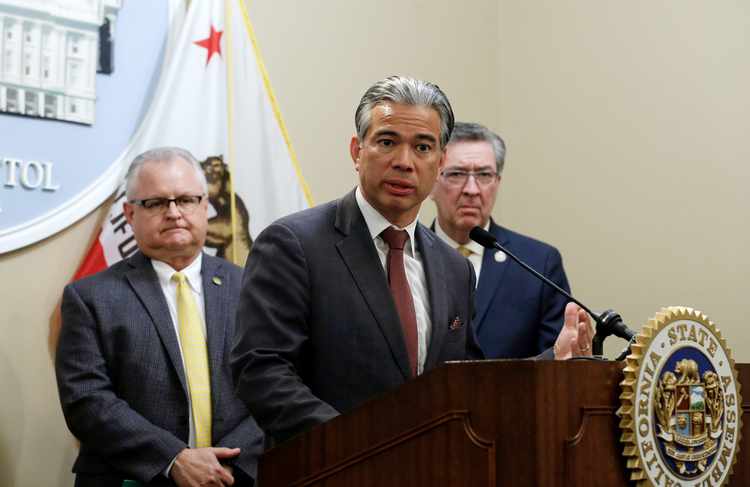
California’s proposed antitrust fix for Hollywood needs a rewrite. Attorney General Rob Bonta calls his demand that Paramount keep its movie studio separate from Warner Bros. a structural remedy. In practice, it would make courts and regulators permanent studio supervisors.
The dispute concerns Paramount Skydance’s proposed $81 billion acquisition of Warner Bros. Discovery, which California and 11 other states have sued to block. Theater owners spent months opposing the deal, but the largest chains changed course after Paramount offered enforceable commitments. AMC Entertainment CEO Adam Aron said the merger should be “welcomed and celebrated.” Regal, Cinemark, and Cinema United—whose members represent more than 31,000 U.S. screens—have since called for a settlement.
Cinema United hasn’t abandoned its concerns about consolidation. It wants a consent decree guaranteeing wide theatrical releases, meaningful periods of theatrical exclusivity, stable film-rental terms, and continued access to both studios’ catalogs and new releases. Paramount has separately offered major chains three-year contracts requiring 30 theatrical releases annually, a 45-day exclusive theatrical window, and a 90-day wait before streaming. The contracts would impose financial penalties if Paramount failed to meet its release commitment.
Bonta rejects such conduct remedies as inadequate. He reportedly wants Paramount to divest some cable channels and keep the two movie studios separate under common ownership. The first demand is structural. The second merely carries that label.
A structural remedy changes a company’s ownership by selling assets or breaking apart a business. A conduct remedy leaves ownership intact while restricting how the company operates. Selling cable channels would transfer their assets and profits to another owner. Requiring Paramount to operate two separate studios would leave the same parent company paying the bills, appointing executives, and collecting the profits.
Common ownership would therefore preserve the incentives that concern California, including the alleged incentive to release fewer movies or demand higher rental payments. The separation order would regulate how Paramount responds to those incentives without eliminating them.
Enforcement would require intrusive, day-to-day oversight. A court would have to determine how independent the studios must remain. Regulators could end up reviewing management appointments, budgets, marketing plans, distribution decisions, and even which projects each studio may pursue. Judges lack the information and expertise to run two movie studios.
Cable divestitures would avoid that problem, but California should require them only where the evidence shows a competitive overlap. Warner’s global linear-network revenue fell 13% on a currency-adjusted basis from 2024 to 2025, a decline of roughly $2.5 billion. Those channels still generate cash, but Comcast’s Versant spinoff, Warner’s proposed Discovery Global, and AMC Networks are pursuing buyers for similar assets. A court-ordered seller burdened by debt, a deadline, and mounting transaction costs would have little bargaining power. Buyers might get a bargain, but consumers shouldn’t expect lower cable bills.
The theater contracts present a far simpler enforcement problem. Economists rightly distrust conduct remedies that require agencies to police prices, product quality, or internal business decisions. Counting releases and measuring theatrical windows require no such judgment. Theater owners could document a violation and collect the agreed penalty without asking regulators to second-guess creative choices.
The U.S. Justice Department cleared the deal after an eight-month investigation covering streaming, linear television, and theatrical film distribution. The European Commission, Britain’s Competition and Markets Authority, and regulators in dozens of other countries also declined to block it. California may reach a different conclusion and seek divestiture on its own, but any remedy should address competitive harm the state can prove.
California also has leverage unrelated to the merits. Trial is set for March 2027, and Paramount owes Warner shareholders an additional $650 million for every quarter the deal remains open after Sept. 30. Each delay raises the price of resisting a settlement, regardless of what the evidence might show at trial.
Theater owners changed course when Paramount offered commitments they could enforce. Bonta shouldn’t trade those guardrails for a studio separation that would require endless supervision. Calling that remedy structural won’t make it so. It would merely become Hollywood’s longest-running production.