

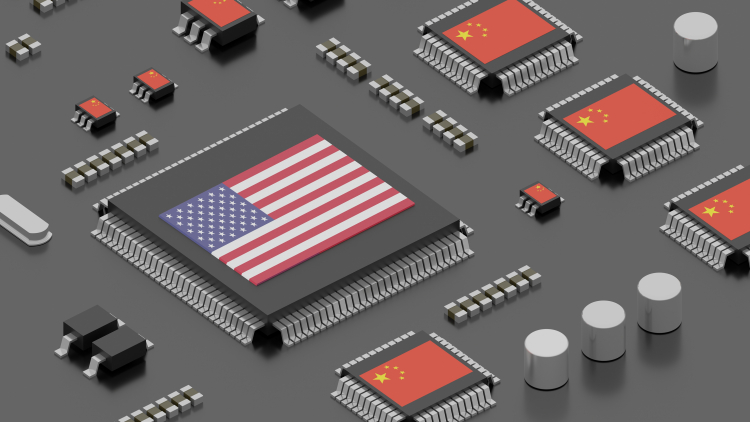
While the President is combating the widespread opposition to data centers and shouting their benefits from the rooftops–or as close as he can get with Truth Social–he is also considering imposing tariffs on semiconductors, a vital component to data centers and every other technological gadget in our lives.
Most Americans are well aware of the President’s proclivity for tariffs. He has unilaterally imposed trade restrictions on everything from soybeans to lumber to vehicles, using a variety of justifications and authorizations. Tariffs enacted through the International Emergency Economic Powers Act (IEEPA) were overturned by the Supreme Court earlier this year. The same could very well happen with the current use of Section 301 to apply tariffs.
While the roller coaster of tariff implementation, then quick reversal may seem unsettling, what’s worse is tariffs that are justified with national security concerns which can’t be challenged easily.
Tariffs imposed under Section 232 of the Trade Expansion Act of 1962, a law passed during the Kennedy Administration to, ironically, loosen trade restrictions, are likely much more resistant to legal scrutiny. Section 232 allows the President to use the ever ambiguous idea of “national security” to place tariffs to protect American interests. Other goods targeted with these national security tariffs include trumpets, upholstered sofas, and kitchen cabinets.
At the beginning of the year, President Trump used Section 232 to apply a 25% tariff to semiconductors entering the United States which will later be re-exported to other countries. While currently the tariffs are only narrowly applied, the President has made clear his intentions for a much wider reaching regime.
In a White House proclamation, President Trump outlined plans for the 25% tariff during a period of trade negotiations. Following negotiations, the President suggests the U.S. would adopt tariffs “at a rate of duty that is significant.” Reports from the White House suggest that this second phase could come sooner rather than later.
If the President does enter the second phase of his planned semiconductor tariff regime, prices will rise for consumers across the board. Semiconductors are used in the medical field, for broadband connections, to produce and transmit energy, and in every piece of consumer electronics.
Most relevant to conversations today, semiconductors are core components of data centers. The chips make up to 50% of the capital investment for building and operating a data center. Increasing tariffs on semiconductors and their inputs will make it prohibitively expensive to use cloud computing, streaming services, and other basic technologies fueled by this infrastructure.
The attack on semiconductors is another iteration of Trump’s attempts to reshore American jobs and industries. Reshoring and protectionism have been part of Trump’s policy portfolio since his first term but the push intensified during the second term. The “Liberation Day” fiasco is demonstrative of the more expansive use of tariffs against not just foreign adversaries but also our closest allies.
Whether or not one supports efforts to reshore industry, tariffs are failing to have the desired effect. Libertarian and free trade groups are long time opponents to tariffs, but even labor organizations are sounding the alarm over the failure of tariffs to achieve the desired effects. The pro-union Economic Policy Institute, trade associations like the Steel Tank Institute/Steel Plate Fabricators Association, and even the Reshoring Initiative, a group with the core mission of reshoring jobs, are reporting on how tariffs have yet to spur the industrial boom Trump wants.
All three organizations blame labor shortages for the failure of expanded industry to materialize. This is an issue in many industries where decades of free trade policies have allowed the majority of Americans to leave behind the harsh conditions and low pay of industrial and factory jobs like running sewing machines in sweatshops or standing on dangerous assembly lines. Few people are champing at the bit to go back to these occupations even if regulatory and wage laws made it possible. This is an issue that simply cannot be resolved with tariffs.
The Congressional Research Service cited shortages of workers for delays in construction and manufacturing at several U.S. sites. Taiwan-based Taiwan Semiconductor Manufacturing Company, a global leader in the industry, resorted to bringing specialized workers from Taiwan to staff its fabrication plant in Phoenix.
McKinsey noted that, in comparing semiconductor production in Taiwan to the United States, half of the cost difference is a result of labor costs. Taiwanese workers are willing to work longer hours and provide higher productivity all while being paid less than their American counterparts. Additionally, the McKinsey report showed construction costs, permitting, and lack of equipment and input materials as increasing costs or delaying new plants.
While workers can be trained or brought in from abroad, equipment and other inputs are harder problems to resolve. The United States has strengths in the global market share of some inputs for semiconductors like speciality gases, deposition tools, and CMP slurry, a specialized liquid for manufacturing, but Japan, South Korea, Taiwan, and the Netherlands dominate others.
For example, the Dutch company ASML has 100% control of the market for specialty extreme ultraviolet (EUV) lithography machines used for patterning wafers. In 2025, it only shipped 48 of the costly, highly technical, room-sized machines needed for EUV lithography. This market share is the result of an investment started in the 1990s on an experimental technology. Today, no other company is close to replicating ASML’s lithography techniques at commercial scale. Free trade allows manufacturers to bring this equipment to the U.S. much faster and cheaper than a policy based on tariffs and distant promises of reshoring.
The U.S. should focus on the parts of the supply chain in which we excel and work with allies who have their own strengths to fill in the gaps in the process of building semiconductors. Critics say that this international cooperation threatens our national security, primarily due to the possibility of a Chinese invasion of Taiwan. With most international observers citing 2027 as the point at which China will be militarily capable of invading the island nation, it is nigh impossible for the United States to be entirely independent in building semiconductors by this time.
Expanding tariffs on semiconductors won’t build up the missing half of the U.S. semiconductor industry. American manufacturing leaders have intentionally built out an intricate web of interlocking companies over decades to develop the most advanced technologies in human history. Cutting ourselves off from that network will increase costs for every American and push our allies away. In trying to address how semiconductors “pose a threat to national security”, the administration will undermine our international relationships and American technological superiority. If Secretary Lutnick and President Trump want to effectively counter Chinese influence and protect U.S. interests, they should lower the barriers for cutting edge technology to enter the country, not raise them.