

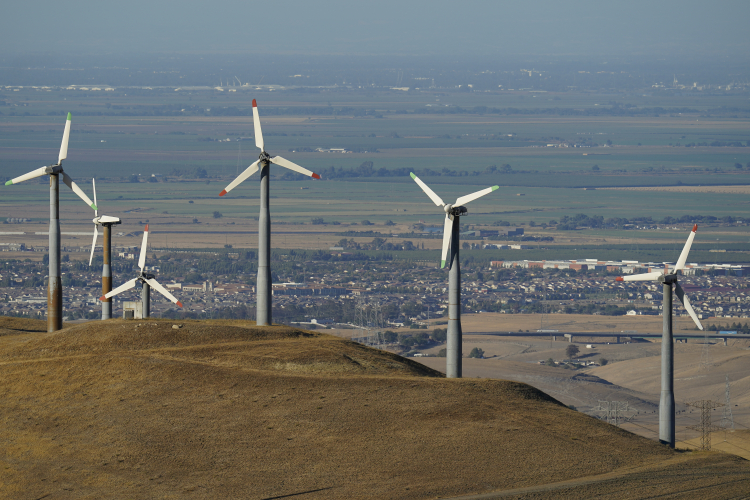
At a moment when America urgently needs more electricity, the federal government should be working to remove unnecessary barriers to new power generation. Instead, an under the radar breakdown at the Department of Defense (DoD) has effectively imposed a nationwide moratorium on new land-based wind power development.
This is not the result of legislation passed by Congress. It is not even the product of a new regulation with public notice and opportunity to comment. It has happened because DoD has stopped completing a review process that developers need before projects can move forward.
The consequences for American energy production, investment, and jobs are enormous.
For 15 years, the Military Aviation and Installation Assurance Siting Clearinghouse has reviewed proposed energy projects to determine whether they could interfere with military operations, including radar systems and aviation. Congress established the process on a bipartisan basis in 2011 to provide what DoD itself describes as a “timely, transparent, and repeatable process” for identifying potential conflicts and developing solutions.
That is a legitimate and important responsibility. National security must come first.
But reviewing projects for legitimate national-security concerns is very different from simply refusing to complete those reviews.
Beginning last year, DoD progressively stopped processing wind projects. It stopped finalizing mitigation agreements. It stopped providing developers with draft agreements. By this spring, meetings between developers and military officials to resolve project-specific concerns were being canceled. DoD even stopped doing preliminary reviews to determine whether a proposed project even posed a concern to DoD or not.
Because DoD's process is connected to the Federal Aviation Administration's (FAA) obstruction review, the consequences cascade across the permitting system. Without DoD completing its work, the FAA cannot issue the final determinations projects need. Without those determinations, developers are unable to complete state and local permitting, secure financing, and begin construction.
The New York Times brought national attention to the problem in May, reporting that more than 150 proposed wind projects had been stalled by Pentagon delays. The problem overwhelmingly affects projects on private land, which is exactly the sort of domestic energy development Washington should be encouraging.
Our latest analysis at the American Clean Power Association indicates that 310 wind projects currently frozen by DoD represent $157 billion in capital investment, and $210 billion in GDP over their construction and operation lifetimes. The projects would support over 336,000 jobs, spanning manufacturers, construction workers, and technicians, supporting hundreds of local economies across the country.
America’s electricity demand is rising rapidly as manufacturers expand domestic production, new data centers come online, and households electrify more of their daily lives. Preventing America from building new wind generation could add an estimated $361 billion to electricity system costs over the next 25 years.
Texas offers a particularly useful lesson. As the Dallas Morning News editorial board recently observed, wind and solar have been providing enormous amounts of electricity during the state's punishing summer heat. The question facing policymakers should not be which politically favored technology gets to generate electricity. It should be, how can America build enough reliable, affordable power to meet rapidly growing demand? Because if we do not increase energy supply to meet rising demand, it will be consumers across the country who will be forced to shoulder the burden of increasing electricity costs.
The underlying military issues are not new. The military, wind industry, and radar experts have understood the potential interaction between turbines and radar for nearly two decades. During that time, they have developed proven ways to address potential conflicts, including changes to turbine locations and layouts, software solutions, hardware upgrades, and operational agreements.
DoD has entered into at least 140 mitigation agreements with wind projects during the past decade. Roughly 20% were signed during President Trump's first administration. Presidents of both parties understood that when a proposed project raised a legitimate military concern, the answer was to identify the problem and solve it.
Despite this system working for years, DoD has not signed a mitigation agreement resolving concerns with a wind developer since August 2025. That does not mean the broader review process has stopped. DoD has continued processing other types of development, including power plants, electric transmission lines, oil and gas infrastructure, and telecommunications towers. Wind projects have been singled out and left in bureaucratic limbo.
Congress did not establish the Clearinghouse so bureaucrats could indefinitely put applications on a shelf. It established a process requiring government oversight to examine projects individually, determine whether an actual military-readiness problem exists and, when possible, work with developers to mitigate it.
A federal court recently reached the same conclusion, staying DoD's review freeze and ordering the Department to resume processing wind projects while litigation continues. Importantly, that ruling does not require the military to approve a single project that threatens national security. It simply requires the government to perform the reviews the law requires.
DoD should return to the project-by-project review process that protected military readiness while allowing billions of dollars in private American investment to move forward. National security and energy security are not competing goals. For years, the Clearinghouse proved we can protect both. It is time to make that process work again.