

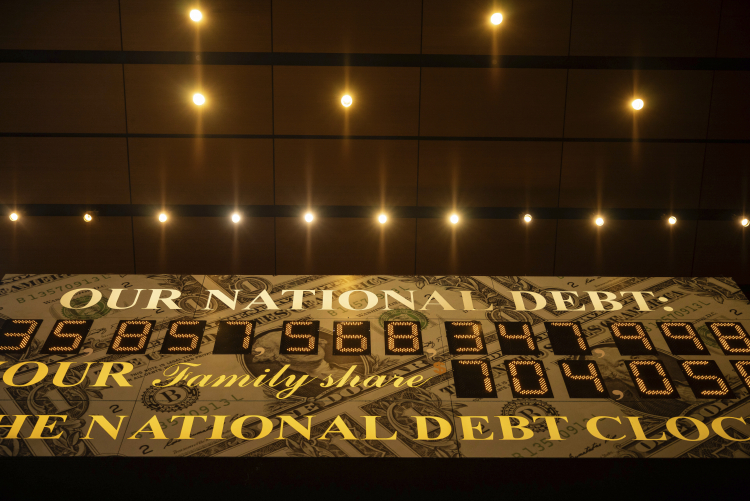
I’m pretty sure you recently heard that the national debt has crossed the $40 trillion mark. And now, we’re supposed to panic. Yes. The math says that every person in the U. S. owes the equivalent of about $120,000.
Take the customary moment to feel sick.
Pundits, economists, politicians, and experts galore have written articles and social media posts warning us that we cannot continue down this path.
But we’ve been on this path for decades. Perhaps some are too young to remember 1981 when Ronald Reagan warned us when the national debt crossed $1 trillion.
At the end of 1981, the market cap of the U.S. stock market was $1.3 trillion. Using data from the World Bank on the market cap of the U.S. stock market, it was 23% larger than the national debt at year-end 1981. At year-end 2025, it was 79% larger. These numbers imply that the stock market is almost $30 trillion larger than the national debt now. It was less than $250 billion larger in 1981.
They’ve been warning us ever since, and we haven’t collapsed.
There’s a reason for that.
When we hear the federal debt level it is never put in perspective. So-called experts often compare debt to GDP. Economists started telling us when debt-to-GDP hit about 80%, we’d have problems. It hit 80% in 2009. Then they told us when we hit 100%, we’d surely have problems. It did that in 2012. It has ben as high as 124% and is now around 122%.
Clearly the economists got it wrong. Perhaps they should make a prediction of when catastrophe will happen. If it doesn’t they have to shut up.
And there’s even more to the debt story. Of the $40 trillion of federal debt, less than $10 trillion is owed to outsiders, meaning foreigners.
And, of that $40 trillion, the federal government itself owns about $8 trillion. How can you count this portion of the federal debt that it owes to itself? But the scary economists do.
About $5 trillion is held by the Fed. How can you count this portion? The Fed needs this Treasury debt to carry out monetary policy. But the scary economists do.
The rest is owned by American entities: us.
So Americans plus the federal government plus the Federal Reserve fund three-fourths of our federal debt.
And never forget, Americans as well as foreigners do not hold public debt because we feel a need to help the government. We hold it because it’s a good investment. It’s a low-risk way to park cash and to balance the risk of portfolios invested in riskier assets.
And don’t forget that the foundation of issuing government debt is “the full faith and taxing power of the government.” “Full faith” means that the government is honest and intends to pay off the debt. “Taxing power’ means that if higher taxes are necessary to pay off the debt, then the government can raise the money. There is virtually no tax a representative government cannot create. We learned that when the Supreme Court ruled that the penalty for not having health insurance is a tax. We’re seeing it right now with the billionaires’ tax proposal in California.
And, consider how much national wealth backs up the debt in a manner similar to how much market cap a company has to support its debt. Latest estimates put that number at about $181 trillion.
But, some say, that is our money. The government cannot get to it. If that’s tru, then the government debt is not our debt. We do not each owe $120,000. So, why worry?
You can’t argue it both ways: we owe the money but our wealth is secure from government taxation.
We worry about it, because we ARE the government. What the government has, it got from the people. What it owes is owed by the people. “We the people” means something.
Less than a 6% one-time wealth tax would retire the debt we owe to foreigners. But, we wouldn’t need to pay back the $30 trillion we owe to ourselves. That would just be a wealth transfer among ourselves.
But, paying back the debt is unnecessary and would be a bad idea. As noted above, investors hold that debt for a purpose, which is not to help the government. Foreign investors hardly want that debt retired.
Does government waste our money? For sure. But the American economy is so productive, this waste barely makes a dent in it. The American economic engine is so powerful it can survive poor fiscal discipline and even thrive. There is nothing new today. The numbers are just bigger. But we are much bigger.