




President Trump’s focus on reshoring industry and putting American workers first is laying the foundation for a long-awaited manufacturing revival. His agenda is clear: rebuild the industrial might of our nation, cut dependence on foreign supply chains, and make America the world’s undisputed leader in production and commerce once again.
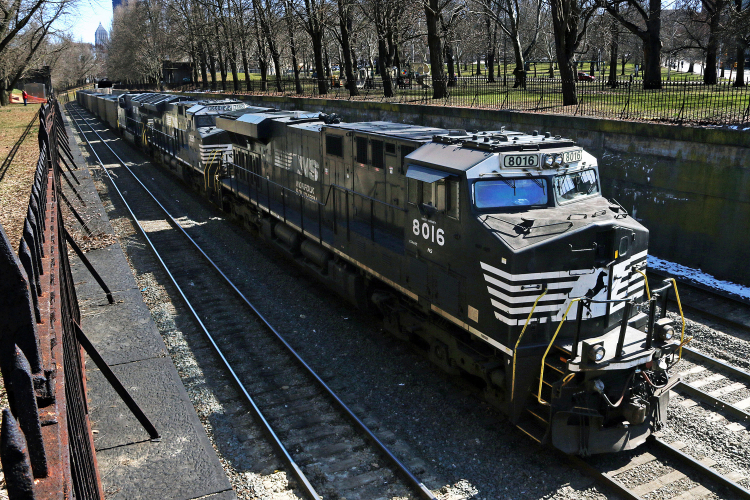
To achieve this, America needs not only new factories, but also the modern infrastructure to connect them and to quickly move goods between them. The proposed merger of Union Pacific and Norfolk Southern, two of the nation’s largest railroad operators, is a critical step toward bolstering our domestic infrastructure to support the manufacturing revival.
The combined network would stretch from coast to coast, simplifying cross-country shipping, reducing costly delays, and strengthening the supply chains that feed our farms, power plants, factories, and retailers. For key industries like agriculture, steel, energy, and consumer goods, a unified rail system means faster delivery times, lower costs, and more reliability. That translates directly into lower prices for American families and more competitive conditions for American businesses.
For decades, American manufacturers have been forced to rely on disjointed rail connections where freight must switch from one operator to another at congested interchanges, where railcars can remain halted for days. Each delay adds costs and uncertainty. By eliminating these bottlenecks, a transcontinental American railroad would dramatically cut waste, improve efficiency, and get products to market at the speed demanded by tomorrow’s economy.
The merger brings our country closer to the America First vision. President Trump has rightly emphasized that a strong industrial base depends on strong infrastructure. Just as Pres. Lincoln’s transcontinental railroad in the 19th century unified the country and unlocked a new era of growth, this 21st century version will supercharge the new industrial revolution already underway under Pres. Trump’s leadership.
Before the companies can consecrate the merger and deliver on those benefits, regulators at the Surface Transportation Board (STB) must sign off. In the coming months, Union Pacific and Norfolk Southern will need to prove to the STB that the merger is in the public interest. It is, and the STB should move quickly to approve it.
At a time when global competitors are racing to dominate supply chains, America cannot afford to fall behind. China has invested billions in its “Belt and Road” initiative to control international logistics, and Canada already boasts its own transcontinental railroad. Approving this merger will ensure that America, not foreign rivals, leads in moving goods across our own land.
It’s no surprise that Canadian Pacific Kansas City (CPKC), which already operates a Canadian transcontinental system, has been among the first to criticize the Union Pacific-Norfolk Southern merger. CPKC understands that an American transcontinental competitor would take freight volume back from foreign operators and put it where it belongs – on American rails, moved by American workers, serving American communities.
Critics claim this merger could cause problems, but the truth is that opposition is often driven by self-interest, not concern for American consumers. Canadian competitors want to keep their advantage. The STB should see through this and act swiftly to approve a deal that benefits the United States above all.
Dave Fellon, owner of Progressive Rail Inc., put it well: “Today’s business environment demands precision efficiency, real-time supply chain solutions, and a speed-to-market tempo that counts seconds, not days. By design, the UP–NS combination will deliver all of that—reviving American manufacturing, creating high-quality careers, and using commerce as a powerful conduit to connect people like never before.”
This is a moment to think big. Just as Pres. Lincoln’s transcontinental railroad was a defining achievement of American ambition, this merger could mark a turning point for America’s new industrial era. If we are serious about reshoring jobs, cutting costs, and competing with the rest of the world, then building an American-owned transcontinental railroad should be at the top of the list.
