




Donald Trump calls tariffs “the most beautiful word in the English language.” That alone in and all by itself ought to establish him beyond doubt as belonging in the loony bin of economics. Trade is necessarily mutually beneficial at least in the ex ante sense and almost always ex post as well.
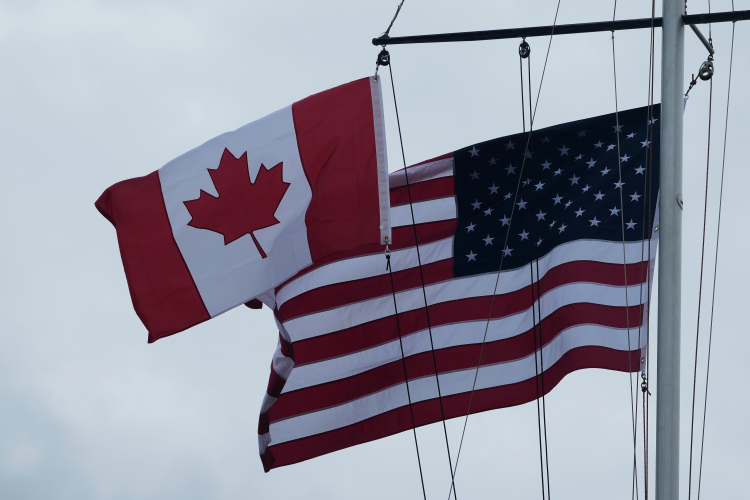
Trump has recently gone berserk with his tariff threats. How should Canada react? Before I get to that, let me just say that Doug Ford, the Ontario Premier, was entirely justified in stuffing down Trump’s throat the undeniable fact that Ronald Reagan opposed tariffs.
There are four and only four realistic options (I rule out physically attacking the U.S. over this imbecilic action of their government).
One, do nothing, stand pat, ignore this latest moronic display of economic ignorance. Two, raise its tariff levels against the U.S.; Trump threatens that if Canada does just that, he will reciprocate, and then both countries will be off to the races with a real trade war. Three, lower the barriers to trade with the U.S. that Canada has previously enacted. Four, eliminate them entirely.
Before answering, consider the following. There are two men in a wooden rowboat, and one of them shoots a hole in the bottom of this vessel. The water starts to seep in. If the saner of the two of them wants to maximize utility, should he shoot a second hole in the boat, allowing even more water to enter?
The answer is yes and no. (Where oh where are we going to get a two handed economist, who doesn’t say on the one hand this, on the other hand that? Not here, thank you very much). The “no” answer is obvious. If the boat takes in too much water, it will capsize, and both passengers will drown. What about “yes”? This too, can be defended. If the second man thinks that his maniacal fellow passenger will keep shooting holes in the boat unless he does so, then a second hole is justified. Better that than turning the bottom of this conveyance into a veritable Swiss cheese.
Sorry, there is no clear answer emanating from the discipline of economics to this query. It is, rather, a matter of strategy and tactics. If Canada thinks that a trade war, shooting a second hole in the boat will bring Trump to his feeble senses, then, yes, shoot a second hold by all means; engage in a trade war with this nutcase. My own gut feeling is that this is a bad strategy, so I recommend against the second option. Not all bullies are also cowards, and I think this applies to the present President of the U.S. who is a lunatic on this issue.
What about the first option, doing nothing? Should we let the intimidator get his way? All I can say in favor of this choice is that it beats an escalation of tariffs. No more “taking off the gloves” and fighting this fanatic.
No, I have not entirely lost my marbles. The case for full free trade is virtually an article of faith among economists. It is based upon a long history of empirical evidence and irrefutable logic. (For a hint of the latter, see Smith and Jones above). If Canada wants to be the proverbial adult in the room, then it should start acting like one. What better way to embarrass Trump than by eliminating all tariffs, not only against the U.S., but which impact any nation on the planet.
And for goodness sakes, while we are on the subject, eliminate all intra Canadian tariffs forthwith, and sow salt where once they stood. They make Canada a laughing stock. One of the reasons the U.S. is so prosperous (Canadian per capita GDP is lower than most U.S. states; if inducted into the U.S., Ontario would be fifth-poorest, Quebec the second-poorest, U.S. state) is because the country to the south of us boasts a gigantic free trade area. There is no tariff interfering with trade between California and Florida, between Louisiana and Montana, no between any other U.S. states.
