




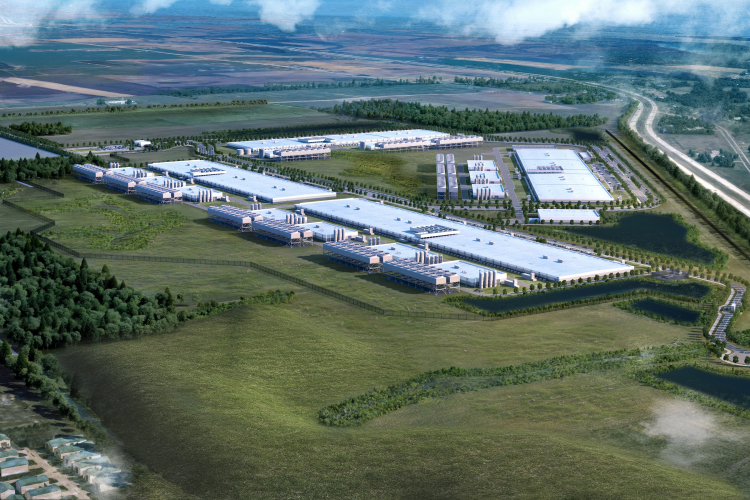
From silly memes to cutting-edge scientific research, artificial intelligence (AI) is intricately linked to American life. However, this emerging technology is nothing without the data centers that house the infrastructure needed to deploy AI applications. And thanks in part to misguided activism and historically high land values, companies relying on data centers are facing an increasingly-hard time finding viable land for their operations.
A recent analysis by real-estate investment management firm Hines found that the world will need about 40,000 new acres of land (or almost 2 billion square feet) to meet growing demand for AI services. To continue being a leader in AI deployment, America will need to contribute about 25,000 new acres worth of land—or almost two Manhattans—for these power-intensive operations.
Fortunately, the federal government has already begun identifying underused agency-owned lands that it could sell or lease to data center operations. But a far larger effort is needed to gear government-held land toward more productive uses. By doing a little downsizing, Washington, D.C. can help power an AI revolution.
One agency that could lead this effort is the National Aeronautics and Space Administration (NASA), the one who helped drive America’s last technological revolution. NASA maintains several large campuses not primarily used for data infrastructure but that nonetheless have substantial power and network capabilities that could conceivably host data centers. Part of NASA’s Glenn Research Center in Ohio, the Neil Armstrong Test Facility spans about 6,400 acres and was originally developed for nuclear and rocket testing. Today, only a handful of its test facilities are actively used, and a 2015 NASA Inspector General (IG) report found that all but one of the major test facilities there had few or no customers. The vast contiguous acreage and existing utility hookups could be repurposed for a secure data center campus, and high-bandwidth connectivity could likely be established without great difficulty.
Even less technologically focused agencies could play a key role in federal land divestment efforts. The Department of Veterans Affairs (VA) has medical centers and campuses nationwide, often in or near urban areas. Some encompass hundreds of acres with their own power and communications infrastructure to support hospital operations. A case in point is the West Los Angeles (WLA) VA Medical Center campus, which spans a sprawling 388 acres in a prime area of Los Angeles. Historically, much of this VA property has been woefully underused. In a 2023 lawsuit, a group of veterans noted there are “more than 100 buildings on the WLA campus, many vacant, closed or underutilized, as well as acres of available land.” Surely, the federal government could sell or lease this land and use the proceeds to fund veteran housing and access to comparable or even better private healthcare.
Then there’s the U.S. Postal Service (USPS) which owns 8,500 properties (including about 7,200 post offices) totaling an astounding 20,000 acres of land. What the USPS does not have is a lot of money. The struggling agency lost more than $9.5 billion in fiscal year 2024, and has accumulated more than $100 billion in red ink over the past fifteen years. Selling underused land to high-valued operations such as data centers would cement American AI leadership while delivering the USPS out of debt.
The USPS is sitting on thousands of acres of land it does not need. Post offices of course provide a valuable function to the millions of Americans that need their mail delivered every day. But it doesn’t follow that there needs to be dedicated brick-and-mortar post offices with an army of federal employees serving consumers. The USPS can sell its real estate and save a significant sum on labor and maintenance costs by outsourcing “window” operations (e.g., stamp sales, package hand-offs) to private retailers. The USPS currently has about 2,500 “alternative retail access points” in which private retailers take the lead on postal operations.
The IG notes though that “these locations have declined by nearly 20 percent in recent years” and closures have been especially significant recently (possibly because of DOGE). The USPS can save money by reversing course and expanding retail contracts, but it needs to tweak its current model. According to the IG, most of these locations are paid fixed sums to provide services, and payouts aren’t closely monitored to ensure that the locations are serving consumers. Instead, the USPS should switch to a commission-based model to make sure that taxpayer dollars aren’t being wasted on seldom-used locations. With this reform, the USPS can successfully partner with private retailers while selling many of its post offices to higher-value uses such as data centers.
The federal government has a large part to play in driving AI deployment. But that role is not through subsidies nor onerous regulations. It’s through unwinding its massive real estate portfolio and giving data center operations room to grow. The right policies can fuel not-so-artificial prosperity.
