




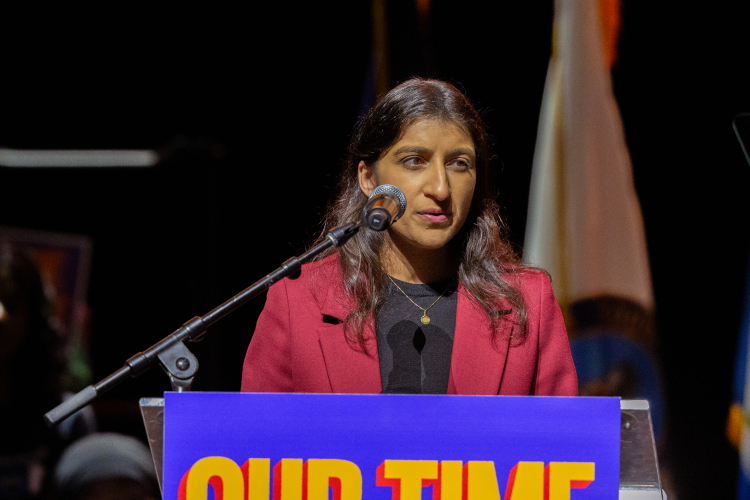
Investment professionals who work on Wall Street may be in need of grief counseling—or at least a hug and a strong drink—as they try to cope with the fallout from November’s New York City mayoral election. It is not just that self-proclaimed democratic socialist Zohran Mamdani will soon occupy the Mayor’s office; it is also that he appointed former Federal Trade Commission (FTC) Chair Lina Khan to his transition team. Khan’s tenure at the FTC was marked by the abandonment of the “consumer welfare standard,” which judges a business's actions by how they affect consumers—which is the way businesses succeed or fail in the free market.
The consumer welfare standard guided antitrust policy from the Reagan years until the Biden presidency. Khan and her allies replaced it with a throwback to the “big is de facto bad” approach to antitrust policy. Khan also promoted what she called “holistic” antitrust which justified government intervention to stop—or at least delay—almost every merger, acquisition, or other business action that would have increased a company's market share, regardless of the impact on consumers.
During Khan's tenure as FTC Chair, the agency filed a record number of challenges to mergers, with a particular focus on the threat of “big tech.” Khan’s war against successful businesses made her a progressive superstar and public enemy number one among free-market conservatives, as well as centrist Democrats and the business community. For example, CNBC commentator and financial advisor Jim Cramer called Khan a “one woman wrecking crew.” Now, Khan will be influencing policy in the financial capital of the world.
Khan, speaking at a Pod Save America event, said that her work in the transition team was focusing on things like taking a full accounting of all of the laws and authorities that the mayor can unilaterally deploy. Reviewing rarely used laws was something Khan did while running the FTC. For instance, under her leadership, the FTC renewed its practice of sending “notices of penalty offenses.” These notices are sent to warn companies that they might be violating antitrust law. Until Khan's appointment, the FTC had not sent any such notices since 1999. During Khan’s tenure, the FTC issued thousands of them.
Khan also revived the Robinson-Patman Act. This New Deal-era law makes it illegal for distributors to offer discounts to large retailers like Wal-Mart or Costco if they do not offer the same discounts to smaller stores. The law ignores the fact that distributors can make more money by selling a higher volume of products at lower prices through Wal-Mart than they can selling fewer products at higher prices in a smaller store. Khan also sought to dramatically expand the FTC’s reach by refocusing the agency’s mandate to protect consumers from “unfair” business practices. An unfair standard is obviously subjective and thus could be used to second guess almost any decision a private business might make.
Khan may have discovered an equivalent in New York City— a 56-year old law giving city officials power to punish “unconscionable” acts. One obvious problem with this statute is that, like the FTC’s mandate to protect consumers from “unfair” practices, what is “unconscionable” is in the eye of the beholder. This is likely one reason that the law has been collecting dust. Now, Khan wants Mayor-elect Mamdani to use it to unleash a regulatory reign of terror. The result will be higher prices, fewer choices, and a declining quality of life in New York City. Hopefully, this will help the more sensible voices in the Democratic party win the debate over whether the party should embrace a more market-friendly approach to policy—or move in the direction of the Khan-Mamdani-AOC wing. Even better, it may dissuade those elements of the “post liberal” right who see Khan as a model for how the right can use antitrust policy to advance a conservative agenda. A prominent example of what happens when Khan’s policies are put in place may finally show them that “Khanservatism” is not the way to make America Great Again.
