




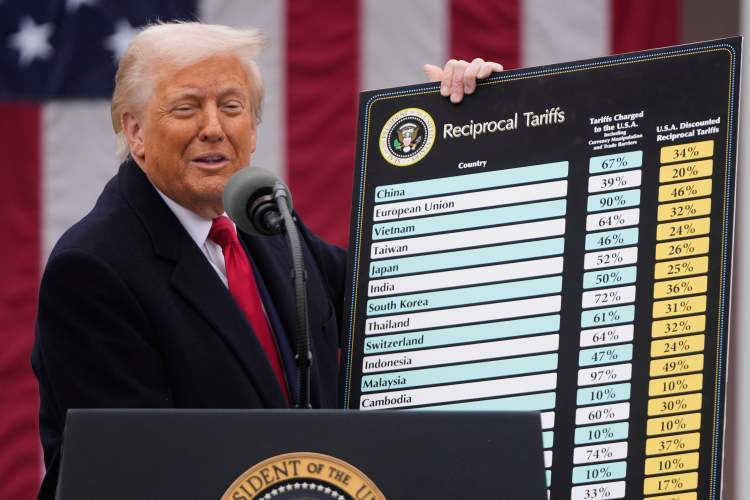
“Ten percent!” “Eighteen percent!” “Thirty-nine percent!” President Trump spells out his trade policy like an auctioneer, leading many in the media to focus on his broad reciprocal tariff rates when trying to follow his economic policies.
Analysts point out that President Trump’s tariffs are the highest the country has levied since the Great Depression, but here’s an important detail in his tariffs that often goes unnoticed: they’re full of holes. Many products have been exempted from tariffs due to national security and price concerns. Such exemptions have been described by United States Trade Representative Jamieson Greer as “swiss cheese.”
Examples are plentiful. President Trump recently declared coffee and meat exempt from his sweeping 50% tariffs on Brazil, after exempting many household food items about a week earlier from broader tariffs. Steep 25% tariffs levied on Kazakhstan exclude oil, uranium, and more, leaving only 5% of Kazakh goods subject to the rate. This pattern represents more than just a recent retreat from broad tariffs. Ever since April, critical electronics and oil have either been exempt or faced significantly lower rates than other products.
If Trump’s tariffs are the miracle elixir he sells them as, why exempt critical products and household items? It's complicated.
We can learn a great deal about the Trump team’s methods and motivations by looking at which goods are exempted and why. The fact that the President’s signature economic policy is filled with carve-outs meant to lessen their impact is indicative of divisions and contradictions between varying goals of the Trump administration and its economic team.
The first principle we learn about Trump’s tariffs is that they represent an attempt to do the impossible: implement a broad tariff regime to bring production back to the U.S. and raise revenues without raising prices for consumers. Trump won the presidency at least partially due to the runaway 20% total inflation that took place under the Biden administration. He and his team know that inflationary policies could prove politically suicidal. Frustration over prices contributed to Republican losses in the most recent round of local elections.
This is almost certainly a reason why the president’s most recent round of tariff exemptions include household items such as fruit, nuts, beef and coffee. Concerns over the burden on industry also led the White House to exempt raw and refined copper materials from broad copper tariffs. For all the partisan bluster over how the experts “got it wrong,”the Trump administration seems to heed the advice of experts on tariffs more than they let on.
These exemptions may stem from the conflict between keeping inflation under control and implementing Trump’s tariffs. The reason tariffs work in protecting domestic industry is because they raise the prices of foreign goods, allowing domestic firms to sell at higher prices and operate at a profit. A tariff regime that attempts to protect domestic industries without raising prices will inevitably run into conflict and result in policies full of exemptions and loopholes.
Another reason we see “swiss cheese” tariffs may very well be disagreement over their impact within the Trump team. It’s true that the President’s team of top economic officials includes staunch protectionists like Peter Navarro, but it also includes those with more conventional economic views like Scott Bessent. This team has been described as a divided “team of rivals,” especially after some took advantage of Navarro’s absence from the White House to push for a tariff pause in April. A team composed of both tariff hawks and more free-market Republicans will likely lead to a more restrained tariff regime.
The complicated nature of Trump’s trade policy doesn’t make things easy on businesses and individuals who rely on the global trade system. The fact that new carve-outs and exemptions are constantly being negotiated and rescinded contributes to the economic uncertainty that has hindered investment and the economy more broadly.
It’s also important to consider the legal headwinds that the President’s tariff policies have faced recently. If the Supreme Court rules against the broad use of the International Economic Emergency Powers Act (IEEPA) to impose sweeping tariffs across entire countries, the President will likely resort to trade rules like section 232 of the Trade Expansion Act of 1962 and section 301 of the Trade Act of 1974.
These laws are used to levy goods on specific items and industries rather than increase general tariff rates. If tariffs right now resemble swiss cheese that covers an entire slice of bread, albeit with holes, these tariffs would look like bits of shredded cheese scattered all over the sandwich. Navigating Trump’s trade policy will become even more of a headache.
Trump's Tariffs Represent An Attempt to Achieve the Impossible
December 11, 2025
Comment
Show comments
Hide Comments
