




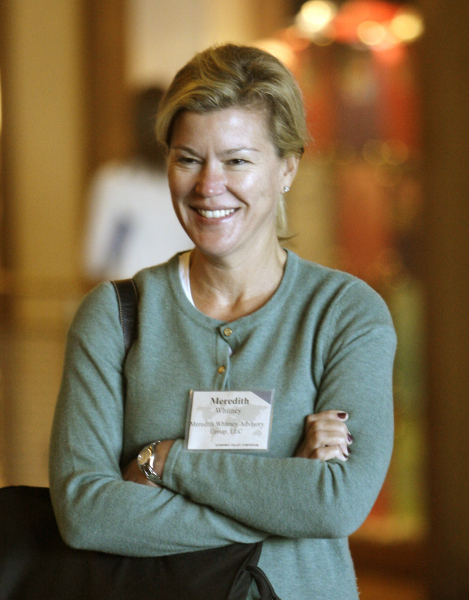
It’s late October 2007 at Oppenheimer & Co. in New York. Trading screens flicker green and red as brokers bark into phones between sips of scalding black coffee. The market is hot — no time to let anything cool down. Meredith Whitney, a thirty-seven-year-old analyst with a coroner’s eye for balance-sheet anomalies, is finishing a report on Citigroup. Trillions in assets span more than a hundred countries, with a market value that only months earlier sat in the hundreds of billions. The numbers look invincible. And that’s usually when Whitney finds trouble.
In doing her number crunching, she stumbled onto something elementary — so elementary it should have embarrassed every other analyst on Wall Street. Citigroup’s dividend was greater than its profit. How does that happen, she asked herself. How does a bank pay out more to shareholders than it’s earning? That doesn’t sound like a business model. It sounds like a countdown.
“I’ve always loved research,” Whitney said later. “I’ve always loved digging into things and breaking things down.” But what she did at Oppenheimer wasn’t complicated, although no one else saw it at the time. She looked at the cash flows — the holy grail of Wall Street analysts — what was coming in and what was going out. When the two didn’t match, she asked why. In fact, she asked it five times.
- Why couldn’t Citi cover its dividend? Because write-downs were eating into earnings.
- Why were write-downs so large? Because the mortgage securities on its books were worth far less than their face value.
- Why were they worth less? Because the underlying loans were going bad at an accelerating rate.
- Why were the loans going bad? Because they’d been made to people who couldn’t repay them — and the underwriting standards had collapsed.
- Why had the standards collapsed? Because everyone in the chain — originators, packagers, raters, buyers — got paid to say yes and never got paid to ask why.
Five “why” questions. That’s all it took to see that the emperor had no clothes. Whitney’s fifty-two-page report said it plainly: cut the price target from $55 to the low $30s, warn of at least $11 billion in write-downs, predict a dividend cut and asset sales to raise capital.
Then holy hell broke loose.
Wall Street read the report in private clubs and fashionable hangouts and coughed. The old guard — masters of the universe in pinstripes who’d ridden the housing boom — dismissed her as an upstart, a “junior analyst” with “alarmist” math. Death threats hit her inbox. Colleagues whispered she was “ruining the party.” On television, Jim Cramer mocked her as a “serial killer” of bank stocks and urged viewers to buy Citi on the dip.
The rebuttals came in neat rows of mansplaining. Bear Stearns’ David Hilder called capital worries “overstated.” Bank of America’s John McDonald said a dividend cut was “extreme at this point.” Buckingham Research waved off her $30 billion capital-needs math as inflated. Inside Citi, executives projected indifference. Months earlier, Fed chair Ben Bernanke had told Congress that subprime risks were “contained.”
Whitney didn’t blink.
Her sister Wendy later told a reporter that Meredith had always been “something of a happy provocateur — arguing with her teachers about school assignments, browbeating her parents into letting her have a paper route at the tender age of eight.” At Oppenheimer, that stubbornness had a different name: rigor. Models needed to survive grueling cross-examination, not lunch-table banter. If a model broke, you didn’t soften the conclusion — you rebuilt your argument from scratch.
A Fortune magazine writer who profiled Whitney put it simply: “There are no shades of truth with her.”
Then the calendar performed the coup de grâce.
November 1, 2007: the report hits at dawn. Citi falls roughly 7 percent in a day — about $15 billion in market value gone.
November 4: CEO Chuck Prince resigns.
November 27: Abu Dhabi Investment Authority invests $7.5 billion in Citi.
January 2008: Citi announces $18 billion in write-downs, slashes its dividend by 41 percent, and raises more than $10 billion in additional capital.
The tally kept climbing. Within eighteen months, Citigroup’s stock had fallen 95 percent from its peak. The bank that was too big to fail nearly did.
Think about what happened. A thirty-seven-year-old analyst at a mid-tier firm asked five questions that the CEOs, regulators, and Nobel-winning economists had stopped asking. She didn’t have better data or any inside information. She just refused to accept the first answer and kept asking why.
Michael Lewis, who called Whitney while researching what would become The Big Short, captured what made her analysis so dangerous to the established order: “This woman wasn’t saying that Wall Street bankers were corrupt. She was saying that they were stupid.”
This isn’t a Cassandra tale. Whitney didn’t see the future. She just asked the questions others had stopped asking. And that discipline — the habit of asking why until you hit bedrock — didn’t come from nowhere. It came from a mentor.
When Whitney arrived on Wall Street in 1994, fresh from Brown University’s English department, she didn’t even know research existed as a job. She landed at Oppenheimer almost by accident. But then she had what she called “the most incredible piece of luck”: she was trained by a man who helped her establish not merely a career but a worldview. His name was Steve Eisman.
If you’ve read The Big Short, you already know that Eisman (played by Steve Carell in the movie) was loud, abrasive, and relentless. He’d built his reputation in the early 1990s covering subprime lenders — the same lenders whose descendants would blow up the global economy fifteen years later. He taught Whitney to distrust the rosy story that management wanted to tell, to follow the cash, and above all, to keep asking why until the math either footed or failed.
“A lot of people don’t get Steve,” Whitney told Lewis. “But the people who get him love him.”
What Eisman gave her wasn’t a formula. It was a culture — a way of being in a room where the obvious answer is never good enough. At Oppenheimer, that culture had a name: the research pod. A small world where the right question mattered more than the comfortable answer. This is what teams do when they work: they build rooms where inquiry is safe.
The discipline Whitney learned goes further back than Wall Street. To see where it came from, you’ll have to head over to the 1950s, to a noisy auto plant in Japan where a wiry engineer refused the first answer.
Toyota was still an underdog. Fresh from wartime ruin, it was building tens of thousands of vehicles while General Motors made more than four million. Outside Japan, Toyota was barely a rumor. At Motomachi — Toyota City, Aichi Prefecture — the acrid smell of welding hung in the air. Workers in starched uniforms moved cars down the track. One day, a welding robot seized; the hydraulic arm locked mid-weld. The line stopped. Minutes — and yen — bled away.
All eyes went to Taiichi Ohno, the loom-mechanic-turned-production chief who had joined in 1932. No patch, no scapegoat. He gathered the team and started asking questions. In an almost hushed voice that his listeners had to lean in to hear, he spoke five simple why questions. The first one was simple, the kind smart people roll their eyes at. The answer led to another. And another. Eyes stopped rolling by that point.
- Why did the robot stop? Because a fuse blew — the circuit overloaded.
- Why did the circuit overload? Because the bearings overheated from friction.
- Why did they overheat? Because oil wasn’t circulating properly.
- Why wasn’t it circulating? Because the pump shaft was worn and wobbling.
- Why was the shaft worn? Because metal filings had slipped in — there was no strainer on the intake.
Ten minutes is all it took. A strainer went in. The robot restarted. The standard changed so the failure wouldn’t repeat. Ohno later wrote it up in Toyota Production System: “Ask ‘why’ five times about everything that matters.”
The ‘Five Whys’ lesson wasn’t about cleverness. It was about culture. Too few whys and you get a bandage. Too many and you get theater. Five keeps you honest. And over time, that discipline — the habit of PQ or persistent questioning — became the foundation of what Toyota called kaizen: continuous improvement. But don’t sell it short by thinking of it as a program. It’s better off being part of your way of life.
What Whitney did with Citigroup’s balance sheet was the same thing Ohno did with that welding robot. She refused the first answer. She followed the thread until she hit the root.
- Why can’t Citi cover its dividend? Because the mortgage assets are worth less than they’re claiming.
- Why are they worth less? Because the loans are defaulting.
- Why are they defaulting? Because they were bad loans from the start.
- Why were they made? Because everyone in the chain got paid to close, not to question.
- Why did no one stop it? Because the room went quiet.
That’s the lesson for all of us playing the home version. Big systems fail when small rooms go quiet — when the people closest to the problem stop asking why because the answer might be uncomfortable, or expensive, or career-ending.
In Whitney’s small world — the Oppenheimer research pod built to ask impolite questions — the habit of inquiry was normal. In the big world — the TV studio, the hearing room, the corner office — the room often goes quiet. The pundit got the laugh line. The CEO got one more quarter. The market got the bill.
In 2007, and before Whiteny laid out the challenges facing Citigroup, its CEO was optimistic. Chuck Prince famously quipped, “As long as the music is playing, you’ve got to get up and dance.”
That’s not really stupidity. Prince was a brilliant corporate lawyer. But intelligence doesn’t matter when it meets culture — a set of unwritten rules that tell people what questions are safe to ask and which ones get you laughed out of the room. Prince heard the music. Whitney heard the silence underneath it.
She broke the rules. So did Ohno, in a different industry, in a different decade, on the other side of the world. They both understood something that most organizations forget: the quality of your answers depends entirely on the quality of your questions.
“Ask ‘why’ five times about everything that matters,” Ohno wrote. On factory floors, it kept robots from freezing. In finance, it could have moved firms from crash to cruise.
Whitney didn’t have a crystal ball. She had a habit and that habit is portable. You can take it from a Toyota factory floor to a Wall Street trading desk, from a platoon hut to a boardroom. The only requirement is a room where honest questions are rewarded, not punished. Build that room in your office, in your community, in your home, and you don’t just fix today’s mess. You prepare for tomorrow’s.
