




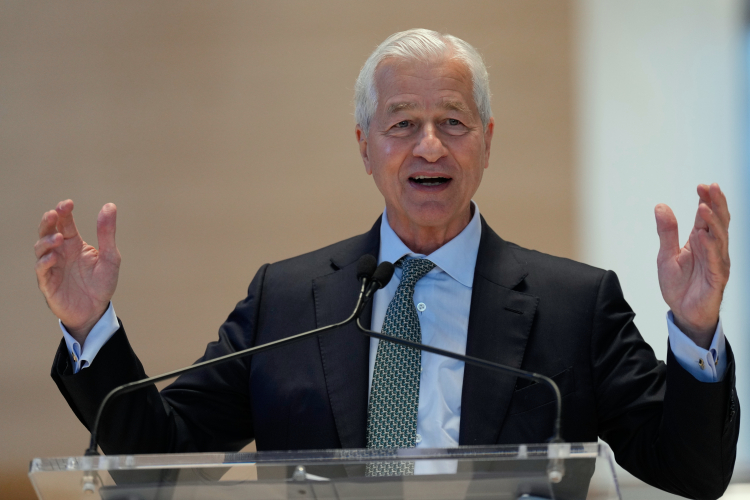
Jamie Dimon’s warning about Europe’s dwindling competitiveness was entirely accurate. It would have been even more so had he singled out the primary reason: Europe’s adherence to the Paris Climate Agreement.
Recently at the Reagan National Defense Forum, JPMorgan CEO Jamie Dimon delivered a hard truth to Europe. “They’ve gone from 90% of the GDP of America to 65. That’s not because America did anything bad to them. It’s their own bureaucracy, their own cost… They do some wonderful things on their safety nets, but they’ve driven business out, they’ve driven investment out, they’ve driven innovation out.”
This is not the first time that Dimon has delivered this message. Earlier this summer in Dublin he also mentioned Europe’s GDP shrinking from 90% to 65% of America’s, but he also added a telling timeline for the relative decline: “over 10-15 years.”
As Dimon concluded this summer, “that’s not good.” No, it’s not. However, it is extremely important because it also overlaps with the 2015 Paris Agreement. “A legally binding international treaty on climate change; it was adopted by 195 Parties at the UN Climate Change Conference (COP21) in Paris, France, on 12 December 2015. It entered into force on 4 November 2016.”
The Agreement aimed at draconian control of global temperature: Hold global average temperatures’ increase to “well below 2 degrees Celsius above pre-industrial levels” and take steps “to limit the temperature increase to 1.5 degrees Celsius above pre-industrial levels.” To reach its latter goal, the Agreement stated “greenhouse gas emissions must peak before 2025 at the latest and decline 43% by 2030.”
Nowhere has the “bureaucracy” Dimon mentioned been more damaging to Europe than in its efforts to adhere to the Paris Agreement. The European Parliament states: “The EU aims to reduce greenhouse gas emissions by 55% compared to 1990 by 2030 and to become climate neutral by 2050. These targets became legally binding with the adoption of the EU climate law in 2021 as part of the European Green Deal.”
The effect of this adherence has been to shift Europe to more expensive “green” energy. Of course, energy is a prime cost component in virtually everything. The collateral impact of this pervasive increased cost component has been twofold.
With its advanced economies, Europe is already high-cost producer in a global context. Unilaterally increasing its cost of production further only makes it less competitive internationally: Increasing its exports’ costs and making imports comparatively cheaper. As an example, from 2019 to 2023, industrial power prices grew 124 percent in the U.K. and 123 percent in Ireland compared to just 21 percent in the U.S.
Internally, Europe’s “green” steps increase prices for its citizens, lowering living standards. In 2025’s Q3, household electricity prices were 40 cents per kilowatt-hour or higher in Ireland, Italy, Germany, Belgium, and the U.K.; in the U.S. the price was 18 cents per kilowatt-hour. In China, which produces most of its electricity from coal (62 percent in 2024), the price was 8 cents per kilowatt-hour.
Certainly, Europe has other examples of bureaucratic sclerosis but no single one can match what it has done to itself regarding energy in pursuit of Paris Agreement adherence.
Earlier this year, Bill Gates gave voice to reasoned sanity on climate change. In response to what he called the “doomsday view of climate change,” Gates stated: “Fortunately for all of us, this view is wrong. Although climate change will have serious consequences—particularly for people in the poorest countries—it will not lead to humanity’s demise. People will be able to live and thrive in most places on Earth for the foreseeable future. Emissions projections have gone down, and with the right policies and investments, innovation will allow us to drive emissions down much further.”
The key word in both Dimon’s and Gates’ statements is “innovation.” The world demands it. The problems the world faces, including climate change, demand it. And this innovation demands energy: to propel the developing world forward and to fuel the AI revolution that offers unimagined prospects for “innovation” and solutions.
We can only hope, for Europeans’ sake, that their governments are listening to what Dimon and Gates have said.
