




Bill Dally dropped out of high school. Something about history class. He didn’t want to sit through it.
Dally subsequently went to work as an auto mechanic, though high test scores eventually secured him admission to Virginia Tech despite him having not received a high school diploma. A master’s degree from Stanford followed, and after that a PhD from CalTech. A tenured professor at MIT by his early thirties, Dally is now Chief Scientist and Senior Vice President of Research at Nvidia.
Dally’s career path amid yet another periodic convulsion on the American right about education is worth thinking about. While anecdote shouldn’t ever be confused for statistic, Dally’s rise from dropout to mechanic to academic to “Bald, fit, quick-talking, and obviously brilliant” (Stephen Witt in the 2025 book The Thinking Machine, a history of Nvidia) billionaire rates thought amid all the handwringing about schooling, or lack thereof.
It’s accepted wisdom that to prosper, young people need to be taught the basics today: math, history, science, literature. The view here is that such a view is questionable, realistically as questionable as the view expressed by protectionist politicians that Americans are hurt when U.S.-based businesses send jobs “offshore.”
The offshoring of work is a brilliant development for the exact same reason that the division of labor at a U.S.-based factory, restaurant, and investment bank is so elevating of those lucky enough to have co-workers. It can’t be said enough that extra humans and machines are an input, not a cost, and the more the better.
What matters is not that people can generalize, but instead that they can specialize, and in specializing raise their productivity to exponentially greater levels. Say it repeatedly that the great unlearning of all kinds of former human functions on the job either due to machines, offshoring, or both, has loved the American worker like nothing else.
Which brings us back to Dally. His alleged “offense” was that he couldn’t stand history class. This triggers those who have a mystical view of education, but the simpler truth is that some are meant to study history all day, others can’t get enough of math, and still others can’t get enough of science, computers, and English lit. We’re all different, and it’s beautiful. Think what a poor country we would be if our classroom passions were the same.
Thinking about all this in the present, it’s once again a bit puzzling that centuries after it was introduced in classrooms, algebra is still being taught. Education is very much unlike business. Whether the latter is good or bad,, let’s stop pretending that a liberal education in a wide array of disciplines is good, or even necessary.
Better to recognize that a massive unlearning awaits that will happen in concert with a great rise of knowledge attainment in much more narrow pursuits. Conservatives will surely get the vapors, but their unease will bear positive fruit.
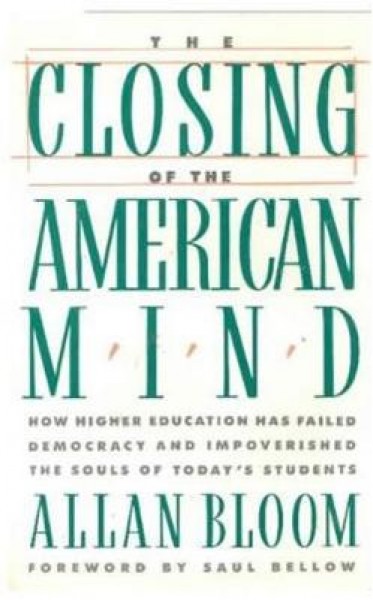
As a reader recently pointed out, nearly 40 years ago University of Chicago professor Allan Bloom published The Closing of the American Mind: How Higher Education Has Failed Democracy and Impoverished the Souls of Today’s Students. Bloom released his book to enormous rapture among conservatives invested in American decline in 1987.
The Dow Jones Industrial Average finished 1987 a little above 2,700. In 2025 it sits at 48,000, largely based on the rise of corporations built by those educated after 1987. Do you trust the markets, or deeply unhappy, book-talking scholars about the meaning of a great unlearning born of increasingly narrow knowledge?
