




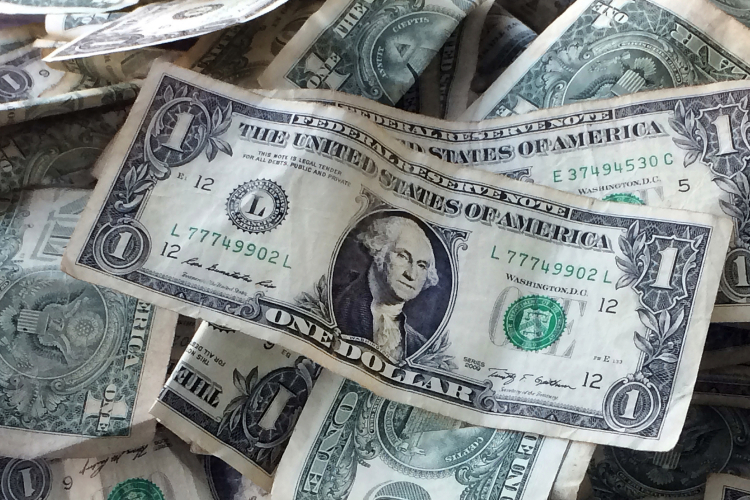
Calls to weaken the U.S. dollar have resurfaced in policy debates, framed to boost exports and reduce the so-called “trade deficit.” President Trump was reported as saying in a recent Wall Street Journal article that a cheaper dollar would restore American competitiveness abroad. The logic may sound intuitive to some, but it is economically flawed and historically dangerous.
As I have argued previously, the U.S. trade deficit is not an isolated failure. It is the accounting counterpart of a capital surplus. When the United States imports more than it exports, foreign dollars do not disappear. They return as investment into U.S. Treasury securities, equities, real estate, and productive businesses. That capital inflow helps finance domestic investment, supports asset values, and keeps borrowing costs lower than they otherwise would be.
This identity matters because proposals to artificially depreciate the dollar implicitly attempt to sever that relationship. And doing so would have consequences far beyond trade statistics.
A weaker dollar wouldn’t even necessary make U.S. exports cheaper in foreign markets when we factor in imported inputs required to produce domestically. Translated, a falling dollar would raise the dollar price of imports immediately. For American households, that translates into higher prices for consumer goods, energy, and intermediate inputs embedded throughout the supply chain. Unless wages rise at the same pace—which history suggests they rarely do—real purchasing power declines.
That is not a minor side effect. In practical terms, dollar depreciation functions as a broad, regressive tax on consumers.
The risk is compounded by growing divergence within the Federal Reserve itself regarding the future path of interest rates. Exchange rates are shaped not only by current policy settings, but by expectations of institutional credibility and policy coherence over time. As Chair Jerome Powell eventually departs, uncertainty surrounding the future composition of the Board of Governors introduces an additional vulnerability. Even absent explicit exchange-rate targeting, a perception that monetary policy will become more tolerant of inflation or more responsive to political pressure would weaken the dollar organically—raising import prices, unsettling capital flows, and further squeezing real consumption.
There is also a financial dimension that trade-focused arguments tend to ignore. The United States has been able to run persistent trade deficits precisely because foreign investors are willing to hold dollar-denominated assets. If policy signals suggest that the dollar’s value will be deliberately weakened—explicitly or implicitly—foreign capital will demand higher returns or look elsewhere. The result would not be painless rebalancing, but higher interest rates, financial volatility, and weaker investment.
History offers a clear warning. After the 1985 Plaza Accord, Japan was pressured into allowing a sharp appreciation of the yen to correct trade imbalances with the United States. The immediate effect was a blow to Japanese exporters. To offset the damage, policymakers turned to aggressive monetary easing, fueling massive asset bubbles in real estate and equities. When those bubbles burst, Japan entered decades of stagnation, deflation, and chronic underperformance.
The lesson is not that exchange rates should never adjust. Markets adjust currencies all the time. The lesson is that politically engineered currency shifts tend to create domestic distortions far larger than the trade imbalances they are intended to fix.
Advocates of a weaker dollar often assume the United States can enjoy higher exports without sacrificing consumption or capital inflows. That assumption ignores both macroeconomic identities and historical experience. Trade balances reflect deeper saving and investment patterns, not simply the level of the exchange rate.
The United States faces real economic challenges: productivity growth, fiscal sustainability, and supply-side constraints among them. Weakening the dollar does nothing to address those problems. Instead, it risks trading long-term stability for short-term optics—undermining consumption, discouraging investment, and destabilizing financial markets.
A strong economy is not built by manipulating the currency. It is built by attracting capital, fostering productive investment, and preserving the purchasing power of households. Artificially depreciating the dollar would jeopardize all three.
