




One of Joe Biden’s biggest fibs received the least amount of attention. Back when he was president, and amid notably high gasoline prices, Biden talked of how when he was young, the price at the pump affected what the Biden family could have for dinner.
It was great politics, but for one problem: what Biden described never happened. If anyone doubts this, they need only Google “oil price history,” and look at how flat the price of crude was right up to 1971, a year when Biden was well out of childhood.
It was in 1971 that President Nixon floated the U.S. dollar. Subsequent to Nixon’s decision, oil prices spiked. They’ve been on a wild ride since, and a dollar that lacks definition continues to loom large in the volatility.
Energy volatility brings to mind a recent report by the Association of American Railroads (AAR). Energy quite literally moves the U.S. and global economy, which means the price volatility has an outsize impact on the U.S. and global economy.
Of crucial importance within the AAR report, the authors focused on energy exposure per unit of output. The more market goods that can be moved, the smaller the energy cost per input. Put another way, the energy costs associated with shipping goods in a Ford Taurus will be very high in a per unit sense relative to a much larger truck.
Yet as readers can imagine, even large trucks aren’t immune to the per unit cost challenge. As AAR found, a 10% rise in trucking costs correlates with a 2.3% increase in costs of market goods shipped within one to two months.
It’s where rail shipment comes in. About what you’re soon to read, it’s useful to stress that implied within it isn’t a preference for rail over trucks, cars, drones, or airplanes. Instead, it’s just a comment on how the amount shipped can mitigate the costs associated with moving goods long distances to their retail destination.
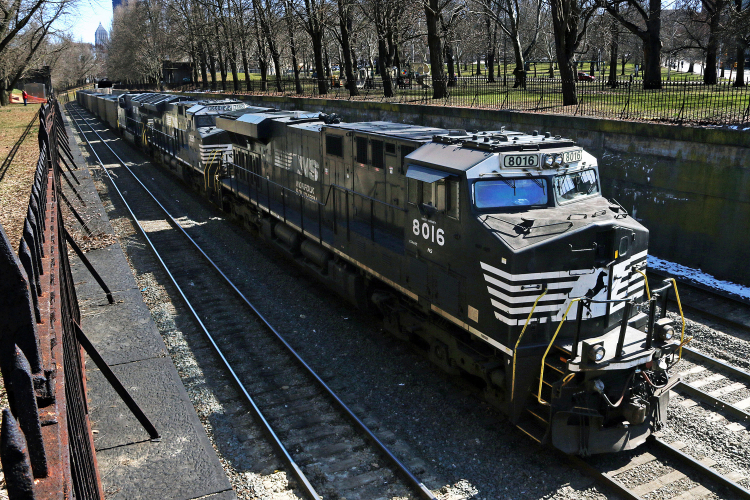
Rail shipping quite simply moves a lot more freight per gallon of fuel required to move it. Just as a truck can move a bigger amount of market goods than a Taurus can, rail dwarfs trucking. As found in the report, rail moves a ton of freight 480–500 miles per gallon of fuel, thus making rail shipping three to four times more fuel efficient. In a numeric sense, the latter means an energy spike isn’t as notable in rail costs; producing a relatively small 0.7% cost increase that quickly fades.
The substantial economic impact of energy-price volatility is worth thinking about in the present, particularly in consideration of its substantial downstream impact. While costs are costs, the size of rail shipments lightens the impact of fuel volatility.
Longer term, it would be meaningful for both sides to contemplate the history of fuel costs as a way of coming to terms with the substantial volatility that was introduced by President Nixon through his embrace of a dollar that no longer had constant qualities. A stable dollar would have a salutary economic impact precisely because it would remove a great deal of cost uncertainty from the shipping equation.
The above would have a huge impact on the costs of all kinds of shipping, all the while raising the fuel efficiency of rail shipments to levels arguably not seen in decades. Much better than mitigating energy-price uncertainty would be a total lack of the uncertainty that needlessly holds down economic progress.
