




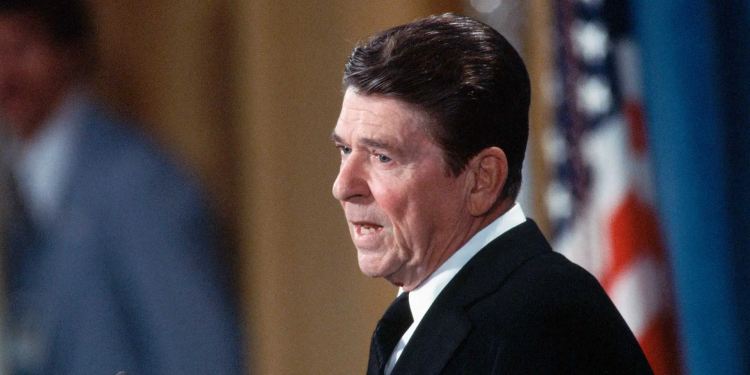
The U.S. oil sector had its worst stretch under Ronald Reagan. So substantially did prices fall during his presidency that even his Vice President (George H.W. Bush) made the rather puzzling suggestion that OPEC should be prodded to restrain oil prices from further decline.
When markets are untouched by the powers that be, the unpredictable often follows. Reagan de-controlled gasoline prices in one of his first official acts as president, and the response was that the former actor was naïve. Ted Kennedy leaned on Democrats to oppose Reagan given his view that gasoline prices sans governmental restraints would rise above $2 gallon (yes, how quaint). Then Massachusetts congressman (now U.S. Senator) Ed Markey described decontrol as something “worse than the disease of oil addiction.”
Much that Reagan’s critics predicted proved false. A barrel of oil that had fetched as much $40 in 1980 fell as low as $7. Too smart to predict markets, Reagan decontrolled them.
What happened with oil in the 1980s speaks to how quickly market outlooks can change, and by extension, the conceited folly of predicting those same markets. While oil exploration on January 28, 1981 (the day Reagan announced decontrol of oil & gas prices) would have been viewed as a great idea by politicians, economists and oil experts alike owing to the widespread perception that fuel prices were set to surge minus governmental guard rails, a few years into his presidency a proposal to invest in U.S. extraction would have netted the proposer haughty dismissal.
The economics of stateside oil extraction no longer made sense given how inexpensive the price per barrel of oil had become. Markets not infrequently reveal what few - left, right or center - see coming.
The Reagan preamble rates mention now as President Trump pursues policies meant to dismantle subsidies for solar and various “green” energy sources. Implicit in the latter is Trump’s view that fossil fuels like oil, plus nuclear and geothermal comprise what the energy of tomorrow will be.
Except that there’s no way of knowing. And it’s not just the up and down fortunes of the oil sector that support this assertion.
Consider November 30, 2022, the day that OpenAI released ChatGPT. Not only did a previously unknown business that can presently claim a $750 billion valuation (OpenAI) emerge from the final day of November in 2022, so did what is presently the world’s most valuable company (Nvidia) come out of relative obscurity. Crucial about the high-profile arrival of Nvidia and OpenAI a little over three years ago, and many more since, is that these developments profoundly changed the energy story in ways we’re still trying to fathom.
For instance, it was recently reported in the New York Times that Amazon, Apple, Google, Meta, Nvidia, OpenAI, and Oracle spent $1.4 trillion last year on data center and manufacturing projects alone. And as most reading this are aware, the data centers will be consuming energy on a scale previously unseen, or perhaps imagined.
Despite this, despite the present and future of commerce changing all the time, President Trump is inserting the federal government into the energy space, deciding what energy forms will and will not play a role in the future. He and those close to him would be wise to step back.
Exactly because the look of commerce is in flux, so will be the energy mix meant to power it. Which means Trump is flying blind when he arrogates to himself the ability to centrally domestic energy production.
See Reagan once again. Rather than take energy sides, he got out of the way. Trump should do the same.
