




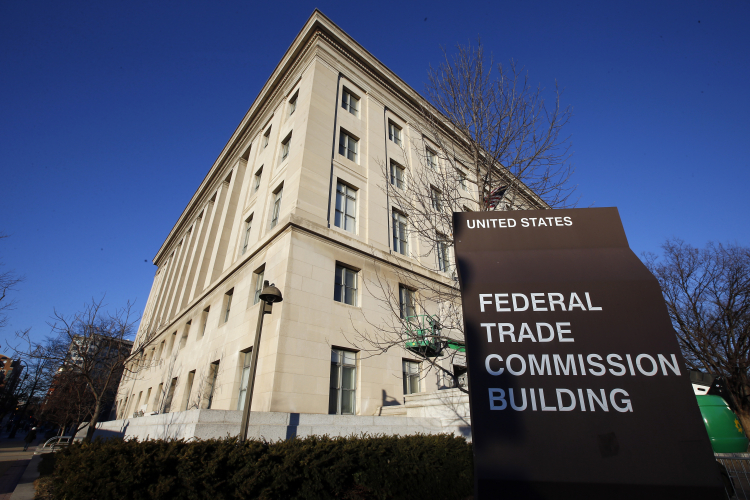
One of the most significant progressive-era “innovations” to American government was the rise of “independent” federal agencies—independent because they are structured outside the control of the President and Congress. These agencies enforce regulations created by bureaucrats, stemming from legislation passed by Congress. These independent agencies exercise legislative and enforcement powers, as well as judicial powers through Administrative Law Judges (ALJs). ALJs decide cases, which can then be appealed to an Article Three Federal Court.
One of the most important independent agencies is the Federal Trade Commission (FTC), which enforces federal antitrust and consumer protection laws. Historically, the FTC has asked federal courts for a preliminary injunction while ALJs hear the case. This is known as a Part 3 proceeding. The FTC can also seek a permanent injunction through an Article 3 federal court.
FTC Chair Andrew Ferguson has expressed concerns about the constitutionality of allowing ALJs to hear cases and make legal judgments. That may be why the FTC appears to be reducing the ALJs’ role by bypassing their office and asking for a permanent injunction in the FTC’s case blocking the proposed acquisition of liquid adhesive giant Pittsburgh Paint (who owns Liquid Nails) by fellow adhesive maker Henkel, the world’s largest adhesive manufacturer.
Asking a federal court for a permanent injunction instead of seeking a temporary one while the ALJs heard the case is a major change. The decision in whether to grant a preliminary injunction would serve as a de facto decision at the agency and trial court level. This is because the losing party would either withdraw the case or appeal. Federal law allows the FTC to obtain a preliminary injunction if the court finds that “weighing the equities and considering the FTC’s likelihood of ultimate success” the injunction “would be in the public interest.”
In practice, this means that the FTC can win a primary injunction by “raising questions” that are sufficiently serious, substantial, difficult and doubtful as to make them fair grounds for thorough investigation, study, deliberation, and determination, first by the FTC and ultimately by the Court of Appeals. In contrast, in order to obtain a permanent injunction, the FTC must prove that allowing the merger would “lessen competition, or tend to create a monopoly.” This is a higher threshold for the agency to meet.
If Chair Ferguson were to stop the FTC from seeking permanent injunctions—it would address concerns that the FTC and the Justice Department have different standards for approving a merger. This would be a victory for the rule of law, since the standard used to determine whether an individual has violated the law should not depend on where their case was adjudicated.
The FTC has a history of filing motions for preliminary injunctions the same day as they approve an administrative complaint. This means the FTC and the defendant companies may only have a few months to prepare for what could be a complex trial. The process to obtain a permanent injunction is longer. So, ceasing to seek permanent injunctions will increase the time it takes to adjudicate an antitrust case. The increased time and cost may cause some businesses to forgo what otherwise would be a beneficial merger or acquisition.
On the other hand, businesses may be more likely to engage in beneficial mergers and acquisitions if they know the FTC will have to meet the higher standards of proof required to obtain a permanent injunction. The increased time and effort required to obtain a permanent injunction may make the FTC more cautious in bringing cases—especially if Congress performs proper oversight of how the agency spends the taxpayers’ money.
The drafters of the Constitution intended that Americans charged with a federal crime receive a trial before an Article 3 court. They also recognized that separating the creation of laws, the enforcement of laws, and the adjudication of laws is necessary to preserve freedom. They would thus be horrified at the existence of independent agencies that combine these powers. If the FTC is going to stop seeking preliminary injunctions from the FTC’s administrative law judges—it would be a good first step toward restoring constitutional government. Congress should contribute to this by forbidding all use of preliminary injunctions as a first step to dismantling the unconstitutional administrative agencies.
