




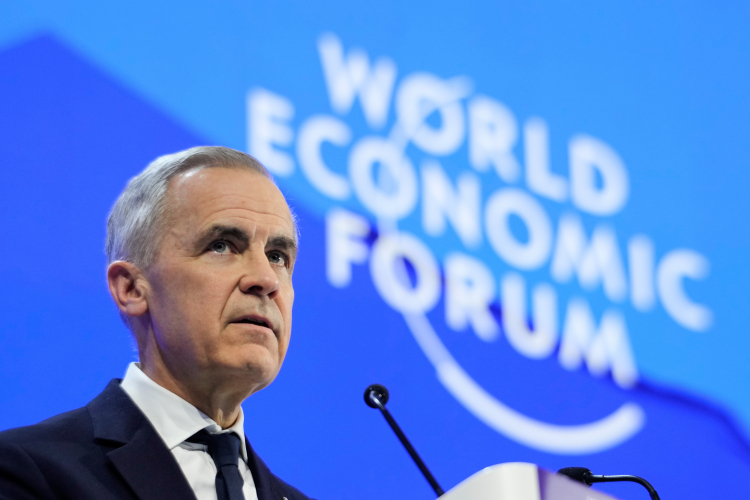
Overlooked amid the Greenland uproar in Davos came an extraordinary statement from Canadian Prime Minister Mark Carney. Not only did the leader of America’s northern neighbor cozy up to Communist China by suggesting a “new order,” but he had the audacity to invoke the moral authority of Václav Havel, the first president of the Czech Republic and fierce anti-Communist crusader.
In portraying life in an oppressive regime, Havel used a parable of a grocer hanging a sign on his window reading “workers of the world, unite." In Havel’s telling, the merchant displays the sign not because he believes the sentiment, but because he is expected to or face the wrath of an oppressive government.
Without choices, Havel warned that such rituals of compliance—small, quiet, and pervasive—crush human freedom.
Carney’s reference was striking and should be taken seriously and literally —especially by the global elites who gather at the World Economic Forum.
While he was invoking the language to criticize the Trump Administration, Carney would be better served looking in the mirror and applying Havel’s lessons to his own country.
Over the past decade plus of left-wing governments, first under Justin Trudeau and now Carney, Canada has implemented policies that pressures and compels speech, markets, and enterprise.
They passed sweeping digital laws empowering regulators to steer lawful speech into “approved” channels. They instituted green mandates under the guide of climate. They forced financial institutions into strict “environmental, social, and corporate” (ESG) structures.
The message to Canadian entrepreneurs has been increasingly clear: hang the sign—or pay the price. The forced conformity is the opposite of the free society Havel championed.
Free markets depend on the same moral infrastructure as free speech: pluralism, permissionless participation, and the humility to accept outcomes that central planners cannot control. When governments dictate not just the rules of the game but the approved outcomes—who may speak, which sectors may grow, which risks may be taken—they replace economic and cultural vibrancy for the dehumanizing embrace of collectivism. The result is not resilience, but fragility and decay.
With the United States challenging behaviors like these, Prime Minister Carney warns that we are “in the midst of a rupture, not a transition” from American leadership. Yet Carney fails to grasp that no political or economic system exists that has in the past, or can in the foreseeable future, produce the globally shared human flourishing produced by American free enterprise.
For more than a century, North American prosperity, including Canada’s, has rested on an open, innovative, and competitive American economy—one that tolerates disruption, rewards risk, and continually renews itself. Canadian firms benefit enormously from this ecosystem: access to capital, scale, ideas, and markets that no central planner could replicate.
The success of the American system is unprecedented in recorded human history: doubling life expectancy, the near-elimination of the most extreme forms of poverty, and a radical expansion of human freedom shared broadly around the world. History offers no example of durable prosperity built on managed speech and managed markets. There are only examples of stagnation and decline.
Havel understood that freedom erodes not all at once, but one sign at a time. Leaders who invoke his name should ask a serious question: are our policies inviting citizens and businesses to speak and compete freely—or are we teaching them which signs they must display to remain in good standing?
The answer matters—not just for Canada, but for the entire democratic world. Open societies rise together when they trust free people to think, speak, and build without fear. They falter together when conformity becomes the price of participation.
That is the real lesson of Václav Havel. It is one no free nation can afford to treat as a pleasant fiction.
