




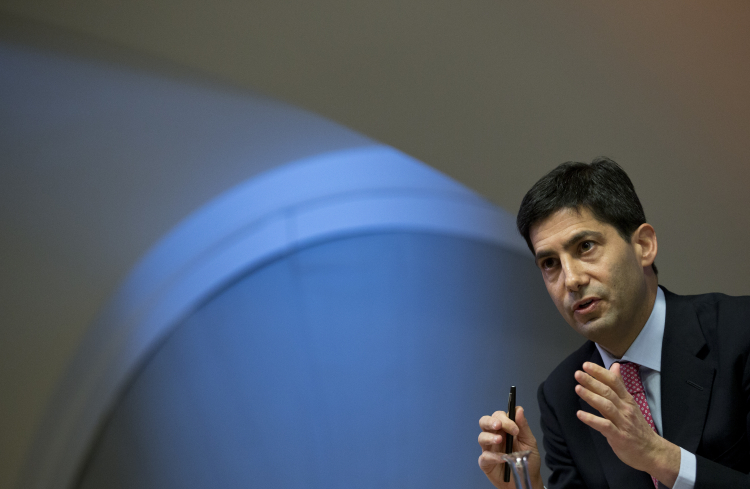
President Trump dislikes an overly strong dollar because it hurts U.S. exporters and manufacturers, and he wants lower interest rates. His Fed nominee, Kevin Warsh, is associated with a strong dollar and is a reputed “inflation hawk” who may be reluctant to cut rates—seemingly just like Fed Chair Jay Powell.
Financial markets are struggling to square that circle. Gold volatility has surged, with the Cboe Gold Volatility Index closing above 44, an unusually elevated reading. Equity volatility has edged higher, and the Treasury yield curve has steepened, signaling investor uncertainty about how a Warsh-led Federal Reserve would balance growth, inflation, and the dollar.
To cut through this apparent contradiction, one need look no farther than how Warsh and Powell view the power of Trumpnomics to generate strong economic growth without triggering inflation.
Trumpnomics is primarily a supply-side strategy built on four engines of growth: tax cuts, deregulation, low energy prices, and protective tariffs designed to attract domestic and foreign investment into new American factories and create jobs.
Powell, the quintessential Keynesian globalist, views tax cuts as a demand-side inflation incubator and tariffs as a toxic inflation factory. As for the obvious supply-side benefits of deregulation and lower energy prices—policies that can accelerate growth while restraining inflation—Powell largely discounts their power.
Because of this worldview, Powell raised interest rates far too soon in Trump’s first term, choking off what would otherwise have been at least one additional point of GDP growth. This first costly blunder by “Too Soon Powell” was later acknowledged by the Fed itself.
Powell’s second major blunder exposed a deeper flaw: partisanship. Eager to distance himself from Trump and curry favor with Biden for reappointment, “Too Late” Powell dismissed mounting inflation as merely “transitory”—a catastrophic misjudgment that allowed inflation to spiral out of control.
Today, Powell’s third blunder is on stark display. Driven by his continued antipathy to Trumpnomics, Powell remains reluctant to cut rates despite strong growth and a falling inflation rate.
Markets now want to know whether Warsh will repeat this pattern—whether he will initially profess loyalty to President Trump only to govern as a high-rate central banker. Yet, that appears unlikely given Warsh’s publicly stated views on each of the four pillars of Trumpnomics.
For example, Warsh has explicitly credited the Trump administration’s first-term tax reforms as a well-timed, pro-growth policy that boosted business activity and raised real blue collar wages.. Unlike Powell’s reflexive “tax cuts equal inflation” view, Warsh recognizes the supply response: greater investment, expanded capacity, higher productivity, and rising wages when work and capital formation are no longer punished.
Similarly, Warsh is not merely sympathetic to lighter-touch regulation. He has called for regime change at the Fed itself, including rolling back the central bank’s expansive regulatory posture toward banks.
That matters. The Bernanke-Yellen-Powell Fed has evolved into an everything-agency—part monetary authority, part super-regulator, part political actor. Warsh has argued that this bureaucratic sprawl is not only undemocratic but economically destructive, a view fully consistent with Trumpnomics’ emphasis on letting supply expand.
On energy, Warsh has not built his profile around more drilling permits and pipeline approvals. But this is precisely where Powell’s analytical failure is most revealing—and where Warsh’s framework matters. Warsh has repeatedly emphasized that inflation is ultimately a monetary phenomenon and that long-run growth depends on productivity and innovation rather than artificial scarcity.
If one accepts that framework, drill-baby-drill is not a slogan; it is disinflationary supply. Cheap, reliable energy lowers costs across the economy, raises real wages, and expands potential output—allowing faster growth with less inflation.
Finally, Warsh has said outright that tariffs are not inherently inflationary. That matters, too, because Powell’s tariff hysteria has been one of his most persistent analytical errors in keeping rates unnecessarily high. Warsh’s view clearly leaves room for a world in which Trump’s tariff policy attracts trillions of dollars in investment (which it already has), strengthens domestic production, raises productivity, and improves national resilience without forcing the Fed into a permanent tightening cycle.
At the end of the Fed day, Warsh is clearly not Powell. Powell’s failures were not merely technical; they were ideological and, at critical moments, partisan. Warsh’s approach is fundamentally different: restore Fed credibility, stop monetizing fiscal excess, shrink the Fed’s footprint, and let productivity do the heavy lifting.
If Warsh governs accordingly, the “circle” financial markets are struggling to square is not a contradiction at all. It is a strategy—strong supply-side growth yielding falling inflation and interest rates that come down not because Washington bullied the central bank into printing artificial prosperity but because America is working and earning them down under the banner of Trumpnomics..
