




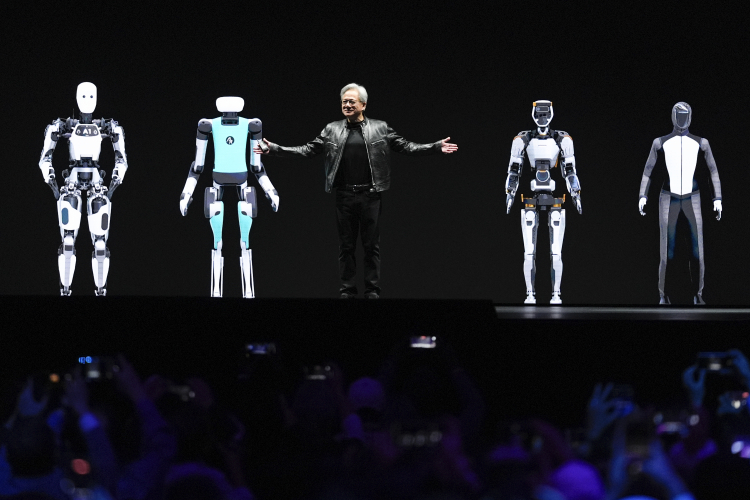
As Nvidia’s Jensen Huang routinely points out, Artificial Intelligence (AI) is work. That’s why it will be the most powerful, growth boosting, job creator the world has ever known.
It can’t be said enough that what does work for humans creates exponentially more work opportunities for those same humans. Those predicting the opposite - that AI will drive mass unemployment – are revealing a profound misunderstanding not just of what progress is, but also what credit is.
In thinking about credit, it’s useful to point out that when entrepreneurs and businesses raise or borrow money, they’re in pursuit of resources. We seek money for what it can be exchanged for. Which means debt and equity are all about attaining commodities, materials, market goods, labor.
It’s useful to think about this with AI in mind. It foretells a great deal more machines doing and thinking for us. What this signals is a surge in production born of staggering productivity leaps that will increase the quantity of most everything while shrinking the price of most everything.
What this plainly foretells is soaring amounts of credit on offer at falling rates of interest alongside growing amounts of equity finance that will fund “impossible” leaps that make the intrepid ones of the present appear strikingly tame by comparison. Credit is produced, by lender and borrower, and credit production in the future will be many, many multiples of what it is today.
In thinking about the credit and equity surge, it’s crucial to remember that as is the case now, and as will be the case in the future, the more credit and equity the more jobs. Just as there are no companies, no jobs and no entrepreneurs without savings and investment in the present, the abundance of savings and investment in the future means that jobs of all kinds that reward an enormous range of unique knowledge will be everywhere.
It’s a reminder that AI and its automation of so much won’t put us out of work, rather it will create enormous amounts of work that won’t in most cases feel like work. It will elevate and amplify skills that already exist, all the while unearthing other talents that in the past had no employable qualities. In the future the worry won’t be about whether there will be jobs, but what jobs to do and when.
In the present most of us pursue one or many jobs in our early years while in search of a specific career path, but in the future a growing number of us will have multiple careers given our desire to pursue a range of work concepts that we can’t not do.
Which is why readers should tune out all the salons, interviews and commentary about a high-unemployment future. The thinking is embarrassingly flawed.
Humans aren’t a cost, rather they’re an input. And with machines and robots set to proliferate, the value of every human worker will soar exactly because the automation of so much will enable so much human specialization.
After that, the driver of jobs isn’t supply and demand (the latter easily the most overrated concept in economics), but it is investment. And investment will be many times more abundant in the future.
Say it again that the only “problem” associated with future employment will be what to do amid a myriad of remarkable choices. Look at babies and the young with envy.
