




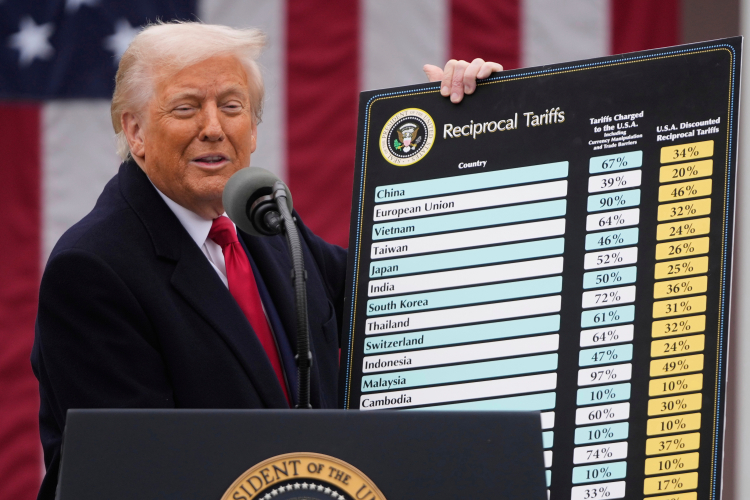
The U.S. Supreme Court has declared a large portion of the tariffs imposed by President Donald Trump to be unlawful. The U.S. Constitution grants the power to levy tariffs to Congress, not to the president. Trump had nevertheless relied on a 1977 emergency law to impose the import duties without congressional approval. The International Emergency Economic Powers Act (IEEPA) allows a U.S. president to regulate trade during a national emergency, but it has previously been used for sanctions rather than tariffs. Trump had described the tariffs as essential to the economic security of the United States.
Trump’s tariff policy rests on the promise that high import duties can bring industrial jobs back to the United States. This is unlikely to work. Manufacturing in the U.S. is simply too expensive. Motorola learned this lesson when it opened a smartphone factory in Texas in 2013, only to shut it down twelve months later. Analysts estimate that Apple would need three years and around $30 billion merely to relocate ten percent of its Asian supply chain to the United States. In reality, Apple responded to Trump’s tariff increases on China by shifting parts of its production elsewhere — not to America, but to India — which in turn triggered new tariff threats from Trump.
In a Wall Street Journal article published on January 30, 2026 (“My Tariffs Have Brought America Back”), Trump claimed: “I have successfully wielded the tariff tool to secure colossal investments in America, like no other country has ever seen before.… In less than one year, we have secured commitments for more than $18 trillion, a number that is unfathomable to many.” This claim is as implausible as his assertion that he ended eight wars within eight months or reduced drug prices by “more than 1,000 percent.” Shortly before, Trumps administration had cited a lower figure of $9.6 trillion. But even that number was fabricated, as U.S. economist Alan Reynolds (CATO) demonstrated:
“Many of the 132 announcements on the White House $9.6 trillion list were not about investments at all, but about foreigners promising to buy more U.S. products. In one so-called ‘investment announcement,’ Japan’s largest electric power company, JERA, pledged to buy $200 billion of LNG from the U.S. So what? Many power companies everywhere rely heavily on U.S. natural gas, liquefied or not. This is just a Japanese import — not an investment.
India was said to be ‘investing’ $500 billion in ‘mutual trade expansion.’ Whatever that is, it is not an investment. Two countries agreeing to increase bilateral exports and imports is not foreign investment in the U.S. The largest genuine investment plans — implausibly attributed to Trump’s ‘leadership’ or tariffs rather than to the rise of artificial intelligence — are investments in ‘Technology & AI’ by Amazon, Meta, Apple, Micron, IBM, and Google.
Other multi-billion-dollar long-term investment plans include R&D spending by major pharmaceutical firms. But R&D is nothing new — it is simply what drug companies always do to sustain growth.
Numerous other ‘investments’ in the White House ‘Trump Effect’ list are described as ‘manufacturing expansion’ or ‘upgrading manufacturing facilities.’ But such investments occur continuously — even during recessions and even among companies simultaneously closing other facilities. One entry lists Heinz investing $3 billion to upgrade manufacturing facilities, while the next lists Kraft-Heinz investing another $3 billion for the same purpose. Whoever compiled the data evidently failed to realize that these are not two companies, but one. Caterpillar is listed as ‘investing’ in a ‘skills training program.’ McDonald’s announced ‘investment’ in ‘workforce expansion’ — otherwise known as hiring.”
In other words, even the $9.6 trillion figure was fictitious. To make the claim appear even more impressive, Trump almost doubled the number, presenting it as proof of the investment boom allegedly triggered by his tariff policy.
Trump’s message is politically appealing. Workers are told that everything can return to the way it once was. This sounds far more attractive than the truth: in an age of globalization, the internet, and artificial intelligence, it is unrealistic to expect existing jobs — especially low-skilled ones, but increasingly many skilled jobs as well — to remain unchanged. Anyone seeking to succeed in this environment must adapt, acquire new skills, and move into areas where human labor is less easily replaced. That is not an appealing message to voters. Far more attractive is the claim that foreigners are to blame: the Japanese, the Chinese, the Germans — accused of flooding American markets with cheap goods while allegedly refusing to buy American products.
American businesses understand how damaging tariffs can be. The Footwear Distributors and Retailers of America warned Trump in a letter that rising costs caused by tariffs threatened the survival of U.S. shoe companies and endangered hundreds of firms with closure. American farmers were also severely affected by the trade war unleashed by the administration. In response, Trump distributed billions of dollars in subsidies to farmers to offset the damage.
This represents a classic example of what the economist Ludwig von Mises described as the “intervention spiral.” Government intervention in markets produces unintended consequences because it distorts price signals and incentives. Attempts to correct these new problems lead to further interventions, which in turn create additional distortions and new problems — generating an ever-expanding cycle of state intervention.
