




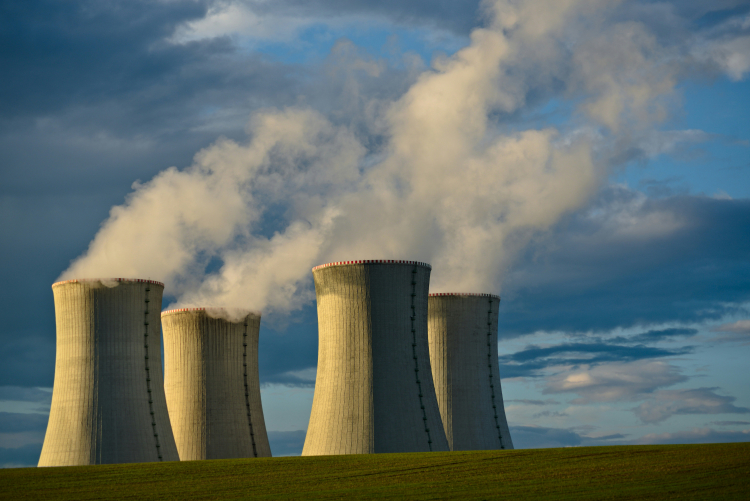
Thank the prestigious journal Nature Communications for helping us to remember that slop needn’t necessarily be AI-generated, plus that peer review is probably worthless. It has graced us with a study indicating that living nearer to a nuclear power plant is associated with higher death rates, specifically 115,000 souls during the decade-long study period.
It is a terrifying number, precisely calculated to make suburban parents clutch their pearls and provide endless fodder for whatever no-nukers yet remain. But if you peel back the layers of statistical voodoo, you find zero substantiation for the claim.
At the very top of the scrap heap of errors is the study’s absolute reliance on proximity as a proxy for exposure. This is the "distance equals death" fallacy, and it is the oldest trick in the activist’s handbook. The researchers seem to operate under the delusion that nuclear reactors are leaky sieves constantly belching out invisible death. In reality, the radiation dose received by a member of the public from a nuclear plant is so infinitesimally small that it’s effectively lost in the noise of everyday life. You get more radiation from eating a banana, flying in a plane, or standing next to a granite countertop than you do living near a well-run reactor. (Well, maybe depending on the banana….)
By using geography instead of actual dosimetric data—the real measurements of radiation—the authors are essentially guessing. They are looking at a map and assuming that because someone is "near" a facility, they are being "zapped." Sure, and standing near a library makes you a Rhodes Scholar. Without a demonstrated physical mechanism, you don't have a study; you have a collection of coincidences.
Then we stumble into the "ecological fallacy." The study looks at county-level data to make sweeping claims about individual mortality. This is statistical malpractice. A U.S. county is a massive, heterogeneous beast.
Within a single county, you might have a high-income suburb, a decaying industrial zone, and a rural farming community. To average these all together and then blame the nuclear plant for the "excess deaths" is a shell game. If a county has a high cancer rate, is it the nuclear plant, or is it the fact that the county also houses a heavy-duty chemical refinery, three major coal-fired plants, and a population that smokes like a Victorian chimney?
The researchers claim they "adjusted" for these things, but you can’t adjust your way out of bad data. Their controls are too coarse to capture the actual lifestyle choices—diet, exercise, and industrial exposure—that actually kill people.
The figure of 115,000 "attributable" deaths is the most egregious part of this fear-porn.
If nuclear power were actually killing 6,400 Americans every single year, we wouldn’t need a complex computer model to find the bodies. Yet, decades of rigorous monitoring by the National Cancer Institute and the Nuclear Regulatory Commission using the National Academy of Sciences have found exactly nothing. Are we to believe that previous studies, local health department, and almost countless independent researcher have been part of a massive, multi-generational cover-up?
It also begs credulity that zero deaths were attributed to an actual partial meltdown with radiation leakage at Three Mile Island in 1979, while only one death has been officially attributed to the three full meltdowns and radiation release caused by the monstrous 2011 Fukushima disaster. (Albeit over 19,000 deaths from the earthquake and tsunami.)
In 2018, the Japanese government reported that one (1) worker died from lung cancer as a result of radiation exposure, but that even that’s dubious.. While it took decades for lung cancer to appear in the atomic bomb survivors, this fellow was diagnosed just five years later in 2016. Lung cancer is also the most common cancer killer in Japan. More likely, someone just wanted to give the poor fellow compensation.
Or is it more likely that this new study is simply a victim of "p-hacking," where you torture the data until it confesses to something, anything, that will get you published in a high-impact journal? When a new study’s findings diverge this wildly from the established consensus, the burden of proof is on the authors to explain why everyone else is wrong. Instead, they just give us a scary number and a "correlation" that they admit doesn't prove causation.
Let’s talk about detection bias, which these researchers conveniently overlook. Communities surrounding nuclear power plants are often more prosperous than their rural neighbors. The plants pay high wages and pour massive tax revenues into local infrastructure. Consequently, these areas often have better hospitals and more frequent medical screenings.
If you screen people more often, le voila!, you find more cancer. If you have better medical records, you accurately record more "cancer deaths" that might have been listed as something else. The "cluster" the researchers think they’ve found might just be the result of a better-funded healthcare system doing its job. It’s a classic case of looking for your keys under the streetlight because that’s where the light is better, rather than where you actually dropped them.
The timing of this "research" is also suspiciously convenient. We are currently in the middle of a major push for a nuclear renaissance, with some U.S. shuttered nukes actually reopening. Small modular reactor nukes, such as one just carried in three parts by Air Force cargo jets, and fusion are the future. The very near future.
Suddenly, as if on cue, a study appears in a prestigious journal to tell us that nuclear power is a silent killer. This isn’t science; it’s narrative-building. It ignores the massive technological leaps in reactor safety and treats a 50-year-old plant with the same broad brush as a brand-new microreactor. It’s an attempt to stall progress by weaponizing the public’s innate fear of anything with the word "nuclear" in it.
Finally, we have the glaring omission of the "alternative" risk, or a risk-risk analysis.
Even if we took the 115,000 figure at face value, there’s no mention that the alternative to nuclear is often coal or gas. The particulate matter and air pollution from fossil fuel plants actually do kill people in measurable, verifiable numbers every year. (Germans, in their infinite wisdom, shuttered an incredibly impressive nuclear reactor system and have greatly replaced energy output with the dirtiest form of coal). Ironically, burning coal produces significant amounts of radiation.) If you shut down the nuclear plants because of this flawed study, you will end up killing far more people through the resulting increase in air pollution.
Indeed, an estimated 5.13 million excess deaths per year globally “are attributable to ambient air pollution from fossil fuel use and therefore could potentially be avoided by phasing out fossil fuels,” according to a recent BMJ (British Medical Journal) study. Oh, but that’s so boring!
