




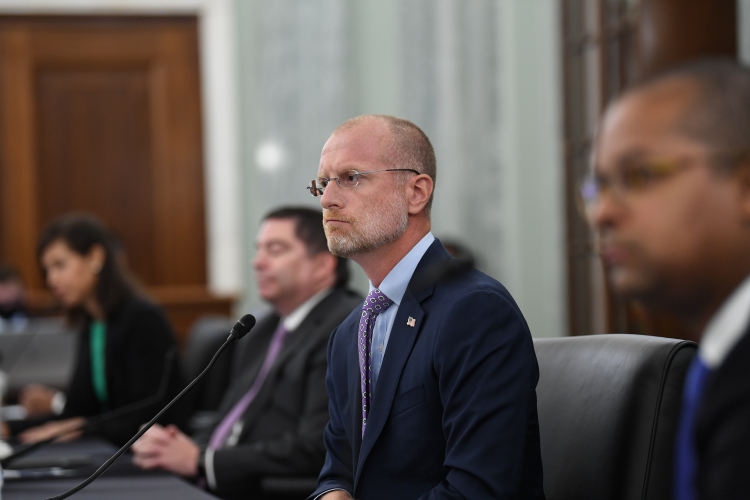
In a recent interview at Semafor's Trust Media Summit in Washington, Federal Communications Commission Chairman Brendan Carr declared: "This isn't Ronald Reagan's FCC, and I think that's a good thing." He was responding to a question regarding some of his headline-grabbing "jawboning" actions against broadcasters' programming decisions.
I beg to differ. I don't think it's a "good thing" for Chairman Carr to proclaim that it's a good thing that the FCC he leads "isn't Ronald Reagan's FCC." After all, it was the Reagan FCC, under the leadership of then-Chairman Mark Fowler, that repealed the notorious "Fairness Doctrine," an onerous regulation of radio and television broadcast programming that was an affront to broadcasters' free speech rights.
I may not have agreed with everything the Reagan FCC did, just as I don't agree with everything that the present FCC does. But there's no gainsaying that the Reagan FCC adopted some key deregulatory initiatives at a time when the telecommunications and media markets were becoming more competitive and very much needed reduced regulatory restrictions. And to his immense credit, Mr. Carr, in little more than one year, already has eliminated many outdated, unnecessary, and costly regulations in his aptly styled "DELETE, DELETE, DELETE" proceeding and otherwise.
That said, I've been concerned about the way in which Chairman Carr apparently has employed, or threatened to employ, the agency's standardless "public interest" authority to involve the Commission more intrusively in regulating broadcast programming. For example, in my essay "Brendan Carr Should Back Off," regarding the Jimmy Kimmel brouhaha, I was critical of the "not-so-subtle threats to broadcast station owners and the ABC television network that now-FCC Chairman Brendan Carr uttered regarding his view that Jimmy Kimmel's show should be terminated." These not-so-subtle threats regarding Jimmy Kimmel's show, and others, all invoke the authority, delegated to the Commission under the Communications Act, to regulate broadcast licensees in the "public interest."
Now back to the Reagan FCC. Surely, one of its signature achievements was the repeal, in August 1987, of the Fairness Doctrine in the agency's Syracuse Peace Council proceeding. Recall that the Fairness Doctrine required broadcasters to cover issues of public importance and to allow a reasonable opportunity for the presentation of contrasting views. Obviously, to enforce notions of "fairness," the FCC necessarily needed to conduct intrusive examinations of the content of the broadcasters' programming. And the agency did.
Recall too that in the famous (or infamous, if you will) Red Lion Broadcasting v. FCC case, the Supreme Court upheld the FCC's authority to sanction broadcasters and threaten revocation of their licenses for violation of the Fairness Doctrine. In other words, broadcasters' licenses could be at risk if the agency determined there had been an insufficient balance in the discussion of controversial issues. The Supreme Court made crystal clear in its Red Lion decision that the Fairness Doctrine was grounded in the FCC's vacuous public interest standard.
It's worth recalling as well, as the historical record will show, that the Fairness Doctrine was employed mostly by Democrats with the aim of silencing conversative voices, especially on radio. The Red Lion case itself involved the FCC's sanctioning of a Pennsylvania radio station, WGCB, for a 15-minute broadcast by the right-wing Reverend Billy James Hargis, as part of his "Christian Crusade" series. Red Lion effectively put the kibosh to conservative talk radio for a generation. It was not until the repeal of the Fairness Doctrine in 1987 that conservative voices, like Rush Limbaugh's, could flourish and invigorate talk radio.
Periodically, Democrats have proposed reinstituting the Fairness Doctrine and adoption of various other speech suppression regulations. In 2018, twelve Democrat members of the Senate urged the FCC to consider revoking the licenses of Sinclair Broadcasting Group for claimed "news distortion." I have no doubt, when it strikes their fancy, the Democrats will continue to do so. Make no mistake, I don't put much stock in their faux outrage at some of Mr. Carr's actions targeting broadcasters' programming.
Nevertheless, Ronald Reagan's FCC had it right when it determined that the Fairness Doctrine "chills speech and is not narrowly tailored to achieve a substantial government interest." And when it concluded, at bottom, that "the fairness doctrine contravenes the First Amendment and thereby disserves the public interest."
Along with the successful implementation of other deregulatory initiatives aimed at supporting emerging competition in the telecommunications and media markets, the repeal of the Fairness Doctrine was a signal achievement of the Reagan FCC.
So, in my book, Brendan Carr shouldn't belittle the Reagan FCC. When it comes to protecting free speech, I prefer that he and his fellow commissioners emulate that Reaganesque version of the agency.
