




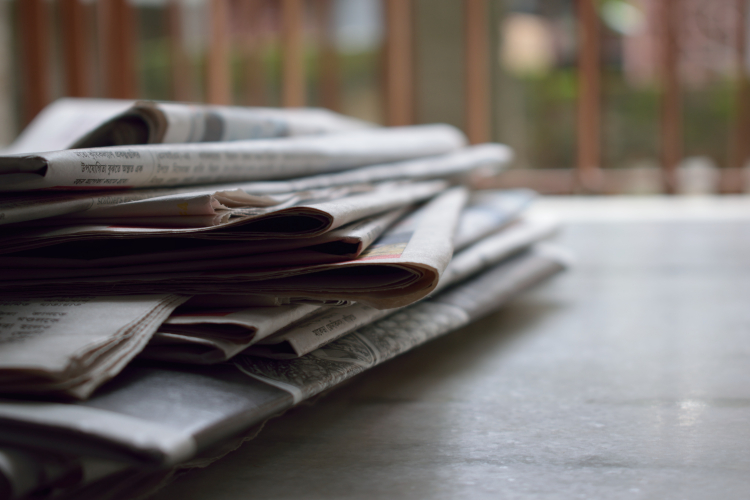
When’s the last time you held a newspaper in your hands? Tick tock, tick tock…
The question you’re contemplating comes from someone who daily reads the print editions of the Wall Street Journal, New York Times, and Washington Post. Which is the point as readers will soon see.
To read newspapers nowadays is to unwittingly seek attention. Some jokingly ask, “What’s that?” Others have jokingly expressed thrill that someone still reads newspapers...
Despite this, “the press” is still the press. Take a recent column by the Wall Street Journal’s Holman Jenkins. In “Why Netflix Lost Warner to Paramount,” Jenkins quipped toward the end that “The left-leaning press, which means most in the press, is preoccupied with what will happen to CNN.”
Jenkins might agree that for the right-leaning press, the left-leaning press has become a prop. Most would say “left leaning” before “the press” is a redundancy. They’re all American-style “liberals” in the press, but who are they? And this has nothing to do with the recent layoffs at the Washington Post that got so much “press.”
About what happened at the Post, it surely was a story. Or was it? No doubt the layoffs were written about at the Wall Street Journal and New York Times, but where else?
It's surely not lost on Jenkins that there isn’t much of a press to speak of anymore. And this isn’t just true for smaller market newspapers that are disappearing or shrinking right before our eyes.
It’s also true for the big markets as a read of the Chicago Sun-Times or Los Angeles Times will reveal in depressing fashion. Without exaggeration, the Los Angeles Times of present day looks like a smaller, sadder version of a local newspaper from before they went extinct.
As for the Sun-Times, it’s no longer even the Sun-Times for the most part. The news section of the paper is now USA Today (if memory of the last read of it from several years ago is correct), while the Sports section is still local reporters. Though even that is likely no longer true given the high cost of maintaining a Sports section. For now the Washington Post still has a Sports section, sort of. The coverage of local teams is Associated Press.
Which furthers the point, or raises a basic question: just what “press” is Jenkins writing about? No doubt there's lots of online media, but this is happily dense with right-wing writers in the way that print media never was.
Jenkins can’t be referring to the Associated Press as all the press, so once again which press? Presumably Jenkins means the New York Times, but it too thins by the day. The Wall Street Journal’s reporting side of the newsroom swings left, but then Jenkins is part of an editorial page that is beloved by the right (including yours truly) precisely because its lean is decidedly right.
It’s all a reminder that while reporters likely do swing left in aggregate, and as a way of fulfilling the needs of news consumers that similarly swing left, there’s really no press anymore to speak of. Which should have readers wondering just who, other than the reporters at the New York Times, cares what will happen to CNN?
Perhaps the answer is a growing right wing “press” who, before Netflix dropped its Warner bid, worried Netflix would turn CNN into the “Obama News Network.” Except that Netflix wasn’t bidding for CNN opposite the rantings of the right-wing “press.”
