




Standing for Delivery. The easy answer to where the silver went. And then the harder one.
Part One: The Story That Makes Sense
There is a phrase in the futures markets — standing for delivery — that sounds almost ceremonial, like something from a medieval guild. You have purchased a contract, a promise written in numbers, and now you are declining the paper exit. You want the thing itself.
In the silver market, the act of standing for delivery has become something closer to a siege.
For fifteen consecutive months through early 2026, physical silver has been leaving COMEX warehouses at volumes the exchange has never processed. December 2025 produced 65 million ounces in deliveries — a single-month record. January 2026 followed with 49.4 million, more than seven times what January 2024 had generated. All of 2025 combined settled 474 million ounces of physical silver, against 203 million the year before. The number more than doubled in a single calendar year, without a headline event most people could name.
A note on what those numbers represent: COMEX silver inventory is divided into two categories. Eligible metal sits in approved vaults but belongs to its owner and is not available for exchange delivery. Registered metal has been specifically warranted for delivery against futures contracts — it is the pile the exchange can actually draw on. When delivery numbers accelerate the way they have, it is the Registered category that drains. As of early 2026, Registered silver had fallen roughly 75 percent from its 2020 peak.
The question everyone asks first is the obvious one: where is it going?
The obvious answer involves solar panels.
Silver is the most electrically conductive element on the periodic table, and the green energy transition has turned that fact into an industrial appetite of unusual scale. Every photovoltaic cell printed onto glass needs silver paste — not as a substitute, not as something that can be engineered around cheaply, but as the conductor that makes the cell function. By 2025, the solar industry alone was consuming somewhere between 200 and 250 million ounces annually, roughly a fifth of global supply, each ounce bound irreversibly into panels that will spend the next quarter century facing the sun. Electric vehicles consume another 40 to 60 million ounces per year. Semiconductors, 5G infrastructure, medical devices, AI data centers — each draws on silver in quantities small enough per unit to seem trivial, large enough in aggregate to close the gap between what mines produce and what the world uses.
That gap has been open for five consecutive years. Analysts estimate the cumulative supply deficit since 2021 at roughly 820 million ounces — nearly a full year of global mine production, simply gone. The silver does not return. A solar panel does not give back its conductor at the end of its operating life in any economically meaningful way. This is inventory being consumed, not shuffled.
Add to that the coming demands: solid-state batteries, which may require something approaching a kilogram of silver per pack versus the 25 to 50 grams in current lithium-ion cells. Nuclear reactor control rods, as scores of new reactors planned for the AI energy buildout come online and lock in silver demand for forty-year lifetimes. The silver market has no clear answer for where that metal comes from.
So the story writes itself easily: the green transition is hungry, the deficit is real, and all those delivery notices at COMEX are the market's way of routing physical metal toward the industries that need it. Demand is industrial. Supply is finite. Price is adjusting.
It is a satisfying explanation. It is also, on closer inspection, the wrong explanation for what is actually happening at the COMEX window.
— — —
Part Two: Nobody Melts Engelhard Bars
Here is the thing about a COMEX registered silver bar.
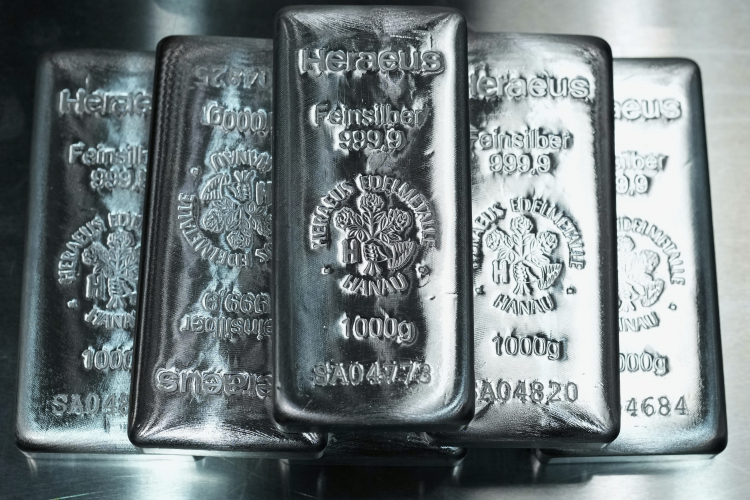
It is not raw feedstock. It is a serialized, hallmarked, institutionally documented object — cast at an approved refinery, stamped with a unique identifier, logged into a chain of custody that follows it through every transfer. The names on those bars are the names of the bullion trade's long history: Engelhard, PAMP Suisse, Johnson Matthey, Asahi. Each bar weighing roughly a thousand troy ounces, each one a distinct and traceable artifact of the monetary system.
Industrial silver users — the solar panel fabricators, the EV manufacturers, the electronics firms — do not source their metal from COMEX registered inventory. They have offtake agreements with mines. They buy refined silver directly from smelters, in forms and quantities suited to their processes. Their procurement departments operate on long-term contracts, hedged forward, designed precisely to insulate production schedules from spot market volatility. A photovoltaic manufacturer in Anhui province does not send someone to a New York vault to retrieve thousand-ounce bars and ship them across the Pacific. That is not how industrial supply chains work.
The COMEX delivery mechanism is a monetary plumbing tool. It exists so that holders of futures contracts can, if they choose, exchange paper for physical — not to provision factories, but to move metal between institutional accounts, between vaults, between the hands of entities that deal in large bars as stores of value. The people standing for delivery at COMEX are, almost by definition, not industrial users.
So who are they?
The delivery data offers some answers, though incomplete ones. In early January 2026, JP Morgan issued 99 percent of 8.1 million ounces in a single day's delivery notices — acting as the seller, the metal-provider, the entity on the issuing side of those contracts. What made the data unusual was that despite these deliveries, open interest in the contract increased by nearly 1,500 contracts the same day. New buyers were arriving faster than metal was clearing. Someone was on the other side of all of it, and the data does not name them directly.
Andy Schectman, who runs Miles Franklin Precious Metals and has been watching these flows for three decades, calls it a full-blown run on physical metal — driven by the biggest money in the United States standing for delivery at levels the exchange has never seen. He is not describing retail investors or Reddit communities. He is describing sovereign-adjacent capital, institutional funds, the kind of accumulation that does not announce itself.
What that looks like in practice: trucks backing up to vaults in northern New Jersey, where most COMEX-approved depositories are located. Pallets of thousand-ounce bars — each one stamped, serialized, logged — loaded and moved to a different address. Metal that had existed for years as a warehouse receipt, a number in a ledger, suddenly becoming a physical object again, requiring weight and space and transport. The exchange processed this at record volume for fifteen straight months.
The Sprott Physical Silver Trust, one of the largest allocated silver funds in the world, doubled its capital raise program in January 2026 — to two billion dollars, enough at then-current prices to buy approximately 18 million ounces of physical silver, representing roughly 16 percent of COMEX registered inventory in a single institutional move. Sprott is not making solar panels. Sprott is betting that physical allocated silver is worth more than the paper claims against it, and it is committing capital to that thesis at a scale that moves markets.
There is also the eastern dimension, which the delivery flow data points toward persistently. JP Morgan has been shipping metal eastward at premiums of ten dollars an ounce or more above COMEX prices, with the VAT tax falling on the Asian recipient. That buyers absorbed both the premium and the tax — willingly, repeatedly — says something about how urgently they valued the physical bar over any paper substitute. Physical silver in Shanghai has traded at a sustained premium over COMEX futures for months, a spread that under normal conditions would be instantly arbitraged away. It has not been arbitraged away because the metal needed to compress the spread cannot easily leave China. What can leave the West is leaving.
China itself reclassified silver as a strategic material in late 2025 and tightened export licenses. The country that had been a significant net exporter of refined silver — more than 4,000 tons shipped in the first eleven months of 2025 — abruptly stopped. The same move it made with rare earths, with tungsten, with antimony: identifying a material essential to the next economy and pulling it behind a licensing wall before anyone in the West had fully understood the implications.
A thousand-ounce Engelhard bar does not get melted into photovoltaic paste. It gets moved — from a Western vault to an Eastern one, from a bank's registered inventory to a sovereign fund's allocated account, from the paper system into the kind of custody that does not depend on anyone's promise.
The industrial demand story is why silver is scarce. The delivery data is what happens when the people who understand scarcity decide to act on it.
Comment
Show comments
Hide Comments
