




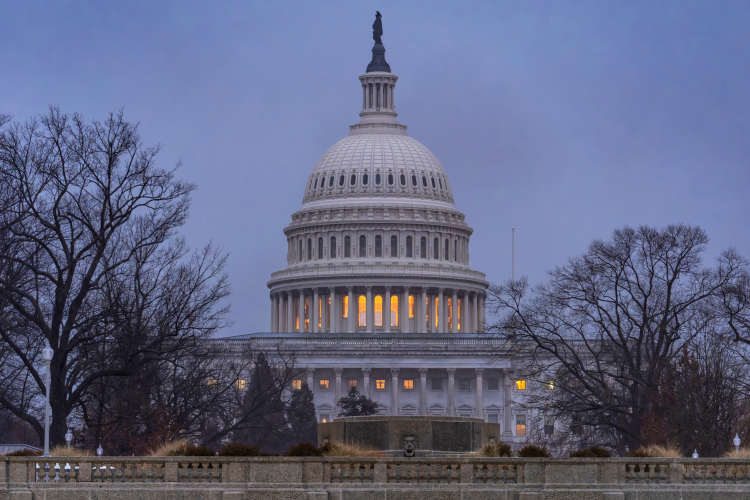
A balanced federal budget in the United States is consistent with a massively bloated government operating well beyond its constitutional limits. This is what the budgetary experts at libertarian and conservative think tanks like Cato and Heritage ignore: balanced budgets and spending cuts will do nothing to shrink the federal government, and they won’t because both gloss over why we have big government and debt to begin with.
To understand why this is true, readers need only look at the national debt of $39 trillion. It’s a powerful market signal that federal tax revenues today are a pale imitation of what they’ll be in the future. Money is ruthless, and there’s no way Treasury could borrow so much money unless it was expected to take in much more in the future.
Consider what you’ve just read with a balanced budget amendment top of mind. Let’s imagine one is passed in 2026. If so, the signal in $39 trillion worth of debt in the present is that budgetary balance in the future will be “achieved” at levels of federal spending that will make total federal outlays in 2026 appear small by comparison.
Which is why spending cuts will similarly achieve less than nothing. The $39 trillion worth of debt here and now yet again instructs. Exactly because it signals soaring tax revenues for Treasury in the future, it’s evident that spending cuts in the present will merely free up more dollars for Congress to spend on new programs thanks to reductions in others.
What’s unfortunate about where we’re headed, balanced budget amendment or not, is that libertarians and conservatives have been complicit in getting us to this point. It can be found in their decades worth of policy analyses calling for a combination of spending cuts, entitlement reform, tax increases, or all three.
About their proposed fixes, notice how none of them address why we have so much debt in the first place: abundant tax revenue now, but much more perilous, the expectation of quite a bit more tax revenue in the future. Instead of taking aim at all the tax revenue that enables so much spending and consequent borrowing, they claim against all logic that the deficits and debt are an effect of too much spending. No, that’s not true.
If it were true, then it would also be true that Canada, Italy and Russia would have debt trajectories that mirror ours. Except that they don’t. Total debt for Russia is presently $460 billion, and no, the latter is not evidence that Vladimir Putin is a closet ascetic. In truth, a debt amount that is tiny relative to $39 trillion is a loud signal that investors with real skin in the game think very little of Russia’s economic future.
Conversely, they think lots of our economic future, which is why they’re so willing to lend to the U.S.: rising economic growth means future tax revenues will once again be enormous. Which is a signal that the U.S. doesn’t just have a too much tax revenue problem, but that a balanced budget will once again correlate with a rapidly growing federal government in the future. Get it?
The experts don’t. Seemingly blithe to the soaring tax revenue problem that the federal debt is a symptom of, they continue to offer solutions that will only succeed insofar as they’ll free up more dollars for Congress to direct to new programs, and more of the borrowing by Congress that they detest. Never has such a large number ($39 trillion) been so misunderstood.
