




Over 5 million children in the United States live in what the federal government designates as “persistent poverty” counties. That designation means a county has had high poverty rates (20 percent or greater) for the last 30 years. Persistent poverty occurs in rural areas of the South, parts of Appalachia, tribal areas of the West, and large urban areas on the East Coast (New York City and Philadelphia).
Trump Accounts, technically 530A accounts, are a new policy tool that could help break the persistence, or intergenerational aspects, of poverty in these areas. Created as part of the “One Big Beautiful Bill Act” of 2025, these accounts were recently highlighted by the president in his State of the Union address. Accounts are flexible, allowing the government, parents, employers, and charitable foundations to contribute funds to tax-advantaged accounts on behalf of children. For example, the federal government plans to contribute $1,000 for children born in the period that runs from 2025 through 2028.
Trump Accounts are designed to build wealth that can be deployed in the pursuit of a variety of goals, such as a college education, home purchase or retirement. In addition, proponents of these accounts point to intangible benefits, namely, the development of an interest among young people in the stock market, wealth creation, and financial literacy. These intangible benefits could be particularly valuable in resetting the economic outlook of persistent-poverty counties.
The largest span of persistent poverty counties is in the South. These counties form a geographic crescent from the Mississippi Delta region, through the central parts of Alabama and Georgia, and up the eastern areas of the Carolinas. The counties are typically rural and, often, majority Black counties.
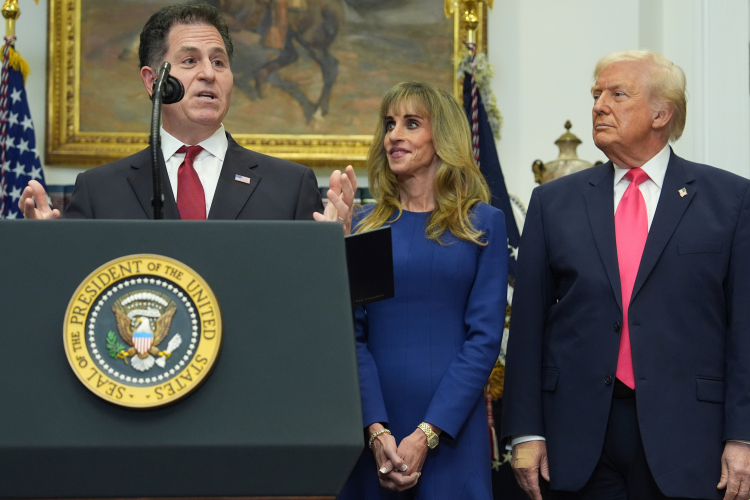
A novel feature of the new Trump Accounts is that charitable foundations can contribute to groups of children based on geography. For example, the Michael and Susan Dell Foundation pledged to contribute $6.25 billion to Trump Accounts for children. This gift will provide $250 per child for children age 10 and under who reside in zip code areas where the median income is below $150,000. The Dell gift is structured to spread small amounts ($250) widely across a somewhat general population.
How could Congress or foundations enhance Trump Accounts? Congress could legislate that an additional contribution, such as $2,000, would be received by children in persistent poverty counties. Because of the importance of compounded investment returns, policymakers could target younger children, for example, ages 0 to 4. In this case, about 1.3 million children would receive the $2,000 contribution, resulting in federal outlays of about $2.6 billion. Then, every year going forward, Congress could provide an additional contribution to newborns. Currently, there are about 260,000 children under age 1 in the persistent poverty counties, suggesting the annual costs in the forward years would be about $520 million per year.
Newborns in these counties will already qualify for the $1,000 current-law government amount and the $250 Dell grant. With an additional $2,000 contribution, the newborns would start with a balance of $3,250. The default investment in these accounts will be something like an S&P 500 index fund, which historically has had about a 10 percent annual return. Over 18 years, the balances would reach $18,100 ($11,000 after inflation).
That amount may seem modest, but it is important to note that median net wealth of African Americans with low income in a recent year was only $2,700. An 18-year-old with more wealth than is typical in a locality might view his or her opportunities and choices very differently. Foundations or states could also contribute to accounts in persistent poverty counties, which would drive balances even higher.
Would some Democrats support enhanced Trump Accounts? Quite possibly. In recent years, Democrats have specifically advocated for policies that target federal dollars to these counties. In addition, a forerunner to Trump Accounts (“Baby Bonds”) was proposed by Senator Corey Booker and Representative Ayanna Pressley as way to close the racial wealth gap.
Republicans may also be inclined to support enhanced accounts and not just because of pride in one of President Trump’s achievements. For years, Republicans have reached back into history to claim Lyndon Johnson’s “War on Poverty” did not work. That “war” was launched when Johnson visited an Appalachian family in Martin County, Kentucky. That county is still impoverished today. Republicans may be ready to try new policy tools to break the persistence of poverty.
