




Energy markets are in turmoil. Prices are lurching, supply chains are being redrawn, and within weeks the confident forecasts will be quietly revised — and the new ones will be just as confident. This is the ritual. Every year, the world’s most sophisticated energy institutions publish charts showing exactly where we will be in 2035, 2040, 2050. Smooth curves. Precise numbers. The future, apparently, has been solved. Then a war reshapes European gas supply overnight. Venezuela collapses. Military strikes on Iranian infrastructure reroute tanker traffic across ocean basins. The charts are revised. New smooth curves appear. And the confidence does not waver. What follows is equally predictable: a wave of revised forecasts, new policy roadmaps, and calls for coordinated intervention — all dressed in the authority of precision. Watch for it.
This is not primarily a failure of data or analysis. It is a failure of thinking -- specifically, of applying the wrong kind of thinking to a world that doesn't cooperate with it.
The philosopher Karl Popper drew a distinction that has never been more relevant. Some systems, he observed, behave like clocks: complicated, perhaps, but ultimately knowable. Given the right inputs and enough expertise, outputs can be predicted. Engineers build bridges this way. Accountants close books this way. Other systems behave like clouds: their components interact, adapt, and co-evolve. Small perturbations cascade unpredictably. The system tomorrow is not simply the system today plus change — it is something genuinely new. Weather is a cloud. Markets are clouds. Geopolitics is a cloud.
The global energy system is emphatically a cloud.
It encompasses the strategic calculations of sovereign states, the investment decisions of private actors operating under uncertainty, the pace of technological disruption, the social behavior of billions of consumers, and the ever-present possibility of war, sanctions, and political rupture. These forces do not interact linearly. They surprise. Venezuela’s trajectory was not written in its geology. Iran’s position in global oil markets has lurched repeatedly — with changes of administration, sanctions regimes, and now direct military conflict. The US shale revolution — which remade the entire geopolitical map of energy in less than a decade — appeared in almost none of the confident forecasts that preceded it.
Yet our dominant institutions respond to this cloud world with clock tools. The most influential energy forecasts on the planet produce precisely calibrated projections of demand, supply, and transition pathways stretching decades into the future. These are extraordinary feats of clock thinking: rigorous, internally consistent, and built on the assumption that the terrain ahead resembles the terrain behind. The problem is not the specific numbers. It is the epistemic posture -- the confidence that the future of a cloud system can be mapped at all.
Consider the most instructive recent example. Through the 2000s, the International Energy Agency — the world’s most authoritative energy forecaster — consistently projected US oil and gas production declining through 2030. The maps were detailed, credible, and built on reasonable extrapolation of existing trends. Then the shale revolution arrived. Within a decade, the United States became the world’s largest oil and gas producer, remaking the geopolitical landscape the IEA had been carefully charting. The terrain moved. The maps did not. A decade of confident forecasts had been describing a world that no longer existed. Now consider Germany. Its Energiewende — one of the most ambitious energy transition plans ever undertaken — was built on a rational premise: cheap, stable Russian pipeline gas would serve as a bridge fuel while renewables scaled. The map was detailed and internally consistent. What it could not encode was a geopolitical variable: Vladimir Putin’s strategic calculus. When Russia invaded Ukraine in 2022, Germany found itself restarting coal plants scheduled for retirement and scrambling for emergency LNG shipments at crisis prices. The map had been optimized for a world that geopolitics had already ended.
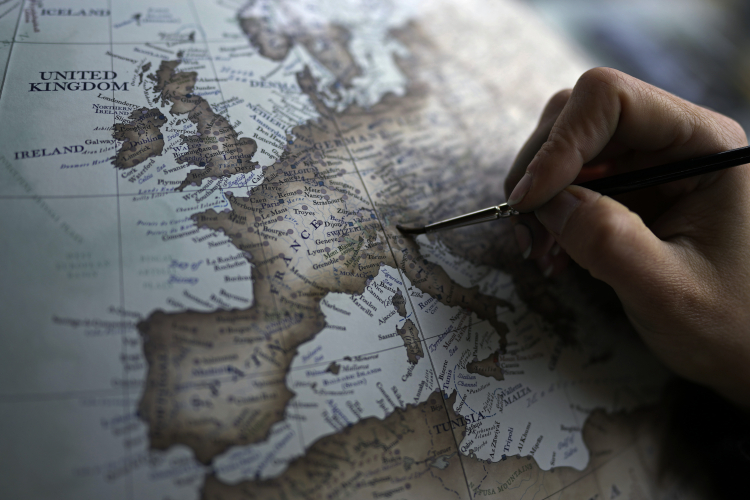
Maps are the instruments of clock thinking. They encode a terrain assumed to be stable. When the terrain is actually shifting -- when new technologies emerge, when regimes fall, when alliances fracture -- the map doesn't feel wrong until suddenly you are irretrievably lost. And the more detailed and authoritative the map, the more dangerous: it crowds out the judgment, improvisation, and adaptability that navigating a cloud system actually requires.
The alternative is not to abandon analysis -- that would be its own kind of folly. It is to hold forecasts differently. Think of a compass rather than a map. A compass doesn't tell you where to go or what the terrain contains. It provides orientation -- a fixed reference point --while demanding that the navigator exercise real-time judgment about what lies ahead. In energy terms, this means scenarios rather than predictions, each built around genuinely different assumptions about which way the cloud will move. It means designing policy for robustness rather than optimizing for a single projected future. It means preserving optionality -- keeping multiple supply pathways open -- precisely because the terrain will shift in ways no model can anticipate.
It also means honesty about what we cannot know. The broad direction of travel toward lower-carbon systems is well-established. But the pace, the sequence, the geopolitical disruptions along the way, and the role of hydrocarbons during the transition are all genuinely uncertain.
Treating that uncertainty as a rounding error to be smoothed away in a forecast is not analytical rigor. It is a category mistake -- the mistake of a clock thinker in a cloud world.
The cost of that mistake is not merely intellectual. Policies built around maps become brittle when terrain shifts. Energy infrastructure investments locked in around a single projected future can strand assets and destabilize economies when reality diverges -- as it always does. Nations that plan as if the cloud will behave like a clock find themselves navigating a transformed landscape with instruments that no longer correspond to the ground beneath their feet.
Which brings us to the hardest part. Modern institutions — governments, regulatory bodies, investors — are structurally dependent on clock thinking. Investors require forecasts. Policymakers require roadmaps. There is enormous institutional pressure to produce smooth curves, to project confidence, to behave as if the cloud were a clock. This is not merely ignorance. It is a choice, and it has a cost. When the current turmoil passes and the revised roadmaps arrive — and they will arrive, with the same authority as the ones they replace — that cost will be embedded in every infrastructure decision, every supply contract, every policy commitment built on the new map. The institutions that reach for clock tools in a cloud world are not simply wrong. They are building brittleness into systems that require resilience.
But Popper’s insight cuts deeper than convenience. A clock thinker who mistakes a cloud for a clock doesn’t just produce wrong forecasts. He builds systems that cannot adapt when reality arrives. Venezuela, Ukraine, the strikes on Iranian infrastructure, the next disruption we haven’t yet named — these are not anomalies to be corrected in the next revision. They are the nature of the system itself.
This is where the deepest difficulty lies — and where energy leaders now stand. A compass doesn’t just help when the map is outdated. The harder challenge emerges when the compass itself seems to point in conflicting directions at once. The energy transition compass has long read clearly: decarbonize, diversify, reduce dependence on volatile suppliers. A major geopolitical rupture in a hydrocarbon-producing region both validates that compass — strengthening the case for renewables and domestic energy independence — and complicates it, by urgently resurfacing the case for supply security, strategic reserves, and the very infrastructure the transition map had scheduled for retirement. Both readings are legitimate. The compass has not broken. But it is pointing at two things simultaneously, and no map resolves that tension for you.
This is the real demand on institutions in a cloud world: not simply preferring the compass over the map, but knowing how to hold both — and, crucially, having the integrity to recognize when the two instruments conflict rather than pretending one of them is telling the truth clearly. The question is not how to make better maps of terrain that will not hold still. It is whether our institutions are capable of navigating honestly when map and compass disagree. That capacity cannot be built after the next disruption. It has to be built now, before the new smooth curves arrive and the false confidence settles back in.
