




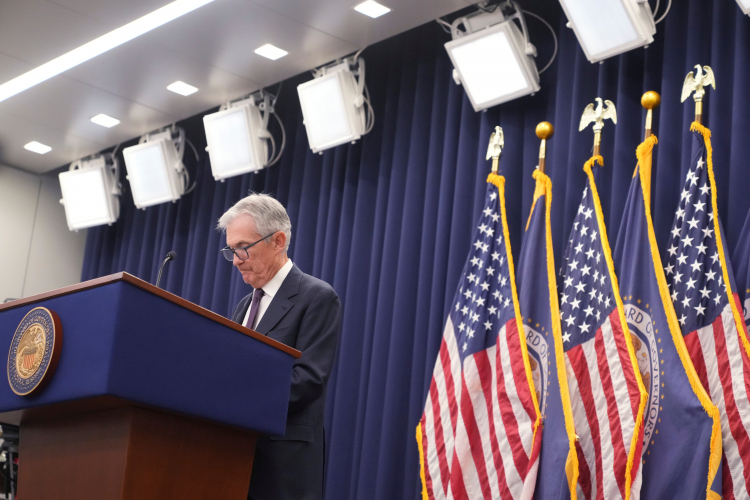
In holding rates steady, Jerome Powell—the worst Fed Chair since Arthur Burns—has once again let his anti-Trump animus cloud his judgment. The damage will not show up only on Wall Street.
It will show up in the monthly payment on a starter home, the financing costs of a machine-tool purchase, the builder who delays a project, the manufacturer who shelves an expansion, and the family that watches its credit costs stay painfully high while the Powell Fed congratulates itself for being “disciplined.”
This is not just a spiteful and damaging policy mistake. It is a fundamental misreading of the economy.
Powell continues act as if inflation is broad-based, demand-driven, and on the verge of reaccelerating. As I have explained in multiple columns on this page, it clearly isn’t.
The data—from CPI to PPI to core goods—point to an array of inflation forces that are cooling. Core goods inflation remains subdued. Powell’s long wrongly predicted tariff-driven inflation surge simply hasn’t materialized. What we are seeing instead is the Powell Fed—new Board member Stephen I. Miran is the clear-eyed outlier--clinging to an outdated narrative while ignoring what the numbers are actually saying.
Now add $100 oil to the mix, and the first-order effect is straightforward: this is a fiscal drag on real income. As consumers pay more at the pump, they will have less to spend elsewhere. That slows growth.
This doesn’t signal an overheating economy. It is a supply shock that weakens demand—and monetary policy cannot pump more oil or lower tanker insurance rates.
What the Powell can do—and has done--is make the damage worse. By holding rates in this environment, Powell is effectively tightening into a slowdown.
Previous Fed Chairs have understood this crucial distinction. Alan Greenspan built a disciplined “look-through” approach to energy shocks, focusing on underlying inflation rather than temporary spikes in headline prices.
Ben Bernanke made the logic explicit: oil shocks act like a fiscal drag and tightening into them can amplify the downturn. When oil surged in 2008, Bernanke didn’t freeze rates—he continued to cut them aggressively. That was not recklessness. It was correct diagnosis.
Powell is doing the opposite. He is leaning on a speculative second-order inflation story—tariffs, expectations, spillovers—that simply is not showing up in the data. Core inflation is not breaking out. Goods inflation is not surging. Tariffs are not driving a sustained inflation cycle. Yet Powell is acting as if all of that is already happening.
Where Greenspan would have looked through this noise and Bernanke would have cushioned the blow with rate cuts, Powell is standing still—and in doing so, holding rates too tight.
This latest major Powell blunder—the fourth in his term--is even less defensible because the United States is far better positioned today to absorb an oil shock than in earlier eras. Thanks to President Trump’s pursuit of strategic energy dominance, America now produces oil at near-record levels and has moved from chronic import dependence to net petroleum exporter status.
This means more of the income generated by higher oil prices stays within the domestic economy rather than leaking overseas. So while oil shocks still may hurt, Powell is calibrating as if every energy spike carries the same inflationary menace it did during the bygone days of OPEC dominance. It doesn’t.
Adding to this policy concern is an institutional issue that should set off alarm bells. Powell has clearly signaled his intention to remain on the Board of Governors even after his term as Chair expires. This is nothing more than a Powell extortion expedition for a “plea deal”—having possibly acted above the law, he is trying to evade any possible accountability by conditioning his departure on the Department of Justice dropping its probe of Powell.
While remaining on the Board may be legally permissible, it would break the modern pattern of Chairs making a clean exit when their chairmanship ends. For more than seventy years, Chairs, from William McChesney Martin Jr., Arthur Burns, and Paul Volcker to Alan Greenspan, Ben Bernanke, and Janet Yellen, have exited when their term ends.
Each of these Chairs understood that Fed credibility requires a clean break—not a shadow chair hovering in the background. If Powell remains on the Board, he will blur authority, weaken incoming leadership, and inject further uncertainty into markets that depend on clarity.
So get thee gone Jay, for the sake of this country and the integrity of the Fed.
