




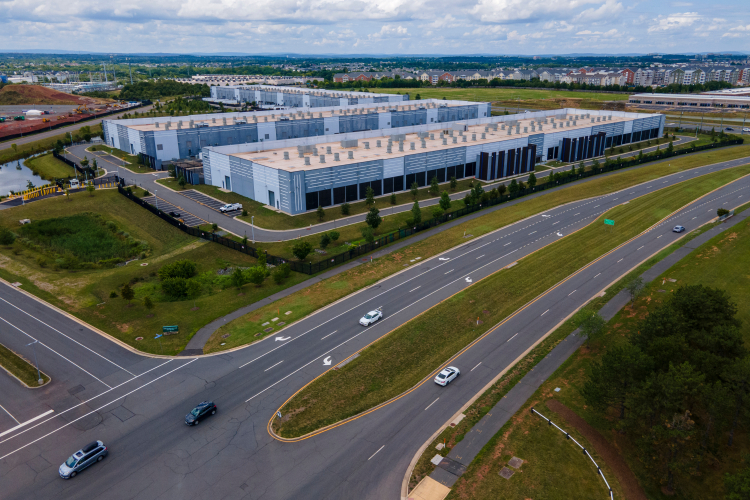
Behind every hyperscale data centre lies a global free market of energy, copper, and logistics that must be discussed just as much as artificial intelligence.
The Hidden Supply Chain Powering the AI Revolution
The AI boom sweeping across the United States is one of the most consequential economic developments of our lifetimes. It promises to transform medicine, commerce, and communication on a scale that very few people are seriously grappling with. Most of the commentary focuses on software: the models, the breakthroughs, the jobs that will exist or cease to exist. Far fewer people are asking what actually keeps these machines running. Cold compute and silicon are only part of the answer. The energy and physical resources required to power hyperscale data centres and the broader computational architecture of the AI economy are enormous, and growing fast. Behind every headline-grabbing breakthrough in artificial intelligence sits a massive, rapidly expanding, and deeply underappreciated physical supply chain.
The Numbers Are Not Abstract
OpenAI's Stargate data centre will consume roughly 1.2 GW of power, exactly half of the total peak system load of El Paso Electric, the regional utility serving the project. This is not an outlier. It is the shape of things to come. Projects of this scale are already reshaping regional electricity markets across the country. In Arizona alone, electricity demand has grown by 8%, driven by over 100 operational data centres with many more in the pipeline. The average data centre demands roughly 500 MW of power, enough to supply 375,000 homes for an entire year.
Whether grids slowly expand to meet demand or data companies build out their own energy sources, the demand for electricity and its supporting infrastructure is set to continue growing. And the pressure does not stop at electricity. For investors and policymakers alike, the AI boom is increasingly translating into surging demand for energy, metals, and transport capacity. S&P Global has projected a copper supply deficit of up to 10 million metric tons by 2040, driven by AI infrastructure and accelerating defence spending. That would represent one of the most significant commodity supply squeezes in modern economic history.
It Is Not Just About Generating More Power
There is a temptation to reduce this to an electricity problem and to just suggest that we require greater electricity generation. That instinct should be resisted. We need natural gas for fuelling power plants, copper wire for transmission, or rare earths for turbine generators, electric vehicles, and energy storage systems. Every one of these resources has to be explored, mined, refined, traded, and transported, often across multiple continents, before it can serve any function in an AI data centre.
Each stage of that process is a market in its own right, with its own price signals, its own supply constraints, and its own vulnerability to disruption. Export controls, geopolitical crises, and shipping bottlenecks are hitting commodity markets with increasing frequency, and technological industries are being caught flat-footed when they do. The lesson here is not that we need more state intervention. Governments across the world must resist the temptation to try to stabilise commodity markets through state direction. We need more resilient, flexible, open markets; ones that can absorb shocks and reroute supply without grinding to a halt waiting for ever-changing political direction.
Data centres have gone from ground zero to operational in a year's time, hosting vast and intricate machinery all dependent on prior logistics, delivery, and upstream market operations. Supply chains, shipping routes, and trade networks provide an invisible background of infrastructure for the development of the AI boom. If hyperscale computing is the visible face of the AI revolution, global commodity logistics are its hidden backbone.
Let’s Trust Private Companies and Markets to Do What Governments Cannot
In an era of geopolitical fragmentation, resilient supply chains are fast becoming a genuine competitive advantage. The question is who provides that resilience, and the answer, as it so often is, is private enterprise operating across borders, absorbing risk, and responding to price signals in real time.
Firms such as Vitol, Petredec, BW LPG, and BGN Group are not peripheral actors in this story. They are market stabilisers. By moving energy and raw materials quickly when disruptions occur, and by absorbing volatility across global commodity markets, these traders perform a function that no state apparatus could replicate at comparable speed, scale, or cost-efficiency. BGN Group, a prominent trader headquartered in Geneva with a major US presence in Houston, spans the full width of the supply chain: trading, shipping and chartering, distribution, storage, and risk management. Worldwide logistics companies with flexible fleets and transport sizes can smooth out volatility by maintaining buffer stocks or quickly shifting suppliers. In doing so, they help ensure that supply shocks do not cascade into wider industrial slowdowns. They are the backbone of the AI revolution and are being driven by private open markets.
Think about what a data centre actually needs to function: LNG from the Middle East, copper from Chile, chips from Taiwan. Even short disruptions in any one of these markets could stall multi-billion dollar technology investments. Logistics companies and commodity traders keep this system functioning, and they do so because the market rewards them for it, not because a government directive told them to.
The risks are not hypothetical. Iranian missiles have struck the Ras Laffan LNG terminal in Qatar this week, the world's largest, causing extensive damage and sending Brent crude above $107 a barrel. With the Strait of Hormuz already effectively closed, roughly a fifth of global LNG supply now hangs in the balance. Any AI data centre that depends on Gulf LNG is already feeling the consequences, and the firms with the most diversified logistics networks and the most agile chartering strategies will be the ones best placed to keep the lights on.
New Corridors, New Opportunities
Geopolitical risk in the Middle East will, no doubt, continue to cause bumps in the road, but logistics companies have the tools to overcome these. Companies have been expanding their fleet with ships of all sizes able to access a greater variety of ports. Fleet diversification and flexible chartering strategies allow traders to reroute cargoes quickly when markets tighten. Others are building rail networks or developing new trade corridors, like those along the Lobito Corridor or the Trans-Caspian Corridor, which can bypass riskier regions. These emerging corridors could become critical for the commodities that power the digital economy. These are not government-designed solutions. They are private capital following price signals and identifying commercial opportunities. That is the market working exactly as it should.
BGN Group offers a compelling case study in what commercially-led engagement with resource-rich nations can look like. Logistics companies are more than tools; they can also be strategic partners. In the Democratic Republic of Congo, the firm helped the government to establish a digital trade facilitation platform, streamlining commodity trade flows and expanding the volume of resources, including cobalt, that can reach global markets. Improving trade efficiency at the point of extraction is not charity. It is good business and ultimately strengthens supply reliability for American industry.
What Policymakers Should and Should Not Do
The instinct of governments facing complex supply chain challenges is almost always to centrally direct them: to create agencies, commission reports,and generally add bureaucratic layers that slow down precisely the market responsiveness they are supposed to be encouraging. That instinct should be firmly resisted.
What policymakers can do and should do is reduce friction. As the AI economy expands, supply security will increasingly become a question not just of technology policy but of market architecture. Clearer regulatory frameworks, streamlined customs cooperation, and lower barriers to cross-border commodity trade would do a great deal to improve America's AI supply chain resilience. Reducing friction in global commodity markets is just as important as investing in the next generation of processors. The private sector, given the right parameters to operate in, will find the solutions.
As the AI economy expands, supply security will increasingly become a question of market architecture, not just technology policy. The commodity supply chains that power the AI revolution need to be resilient, flexible, and deeply integrated with global markets. Governments can help by getting out of the way, removing trade barriers, and allowing commodity traders and logistics companies to do what they do best. The United States will not win the AI race on the strength of its software alone. It will win it, or lose it, on the strength of the invisible infrastructure that no one in Washington is talking about.
