




One year ago, the case for tariffs rested on four pillars: they would fund the government, decouple supply chains, rebalance trade, and give America negotiating leverage. I argued, using theory and history, that none of them held much water. But now we have something better to look at than theory or historical analogues: evidence.
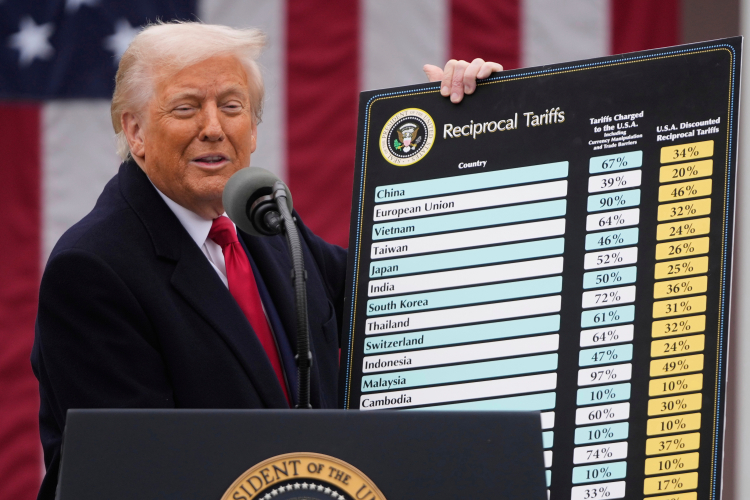
On April 2, 2025, President Trump announced “Liberation Day,” where sweeping tariffs were imposed on nearly every country on earth, whether they were friend or foe, rich or poor, or (strangely) inhabited or uninhabited. The rates ranged from 10 to 50 percent and covered some 180 nations. Trump promised us that it would be one of the most important days in American history, that it would raise trillions and trillions of dollars, reshore American jobs, and make America wealthy again.
Twelve months on, it’s time to assess.
Funding
The revenue case for tariffs was by far the weakest and most over-stated by the Administration and it has not improved with age.
Recall that Peter Navarro said that tariffs would generate an additional $6 trillion over the next decade, working out to an average of $600 billion per year. Actual revenues raised fell far short of that. From April 2025 to February 2026, the government collected about $166 billion in IEEPA tariff revenue. While that sounds like a lot of money, it’s a drop in the bucket compared to the $7 trillion of federal spending and nowhere near replacing income tax revenue, which for 2025 totaled $2.7 trillion.
Worse still, these tariffs are estimated to have cost the average American household an additional $1,700 in 2025. With an estimated 134.8 million households in the U.S. for 2025, that equates to $229.2 billion in additional expenses for Americans. In other words, American households paid more in the form of higher prices because of the tariffs than the government collected in tariff revenue. We were already losing money before the courts got involved.
And “get involved” they did. In February of 2026, the Supreme Court struck down the IEEPA tariffs, meaning that now the $166 billion collected is potentially going to have to be refunded. And while American importers could potentially be receiving refunds, it seems unlikely that the millions of households are going to see refunds for their additional expenses.
Decoupling
The second claim, that tariffs would shift supply chains and reshore American manufacturing jobs, was obviously the most emotionally compelling argument for working class voters. It was also the one that most spectacularly failed.
From April 2025 to February 2026, the US manufacturing sector lost 89,000 jobs. The Institute for Supply Management’s monthly report for January cited the first increase in manufacturing activity in twelve months, though still declining manufacturing employment. However, they also caution that “Although these are positive signs for the start of the year, they are tempered by commentary citing that January is a reorder month after the holidays, and some buying appears to be to get ahead of expected price increases due to ongoing tariff issues.” The February ISM report again saw increases in manufacturing activity accompanied by falling employment.
This is exactly what pre-Liberation Day opponents warned about. When you tax the inputs that manufacturers need, like steel, aluminum, and raw materials, you raise the cost of production in downstream industries. America is an advanced manufacturing economy. Our comparative advantage lies in importing raw materials and transforming them into high-value goods. Taxing the inputs does not strengthen American manufacturing, it hinders it. When the cost of production rises, the inevitable result is decreased employment and greater automation. The tariff that protects one steel worker eliminates multiple workers in downstream manufacturing industries, which is exactly what we saw with the 2018 tariffs, too.
One year ago, Howard Lutnick said, “in the fourth quarter of 2025, this economy is going to be humming.” President Trump, citing the Atlanta Fed’s GDPNow, proclaimed that the economy would grow at an annualized rate of 5.4% for the fourth quarter of 2025. The reality? A mere 0.7%, bringing 2025’s GDP growth rate to a mere 2.1%.
Rebalancing Trade
On this, the New Right can claim to have succeeded in one very narrow sense: the bilateral goods trade deficit with China did decrease by 31.6% compared to 2024. There is, of course, the serious and well-documented problem of transshipment -- the idea that e.g. China could simply route their shipments to the US through e.g. Europe, acquiring a European shipping label along the way, and thus only reduce our Chinese imports in a de jure but not de facto way -- that is so severe that the President announced a new Trade Fraud Task Force. Insofar as this is the reason why the trade deficit we have with China has fallen, then its celebration is, at best, premature.
But what about the overall trade deficit? As I’ve written before, the trade deficit itself is perhaps the single most misunderstood concept in all of economics. However, the Administration has loudly and vociferously proclaimed that reducing it is of utmost importance. Far from reducing it, the trade deficit stands at a record high, having grown 2.1% over the course of 2025.
And when it comes to getting tough with China, trade patterns look even more grim. While Chinese exports to the U.S. fell by about 30%, China’s overall exports actually rose by 5.5% over 2025 as they further diversified their trade with e.g. the EU, Southeast Asia, Latin America, and Africa instead. This propelled them to a $1.2 trillion trade surplus for 2025.
Instead, what we increasingly see are countries deciding to shift their trade away from the U.S. and toward other countries. Canadian Prime Minister Mark Carney summed it up, referring to China of all countries as “more predictable” than the U.S.
And while pushing our neighbors away may eventually lead to a smaller trade deficit than what we have now, it will be because other countries supplant U.S. trade with other, more reliable trading partners. This will only make us poorer, not richer.
Negotiations
Here, tariff policy initially showed genuine, though narrow, potential. Unfortunately, it’s also the area where tariff policy undermined its own success.
In the beginning stages of 2025, the Trump Administration racked up quick trade victories against Columbia, Canada, and Mexico and, as I wrote, “there’s an argument to be made that El Salvador [was] willing to accept U.S. prisoners in the hopes that they, too, will be spared from tariffs in the future.” This was not surprising. Those countries are particularly dependent on US trade, the tariffs were imposed quickly, and there were clear, identifiable, and specific goals in each situation that could be easily assessed.
But then, Liberation Day was announced, with the President and his team repeatedly referring to the tariffs as “reciprocal.” While much was made about how the rates were determined, Trump heavily implied that if other countries lowered their tariffs and non-tariff barriers against the U.S., he would respond by lowering our tariffs against them. That’s what “reciprocal” means. And when the EU offered “zero-for-zero” tariffs on certain products, one would expect that the White House would claim victory, however this was not to be. Trump rejected that offer as not being enough. This sent a chilling message to the rest of the world: these tariffs are not “reciprocal.”
As if this message weren’t bad enough, the justifications for the tariffs kept multiplying and often contradicted themselves. Were these tariffs implemented as a negotiating tactic? The White House said yes, Scott Bessent said “we’ll see,” and Howard Lutnick said, “no.” Stephen Miran said that the tariffs were supposed to devalue the dollar on the world stage, Peter Navarro said that they were designed to raise revenue, and Howard Lutnick said that they were implemented to bring back manufacturing jobs… which he then said would be automated. And who could forget the Switzerland example, where President Trump raised their tariffs because he “didn’t really like the way she talked.” The whole Greenland debacle certainly didn’t help, either.
The bottom line here is that if tariffs were supposed to be a negotiating tactic, their implementation only served to undermine their already limited and diminishing effectiveness. Any successful negotiation begins with both parties understanding what the other wants to achieve. Without this, negotiations are doomed to fail before they even begin.
What We’ve (Re)learned
Imagine that you were told one year ago that this Administration was going to raise prices for Americans, wipe out 89,000 manufacturing jobs, achieve a record high trade deficit, and severely damage good will around the world. All of this so that we can reduce our trade deficit with China by about a third while also strengthening their position on the world stage. Would you have described this as “liberation?”
The tariff experiment of the past year did not fail because it was poorly executed, even though it was. It failed along predictable lines because both theory and history show that it fails. Tariffs are taxes, plain and simple. Because they are taxes, they change the incentives and shift burdens, but they do not create wealth. At best, they redistribute wealth that exists from the many to the few, but even that is a romantic fantasy.
The New Right is clever. They will adapt their framework, shift their goalposts, and find new ways to argue that this was actually the plan all along. And when they announce their next iteration of tariff policy, promising that this time will be different, economists will still be here with the same three word answer: no, it won’t.
In the meantime, as Adam Smith noted 250 years ago and as the past twelve months have confirmed once more, the wealth and prosperity of a nation does not come from keeping goods and materials out. It comes from letting them in and putting them into the hands of the most productive workers on the planet, bar none.
