




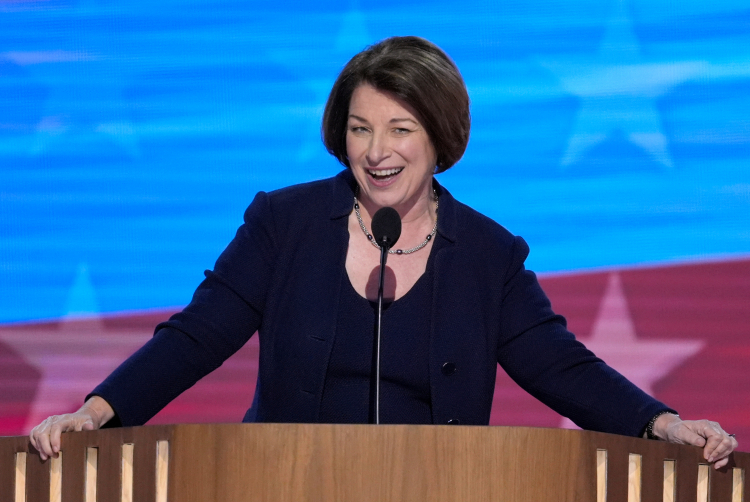
In the wake of the Department of Justice’s antitrust settlement with LiveNation, Senator Amy Klobuchar (D-Minn.) has introduced a bill that would allow state attorneys general to relitigate federal antitrust decisions. Changing the rules when you dislike the outcome of a judicial proceeding undermines the rule of law and makes for bad antitrust policy, which must rely on predictable standards for businesses to grow.
One of the great bequests of Western Civilization to the modern world is the concept of the rule of law, one with roots in classical antiquity but more recently refined by the Anglo-American tradition of common law. In the same manner that the rule of law prevents abuse of civil liberties by subjecting all citizens to the same rules, consistent antitrust standards bring stability to markets, enabling growth.
This is as true of predictable regulatory standards as it is of antitrust enforcement. Mergers and acquisitions are long, expensive processes; too many proposed deals have been agreed at great cost in time and money only to be vetoed by regulators or subjected to attempts to unwind them after the fact. Clear and predictable parameters – i.e. the rule of law – provide certainty to businesses that their investments will pay off.
Stability, certainty, and fairness is what Robert Bork had in mind with the consumer harm standard. Though never elevated to the Supreme Court, Bork nonetheless left a legacy through his influential writings that have governed antitrust enforcement for the past five decades. Some companies do become monopolies by successfully absorbing all their competitors. With no competition, they can jack up prices, harming consumers. This is where government action is legitimate to restore consumer choice.
Of course, monopolies rarely last for very long. Unless protected by government mandate, the high prices enabled by market consolidation creates an incentive to develop new ways of getting products to consumers at lower cost. The higher the price, the more competitors stand to profit by charging slightly less or improving quality at the same price. Uber disrupting taxi cartels is an example of this. Nonetheless, the consumer harm standard has generally served the public and the private sector well since the 1980s.
Sen. Klobuchar prefers a “keep litigating until I get the result I want” standard. Her proposed legislation – cosponsored by eight fellow Democrats, including Elizabeth Warrren – would allow state attorneys general to intervene in federal antitrust cases, even after they are resolved, to achieve a more punitive result. It would allow them to resurrect cases settled or dropped by the federal government. And it would require public disclosure of all communications around antitrust settlements, offers and counter-offers that came up in the process, and other proprietary information that could be used to damage the reputations of the companies and individuals involved.
Her bill would further hold judges to a nebulous “public interest standard” rather than the much clearer consumer harm standard. Judges would have discretion as to what constitutes the “public interest” and exercise power over the private sector accordingly.
In the Live Nation case, the parties reached a settlement. Whether or not one agrees with this outcome, it conformed to due process. Reopening it now instead of allowing Live Nation to comply with the agreement by paying a fine and divesting from some of its venues is vindictive and invites corruption. If politicians get repeated bites at the apple, antitrust becomes a tool for campaign fundraising shake-downs, not consumer protection.
As the saying goes, “A.G.” stands for “Aspiring Governor.” How many aspiring governors would turn down the opportunity to raise campaign cash be threatening to reopen settled cases after all the discovery is made public? Should every merger be subject to 51 reviews at the state and federal level? What if Puerto Rico wants to get in on the fun?
The argument for the bill is that the Trump administration has been too lax and pro-corporate in its antitrust enforcement. While it is true they have been friendly to some industries, several key antitrust positions have gone to so-called “Khanservatives,” self-proclaimed conservatives who want to punish corporate America for being too woke.
The Trump administration has arguably been too aggressive on antitrust – the allegation that the administration continuing Biden-era suits against Meta, Google, and Apple while opening a new one against Amazon is too permissive toward mergers is unconvincing.
Trump’s antitrust enforcement has been incoherent at best. The president did attempt to prevent a potential merger between Netflix and Warner Bros despite obvious consumer benefits from merging streaming services. This was untoward, as the shareholders of Warner Bros. should have the ultimate say on who gets to buy their property, not some government lawyer.
Ultimately, however, Netflix withdrew their offer because Paramount outbid them. Despite unhelpful noise from the president, the shareholders of Warner Bros. received a better offer, and it looks like they will take it. This is how mergers should work.
Senator Elizabeth Warren, like her colleague from Minnesota, does not agree. She would like prevent the Paramount deal because she regards the company’s CEO, David Ellison, as a political foe.
Without a clear standard like consumer harm, enforcement will necessarily become selective and politicized. That both parties seem poised to abandon principle for political preference has rendered the state of American antitrust policy a shambles.
Politicized antitrust review is more than a matter of bad economic policy. It is an inducement to public corruption and a threat to property rights. Sensible antitrust enforcement relies on clear standards and decisive settlements. Senator Klobuchar would abandon what has worked well in favor of endlessly relitigating cases until she gets her way.
