




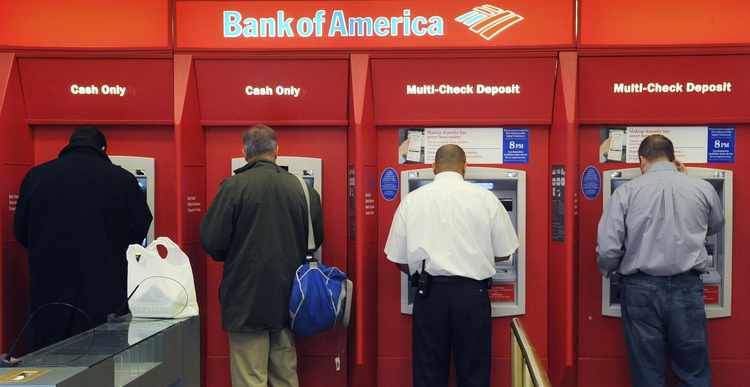
Of the most banal-but-sinister political efforts to enforce ideological orthodoxy in recent years, debanking must rank highly. Quietly, without warning or, often, explanation, Americans and the institutions or businesses they form have been told that their bank accounts are to be closed. A Christian organization engaged in charity work in Uganda, the National Committee for Religious Freedom, investors in cryptocurrencies, businesses in such industries as firearms, payday loans, and credit repair—all these and more have discovered their access to financial services, the circulatory system of modern economic life, suddenly terminated.
The Federal Trade Commission (FTC) recently sent missives to PayPal, Stripe, Visa, and Mastercard “warn[ing] the companies that any act or practice to deplatform customers or deny them access to financial products or services…may violate the FTC Act.” The Trump administration, for all its salutary action to excise the debanking canker from the body politic, has in part misdiagnosed the malady. Debanking’s primary cause is the state: a byzantine regulatory apparatus ripe for discretionary and capricious enforcement—not the freely chosen business practices of private financial institutions.
It is a fact of economics that the incentives guiding financial institutions—indeed, all businesses—direct them to serve a maximally broad customer base. More customers mean profits; fewer customers mean profits forgone.
Such statutes as the Bank Secrecy Act (BSA), which suspends liability like a sword of Damocles over financial institutions that do business with customers engaged in “suspicious” activities, all but coerce banks to decline service to individuals with whom they otherwise would. Should a bank make a “suspicious activity report”—often for such commonplace behavior as making a transaction approaching $10,000—the customer comes under suspicion. “[E]ach report…counts against a customer because financial institutions can face hundreds of millions of dollars in fines if it turns out that someone was indeed breaking the law and the accounts were not closed,” the Cato Institute’s Nicholas Anothony notes. Add thereto the federal government’s debanking initiatives of the last decade and a half (e.g., Operations Chokepoint and Chokepoint 2.0), during which bureaucrats employed the nebulous standard of “reputational risk” to ensure financial institutions’ activities adhered to their ideological and economic preferences.
The FTC frets that the four aforementioned firms are “denying their customers access to services due to their political or religious views.” And so far as the government has coerced or induced such decisions, reform must ensue. “Don’t shoot the messenger” is hardly a legal standard, but it is sound policy advice, nonetheless. Cases of debanking ought to prompt the Trump administration to investigate bad statutes in need of reform or the activities of the administrative state, and not private actors.
A financial institution might deny service to an organization for reasons adjacent to, or coterminous with, political belief. To take but two extreme cases, many banks would not wish to serve a neo-Nazi militia or an antifa cell, both of which as customers could prove an economic liability. The categorical and prescriptive quality of the FTC’s letters ought to worry conservatives, who know of the veiled complexities of markets and, therefore, value the liberty of private businesses to choose freely. Remove state interference to secure liberty; anything more lurches toward overreach, the mother of unintended consequences.
President Trump began his tenure with magisterial efforts to end debanking—most notably, eliminating the use of reputational risk. As he looks about for further reforms, his gaze should shift to Capitol Hill. To destroy reputational risk for good—that is, statutorily—Congress must act. Likewise, the BSA requires an overhaul, work which none but the legislative branch can accomplish. Administrative rulemaking, ominous letter-sending, and regulatory enforcement come more quickly and efficiently than lawmaking—as Progressives like Woodrow Wilson, the progenitor of the administrative state, knew well. But as modern progressives have found, administrative hubris and non-statutory lawmaking are evanescent and likely to incite the ire of free-minded Americans.
The pandemic of debanking surely must be halted before it becomes endemic to the American republic. The cure, however, must be well-crafted and fitting, lest it fail in its professed task and produce side effects that will further vex the patient.
