




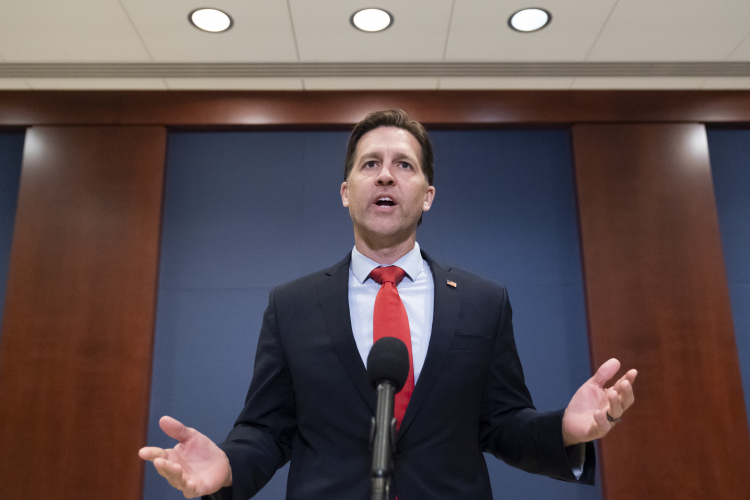
Ben Sasse couldn’t care less where a cure comes from, he just wants to survive. Sasse didn’t tell me that, and he didn’t need to. His desire to live is all over his face, literally and figuratively.
Sasse, as most know, has pancreatic cancer. And as he bluntly told readers upon receiving this most cruel of diagnoses, he’s going to die. Which is tragic for reasons beyond the sad truth that Sasse’s family will soon lose a beloved husband and father.
What makes it sick inducing is that the resources necessary to cure death sentences like pancreatic cancer already exist. The heartbreaking problem is we don't know which ones.
Still, it’s worth repeating that the resources exist in much the same way that everything necessary to create air conditioning, cars, airplanes, computers, smartphones, and WiFi has always existed too. The only barrier to people from the past enjoying miracle products that we take for granted today was a lack of information.
As George Gilder routinely reminds us, information is wealth. We once again have what’s necessary for Sasse to beat pancreatic cancer, but we don’t have the information.
What this means as Sasse valiantly fights a devastating death sentence is that the need for a pancreatic cancer cure is urgent. We hear politicians talk a lot about “all of the above” approaches to energy, but perhaps not enough about something similar when it comes to cures.
Instead, we hear a lot about how we must “beat China” to this or that. What mindless thinking. Doubtful? Simply conduct a search on Google of “Ben Sasse,” then click on “Images.”
We’ve lost too many people and we’ll lose too many more thanks to a disturbing, anti-Adam Smith, anti-markets, anti-reason belief among politicians that trade is war, that somehow achievements in other countries come at our expense. But most disturbing of all is the popular view that there should be a race between countries to create products, services, and cures.
None of this is to say that competition is bad, but it is to say that the best, quickest and most abundant leaps are an effect of talent collaborating with talent, regardless of country borders. People aren’t a cost or a threat, rather they’re an input.
This basic truth especially requires embrace now as Pfizer and other U.S. pharmaceutical companies make bigger and bigger investments in China. A tendency will no doubt arise to suggest that “Big Pharma” is playing a “globalist” game with the CCP, and other nonsensical claims.
More realistically, and as written here last week, 30 percent of clinical trials for innovative drugs are started by Chinese companies. Of importance, China conducts Phase I drug trials 50% faster and 40% cheaper than U.S. drugmakers, with Phase II trials 25% faster and 30% cheaper. Readers should revel in these truths.
They don’t just represent regulatory competition that will ideally force the FDA’s hand, they crucially signal the arrival of incredibly talented hands and minds in the creation of lifesaving drugs. The essential entry of Chinese talent into the drugmaking space recalls the pin factory Adam Smith visited in the 18th century, albeit one that pancreatic cures will eventually be manufactured inside of.
The only barrier to major commercial leaps is information, and information is produced in greatest amounts when production is spread across as many specialized hands and machines as possible. Hopefully U.S. politicians will recognize this amid growing pharmaceutical collaboration between the U.S. and China, and that they won’t restrain it. If they’re confused, a quick Google search of Sasse will yet again remind them that nationalism has a body count.
