




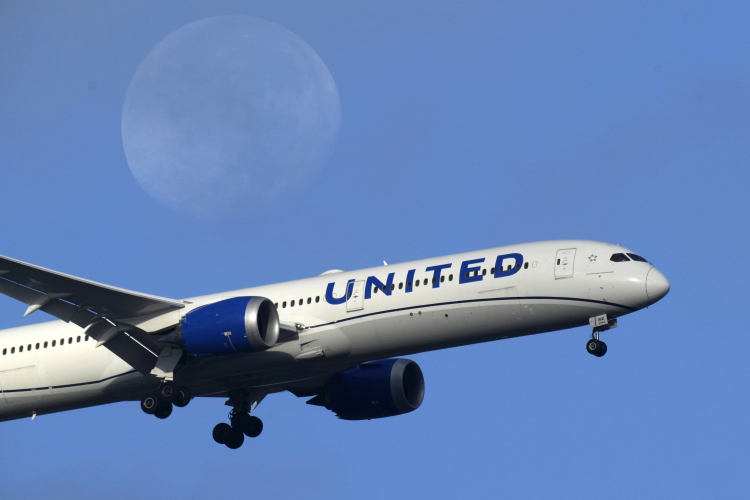
Airline travelers have had plenty to complain about lately, and United Airlines has been busy adding to the list. Rather than focusing on competing for passengers' business by offering better service and lower fares, United has spent much of the year trying to kneecap its rivals. Fortunately, the Trump administration is putting a stop to those efforts. Consumers are better off for it.
The trouble began in January, when United CEO Scott Kirby declared he’d do what he could to prevent his chief rival at Chicago O'Hare, American Airlines, from receiving additional gates. "We are not going to allow them to win a single gate at our expense," Kirby announced, vowing to "add as many flights as are required" to hold United's ground. It was a bold statement, and United followed through, inflating its summer schedule at O'Hare by an astounding 34 percent compared to the prior year.
The goal wasn't to serve more passengers. It was to crowd out the competition.
The FAA wasn't impressed. Alarmed by safety risks and the prospect of widespread cancellations from an airport operating far beyond its capacity, federal regulators stepped in and ordered United to cut roughly 200 flights from its ballooned summer schedule. The intervention was the right call. Transportation Secretary Sean Duffy and FAA Administrator Bryan Bedford deserve credit for restoring order and putting passenger safety ahead of one airline's market ambitions. Consumers should be grateful that common sense prevailed.
But United, apparently undeterred, quickly pivoted to a far more aggressive strategy: if you can't beat your competition, buy it.
Word leaked that Kirby met with President Trump to discuss a potential acquisition of American Airlines. Bipartisan condemnation came swiftly – and rightly so. A United-American merger would combine the two largest U.S. airlines by capacity, creating a behemoth that would more than double the fleet size of the next largest competitor. In a domestic market that already has only four major players, that level of consolidation should raise serious alarm bells for anyone who cares about keeping airfares affordable.
Reduced competition of this scale reliably produces higher prices, and the airline industry is no exception. A merged United-American would control nearly half of the U.S. market. For the average traveler, that's means the creation of one major company with little incentive to keep costs down.
Senators Mike Lee and Elizabeth Warren – not a duo who align often – launched a joint bipartisan probe into the proposed merger, with a focus on exactly these consumer-cost concerns. When senators who disagree on almost everything agree that a corporate deal would spell disaster, that's a signal worth heeding.
Soon after, President Trump joined in swatting down the idea. “I don’t like having them merge,” the president said in an interview, adding that consolidation “makes them lazy.”
Between putting a stop to United’s anticompetitive actions at O’Hare and dumping cold water on its misguided acquisition interest in American, the Trump administration is promoting competition and putting consumers first.
The administration has made reducing prices a central priority. Handing control of nearly half the country's air travel to a single company would work directly against that goal. If United's executives believed an acquisition of American would sail through Washington, they misread the room – and the math.
Free markets work when competition is real. That means companies should be jostling for customers' business by offering better service, lower fares, and more options – not by gaming gate allocations or gobbling up rivals to eliminate the pressure to perform. United’s recent maneuvers have been a case study in choosing market manipulation over market competition.
Here's a better path: compete on the merits. Invest in the customer experience. Win passengers with reliability, value, and service – not by locking competitors out of terminal space or absorbing them entirely. Consumers deserve airlines that are hungry for their business, not airlines that are busy eliminating the need to be.
United's anti-competitive gambits haven't worked out for the company. More importantly, they haven't been good for the millions of Americans who just want to fly somewhere at a fair price. American travelers want airlines that compete for their business with competitive fares, greater convenience and comfort, and a focus on reducing delays and cancellations. Who can complain about that?
