




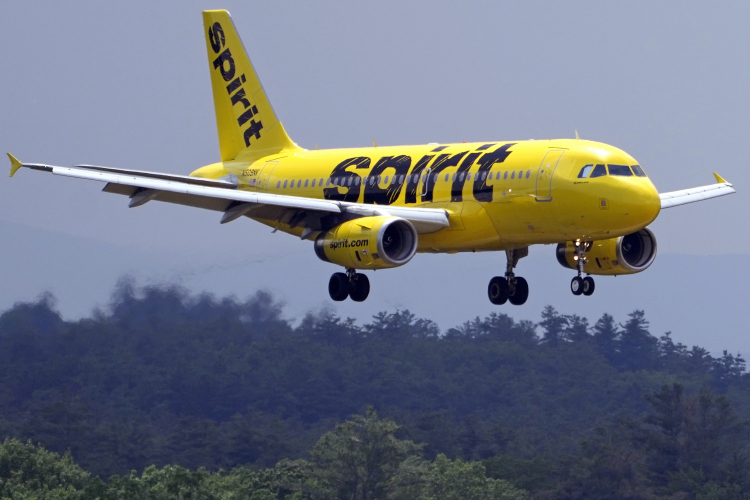
After one administration blocked Spirit Airlines’ merger in the name of protecting consumers, another may step in to prevent its collapse, lending as much as $500 million in exchange for a warrant to receive an ownership stake in the airline. This is government’s approach to economic policy in a nutshell.
“Maybe the federal government should help that one out,” President Trump said after Spirit Airlines sought an emergency bailout, citing concerns about the potential loss of 14,000 jobs, according to The Wall Street Journal (WSJ). Without government rescue, Spirit would likely have to liquidate, as its creditors object to the new reorganization plan under Chapter 11 bankruptcy. The airline already had to reorganize once—after the Department of Justice (DOJ) won its antitrust case against the Spirit-JetBlue merger.
Government assists the consumer. Government steps in to shield the worker. In “protecting” one of these two groups, government often creates the conditions from which it will later be called upon to rescue another. Paraphrasing Milton Friedman, one might say that there are hardly any problems government is asked to solve to which it did not contribute.
In 2006, Spirit emerged as an airline industry disruptor, having imported the European low-cost business model. The company thrived until more and more airlines adopted the same competitive tactics—lowering their fares, introducing new memberships and travel packages, and vying vigorously for consumers. Such are the rules and realities of a free market, the results of which benefit consumers the most. “Indeed, every ‘victory’ over your rivals in competitive markets is only temporary because the competitive fray is unending,” Samuel Gregg contends in The Next American Economy. Facing increasingly fierce competition from larger airlines, Spirit’s leadership decided in 2022 it could no longer withstand competition alone and would do better consolidating with another low-cost airline.
The DOJ judged that it knew better. “Lawyers for the government said that most of Spirit’s problems were temporary and that it would quickly get back on track to resume its rapid expansion,” as WSJ reported in 2024. The DOJ prevented JetBlue from buying Spirit––the deal the Spirit’s CEO thought could save the company. Ultimately, a federal judge blocked the merger, fearing that Spirit and JetBlue combined “would harm cost-conscious travelers.” Post- Covid travel exuberance, lower fares, rising losses, fierce competition from larger airlines, surging labor costs, and pilot shortages all worked against Spirit’s solvency, leading to its bankruptcy. Spirit never recovered.
Policymakers’ astounding inability to learn from their past failures should turn their thoughts to Adam Smith. In the Wealth of Nations he wrote, “every individual, it is evident, can in his local situation judge much better than any statesman or lawgiver can do for him.”
Now, as Spirit is poised to receive relief from the federal government, policymakers should heed the warning of the Cato Institute’s Tad DeHaven: “Once politicians start deciding which firms deserve rescue and which do not, market competition gives way to political competition.”
Should the federal government offer itself as a “lender of last resort” to private companies— as its promise of a $500 million loan to Spirit would effectively communicate to the market—it would foster moral hazard by dulling companies’ aversion to imprudent risk.
The invisible hand of the market would no longer channel companies’ self-interest toward consumer welfare with the same degree of discipline. Instead, companies would direct their entrepreneurial energy toward securing political favors from the government—loans, subsidies, bailouts, and, of course, equity stakes. Spirit’s inviting the Trump administration to take a stake would guarantee that the company will not fail again so long as the government remains its shareholder. One can only wonder what incentives that would reinforce.
President Trump has repeatedly shown readiness to shield workers from “unfair” market outcomes. The prospect of 14,000 American workers losing their jobs if Spirit had to liquidate likely moved the administration to arrange the rescue. Yet, like the administration’s other market ventures—“strategic stakes” in some companies, strategic investments to others, a sweeping tariffs agenda, and bailouts of politically favored industries—all come at Americans’ expense not only as consumers, but as taxpayers also. David Bahnsen explains: “The way a government with $3[9] trillion of debt creates a stock portfolio is by adding to its stockpile of debt.” Federal protection of Spirit workers will be financed by adding to that stockpile.
Improvident government intrusions into the market’s spontaneous order, arranged to benefit consumers, breed market disorders, which the government would feel called to “fix.” As if it came from the pages of Friedman’s Free to Choose, the unfolding of Spirit’s struggle to stay in business exemplifies this corollary of government intervention—“ludicrous if it were not so serious.”
