




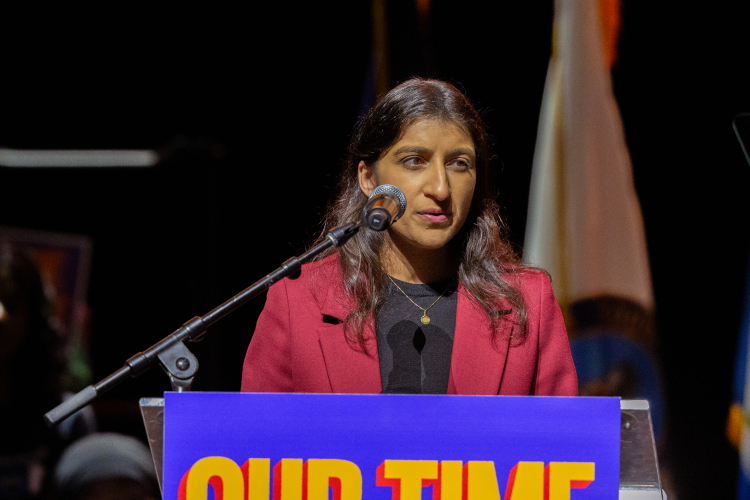
One of the lowlights of the Biden Administration was Lina Khan’s reign as Chair of the Federal Trade Commission (FTC). Khan is a (the?) leader of the Neo-Brandeisian movement, which advocates returning to the “big is de facto bad” school of antitrust enforcement. During Khan’s tenure, the FTC filed a record number of challenges to mergers and acquisitions. Khan’s crusade against big business made her a progressive rock star… and also won her some fans on the populist right.
Khan’s counterpart at the Justice Department’s Antitrust Division, Jonathan Kanter, shared Khan’s philosophy, which is why the Justice Department also brought a record number of antitrust cases during the Biden years. After President Trump told Khan those two words he loves so much, Khan returned to her prior job as professor at the Columbia School of Law. Khan is also the head of Columbia’s newly established Center for Law and the Economy, which is devoted to advancing progressive economic policies. One of the Center’s priorities is working with promising progressive students. This gives Khan an opportunity to influence generations of progressive lawyers, advocates, journalists, scholars, and politicians.
Khan remains influential amongst current Democratic politicians. She is an advisor to New York’s Mayor Zohran Mamdani and, according to numerous media reports, several prospective 2028 Democratic candidates have sought out Khan’s advice. Khan’s views are also being solicited by prominent Democrats like Senate Minority Leader Charles Schumer. These Democrats are looking for Khan’s ideas on ways to address the affordability crisis. That’s like asking Keith Richards for advice on healthy living. Khan’s aggressive approach to antitrust policy can actually make markets less competitive, thus making it unlikely that goods and services will become more affordable.
One example of how Lina Khan harmed consumers is the FTC’s success in blocking a merger of grocery store chain Kroger (owner of Harris Teeter, Ralphs, Food 4 Less and others), and Albertsons (owner of Safeway, Shaws, Randall’s, Shaw Markets and others). The FTC blocked the merger in part by claiming that Albertsons and Kroger only compete with traditional grocery stores. Limiting the market to traditional grocery stores excludes stores like Walmart, even though Walmart is the nation’s leading grocery retailer. A Kroger-Albertsons merger would not affect Walmart’s dominion of the grocery market. What it would do is allow Kroger and Albertsons to use economies of scale to increase efficiency and thus lower prices.
Khan also tried to revive enforcement of the Robinson-Patman Act. This New Deal-era law outlaws price discrimination, which is when a distributor offers a retailer an exclusive discount on products. Distributors offer some stores a discount because they can sell more of their product at a Walmart or Costco than at a mom-and-pop store. Thus, the distributor makes more money selling at Walmart even if they receive a lower price per unit. The last time the FTC sued a business for violating Robinson-Patman was in 2000. That’s because antitrust enforcers realized it was not good policy to sue businesses for the crime of keeping prices low. However, this did not deter Lina Khan from trying to revive Robinson-Patman enforcement. So, the Democrats’ affordability queen wants to punish Walmart for the crime of lower prices.
Perhaps the best example of antitrust enforcement making markets less competitive comes not from Lina Khan, but rather from her partner in crime Jonathan Kanter. Under Kanter’s leadership, the Justice Department’s Antitrust Division blocked the proposed merger of the discount airlines Spirit and JetBlue.
The Justice department successfully blocked the Spirit-Jet Blue merger on the grounds that allowing the merger would increase consolidation in the budget airline market. Similarly to the Albertsons and Kroger case, the limited definition of the relevant market allowed the Justice Department to ignore the fact that if the merger were approved, the resulting entity would control a mere 10% of the air travel market.
Now, Spirit is out of business.
If, as is a real possibility, Democrats gain control of one or even both houses of Congress this year and return to the White House in 2028, Lina Khan will become more influential than ever. This would increase government’s role in the economy, raising prices and crippling innovation. The only upside is that this might finally discredit the notion that we can regulate our way to prosperity.
