




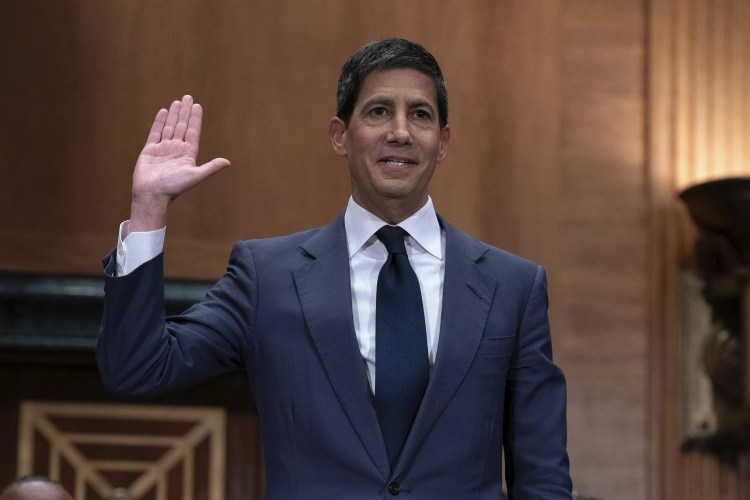
The Senate is expected to vote soon on Kevin Warsh’s nomination to serve as the next chair of the Federal Reserve. Warsh is widely expected to be confirmed.
If confirmed, Warsh will inherit an economy with significant long-term potential, but also a growing challenge on Main Street: uncertainty surrounding interest rates, financing conditions, and the affordability of capital for small businesses.
In conversations I conducted with small business owners across manufacturing, transportation, construction, equipment, logistics, and services while researching my recent book on economic growth, one theme surfaced repeatedly: uncertainty surrounding borrowing costs and financing conditions is increasingly slowing business expansion.
Warsh’s recent testimony offered perhaps the clearest blueprint yet for that transition. His framework is fundamentally different from the activist posture that has increasingly defined modern central banking. His argument is that America does not need a broader Federal Reserve involved in quasi-fiscal policy, market engineering, and prolonged intervention. It needs a narrower, more disciplined, inflation-focused institution that restores monetary credibility while improving conditions for community lenders and the small businesses they support.
For small businesses, the cost and predictability of borrowing matter enormously.
Unlike large corporations with direct access to capital markets, smaller firms rely heavily on commercial loans, equipment financing, lines of credit, and community-bank relationships to fund expansion and long-term investment.
That makes uncertainty surrounding interest rates especially consequential across the real economy.
This dynamic is why the next Federal Reserve chair must think beyond the traditional debate over whether interest rates should move incrementally higher or lower.
Warsh’s emphasis on monetary discipline reflects a broader belief that the Federal Reserve best supports long-term economic growth when borrowing conditions are stable, inflation expectations are anchored, and capital markets are not distorted by prolonged intervention.
That view also reflects skepticism toward prolonged quantitative easing and large-scale balance-sheet expansion, policies Warsh has argued can distort capital allocation, weaken inflation credibility, and create instability that ultimately reaches Main Street through borrowing costs and financing conditions.
Over the past two decades, the Federal Reserve’s role expanded dramatically through quantitative easing, prolonged balance-sheet growth, and increasing involvement in financial-market stabilization. Warsh’s testimony suggests a different direction, one where the central bank returns to a narrower interpretation of its mandate, with greater emphasis on price stability, monetary credibility, and predictable capital conditions for the broader economy.
That reality makes one of Warsh’s most important observations especially significant. He argued that “community banks and the small businesses they serve have been the most negatively impacted by the regulatory and supervision agenda of recent years.” That statement deserves serious attention.
For many small businesses, community banks remain essential relationship lenders, particularly across manufacturing, transportation, agriculture, and construction. Their importance increases when borrowing costs rise and credit conditions tighten. Unlike larger institutions that rely more heavily on standardized underwriting and capital-market activity, community banks often evaluate borrowers through longer-term operating relationships and local economic knowledge.
If those lenders weaken, capital access deteriorates precisely where economic growth is most dependent on entrepreneurial activity and local investment.
Inflation functions as a hidden tax on small businesses. Higher interest rates raise borrowing costs, compress margins, and make long-term investment harder to justify. Predictability matters almost as much as rates themselves.
Stable monetary conditions matter especially when businesses are evaluating long-term investment decisions.
Financial markets can adjust quickly to monetary shifts. Main Street businesses often cannot.
For small businesses dependent on loans, equipment financing, and relationship banking, stable borrowing conditions matter enormously.
That is why the significance of a Warsh-led Federal Reserve extends well beyond financial markets. It signals a possible return to a more disciplined monetary framework focused on inflation credibility, stable capital conditions, and long-term investment confidence.
If Kevin Warsh becomes the next Federal Reserve chair, the true test of his leadership will not simply be whether inflation falls or markets rally. It will be whether the Federal Reserve can restore the monetary stability necessary for Main Street businesses to borrow, invest, and plan for long-term growth again.
