




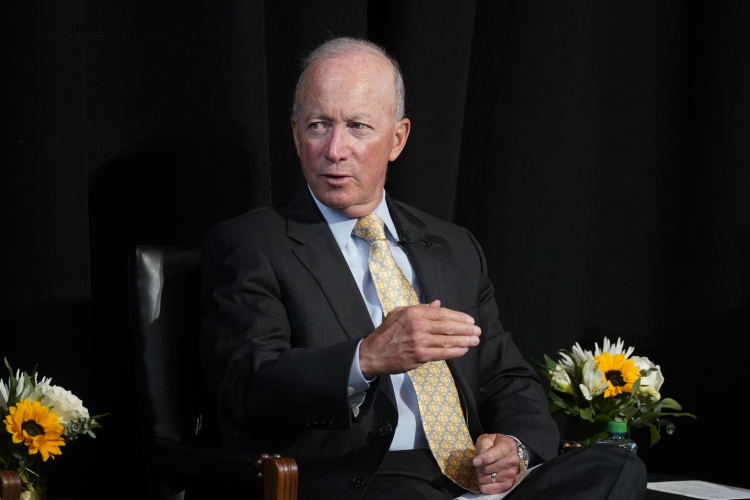
Mitch Daniels looks admiringly in the mirror through the words he puts on a page. See his latest Washington Post op-ed, and his comment that “No impulse is more human than wishfulness, the tendency to grasp at any straw that enables us to avert our eyes from difficult realities and put off facing them.”
Daniels is referencing the national debt, but really he’s talking about himself. Daniels sees himself as the sober man in a rather small room filled by the libertarians at Cato, the conservatives at AEI, and a few left-leaning Keynesians at Brookings, all who revel in what they deem a righteous, surely moral stance against rising government debt.
Not asked enough by the debt religionists is if they’re the ones in denial. All these decades of ministering to the rest of us about what we can’t see, and that because we can’t, we’re risking “the nation’s economic future and national security” as the “inexorable arithmetic piles up.” Would Daniels ever entertain the possibility that he’s the blind one, along with his allies? And no, this is not a defense of government spending or government debt.
Government spending is the biggest, most economy-sapping tax of all. Larry Ellison, Jensen Huang and Dario Amodei will work at all manner of tax rates, but they can’t innovate without capital.
Which speaks to the first thing Daniels et al don’t see: the crisis is now, and it’s been with us for decades. How many Oracles, Nvidias and Anthropics never came to be because government was consuming so much precious capital?
While Daniels et al are focused on debt, and what they deem a future crisis (call the national debt “global warming” for the right), some who follow markets have all along been focused on the extraction of precious wealth. The debt is a distraction.
Daniels et al naturally think it’s the story. Which is them revealing a misunderstanding of how markets work. They’re obsessed with symptoms, not causes. But as falling Treasury yields (a market signal) amid soaring debt over the last 45 years have made screamingly plain, the debt is a symptom of a way-too-much-tax-revenue problem.
How else could Treasury run up $39 trillion in debt unless the markets felt future tax revenues would dwarf those of the present? If willing to address the previous question in lieu of telling everyone else how irresponsible they are, Daniels et al might be willing to have a discussion about ways to reduce the flow of tax dollars into Treasury, and as a way to ensure not just less government spending, but less borrowing.
Alas, Daniels and friends continue to avert their supercilious gaze from market signals telling us the real crisis is that there is no debt crisis, all in favor of promoting the dangerous government and government-debt expanding fiction that more tax revenue is the fix for the debt. The only difference is that the policy dyspeptic in Daniels thinks the “miracle” born of AI-driven tax revenues allegedly necessary to pay off the debt won’t happen.
Actually, low Treasury yields are telling Daniels the tax revenue “miracle” will happen, thus making it possible for the federal government to continue to spend and borrow. Which is the point so-called “debt denialists” are making about the national debt: more tax revenue is its certain cause. "Debt denialists" watch markets.
The markets are telling us that a soaring national debt will be the norm until we reduce the tax revenues that enable the debt. Naturally, Daniels et al disagree in upturned nose fashion. They don't follow the markets that "debt denialists" do.
