




The political scientist Harold Lasswell wrote the best-titled book about modern politics. “Politics” he said, is about “Who Gets, What, When, and How.”
Lasswell’s instincts were right. Anyone who has worked in politics knows that it begins, and ends, with money. In government, there’s never enough money for everyone. Leadership involves making difficult decisions to deny taxpayers’ cash to some people and programs, when necessary, in the national interest.
President Donald Trump acknowledges this fact. In 2016, he lamented the country being “19 trillion dollars” in debt (now doubled to $38 trillion) and, upon returning to office in 2025, sanctioned DOGE to target government waste. Besides, “fiscal responsibility” was long a message of the Republican Party before Trump. Now, governing like a businessman, with the perspective of a cold balance sheet, should come easily to his administration.
Yet, Trump’s subordinates in government – at the Department of Transportation (DOT) – seem ready to do the opposite. Recent reports indicate that the department’s “Build America Bureau” is planning to give a taxpayer-funded $6 billion bailout to rescue a commercial disaster, Brightline West. It’s a project that will fail, at best, and vacuum up taxpayer money, at worst. Trump’s DOT needs to reject it.
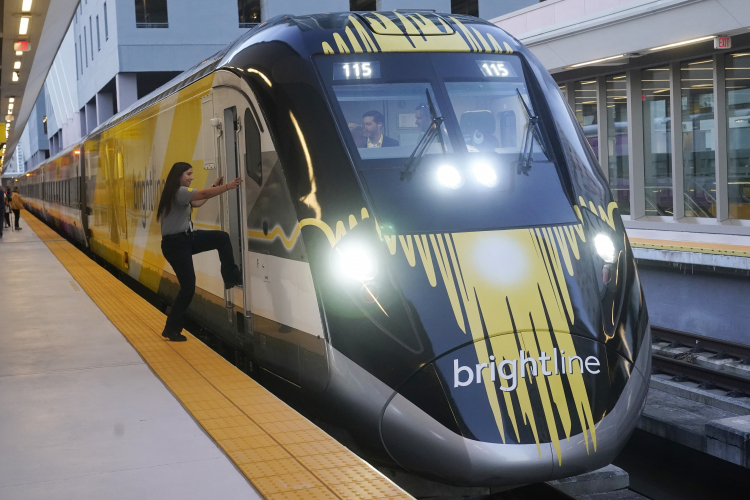
You may have heard of Brightline. It’s a private rail company in Florida – and the only private inter-city railroad in America – which runs a passenger train between Orlando and Miami via West Palm Beach. Brightline began full service in 2023 and, charging $80 per ticket for a three-hour ride, expected to carry 6.6 million passengers per year.
They failed. Brightline’s Florida ridership last year was just 47 percent of estimates, as people continued to fly and drive for convenience, and it has consistently underperformed. Despite modest ridership growth, the company’s revenue is just 33 percent of what expected, and it’s a whopping $5.5 billion in debt. Ernest & Young, the auditing firm, projects bankruptcy soon. Brightline’s bonds are now graded “CCC” by Kroll with a negative outlook, i.e., junk bond status.
Given its repeated failures to break even, Brightline isn’t worthy of more taxpayer funding for any project. First, it needs to get its act together. For private projects, federal support should always be the last step, to cross the finish line, after a substantial stack of private funding has been obtained. It should not be the first (and only) option on the table to save a project. That belies the free market and private competition.
At the very least, before fixing its Florida operation, Brightline should not be asking for more taxpayer money to build other projects. Yet, that’s exactly what they’re doing. The proposal before DOT, from Brightline West, seeks a $6.6 billion loan from the Railroad Rehabilitation and Improvement Financing (RRIF) program, which (as the name suggests) should be intended for existing projects and not new ones. Brightline “West” is the company’s new venture to allegedly build a train line between Las Vegas, Nevada, and Los Angeles, California.
Except, that’s fake news. Brightline West won’t be going into downtown Los Angeles, which is far too expensive to build even in their dreams. Instead, the station will be in Rancho Cucamonga, a small city over 40 miles away from Los Angeles by car (i.e., 1.5 hours in peak California traffic).
From Cucamonga, the train to Las Vegas will take another two hours. By contrast, one could fly to Las Vegas from LAX and back, in shorter time; each flight takes just 75 minutes. This fact undermines the profitability of the whole project. Without dirt-cheap tickets, there’s no way a four-hour train-and-road trip will compete with such a short flight, for those who don’t drive.
Despite that fact, this project is anything but dirt-cheap. Brightline West’s costs have already ballooned to $21.5 billion from a projected $8 billion – due to inflation, labor shortages, construction costs, and expensive regulatory compliance. Investors are pessimistic and the project is struggling to raise more private capital. Already, the Biden administration pumped $3.5 billion into the project, as part of Amtrak Joe’s effort to wean Americans off cars and onto trains. This federal money couldn’t save Brightline West, then. It’s not going to work again.
Yet, bizarrely, the Federal Railroad Administrator, David Fink, on April 30 said that the “government is interested in putting in money” into the project.
The problems with Brightline West, like another big train boondoggle – the California High Speed Rail project – are structural. It’s just too expensive to build on a reasonable timeline and, even when it’s built, not enough people will use it to be worth the cost. Trump has railed against California’s HSR project – whose costs ballooned from $33 billion to $231 billion – for years and withdrew federal funds for it. Similarly, the Texas High-Speed Rail project, whose costs exploded from $10 billion to $40 billion, had its Amtrak seed money cancelled by Trump’s DOT.
Now, by giving $6.6 billion from the RRIF fund to Brightline West, Trump will be following Gavin Newsom’s footsteps and propping up another white elephant.
There is a time-honored American tradition of trial and error. We persist through hard times and may seek a helping hand, hoping that hard work will yield success. Yet, after some trials, sometimes there is just error. It takes humility and maturity to know when to stop. For Brightline West, from experience, that time is now. This train shouldn’t ever leave the station, let alone the track be built. At the very least, the American taxpayer shouldn’t be on the hook.
Stupidity is often defined as doing the same thing, repeatedly, and expecting different results. Trump should not follow suit in beating the dead horse that is Brightline West. The market has spoken. Investors have spoken. The government should have the final word. Save our money. Deny the request.
