




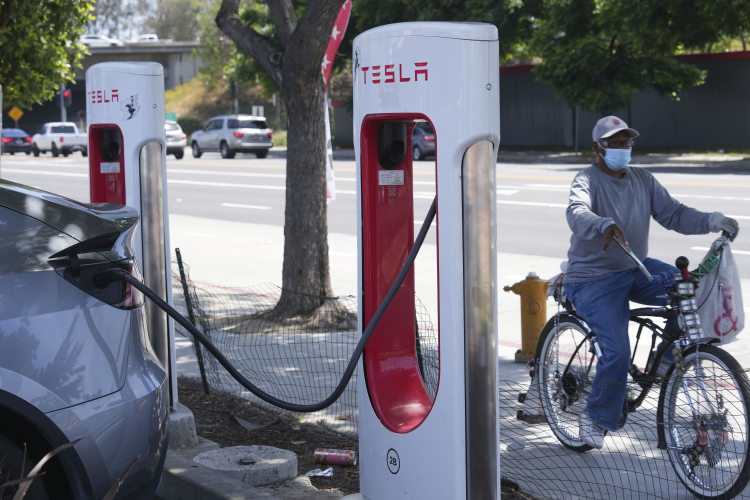
The legal principle dominating Supreme Court jurisprudence in recent decades known as the anti-commandeering doctrine, holds that the Constitution, in particular the Tenth Amendment, bars Congress from forcing state governments to enforce federal law, including federal tax law. Yet congressional Republicans are now advancing a bill that seeks to do just that, with the House Transportation and Infrastructure Committee’s May 22 passage of H.R. 8870, legislation that would institute a $150 yearly federal tax on electric vehicles (EVs) and a $50 tax on plug-in hybrids. The bill requires state governments to collect and remit this new federal car tax.
The chief executive of the nation’s third largest state by population size, Florida Governor Ron DeSantis (R), took to X over Memorial Day weekend, a time when millions of Americans are traveling by car, to lambast not only the economic harm that would be inflicted by the proposed national car tax included in H.R. 8870, but also the way in which the bill seeks to force state DMVs to collect and remit the new federal tax. “Commandeering state DMVs into federal tax collectors is not constitutional,” Gov. DeSantis noted in a May 24 post on X. “The proposed tax is bad on its own, but this aspect is an attempt at usurping state sovereignty.”
“The Federal government can only act within its constitutionally enumerated powers, and when it does it is responsible for enforcing its laws,” DeSantis added on May 26. “It cannot force states to do its bidding.”
Mike Palicz, director of tax policy at Americans for Tax Reform, points out that if the new federal tax for EVs and hybrids included in H.R. 8870 were to be enacted, a future Congress would likely apply the new tax to gas-powered vehicles. Gov. DeSantis concurs, replying to Palicz that “yes, the tax would be extended to all cars in no time.”
DeSantis is also challenging the central premise upon which the proposed federal car tax is based, which is that EV owners aren’t paying their “fair share” in taxes. DeSantis pointed out that “it’s inaccurate to claim EV owners ‘don’t pay tax’ — they pay various taxes when utilizing a charger depending on the jurisdiction.” What’s more, EV drivers have also been hit with targeted state vehicle registration fee hikes in recent years, in both blue and red states.
Aside from the policy arguments against the new federal car tax passed by the House Transportation Committee, there is the political stupidity of imposing a new tax that would raise the cost of driving by design and do so just before an election. Public sentiment tends to go against proposals that make driving more expensive, a fact that spans the spectrum of political landscapes. For example, in Oregon, the same voters who put Democrats in full control of state government recently rejected a ballot measure to hike the state gas tax. That measure was defeated with 83 percent voting against it.
Oregon isn’t the only blue state where a proposal to make driving more costly was recently defeated. In perhaps the nation’s bluest region, New England, a proposed regional cap-and-trade program dubbed the Transportation and Climate Initiative (TCI) was abandoned in 2021 after it became clear that none of the Democratic-run legislatures in the Northeast or Mid-Atlantic were going to join, in large part because of the way in which the program would raise gas prices. In fact, TCI proponents themselves conceded the program was projected to raise the price of gas in member states by more than 30 cents per gallon.
In response to a proposal last year for a similar national car tax, Congressman Chip Roy (R-Texas) articulated what a political loser it would be for Republicans. “Are you out of your fricking mind?,” Roy posited on the House floor. “Like, the party of limited government is gonna go out and, ‘say we’re gonna have [a car tax]?”
The new national car tax passed by the House Transportation Committee in May will likely get a floor vote at some point this year. It will be up to each member of Congress to decide whether to support the bill, but any Republican who votes for it ought not criticize Gavin Newsom, Josh Shapiro, Roy Cooper, or other Democrats for their support of cap-and-trade. To do so after voting for a new national car tax, one that states are unconstitutionally mandated to collect, would rightly be seen by many voters as hypocritical.
