




In Greek mythology, Icarus sought to escape prison from the Island of Crete. With feathers and beeswax, his father helped build wings. The wings worked. Icarus soared. Aspiring to soar higher despite his father’s warning, Icarus flew too close to the sun. The wax melted, his wings fell apart, and Icarus perished.
Sometimes, in efforts seemingly to “boldly go where no one has gone before,” our political leaders may steer too close to the sun. This seems to be happening with President Trump, the economy and his desire to manage the world. The “golden age” he has promised, which never really started, sadly may be over. To explain, we must tie together a series of well-known events and actions.
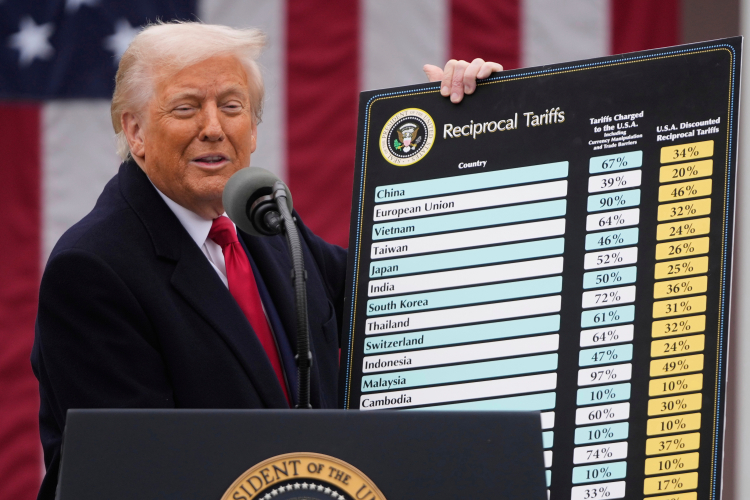
On April 2, 2025, President Trump famously unveiled reciprocal tariffs that imposed import taxes on goods from around the world. Trump promised that we would soar and held to this message throughout the ensuing months.
On February 16 of this year, he celebrated the golden age in a White House posting. There he shared a list of accomplishments, including the fact that his administration had helped to bring down the price of gasoline. With the benefit of hindsight: Gasp!
Four days later, the Supreme Court struck down most of the new tariffs. Now, while a new basis for imposing border taxes is in the works, the previously collected tariffs are being refunded. Lots of feathers got ruffled as our trading partners attempted to adjust to the on-again, off-again nature of doing business with the U.S. in the Trump era.
Another four days later, on February 24, Trump once again painted a bright picture of the economy in his State of the Union address: “Inflation is plummeting, incomes are rising fast. The roaring economy is roaring like never before, and our enemies are scared, our military and police are stacked, and America is respected again.”
On February 28, the war in Iran began. It is strange indeed that the economic optimism in Trump’s State of the Union did not brush against a major multibillion dollar war to be undertaken in a matter of days. Neither the possibility of conflict nor the implication for gas prices was a secret.
But let’s face it, there’s a season for all things. There are times to promote, times to entertain and times to be more serious. States of the Union have become evenings of entertainment with heavy doses of reality TV. We the people love bread and circuses. It was apparently not the time to speak of the downsides of an international conflict.
Among data Trump may have reviewed when preparing his State of the Union remarks, one finds an advanced estimate for fourth quarter 2025 GDP growth that was released on February 20, the week before his speech. While not exactly “roaring like never before” at 1.4%, it was revised down later to 0.5%.
And what about economic growth at the time Trump was actually speaking? The first estimate for 2026’s first quarter GDP arrived on April 30. It showed 2.0% growth, still not roaring and a bit weaker than 2025’s 2.1% growth rate. That number was revised down to a definitely-not-roaring 1.6% when the second estimate for growth was issued on May 28. (Real GDP growth in 2024 was 2.4%; 2023 saw 3.4%; and 2022 1.3%.)
What about inflation? The Iran war disrupted world energy markets and the price of oil rose sharply overnight. In February, the average price of a gallon of gas was $2.91. In April, the price was $4.10. The all-item Consumer Price Index was growing 2.4% annually at the time of the State of the Union. In May, just a few weeks ago, it was climbing at an annual rate of 3.8%.
When Trump spoke in February, average wages were rising 3.7% year-over-year. Two months of flying close to the sun snuffed out the year’s gains. Capturing inflation in its interest rate, on February 26, the 30-year, fixed rate mortgage fetched 5.76%. On May 14, the rate was 6.3%. Home ownership has become more challenging, especially for first-time homebuyers.
Moving into summer, we are not living in a new, unprecedented golden age. Hard data tell us that life is still pretty good, but inflation is heading skyward and signs of stress are beginning to appear across traditional allies. Italy, Spain, Germany, France, and the UK have not been able to muster support in their democracies for getting on Trump’s Iran war band wagon.
Now, let’s back the lens up. Since taking office, Trump has promised to turn devastated Gaza into the Riviera of the Middle East managed by a National Committee for the Administration of Gaza with a planned Board of Peace to fund and oversee the effort. He promised that we would have Greenland and settled for some concessions. He orchestrated regime change in Venezuela. He has ambitions with Cuba and perhaps Mexico, which are feeling pressure and pain from his efforts to control this hemisphere.
At home, Trump is forming what some call a new state capitalism where free-market competition is pushed aside and the federal government takes equity positions in large enterprises as a way to control outcomes and achieve greatness.
What can we learn from all this? Is flying so high better than taking a lower road of inaction or pessimism?
We surely want political leaders who dream big and by doing so lift our hopes for better times. Yet we need to call balls and strikes and recognize that not every pitch knocked over the fence is a home run. Some are outside the foul line. The search for a more prosperous era requires not just big swings but regular, sober reviews of all of the box scores. We need quarterly, systematic, nonpartisan reports on how the economy is doing and how Trump is keeping his promises.
Let’s hope that Mr. Trump does not fly much closer to the sun and that the wax doesn’t melt.
