




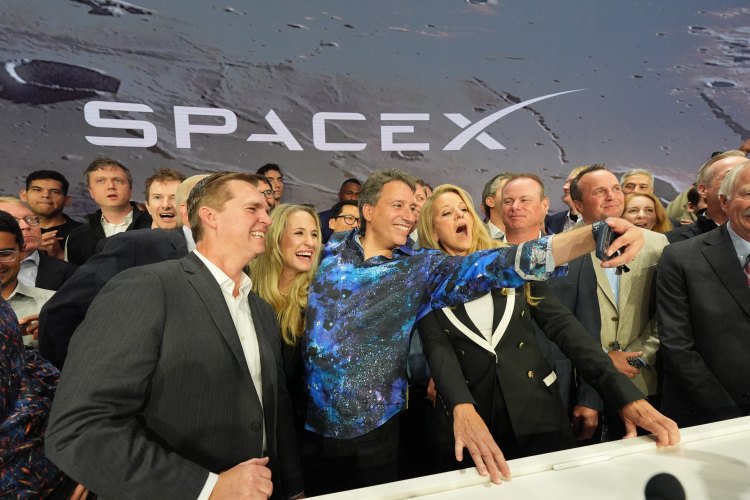
This past June 12 was a remarkable day, marking three great and closely related events: the 250th anniversary of the Virginia Declaration of Rights in 1776, the 39th anniversary of President Ronald Reagan’s “Tear down that wall” speech in 1987, and the SpaceX IPO. The Virginia Declaration of Rights inspired both America’s Declaration of Independence and the Bill of Rights. Reagan’s speech challenged Mikhail Gorbachev to end the Soviet Union’s oppression of Central and Eastern Europe. The SpaceX IPO was the largest public offering in history and made Elon Musk the world’s first trillionaire. If we understand the thread that connects them, we can see what our future can be, if we choose it.
The Virginia Declaration of Rights was pioneering, the first real declaration of the rights of every individual to be passed by a government. The author, George Mason, laid out the inherent rights of every person that a government must respect and protect if it is to be legitimate. Ronald Reagan’s speech challenged Mikhail Gorbachev, leader of the worst tyranny in history, to acknowledge these unalienable rights and reverse course. Gorbachev ultimately accepted Reagan’s challenge, resulting in the dissolution of the Soviet Bloc and liberation of millions of people from despotism. The Virginia Declaration and Reagan’s speech were both bold, assertive challenges to tyrants. But the SpaceX IPO? What could this have to do with a declaration of our rights and a challenge to a dictator to acknowledge and respect these rights. Isn’t it just an example of capitalist excess, freedom gone wrong?
Not at all. To the contrary, the SpaceX IPO is a result of the principles of the Virginia Declaration, and a confirmation of its wisdom. And it shows the correctness of Reagan’s demand for liberty. When humans are freed to use their creative energy, constrained only by others’ equal rights, the best will rise to the top, taking billions of people with them. The IPO marked Elon Musk’s holdings at a level that made him the world’s first trillionaire. More than four thousand current and former SpaceX employees reportedly became millionaires from the IPO, and some became far wealthier. Not a single American was made poorer by the IPO itself; this was not a zero-sum transfer. This is what happens when a society follows the principles of the Virginia Declaration.
SpaceX and its IPO are a premier example of the consequences of liberty and free commerce; it is not a coincidence that SpaceX is an American phenomenon. Elon Musk left his native South Africa for a reason. America’s political and economic institutions favor innovation and entrepreneurship like nowhere else. America is the land where the default is that one may try something new, to innovate. In much of the rest of the world, an innovator or entrepreneur is fortunate if the only obstacle is that he or she must ask permission from an impersonal bureaucracy. SpaceX and its IPO are exemplars of American liberty, including free enterprise. This kind of thing happens in America and almost nowhere else.
SpaceX has enormous potential to create value for us all by expanding Starlink, launch services, xAI and orbital data centers, and other services. It also is essential for America’s national security. For example, in May, SpaceX signed contracts to build and launch two essential satellite constellations for Space Force. The IPO means SpaceX will accelerate these important, valuable services. For the longer run, the IPO moves us closer to space mining, space manufacturing, a permanent base on the Moon, and ultimately, colonization of space. Civilization grows and humanity flourishes. Freedom makes our future.
When George Mason wrote the Virginia Declaration and the Virginia Convention adopted it unanimously 250 years ago, they established the principles with which President Reagan could boldly challenge a tyranny, and established a system that made a thing like SpaceX possible. They set in motion events that resulted in America as the world’s engine, the opportunity economy that advances civilization. June 12 is not a national holiday, but we should celebrate it anyway.
