




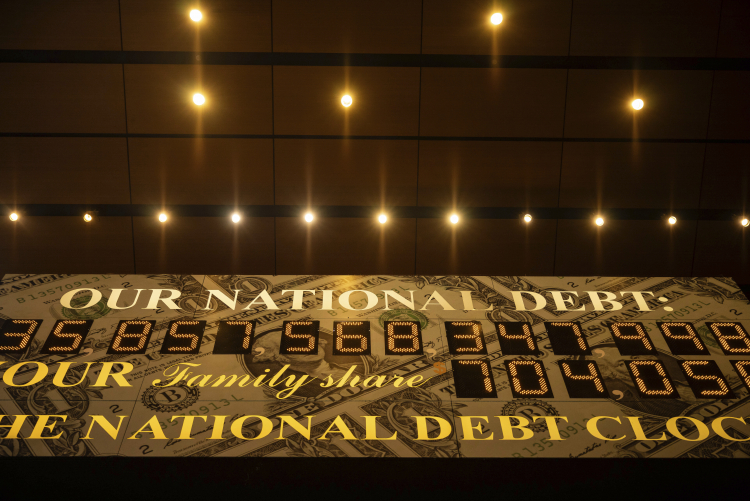
When economists and pundits write with performative alarm about the urgency of shrinking the national debt, and subsequently search for ways to raise more tax revenue to shrink it, they write as though the past 45 years didn’t happen.
Which means they’re blindly pursuing non sequitur. Same with those who think spending cuts will reduce the debt.
Let’s start with handing more money to Congress on the supposition that doing the latter will unearth the inner cheapskate in each member of Congress. It’s a nice, idealistic notion, but one wholly discredited by the last 45 years.
During that time federal tax revenues have risen in substantial amounts, but sans the retirement of debt. Quite the opposite actually, which is one of the main points of The Deficit Delusion.
Happy talkers have said forever that we can “grow our way out of the debt,” but as soaring stock markets amid remarkable economic growth have revealed quite vividly since 1981, growth is the certain path to more government debt, not less. Politicians exist to spend, and growth makes more spending and borrowing possible.
To which some reply that if “we could just get spending under control, we could pay off some of the debt.” No, that’s not serious. See above. It’s not just that politicians exist to spend, it’s that reduced government spending will, if anything, lead to more debt. That’s because spending cuts free up dollars for Congress to direct to other wasteful ideas, while also expanding Congress’s borrowing capacity. The last 45 years vivify the previous truth.
Where it becomes comical is that in their hysterical efforts to wake us up to a “debt crisis” that Treasury markets have never reflected from 1981-present, some try to convince us that all the government spending and debt is depriving Congress of an ability to do for us in the future. That’s how the Washington Post’s Megan McArdle puts it, that “There is only one way this kind of profligacy can end: in a fiscal crisis that forces Congress and the President to hike taxes and cut spending, very probably at the worst possible time, when the economy is already nose-diving for some other reason.”
Except that government spending is an economy-shrinking tax. Is central planning of resources good when the economy is bad?
At Cato it’s said that all the spending and debt is exerting “downward pressure on other budget priorities.” Ok, but libertarians don’t want the federal government to expand, with good reason. Just what are the priorities the libertarians at Cato are unhappy the federal government isn’t funding at present?
Wisconsin Senator Ron Johnson says the “reason we are in trouble is because over 74 percent of federal spending is on autopilot, mandatory spending.” Actually, that’s kind of bullish. Would readers prefer the mistaken knowns that are Social Security and Medicare, or less of both so that Senators with last names like Sanders and Warren and Johnson can fund their own priorities?
Furthermore Johnson, like McArdle, like Cato, is mistaking symptoms for causes. Government borrowing doesn’t just happen, precisely because money is ruthless. The debt is an effect of too much tax revenue alongside the expectation of much more, but as the title of this opinion piece indicates, national debt hawks write as though 1981-present didn’t happen.
