




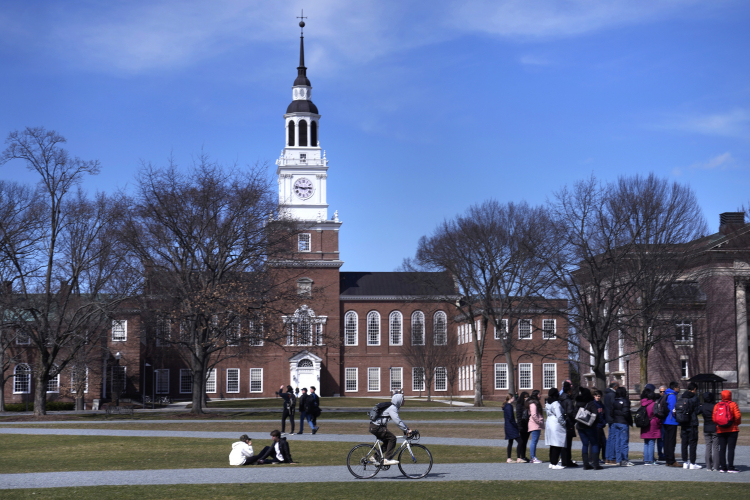
Seventy years ago, this summer, a small group of scientists gathered at Dartmouth College to explore a radical question: Could machines learn, reason and solve problems in ways that resembled human intelligence?
The workshop gave us the term "artificial intelligence" and launched one of the most consequential technological revolutions in history. Today, governments, universities and technology companies around the world are celebrating AI's 70th birthday and competing to be AI leaders.
But there is an irony buried in AI's origin story.
The same year that the Dartmouth workshop introduced a new vision for computing, the federal government was imposing restrictions on two of the companies most closely connected to that vision: AT&T and IBM.
Claude Shannon of Bell Labs, one of the principal architects of modern information theory and a co-author of the Dartmouth workshop, worked for AT&T’s Bell Labs. IBM researchers were among the pioneers exploring machine learning and advanced computing. Yet in 1956, the Justice Department concluded antitrust actions against both companies. AT&T was restricted to its regulated communications business and required to broadly license its patents. IBM was compelled to alter its business model, including offering its machines for sale rather than relying primarily on leasing arrangements that gave the company constant customer engagement.
Whether those decrees slowed the development of artificial intelligence is impossible to know. History does not provide control groups. Bell Labs continued to produce groundbreaking research, and IBM remained a central force in computing innovation.
The more important lesson lies elsewhere.
The antitrust actions reflected a view of the economy shaped by the industrial age. Regulators believed they saw concentrated market power in telephony and tabulating machines and sought to restructure those industries to create more competition. Their focus was on the most successful firms and business models of the day.
What they did not see was that the future would be defined not by telephone service or punch-card tabulators, but by the convergence of computing, communications and information networks. The most important economic developments of the next half-century would emerge from technologies that were still largely invisible to policymakers but envisioned by the innovators.
This is not a criticism of antitrust enforcement itself. Governments have legitimate reasons to worry about market power and barriers to competition. Rather, it is a reminder of the limits of our foresight.
Innovation rarely arrives as a single breakthrough. It emerges through countless interactions among universities, entrepreneurs, established firms, investors and customers. The pathways are unpredictable. Technologies developed for one purpose often become the foundation for entirely different industries. Shannon’s information theory helped create modern communications networks; those networks helped enable the internet; the internet helped generate the data and computing infrastructure that made modern AI possible.
The danger is that policymakers, no less than business leaders, are tempted to fight the last war. We too often evaluate firms according to current market definitions and current competitor concerns. Meanwhile, the next technological paradigm is forming just beyond our field of vision.
That lesson feels particularly relevant today. Once again, antitrust authorities around the world are scrutinizing the largest technology companies. Once again, policymakers are debating how much power is too much power in rapidly evolving digital markets.
Some of those concerns may well be justified. But AI's birth year reminds us that today's seemingly dominant firms may also be helping create tomorrow's technological possibilities. The challenge is not choosing between competition and innovation. It is recognizing that innovation often emerges from places and institutions that do not fit neatly into our theories of competition.
In 1956, government officials were trying to address situations they could see. A few researchers gathering at Dartmouth were imagining possibilities that few others could. History remembers both. But only one of those efforts helped launch the future.
