




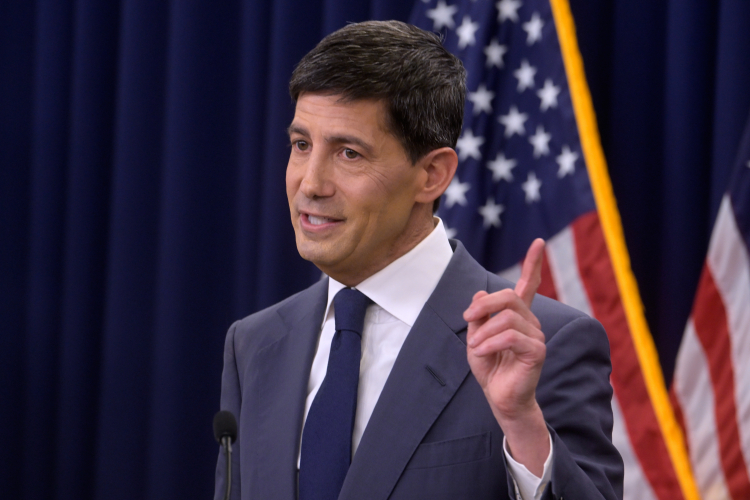
Kevin Warsh has now taken the oath as chairman of the Federal Reserve. The debate over who should lead the central bank is over. The harder debate is what he should say now that he has the platform.
He should use it to wake Congress up.
The United States now carries roughly $39 trillion in total public debt, with more than $31 trillion held by the public. Debt held by the public is now close to the full size of the American economy. That does not mean debt alone sets interest rates. It does not. But it does mean Congress is asking capital markets to absorb a federal claim on resources that is historically enormous.
That reality deserves a more honest public discussion.
Interest rates are not determined by debt alone. They reflect inflation, expected growth, risk, global savings, investor confidence, monetary policy, and the judgment of markets at a particular moment in time. They also reflect the philosophy of the Federal Reserve chairman and the policy regime of the era.
Paul Volcker, Alan Greenspan, Ben Bernanke, Jerome Powell, and Kevin Warsh would not all respond to the same economy in the same way. Each chairman brings a different view of inflation, employment, markets, and the proper role of monetary policy. Each era produces a different price for credit.
That is why comparisons across decades must be made carefully. Interest rates were much higher in 1980, even though federal debt was much lower. That fact matters. But it proves only that debt is not the sole driver of interest rates. It does not prove that debt is irrelevant.
Markets set the price of credit. They do not take orders from a debt chart. But markets must still absorb what Treasury issues. A government that borrows lightly asks less of capital markets. A government that borrows constantly asks far more.
Today, Washington is asking far more.
Still, the larger issue is not interest rates alone. The larger issue is spending.
Government spending is a tax. It may be financed through current taxes, future taxes, borrowing, inflation, or some combination of all four. But however the money is collected, it comes from the same economy. Every dollar Washington spends must first be taken, borrowed, or redirected from somewhere else.
That makes excessive government spending one of the most dangerous taxes because its true cost is often hidden.
An income tax is visible. A payroll tax is visible. A property tax is painfully visible to anyone who owns real estate. But spending hides its cost behind deficits, debt issuance, future tax obligations, and political promises. The benefit is announced today. The cost is spread across tomorrow.
The damage is not merely fiscal. It is economic.
Capital is the lifeblood of innovation. Elon Musk can work under many different tax rates, but he cannot build rockets, electric vehicles, satellites, or artificial intelligence infrastructure without capital. No entrepreneur can. No business can. No economy can.
When Washington consumes more capital, fewer dollars find their way to better ideas. Fewer dollars reach the start up, the factory expansion, the medical breakthrough, the housing project, the software company, the machine shop, or the young entrepreneur whose idea might improve the world.
That is the real tax on progress.
Private capital is disciplined by return. It flows toward people and companies that can satisfy customers, solve problems, and create value. When private capital is misallocated, losses expose the mistake. Bad ideas lose money. Poorly run companies shrink or disappear. Better ideas replace them.
Government spending operates under a very different discipline. Programs often continue long after their usefulness has faded. Budgets rarely shrink because the original problem was solved. Agencies do not face the same market test as private enterprise. Failure is more often rewarded with larger appropriations than with elimination.
This does not mean all government spending is wasteful. National defense, courts, basic public safety, core infrastructure, and the protection of property rights are essential functions of government. A market economy cannot flourish without order, contract enforcement, and the rule of law.
But that is not where Washington stops.
The modern federal government reaches far beyond essential functions. It subsidizes, directs, regulates, transfers, favors, penalizes, and redistributes on a scale earlier generations would not recognize. The result is not simply a larger public sector. It is a smaller private future than we otherwise might have had.
That is what Congress needs to hear.
And Chairman Warsh is in a position to say it.
The Fed cannot pass a budget. It cannot reform entitlements. It cannot stop Congress from spending money it does not have. But the Fed chairman has one of the most powerful public platforms in the world. His testimony, press conferences, speeches, interviews, and congressional appearances move markets and shape public debate.
He should use that platform to explain that monetary policy does not operate in a vacuum.
The Fed can influence short term rates, manage liquidity, and defend price stability. Markets set the broader price of credit. But fiscal policy shapes the environment in which both operate. When Congress spends far beyond revenues year after year, it increases the federal government’s claim on national resources and places more pressure on the private economy.
That is not partisan. It is arithmetic.
Congress should not be allowed to complain about interest rates while continuing to create the fiscal conditions that make capital more scarce and more expensive than it otherwise might be. Nor should it be allowed to pretend that deficits are harmless simply because Treasury can still borrow.
Of course Treasury can borrow. It is backed by the future taxing power of the most productive people on earth. But that is not a defense of spending. It is an indictment of it.
The fact that investors believe American taxpayers can repay the debt does not prove the borrowed money was used wisely. A borrower’s creditworthiness is not the same as economic productivity. The real question is not whether Washington can borrow. The real question is whether Washington puts the money to better use than the private economy would have.
Too often, it does not.
Even cheap borrowing can destroy value if the money is wasted. A bad investment does not become good because financing was easy.
That is where the interest rate debate becomes too narrow. The problem is not only whether federal borrowing raises rates in a given month or year. The deeper problem is that excessive government spending diverts resources away from the private economy regardless of the rate.
We can see the government program. We can see the grant, the subsidy, the ribbon cutting, the agency, the transfer payment, and the political announcement. What we cannot see as easily are the businesses never formed, the products never launched, the buildings never improved, the risks never taken, and the ideas never funded.
Those lost opportunities are the true burden of excessive spending.
With debt held by the public now near 100 percent of GDP, even moderate rates impose a far larger fiscal burden than they would have when the debt load was much smaller. That burden reduces flexibility, increases federal interest costs, and leaves less room for both productive public priorities and private investment.
But the central point remains larger than rates.
Government spending taxes progress because it moves resources from market allocation to political allocation. It takes capital from builders, entrepreneurs, investors, lenders, workers, and customers, and moves it into a world of appropriations, lobbying, bureaucracy, and electoral incentives.
The money still gets spent. The question is by whom, and toward what end.
If the private economy keeps it, the decision is disciplined by competition, risk, return, and accountability. If Washington spends it, the decision is disciplined mostly by politics.
That difference matters.
America’s greatest strength has never been the size of its government. It has been the creativity, ambition, risk taking, and productive energy of its people. The more Washington consumes, the less room there is for that energy to work.
Chairman Warsh should say so.
He does not need to lecture Congress. He does not need to become partisan. He does not need to blame Congress for every movement in interest rates. But he should make clear that fiscal policy affects the economic environment the Fed is trying to manage, and that excessive spending imposes costs far beyond the federal budget.
Debt does not set rates by itself.
But debt at today’s scale matters. Spending matters even more. And every unnecessary federal dollar spent is a dollar that cannot find its way to a better idea.
Better ideas are where progress comes from.
