




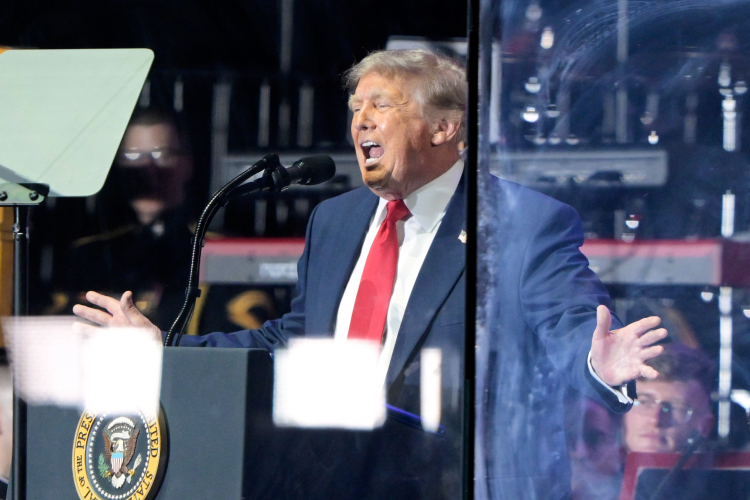
Four days after the Supreme Court told him tariffs are a branch of the taxing power belonging to Congress, President Trump stood before a joint session and said tariffs would "substantially replace the modern-day system of income tax." That statement was not a policy preference. It was a constitutional collision, stated plainly, in front of the legislators the Constitution charges with making exactly that decision.
Three facts belong in the same sentence: the Supreme Court ruled on February 20 that tariffs are a branch of the taxing power. The Sixteenth Amendment placed that power in Congress in 1913. The President told Congress four days later he intends to use it to replace the income tax. Nobody in Washington has connected those three dots publicly. Here they are.
The majority in Learning Resources, Inc. v. Trump was unequivocal. IEEPA's authorization to "regulate importation" does not include the power to impose tariffs. Chief Justice Roberts, citing Gibbons v. Ogden (1824), stated that the power to impose tariffs is "very clearly a branch of the taxing power." The government conceded the President has no inherent peacetime authority to tax. Six justices agreed, two rationales, one outcome: IEEPA is not a tariff statute.
The Sixteenth Amendment says Congress shall have power to lay and collect taxes on incomes, from whatever source derived, without apportionment among the several states. The amendment overruled Pollock v. Farmers’ Loan & Trust Co. (1895), which had struck down the income tax as a direct tax requiring apportionment. But Pollock’s structural premise - that the taxing power belongs to Congress and is subject to constitutional constraints on its exercise - survived Pollock’s demise intact. The Sixteenth Amendment expanded what Congress could tax. It did not expand who could tax. That distinction is the one the tariff debate has been carefully avoiding.
The administration has now made three attempts to reconstruct its tariff authority in five months. IEEPA fell on February 20. Section 122 - a balance-of-payments statute unused in its 52 years on the books - fell at the Court of International Trade on May 7, and is on appeal. The clock on Section 122 runs out July 24 regardless. On June 2, USTR proposed 10-12.5% duties on 60 countries covering 99.4% of U.S. imports under Section 301 of the Trade Act of 1974, timed precisely to fill the gap when Section 122 expires. Public comments close July 6. Hearings begin July 7.
Section 301 is the most legally defensible of the three. Unlike IEEPA, it requires a formal investigation and administrative record. Unlike Section 122, it has no 150-day expiration. Unlike either, it has no statutory ceiling on rates. That is what makes it constitutionally interesting: the administration is building a permanent tariff architecture with no rate cap and no duration limit, using authority the President himself has framed as a substitute for the income tax. Treasury Secretary Bessent described tariff revenue as "a melting ice cube" - as imports shift to domestic production, the revenue shrinks. He meant it as a feature, not a flaw. If the ice cube melts fast enough, the income tax never actually disappears. It just gets squeezed while tariffs collect the difference.
Meanwhile, Trump said on June 10 he is "not looking to renew" the USMCA trade agreement when its review deadline hit July 1. USMCA currently shields roughly 90% of Canadian exports and a comparable share of Mexican trade from Trump’s tariffs - approximately $1.3 trillion in total trade. The Tax Foundation estimates removing USMCA exemptions would raise taxes by $466 billion over ten years, or about $300 per household per year. Congress has not voted on any of it. Section 232 pharmaceutical tariffs, signaled at 200%, are pending under a separate investigation. Each layer adds to the tariff architecture the President has explicitly said is designed to replace what Congress built in 1913.
Administration lawyers find Section 301 attractive for rational reasons. It has a statutory record requirement that survived the Supreme Court's skepticism of open-ended emergency powers. It has no rate ceiling. It has no expiration. These are features, not accidents. The problem isn't that the administration is operating in bad faith. The problem is that a tariff authority with no ceiling, no duration limit, and explicit presidential framing as an income-tax substitute represents a different constitutional question than any the Court has yet answered. The Sixteenth Amendment was ratified specifically to settle who controls that taxing power. The courts resolved IEEPA on statutory grounds. Section 301 will force the constitutional question.
Hamilton called the taxing power “the one great power upon which the whole national fabric is based.” In fiscal year 2025, the federal government collected roughly $2.66 trillion from individual income taxes - nearly 51% of total revenue. Customs duties that same year came to about $195 billion. Replacing one with the other would require either a 93% across-the-board tariff rate or cuts to non-interest federal spending exceeding $2.6 trillion. The ice cube, fully melted, leaves a hole. Congress hasn’t voted to make that trade. The Sixteenth Amendment says Congress has to.
The Section 301 comment deadline is July 6. USMCA's review deadline was July 1. Section 122 expires July 24. Pharmaceutical tariffs are pending. These are not separate policy questions. They are the same constitutional question arriving in four installments, and the answer the Sixteenth Amendment gives hasn't changed since 1913.
