




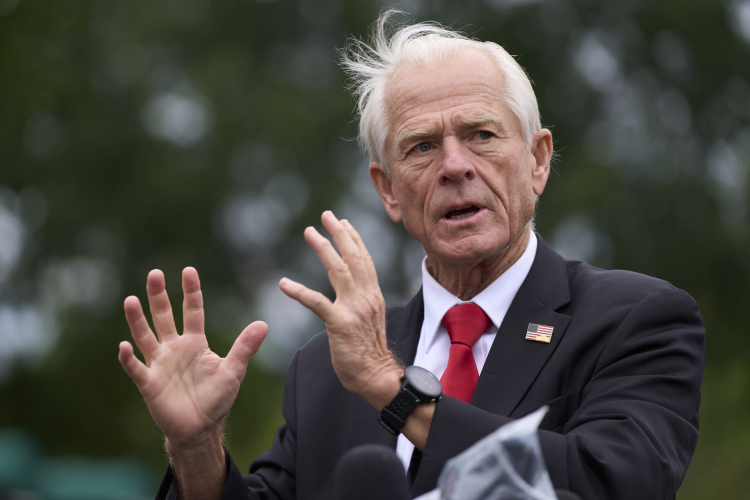
Writing here, Peter Navarro warns us of a “Great Transshipment Scam” and its web of foreign staging grounds and back doors through which sly exporters sneak their goods into America under a false flag. He wants customs scrutiny, penalties, and tightly enforced rules of origin to catch these ne’er-do-wells. He describes an unenforced tariff as a “tollbooth with no collector.”
There’s a problem with his story. The culprits he’s after are, overwhelmingly, Americans.
Imagine a small manufacturer in the midwest, employing a few dozen American manufacturing workers. These workers, because they are in America, are already the most productive manufacturing workers on the planet. To build their wares, they need materials such as steel and aluminum. When a tariff is imposed, he doesn’t get a bill from Beijing. He gets a bill from the US Customs and Border Protection because under American law, the importer of record owes the duty. This is the legal incidence of a tariff. Foreign countries and companies do not send a single penny to the Treasury.
The economists who study where the burden of the tariffs actually settle reach the same conclusion. The Federal Reserve, examining the 2025 tariffs, found that close to 90 percent of the economic effect fell on American firms and consumers. Harvard’s Pricing Lab, which President Trump cited favorably in the Wall Street Journal this past January, finds similar results. The Import Price Index, produced by the Bureau of Labor Statistics, also finds the same result.
In other words, the tariffs are levied on Americans in law and paid by Americans in fact. Because of this, the people who are most trying to avoid the tariffs through transshipments are not foreign schemers. They’re hardworking Americans and this is who Navarro seeks to punish.
When a businessman rearranges his supply chains to lower their duty, he is doing something Americans have done for as long as we’ve had tariffs and something that the Supreme Court affirmed 145 years ago in Merrit v. Welsh. Here, Welsh added molasses to refined sugar in order to darken its color and therefore qualify for a lower rate of import duties. The Court sided with Welsh, arguing that so long as the goods are honestly invoiced and openly shown to customs, no deception or fraud was committed and no penalty was warranted. In doing so, the Court held that manufacturers have every right to make their product in a way that carries the least tax, provided that they are truthful about what they are doing.
This principle has held ever since. Converse molds a thin layer of felt onto the soles of their shoes so that they are classified as slippers, which can be imported at a lower rate. Columbia Sportswear adds a small, zippered pocket below the waistline of certain garments so that they can be exempted from higher duties. Snuggies are imported as a blanket, not a clothing item, as a means of lowering their tax burden. This practice is called “tariff engineering” and, thanks to the Trump Administration, it has never been more profitable.
These are perfectly legitimate and legal forms of tariff evasion. What Navarro is talking about in his piece is different. Taking Chinese steel and stamping “Made in Vietnam” is fraudulent and he is exactly correct to point out that fraud should be prosecuted. But legal engineering and illegal fraud share the same underlying motivation: avoid the tariffs. By raising the cost of lawful importation, tariffs invite both clever redesigns and fraudulent labels.
The prosecution Navarro calls for is not going to fall evenly. A large, well-lawyered corporation can afford to hire a team of tariff engineers, a compliance department that can document every step, and a lobbyist with a rolodex of contacts to secure an exemption if all else fails. Jeff Tooze, the Vice President for Global Customs & Trade at Columbia Sportswear said in 2015, “I have a whole team of people that work with together with the designers and developers and merchandisers and with customs, actually, and to ensure that during the design process that we’re considering the impact of tariffs.” Smaller manufacturers can afford none of these. When the enforcement agents come knocking, it’s the little firms without the paperwork and connections that will get caught, while the big players who helped write the rules in the first place continue on their way.
At this point, it’s worth asking a simple question that Navarro avoids: why are American businesses going through all this trouble in the first place? Why hire teams of product designers and consultants to ever-so-slightly change a product, reroute shipment, and restructure production in order to avoid tariffs? And the answer is equally simple: because tariffs are hurting them.
But we don’t have to take my word for it. We can turn to President Trump himself. On June 1, President Trump signed Proclamation 11032, which lowered tariffs on “agricultural equipment, like combines and harvesters, as well as certain other equipment, from 25% to 15%” and “encourages foreign companies to use more U.S. steel and aluminum by allowing them to qualify for a 10% duty rate, if their capital equipment include at least 85% U.S. melted and poured or smelted and cast steel or aluminum by weight.”
Why did they do this? Per the White House’s Fact Sheet, it was to “to more effectively address national security threats, spur investment in American agriculture, housing, and manufacturing, and facilitate U.S. production of related products.” Just a few weeks later, the President suspended “certain anti-dumping and countervailing duties in connection with importation of phosphate fertilizer from the Kingdom of Morocco” so as to “safeguard America’s food supply and support domestic agricultural production.”
In other words, in 2025 the Administration had the goal of helping American producers and encouraging investment. To do so, they raised tariffs. In 2026, the Administration has the goal of helping American producers and encouraging investment. To do so, they lowered tariffs. This is a stunning admission that the tariffs were the problem all along.
Consider what Navarro is actually proposing. The tariffs have, by the President’s own admission, harmed American businesses. These businesses, bearing the cost of the tariffs, have responded as any rational person would and looked for cheaper paths. Some did so lawfully while some crossed into fraud. Navarro’s answer is not to remove the tax that created the whole problem. It is to build a larger enforcement apparatus to hunt down the people responding to the tax that will disproportionately catch small, less well-connected firms just trying to make ends meet and keep their workers employed instead of large, connected firms able to secure exemptions.
The Administration has created the very problem it now seeks additional power and money to solve. It taxed American producers, watched them scramble to deal with the fallout, and is now preparing to punish the scramble. This isn’t draining the swamp, it's widening and deepening it by securing the employment of trade lobbyists, giving new advantages to the larger firms who employ them, while saddling smaller firms with additional burdens. Americans, who have to pay for the tariffs in the form of higher prices, pay for the workarounds, and now pay for the enforcement costs, are poorer for this, not richer.
There’s an easier way to deal with all of this: put an end to this tariff experiment once and for all. Doing so will drain the swamp, allow smaller firms to compete on a level playing field, and put more materials in the hands of the most productive workers on the planet so they can continue to win on the world stage. This will not only make us richer, it will make us safer as a nation, too.
